
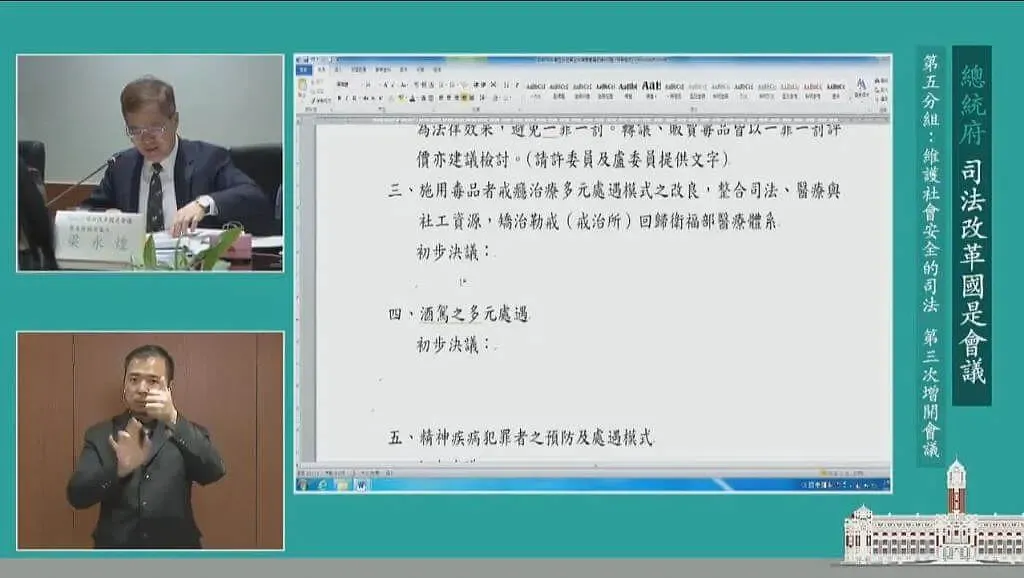
Review: Third Extraordinary Meeting of Group 5 of the Presidential Office's National Consultative Conference on Judicial Reform
Last edited: 2026-08-29
This meeting lasted approximately six and a half hours and was the final meeting of Group 5. It adopted 22 resolutions on the newly added agenda item, "Child and Gender-Friendly Justice."
No preliminary resolutions were made; all decisions were formulated directly as "final resolutions," including the confirmation of preliminary resolutions and reserved items from the previous meeting.
Except for the "reconstruction of the chapter on offenses against sexual autonomy," where members held divergent views and failed to reach a consensus, all other proposals were successfully resolved.
Discussion Subtopics and Opinions
Regarding "Current Status of Medical Care in Correctional Institutions and Suggestions for Improvement," the discussion lasted about 20 minutes. Members Yu Li-chen, Huang Hsu-tien, and Hsu Shih-feng all noted that Article 22-1 of the Sexual Assault Prevention Act already requires sexual offenders to be sent to medical institutions or other designated places. However, current practice invariably results in them being sent to prisons, which violates the spirit of the law. The Ministry of Health and Welfare (MHW) argued that if sexual offenders were sent to medical institutions, local residents and village wardens would certainly protest. Nevertheless, the members present maintained that the MHW should fulfill its duty of communication.
Regarding the "Review of Drug Enforcement and Heavy Penalties for Drug Offenses Policy," the discussion lasted about 15 minutes. The members present shared a consensus on expanding suspension of prosecution for the prevention of drug offenses. However, no consensus was reached on whether to rigidly abolish the rule of "punishing each act of drug consumption as a separate offense" (i.e., multiple offenses for multiple acts of drug use).
Regarding "Diverse Treatment for Drunk Driving," the discussion lasted about 20 minutes. Members noted that the Legislative Yuan had deliberated on a draft Alcohol Harm Prevention Act in 2012, but due to the principle of legislative discontinuity, no such draft is currently under review in the Legislative Yuan. Member Huang Hsu-tien, the chairperson, and other members specifically reminded everyone that alcoholic beverages are far too easily obtainable in Taiwan, which explains why drunk driving is so difficult to prevent.
Regarding "Investigation Management," the discussion lasted about 25 minutes, with the majority of the time spent on the issue of "replacing the escort of wanted persons with remote interrogation in another jurisdiction." The original intent of this proposal was to rationalize police workloads by allowing wanted persons apprehended in another jurisdiction to be interrogated via remote technological equipment rather than being escorted back to the original issuing authority. This issue was previously reserved during the second extraordinary meeting on May 11 because the National Police Agency (NPA) had failed to provide relevant data on the escort of wanted persons. At this meeting, the NPA stated that its established fugitive apprehension system lacks data on cross-jurisdictional escorts. Instead, it substituted data on the number of escort personnel, the number of wanted persons escorted by police agencies to the Chiayi District Prosecutors Office, and the number of detention requests filed by prosecutors from the Chiayi District Prosecutors Office. The NPA emphasized that detention requests accounted for only about 2% of apprehensions—a negligible fraction—yet massive police manpower was deployed to escort wanted persons, which is a truly unreasonable and wasteful use of human resources. Member Li Ming-hung questioned the relevance of the cited data to the supporting argument, noting that the issue at hand was how heavy the duty of cross-jurisdictional escorting actually is and whether it is necessary to switch to remote interrogation, whereas the NPA provided total escort figures for all wanted persons. Members Yu Li-chen, Li Ming-hung, and Hsu Shih-feng all emphasized that what the NPA should review is why police fail to earnestly execute arrest warrants for defendants, only arresting them once a fugitive warrant is issued. Does this happen because arresting wanted persons yields performance credits while executing arrest warrants does not?
Furthermore, under "Investigation Management," the meeting continued discussions on the proposals for "Police Performance Reform" and "Police Education Reform" submitted by members Huang Hsu-tien and Chou Su-hsien. The text of the proposal was primarily provided by Chou Su-hsien, but as she was excused from this meeting, Huang Hsu-tien took the lead in explaining it. Because the complete proposal was simplified during the process of converting it into a resolution, some important content was omitted. In the "Police Performance Reform," a provision originally requiring meetings involving frontline police officers to discuss the feasibility of performance metrics disappeared from the resolution text. In the "Police Education Reform" proposal, member Huang Hsu-tien requested that the resolution text be supplemented with wording from the original complete proposal: "Reviewing the problems of the quasi-military education and training model (including the cadre system and ideological education system)." However, this was opposed by member Chang Kuang-ming, who emphasized that quasi-military education is the essence of police education and training and requires no review; Convener Liang Yung-huang seconded and agreed with this view. Member Hsu Yu-hsiu, attending as an observer, added that the call to review quasi-military education encompasses not only its format but also its ideology, but this was not adopted by Convener Liang Yung-huang.
Regarding the diagnostic function of "Juvenile Detention Homes," the Director-General of the Agency of Corrections argued that assessing the physical and mental states of juveniles consumes too much manpower and that this task should be handled by juvenile probation officers rather than detention homes. Member Li Ming-hung pointed out that Article 6 of the Statute for the Establishment and Implementation of Juvenile Detention Homes explicitly mandates the establishment of a diagnostic unit, whose duties include assessing the physical and mental states of juveniles. The representative from the Agency of Corrections retorted that pursuant to Article 7 of the Organization Act of the Agency of Corrections, Ministry of Justice, where provisions concerning the organization of correctional institutions in the Statute for the Establishment and Implementation of Juvenile Detention Homes were not promptly repealed or amended upon the enforcement of the Agency's Organization Act, they shall no longer apply after the enforcement of this Act. Member Li Ming-hung had cited an obsolete law; juvenile detention homes have since been reorganized into General Affairs, Discipline, and Counseling divisions, with the diagnostic unit abolished. However, member Li Ming-hung countered by citing Article 2 of the newly revised Organizational Regulations for Juvenile Detention Homes of the Agency of Corrections, Ministry of Justice, which stipulates that juvenile detention homes are responsible for the diagnosis and counseling of juveniles. This has always been the duty of juvenile homes and cannot be shirked.
Regarding "Strengthening the Anti-Flight System," members discussed whether to amend Article 312 of the Code of Criminal Procedure to mandatorily require defendants to appear in court during sentencing. The members present concluded that since the Ministry of Justice is already amending the law regarding this matter, it would not be discussed further.
Regarding the "Review of Anti-Corruption Legal Systems—Sunshine, Transparency for Legislative Bodies and Political Appointees," no objections were raised regarding the inclusion of congressional aides within the scope of the Lobbying Act and the enhanced disclosure of accounting report contents under the Political Donations Act. Regarding the Act on Recusal of Public Servants Due to Conflicts of Interest, the Agency Against Corruption (AAC) expressed the opinion—based on J.Y. Interpretation No. 716: "However, as for the interested parties of public functionaries, if prohibiting them from participating in competitive transactions would create a monopoly by a few other transaction participants, which is manifestly disadvantageous to the public interest, then in such cases, provided the aforesaid organs have followed open and fair procedures during the transaction process and have adequate corruption-prevention regulations in place, whether there is still a risk of improper transfer of benefits or conflicts of interest, and whether it is necessary to prohibit transactions by interested parties of public functionaries, the relevant organs shall conduct a comprehensive review and make improvements as soon as possible"—that interested parties should be permitted to bid below a certain amount. Member Tsai Hsiu-chuan expressed concern that the AAC's reform plan risked excessive leniency without considering public perception, which the AAC denied. Ultimately, the resolution concerning the Act on Recusal of Public Servants Due to Conflicts of Interest was amended to add text stating: "The competent authority shall reference J.Y. Interpretation No. 716, current socio-political and economic backgrounds, public perception and expectations, and the recruitment of national talent, to prudently evaluate the Act on Recusal of Public Servants Due to Conflicts of Interest..."
Regarding the "Establishment of Child and Youth Placement Institutions," the discussion lasted about 35 minutes. This issue was a reserved item from the 6th meeting of Group 5 on May 18. Members Li Ming-hung and Hsu Shih-feng complained that when judges issue rulings to place children or youth, due to the shortage of placement institutions, even judges are unable to find suitable placement facilities for them... Member Liu Shu-chiung reported that, according to calculations, placement costs for a child amount to at least roughly NT$60,000 per month, yet the courts allocate only NT$18,000..., which is far too little! The Judicial Yuan argued that the problem of underfunded placement costs has indeed failed to keep pace with the times. The chairperson angrily remarked: "How can you simply leave it to judges to search on their own? Are the Executive Yuan and the Judicial Yuan separate entities? Do you have no concept of a unified government?"
- Regarding the "Feasibility of Improving Judicial Treatment for Drug-Using Children and Youths," this issue was also reserved from the 6th meeting of Group 5 on May 18. Members Wang I-fan and Chi Hui-jung both pointed out that because the Ministry of Labor's treatment methods for drug-using youth do not allow them to attend school, and the courses provided by the Ministry are insufficient to enable such youth to acquire specialized skills, they proposed that the Ministry of Labor review the skills courses offered to drug-using youth.
-
Regarding "Providing Necessary Protection and Assistance for the Special Characteristics of Children and Youths in Judicial Proceedings," the discussion lasted about 30 minutes. Members Lai Fang-yu, Li Ming-hung, Hsu Shih-feng, and the Judicial Yuan all noted that the lawyers appointed for children in family courts are not necessarily specialized, and thus expressed hope that this proposal could help ensure that lawyers assisting children are more professional. The professional training of lawyers is related to the resolution from the 6th meeting of Group 2 on May 8: "The examination, pre-service, and in-service training of lawyers should be reviewed and improved in reference to the resolutions of Group 4 in order to enhance the professional competence of lawyers, and the establishment of a specialized lawyer division system should be studied."
Regarding the "Reconstruction of the Chapter on Offenses Against Sexual Autonomy," the discussion lasted about 30 minutes. Member Chi Hui-jung proposed that the proof of "sexual offenses against sexual autonomy" should not require the victim to prove that they did not consent to the sexual act; rather, as long as the victim "did not give affirmative consent," the sexual act between the defendant and the victim should be evaluated as an "offense against sexual autonomy." However, members Hsu Shih-feng, Chiu Chin-ting, and Yu Li-chen all expressed reserved opinions. Due to time constraints, the proposal was put to a vote and passed with only 4 votes in favor.
"Research and Education on Crime Prevention" and "Establishing a Research Mechanism, Utilizing Judicial Statistics, and Enhancing the Quality of Judicial Practice Operations" were merged into a single topic and discussed for about 15 minutes. Members present had reservations about whether the research institution should be directly designated as a "central tier-3 agency" as proposed, and thus did not resolve the administrative rank of the research institution. Furthermore, regarding the proposal by the Ministry of Justice's Crime Prevention Research Center to establish a "Community Law School," the chairperson directly deleted it on the grounds that no members were interested in discussion. Member Lu Ying-chieh suggested establishing a crime database that would anonymize crime data and make it publicly available for research use, while member Chang Kuang-ming believed that the Ministry of Justice's Crime Prevention Research Center should integrate with existing criminal policy research resources at the Central Police University.
Meeting Resolutions
Study the Establishment of a Cross-Divisional Child, Youth, and Gender-Friendly Committee within the Judicial Yuan
The Judicial Yuan shall establish a cross-divisional "Child, Youth, and Gender-Friendly Justice Committee" within six months to implement the review of the implementation of laws and regulations related to juvenile and family affairs, inspect and execute gender-related policies, conduct gender awareness training for judicial personnel, and handle issues concerning domestic violence, sexual assault, sexual harassment, gender equality in employment, sexual exploitation, human trafficking, and other gender-related matters. No single gender shall account for less than 1/3 of the committee members, and external members shall account for no less than 1/3. The committee shall have the power to request relevant public judgments and gender statistics pertaining to the aforementioned cases. (Passed with 15 votes)
Child human rights policies shall be the nation's highest priority policy, and the government shall prioritize and generously allocate child protection budgets. (Passed with 15 votes)
Comprehensively Review Child Abuse Prevention Policies
The government should actively protect the rights and interests of children and youths, generously allocate budgets for children and youths, and evaluate the feasibility of establishing a "Child and Youth Protection Office" under the Executive Yuan. Drawing reference from Japan's Child Consultation Center system, it should integrate resources from social welfare, police, medical, educational, and prosecutorial systems to assist local governments in establishing specialized mechanisms for diagnosis, screening, and counseling regarding children, unaccompanied minors, at-risk youths, and drug-using youths.
In parallel with the existing high-risk case network meetings of the "Domestic Violence Safety Protection Network," study the establishment of a prosecutor-led network for "severe child abuse cases" to strengthen existing child protection mechanisms.
The Ministry of Justice should study the establishment of a "Child Death Review" mechanism and amend relevant laws and regulations to evaluate the feasibility of reporting child death cases involving children under the age of 6 to prosecutors for cause-of-death investigations.
The competent authorities should study amendments to Article 53 and Article 56 of the Protection of Children and Youths Welfare and Rights Act, Article 11-1 of the Communication Security and Surveillance Act, the Personal Data Protection Act, and other relevant laws and regulations. Regarding the "Regulations on Reporting, Grading, Classified Handling, and Investigation of Child and Youth Protection," where there are obvious difficulties in conducting home visits or the whereabouts of the child or youth are unknown for Tier-1 emergency child protection and placement cases and Tier-2 Category-1 placement and assessment cases, if it is necessary to request the communication records, health insurance, or medical records of the person caring for the child, application may be made to a prosecutor to retrieve them or to a court for the issuance of a retrieval warrant. Furthermore, the Code of Criminal Procedure Article 131 should be revised to confer upon judicial police (officers) the feasibility of conducting warrantless searches when necessary. (Passed with 15 votes)
Abolish Article 239 of the Criminal Code. If abolition is not immediately possible for any reason, the proviso of Article 239 of the Code of Criminal Procedure should be immediately deleted, returning to the application of the principle of indivisibility of complaints under the Code of Criminal Procedure. (Passed with 15 votes)
Reasons:
The existence of the crime of adultery in the Criminal Code served a function of protecting vulnerable spouses in an era when gender equality awareness had not yet developed and our gender equality legal framework had numerous gaps. However, today our country possesses the Domestic Violence Prevention Act and the Sexual Assault Prevention Act. Within the Book of Family of the Civil Code, property regimes between spouses, fault-based and breakdown theories of divorce, and child custody have all met the standards of gender mainstreaming, taking the best interests of the child as the guiding principle for the exercise of parental rights. Therefore, the legitimacy of the crime of adultery—which involves the intervention of state penal power into private relationships—is now weak.The proviso of Article 239 of the Code of Criminal Procedure relating to the crime of adultery constitutes an exception to the principle of the "indivisibility of complaints." Under this provision, a spouse may withdraw a complaint solely against their adulterous spouse, and such withdrawal does not extend to the third party involved in the adultery. This provision violates the principles of criminal procedure and results in the number of women substantively serving prison sentences for adultery being far higher than men, creating substantive inequality that oppresses women.
Moreover, actual cases have occurred where a complainant alleging sexual assault was unable to secure a conviction due to insufficient evidence, yet was subsequently counter-sued and convicted of adultery by the defendant's spouse. Consequently, it is common in practice for sexual assault victims to refrain from reporting or filing complaints about sexual assaults out of fear of being sued for adultery by the perpetrator's spouse, thereby impairing the protection of the right to sexual autonomy and the victim's right to file a complaint.
Articles 227 and 227-1 of the Criminal Code
It is recommended that the relevant competent authorities reference legislative examples from other countries to review current penal and reporting regulations concerning consensual sexual behavior between "two youths," replacing judicial proceedings with educational guidance and replacing criminal liability with the provision of services. (Passed with 15 votes)
Amendment Draft for Article 9 of the Genetic Health Act
It is recommended to amend the provisions of Article 9 of the Genetic Health Act concerning the right of minors and married women to decide on artificial abortions, in order to realize women's autonomy and appropriately introduce judicial and administrative dispute resolution mechanisms when opinions diverge. (Passed with 15 votes)
Reasons:
Under Paragraph 2 of Article 9 of the current Genetic Health Act, once a person under the age of 20 becomes pregnant and wishes to undergo an artificial abortion, the consent of their statutory agent is required without exception. This forces minors who wish to undergo an artificial abortion without the consent of their statutory agent to seek unlicensed doctors or other illegal channels, violating child and youth physical and mental protection as well as international norms. The competent authorities shall immediately study mechanisms where minors aged 18 and above may make independent decisions, while for those under 18 where opinions diverge between the minor and the statutory agent regarding the artificial abortion, judicial or administrative intervention mechanisms should be established to assist in the minor's decision-making and the protection of their physical and mental well-being.According to Paragraph 2 of Article 9 of the current Genetic Health Act, when a married woman wishes to undergo an artificial abortion pursuant to Subparagraph 6 of Paragraph 1 of Article 9 (where pregnancy or childbirth affects her mental health or family life), the consent of her spouse is required without exception, entirely disregarding whether the woman is suffering from domestic violence within the marriage or facing other circumstances where the marriage cannot be maintained. This forces battered women or women undergoing divorce proceedings to potentially be unable to undergo artificial abortions or suffer other adverse pressures due to this provision, which should likewise be amended. It is recommended to add exception clauses waiving the requirement for spousal consent, and even in the absence of exceptional circumstances, where a pregnant married woman and her spouse disagree on whether the conditions of Subparagraph 6 are met, a judicial or administrative dispute resolution mechanism should be established to safeguard the reproductive autonomy of pregnant married women.
In order to enable sexual assault victims to retain their judicial subjectivity and fulfill the legislative intent of the Sexual Assault Prevention Act and its newly added provisions introduced in 2015, it is recommended that relevant units study the design of various victim litigation participation systems across all stages of judicial proceedings, including case registration and investigation, review for indictment, court trial, and execution of penalties. (Passed with 15 votes)
Institutions housing detained juveniles, executing juvenile imprisonment, and enforcing reformatory education (Juvenile Detention Homes, Juvenile Reformatories, Juvenile Correction Schools) shall remain under the jurisdiction of the Agency of Corrections, Ministry of Justice, or the Ministry of Education
Institutions housing detained juveniles, executing juvenile imprisonment, and enforcing reformatory education shall remain affiliated with the Agency of Corrections, Ministry of Justice. The education of juveniles in correctional institutions shall be protected by the Fundamental Education Act, and their teaching, counseling, and personnel expenses shall be budgeted from educational funds allocated by central or local governments. Relevant competent authorities (such as the Ministry of Justice and the Ministry of Education) are urged to study the feasibility of allocating independent budgets. (Passed with 14 votes; some members had left by this time)
Evaluate the Comprehensive Conversion of Juvenile Reformatories into Juvenile Correction Schools
The Ministry of Justice is urged to implement the provisions of the Statute for the Establishment and Educational Implementation of Juvenile Correction Schools, expeditiously complete the conversion of juvenile reformatories into correction schools, and formulate measures related to correctional education.
Adjust the structure of the Correctional Education Guidance Committee to incorporate organs such as the Judicial Yuan, the Ministry of Health and Welfare, and the Ministry of Labor, as well as private representatives, and fulfill functions such as reviewing correctional education content and textbook research.
Establish selection, appointment, and elimination mechanisms for professional teachers (including principals) and counseling personnel in juvenile correction schools, as well as professional training and incentive systems for correctional personnel.
The Executive Yuan is requested to study the feasibility of establishing a "Juvenile Correction Education Research Center" across relevant ministries.
Prior to the conversion of juvenile reformatories, competent authorities such as the Ministry of Education are advised to provide abundant resources. (Passed with 14 votes)
Comprehensively Review the Content and Counseling Methods of Juvenile Execution in the Aforementioned Institutions (Juvenile Detention Homes, Juvenile Reformatories, Juvenile Correction Schools) and the Coordination of Various Administrative Departments, While Perfecting the Institutional Framework for Reintegration into Society
Regarding gender equality in the treatment of female juveniles undergoing institutional treatment: The Executive Yuan is requested to provide sufficient resources to assist the Ministry of Justice in establishing specialized female correction schools. Based on gender equality, vocational training for female incarcerated and reformatory juveniles should include diverse courses (such as auto repair, painting, woodworking, etc.).
Regarding juvenile detention homes: The Judicial Yuan is advised to reference South Korea's diverse detention system and study the feasibility of adding diverse detention measures to the Juvenile Justice Act. Furthermore, to fulfill the diagnostic function of juvenile detention homes, the Agency of Corrections, Ministry of Justice, should increase professional manpower in medical, psychological, and social work fields.
Regarding juvenile correction schools:
(1) The Executive Yuan is requested to assist the Agency of Corrections, Ministry of Justice, in categorizing and establishing juvenile correction schools according to the traits and needs of detained juveniles, developing juvenile treatment efficacy assessment mechanisms (including regular evaluations, adjustment of treatment content and objectives, etc.), and studying the feasibility of establishing family co-residence facilities and halfway zones within schools, as well as implementing diverse treatment measures.
(2) The Ministry of Justice is advised to promptly study amendments to Article 3 of the Prison Act and related regulations to allow incarcerated juveniles who reach the age of 23 prior to the completion of their sentence to continue being housed in juvenile correction institutions according to their educational needs until the completion of that educational stage.Regarding stabilization measures after juveniles leave school:
(1) To strengthen stabilization measures for juveniles after leaving school, the Judicial Yuan is advised to study the feasibility of amending Article 27 of the Enforcement Rules for Juvenile and Child Protection Cases, requiring juvenile probation officers to conduct on-site verifications whenever the court accepts a motion from a juvenile correction school to exempt or suspend reformatory education.
(2) The Ministry of Health and Welfare is requested to implement the spirit of Article 68 of the Protection of Children and Youths Welfare and Rights Act to assist juveniles in need upon leaving school to reside in independent living dormitories or provide relevant subsidies; the Rehabilitation Protection Association is advised to assist discharged incarcerated juveniles aged 18 and above in residing in halfway houses for rehabilitated persons and to provide services such as vocational training and employment matchmaking mechanisms.Regarding the protection of children who have committed offenses: It is recommended that the government promptly establish placement facilities for children who have committed offenses. Prior to the establishment of such facilities, the Judicial Yuan and administrative competent authorities (such as the Ministry of Health and Welfare and the Ministry of Education) are requested to consult on adjusting the treatment methods for such children, shifting toward welfare services and educational guidance.
Regarding the protection of privacy and counseling quality for detained juveniles: It is recommended that the Ministry of Justice formulate a review mechanism for private organizations and volunteers entering schools (homes) for counseling, in order to properly safeguard the privacy of detained juveniles and ensure the quality of counseling and services. (Passed with 14 votes)
Establish a "Police Education and Training Commission" under the Ministry of Interior, wherein at least over half of the committee members are composed of student (trainee) representatives and non-police personnel (such as adult educators, psychologists, human rights experts, physical training experts, and social science experts) to jointly assist in planning and supervising curricula and training, reform the police education system, improve the quality of law enforcement, and meet modern societal expectations for law enforcement personnel.
(ii) Establish a "Police Project and Performance Management Commission" under the Ministry of Interior, wherein at least over half of the committee members are composed of external members outside the National Police Agency, such as frontline police representatives, human rights experts, and social science researchers, in order to utilize rational performance systems (including publicizing calculation standards, calculation methods, and reasons for performance evaluation items), review relevant job responsibilities, enhance enforcement efficiency, improve the quality of transferred cases, thoroughly maintain social safety, and increase public confidence in the judiciary. (Passed with 14 votes)
(iii) Recommend amending Article 91-1 of the Code of Criminal Procedure to use remote technological equipment for interrogations in minor offenses, and request the National Police Agency to review the apprehension rate year by year. (Passed with 13 votes; member Huang Hsu-tien had left by this time)
Current Status of Medical Care in Correctional Institutions and Suggestions for Improvement—"Establishing Medical Institutions Attached to Correctional Institutions or Medical Zones Established Near Correctional Institutions"
(i) The Ministry of Justice and the Ministry of Health and Welfare are requested to cooperate in implementing medical care work in correctional institutions.
(ii) Regarding the housing and execution of compulsory post-sentence treatment for sexual offenders, central and local competent authorities are urged to consider various factors and negotiate the establishment of appropriate venues. (Passed with 13 votes)
Review of Drug Enforcement Policy and Heavy Penalties for Drug Offenses Policy
(i) The Ministry of Justice is requested to review provisions in the Narcotics Hazard Prevention Act concerning repeat offenses of mere drug use within five years, evaluate the feasibility of moderately shortening the time limit, study the adjustment of the timing and frequency limits for using observation and rehabilitation, review the rationality of punishing each offense separately, and appropriately combine security measures and punishments for repeat offenders. Expand prosecutors' discretion to grant suspension of prosecution with conditional addiction treatment for repeat drug users.
(ii) Examine provisions in the current Narcotics Hazard Prevention Act regarding penalties that are disproportionate to criminal responsibility, and review conflict provisions between this Act and penalty provisions in the Pharmaceutical Affairs Act and the Control Drugs Act. (Passed with 13 votes)
Improvement of Diverse Treatment Models for Addiction Treatment of Drug Users, Integrating Judicial, Medical, and Social Work Resources, and Returning Detention and Rehabilitation (Rehabilitation Centers) to the MHW Medical System
The Ministry of Justice and the Ministry of Health and Welfare are requested to study the feasibility of establishing community addiction and treatment assessment mechanisms, establishing social surveys and medical evaluations conducted by probation officers and medical institutions in communities for individuals merely using Category 1 and Category 2 narcotics, for prosecutors' reference in selecting treatment methods. (Passed with 13 votes)
Diverse Treatment for Drunk Driving
(i) The Health Promotion Administration of the Ministry of Health and Welfare and the Legislative Yuan are requested to promptly enact an Alcohol Harm Prevention Act to protect citizens from alcohol-related harms.
(ii) Enforce penalties for selling alcohol to children and youths. (Passed with 13 votes)
Review of Anti-Corruption Legal Systems—"Sunshine, Transparency for Legislative Bodies and Political Appointees"
(i) Lobbying Act: Congressional aides shall be included within the scope of regulation of the Lobbying Act.
(ii) Political Donations Act:
Provisions of Article 5 of the Political Donations Act concerning entities eligible to receive political donations shall be amended to add the initiator/lead proposer and the person subject to recall in a recall case, with supplementary provisions added for processing mechanisms such as donations, record-keeping of revenues and expenditures, utilization, and regular reporting.
Provisions of Article 21 of the Political Donations Act concerning the disclosure of political donations on computer networks shall be amended from the current "income and expenditure settlement statement of political donation accounting reports" to the "entire contents" of political donation accounting reports. (Passed with 13 votes)Investigation Management
(i) Establish a "Police Education and Training Commission" under the Ministry of Interior, wherein at least over half of the committee members are composed of student (trainee) representatives and non-police personnel (such as adult educators, psychologists, human rights experts, physical training experts, and social science experts) to jointly assist in planning and supervising curricula and training, reform the police education system, improve the quality of law enforcement, and meet modern societal expectations for law enforcement personnel.
(ii) Establish a "Police Project and Performance Management Commission" under the Ministry of Interior, wherein at least over half of the committee members are composed of external members outside the National Police Agency, such as frontline police representatives, human rights experts, and social science researchers, in order to utilize rational performance systems (including publicizing calculation standards, calculation methods, and reasons for performance evaluation items), review relevant job responsibilities, enhance enforcement efficiency, improve the quality of transferred cases, thoroughly maintain social safety, and increase public confidence in the judiciary.
(iii) Recommend amending Article 91-1 of the Code of Criminal Procedure to use remote technological equipment for interrogations in minor offenses, and request the National Police Agency to review the apprehension rate year by year.
Establish Placement and Counseling Institution Settings and Manpower Based on the Types of Children and Youths Received
(i) The government shall bear the responsibility of placing children and youths who have committed offenses or are difficult to place (e.g., drug users, those who remain unresponsive to best-effort correctional efforts, or those unsuited for family upbringing). The Judicial Yuan and the Ministry of Health and Welfare are requested to establish a child and youth placement coordination mechanism, hold regular consultations, and advise the Ministry of Health and Welfare to handle the following issues:
Establish publicly funded and publicly operated placement institutions categorized by the characteristics and required services of children and youths, and actively assist courts in placing children and youths ordered for placement and counseling.
To maintain the willingness of private institutions to continue participating in placement services for child offenders, it is recommended to study graded and classified revisions of relevant regulations and entrusted placement fee standards in order to resolve the operational difficulties of private institutions.(ii) To safeguard the right of placed child offenders in placement institutions to receive compulsory education, the Ministry of Education is requested to study relevant mechanisms and, when necessary, promptly review and amend relevant educational laws and regulations.
(iii) The Judicial Yuan is advised to budget sufficient funds for placed children and youths. (Passed with 12 votes)
Feasibility of Improving Judicial Treatment for Drug-Using Children and Youths (Including Rebuilding Social Chains and Coordination of Administrative Departments)
(i) The Ministry of Justice is requested to formulate appropriate juvenile addiction assessment and diverse treatment mechanisms based on the age, substance use habits, and treatment needs of juveniles sent for observation and rehabilitation.
(ii) To assist child offenders and at-risk youths who do not continue their education in acquiring skills and employment, the Ministry of Labor is requested to strengthen juvenile skills training and employment counseling, and study suitable and diverse training courses based on juvenile characteristics and needs (such as relaxing educational background requirements).
(iii) To assist addicted youths in changing environments and meeting employment and self-reliance needs, it is recommended to study amendments to Article 23 of the Protection of Children and Youths Welfare and Rights Act to incorporate community youths who have not received institutional treatment as target recipients of independent living adaptation program services. (Passed with 12 votes)
Establish Research Mechanisms/Institutions, Utilize Judicial Statistics, and Enhance the Quality of Judicial Practice Operations
Strengthen research and education on crime prevention, including criminal psychology, to analyze offender motives, environments, etc.
(i) The Ministry of Justice is advised to follow the example of the Health and Welfare Data Science Center of the Ministry of Health and Welfare by anonymizing and releasing basic crime-related data for academic research on crime issues.
(ii) Under current conditions, the Ministry of Justice is requested to promptly enrich the research manpower, budget, and equipment of the Crime Prevention Research Center to effectively enhance research capabilities, and integrate domestic criminal justice and criminal policy scholars to give full play to research functions. (Passed with 12 votes)
(iii) Public Functionaries Assets Disclosure Act:
Regarding amendments to the active disclosure system, mandatory trust system, and variable reporting system, conduct reviews and propose directions for legal amendments by referencing government transparency, benchmark national practices, talent recruitment, and social expectations.(iv) Act on Recusal of Public Servants Due to Conflicts of Interest:
The competent authorities shall reference J.Y. Interpretation No. 716, current socio-political and economic backgrounds, public perception and expectations, and national talent recruitment, to prudently evaluate the necessity of exceptions and cost-benefit evaluations regarding transaction restrictions between public functionaries or their interested parties and the organs where the public functionaries serve or organs supervised by them. (Passed with 12 votes)Difficulties Faced by Reintegrated Persons in Earning a Livelihood and Recidivism Rates—"Loan Assistance for Reintegrated Persons"
It is recommended that the Rehabilitation Protection Association adopt a principle of lenient loan approval for entrepreneurial loans for reintegrated persons, providing more adequate assistance. (Passed with 12 votes)
Review
This meeting featured extensive discussions on institutional placement for children and youths, lawyer professionalism for children and youths, and affirmative consent for sexual assault. Regarding affirmative consent, because the information provided by member Chi Hui-jung was difficult to persuade members immediately, it raised concerns among members that affirmative consent might arbitrarily incriminate people. However, Germany recently enacted legal amendments regarding the prevention of sexual assaults, where Germany did not adopt member Chi Hui-jung's proposal that a defendant commits sexual assault simply because the victim "failed to give affirmative consent" regarding "sexual acts without the victim's consent." Instead, for determining "whether the defendant consented to the sexual act," it added two categories: "shock leading to inability to resist" and "failure to resist due to fear." This serves as a reference for future legislative amendments regarding "sexual assault prevention." Nonetheless, member Li Chia-wen of Group 3 also previously published an article online supporting the concept that a defendant commits sexual assault if the victim fails to give affirmative consent, which shows that this topic is indeed worthy of discussion. Unfortunately, due to time constraints, this meeting failed to thoroughly clarify the issue.
Regarding Article 9 of the Act on Recusal of Public Servants Due to Conflicts of Interest under the anti-corruption system, which stipulates: "Public functionaries or their interested parties shall not engage in sales, leases, contracting, or other transaction behaviors with organs where the public functionaries serve or organs supervised by them," whether transaction freedom and contractual freedom for interested parties should be relaxed to a certain extent can actually be seen in the opinions of Grand Justices Lo Chang-fa and Su Yung-chin in J.Y. Interpretation No. 716. Those Grand Justices considered that Paragraph 4 of Article 15 of the Government Procurement Act also provides a certain degree of relaxation for interested party transactions: "Where a vendor or its responsible person has the circumstances set forth in paragraph 2 with the head of the organ, they shall not participate in procurements of that organ. However, when the enforcement of this paragraph is disadvantageous to fair competition or the public interest, approval may be requested from the competent authority to exempt it." This was intended to counteract the adverse effects of excessive restrictions, leading those Grand Justices to believe that Article 9 of the Act on Recusal of Public Servants Due to Conflicts of Interest should also be relaxed to a certain extent. Regrettably, the AAC did not mention the provisions of Paragraph 4 of Article 15 of the Government Procurement Act during the meeting.
Ahead of the upcoming plenary session of the National Conference on Judicial Reform, the President is about to convene all 100 members to discuss the future direction of the nation's judicial reform. However, given that the issues in every group are highly specialized, how will each group communicate? How can proposals rejected by groups be re-submitted for discussion at the plenary session? Is member Chi Hui-jung's "sexual assault prevention" proposal likely to be re-submitted and discussed before all 100 members? Is it possible for specialized issues in this group concerning drugs, children and youth, and anti-corruption to be understood by the other 80 members and the President regarding the importance of those resolutions within a short period of time? Which resolutions should be implemented first, and which later? (For related concerns, refer to Hsu Yu-hsiu / Imagining the Closing Summary Conference on Judicial Reform). With every resolution understood differently in the minds of members from diverse backgrounds, this poses a difficult problem to be confronted by the upcoming plenary session of the National Conference on Judicial Reform.
This article is an AI-generated translation of the original Chinese text. In the event of any discrepancy, the Chinese version shall prevail.