
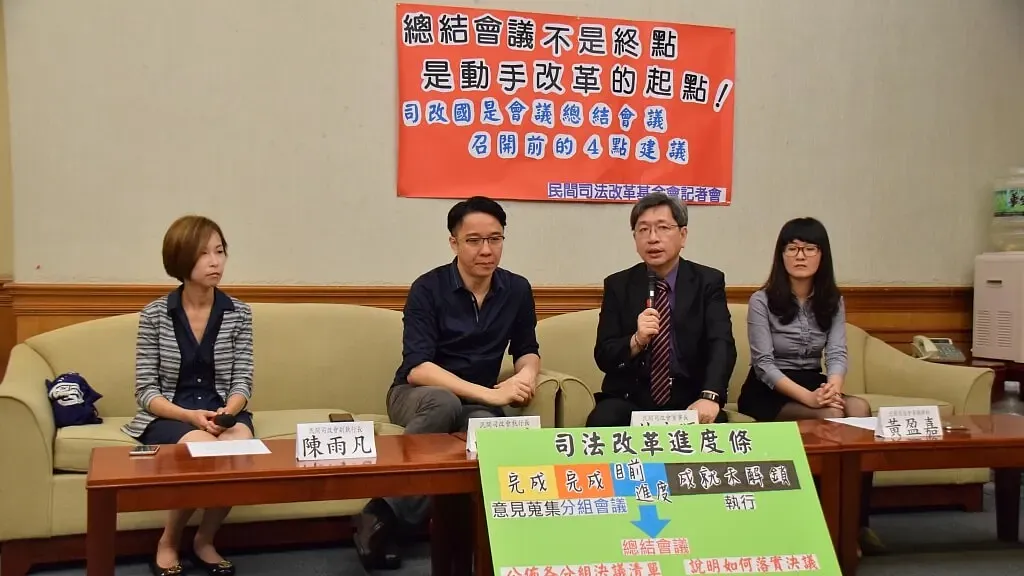
The Concluding Conference Is Not the Destination, But the Starting Point for Hands-On Reform! ~ 4 Recommendations Prior to the Concluding Conference of the National People's Congress on Judicial Reform
Last edited: 2026-08-29
已核對,發現多項與本對話系列已確立慣例不一致之處,皆為先前已多次確認之修正模式:
重大修正
| 原文 | 修正 | 依據 |
|---|---|---|
| "National Congress on Judicial Reform"(全文出現多次) | ❌ 應修正為 "National Conference on Judicial Reform" | 與本對話系列全篇已一致確立之官方譯名相符 |
| "Chunghsing Building" | ❌ 應修正為 "Zhongxing Building" | 與本系列先前文件已統一採用之漢語拼音一致 |
| "Ch'en Yü-fan"(陳雨凡) | ❌ 應修正為 Chen Yu-fan | 已於本系列先前文件多次確認(去除送氣符號及變母音) |
| "Deputy Executive Officer"(陳雨凡職稱) | ❌ 應修正為 "Deputy Executive Director" | 與本系列已確立之官方職稱一致 |
| "Executive Officer"(高榮志職稱,出現2次) | ❌ 應修正為 "Executive Director" | 與本對話系列全篇已一致確立之高榮志官方職稱相符 |
已確認正確
Lin Yung-sung、Huang Ying-chia、Kao Jung-chih(姓名本身)✅ 皆已於本系列多次確認正確。
修訂版全文
The preparatory group meetings of the National Conference on Judicial Reform concluded last week, and the concluding conference is scheduled to be held in late June or July. Following enthusiastic participation and discussion among committee members, the preparatory groups have reached a substantial number of resolutions. However, the operational model for the concluding conference has yet to be publicly announced.
The concluding conference is not the destination of judicial reform; how these resolutions will be implemented in the future marks the true beginning of the test. Today (the 8th), we held a press conference in Room 101 of the Zhongxing Building to propose four recommendations regarding how the concluding conference should be conducted and how subsequent reforms should be implemented: 1. Publish the list of resolutions; 2. Announce the agenda and rules; 3. Explain how to implement them; and 4. Determine how to track progress.
Three weeks before the concluding conference, the list of resolutions from each preparatory group should be published
The items for discussion at the concluding conference should logically be the issues addressed in the preparatory group meetings. According to the original rules of procedure, the concluding conference should respect the conclusions of the preparatory groups, but it may also "veto" or "add notes or supplementary differing opinions" to them. Therefore, in order to allow for timely and thorough discussion, the exact content of the resolution lists from the preparatory groups, as well as when and how they will be published, is of utmost importance.
Given the large number of resolutions produced by the preparatory group meetings, we recommend that officials compile the resolutions three weeks prior to the concluding conference, and prepare and release a public list for advance review and discussion by participants of the concluding conference and the outside world. This will simultaneously elevate public attention toward the concluding conference and allow external opinions an opportunity to enter the conference.
Furthermore, we recommend that the resolution list be drafted in plain, accessible language. If any resolutions adopted by different groups are mutually intertwined or potentially in conflict, they should be clearly summarized and categorized in advance. When each resolution is published, the "primary responsible unit" for its future execution should be indicated concurrently to preliminarily clarify the attribution of authority and responsibility.
Prior to the concluding conference, the meeting rules and agenda should be announced in advance
The "meeting rules" and "meeting agenda" should be published ahead of the concluding conference to enhance transparency and prevent potential procedural disputes afterward. We recommend that voting at the concluding conference adopt options for "approval," "rejection," and "abstained/invalid votes," and that a "roll-call vote" be implemented so that committee members are held accountable for the issues they vote on.
Aside from procedural matters, regarding substantive issues—should individual preparatory group topics fail to reach a conclusion even on their policy direction—if the concluding conference can engage in thorough discussion, it is recommended that initial directions be clarified as much as possible (for example: the system of public participation in trials). If external parties consider that complementary measures for individual issues may be lacking, it is recommended that these be thoroughly discussed at the concluding conference. If individual resolutions potentially involve major controversies, every effort should be made to conduct in-depth discussions and exchange opinions during the concluding conference to pool wisdom and achieve collective benefits.
The concluding conference should specifically explain how to implement the resolutions
Every session of the National Conference represents the analysis and discussion conducted through the time and energy of its members; the core of these resolutions, which aggregate public wisdom, lies in how they can be concretely implemented. We expect the concluding conference to provide specific explanations in this regard.
To facilitate the future execution of resolutions made at the concluding conference, formal consideration should first be given to concrete feasibility. For instance, each resolution should list a "primary responsible unit" alongside a preliminary draft of its "concrete execution plan" (e.g., short-, medium-, and long-term implementation steps), and a "concrete schedule" should also be planned.
Moreover, we believe that when the Judicial Yuan, the Ministry of Justice, or other ministries and commissions implement these resolutions in the future, they will inevitably establish amendment committees or policy groups. We recommend that these also adopt the open spirit of the National Conference by broadly incorporating policy opinions from all sectors, inviting external scholars, experts, or NGO representatives concerned with specific issues to participate, and making committee content and progress public in a timely manner. This will achieve the effects of pooling collective wisdom and reducing resistance to policy implementation.
The concluding conference should make a decision on how to track progress
In addition to planning how to implement resolutions, the concluding conference should also decide how to track and evaluate progress. The resolution of Preparatory Group 4 recommends that the President, in accordance with the powers conferred by the Constitution, establish a "consultation platform" as a channel for continuous dialogue between society and government departments to facilitate the implementation of the National Conference resolutions. We express our support and affirmation for this.
Furthermore, to enable citizens to inspect and oversee the implementation of resolutions, we recommend that the website continue to regularly publish progress updates on the implementation of the judicial reform resolutions. Going a step further, to objectively measure the effectiveness of resolution implementation, officials should establish policy evaluation indicators for individual resolutions (e.g., to implement public participation in trials, what should the policy evaluation indicators be? How should the degree of policy achievement be measured?) as well as overall evaluation indicators (e.g., whether public trust in the judiciary as a whole has increased), using objective measurement methods as much as possible to articulate the degree to which resolutions have been implemented.
Finally, we specifically recommend that since the President serves as the convener of the National Conference on Judicial Reform—demonstrating their determination to reform the judiciary—they should report on the progress of judicial reform to all citizens on "Judicial Day" (January 11) each year, continuously demonstrating their unwavering determination to see it through to the end through concrete actions.
Over seven months have passed since the National Conference on Judicial Reform. Through opinions gathered from the internet, we have seen the problems within the judiciary, and with the adoption of preparatory group resolutions, the dawn of reform is gradually coming into view. In order to welcome the concluding conference, adequate preparations must be made beforehand to ensure the smooth conduct of the meeting, and various feasible and challenging aspects of future resolution implementation and tracking must be anticipated in advance. Only by carefully taking stock of issues, comprehensively considering implementation methods, and concretely carrying them out can we deliver an impressive scorecard for judicial reform.
Notes
Article 28 of the Rules of Procedure stipulates: "The concluding conference shall respect the conclusions of the preparatory groups. If there are differing opinions, the concluding conference may, with the consent of more than one-half of all members, veto the conclusions of the preparatory groups, or add notes or supplementary differing opinions to the conclusions of the preparatory groups."
Resolution 4-2-4 of the Preparatory Group: "It is recommended that the President, in accordance with the powers conferred by the Constitution, design and provide a consultation platform for continued dialogue between society and relevant government departments, in order to facilitate efforts by the Judicial Yuan, the Ministry of Justice, the Executive Yuan, the Legislative Yuan, the Examination Yuan, and the Control Yuan to implement the recommendations of the National Conference."
Attending Representatives
Lin Yung-sung, Attorney at Law / Chairman, Judicial Reform Foundation
Chen Yu-fan, Attorney at Law / Deputy Executive Director, Judicial Reform Foundation
Huang Ying-chia, Attorney at Law / Staff Attorney, Judicial Reform Foundation
Kao Jung-chih, Attorney at Law / Executive Director, Judicial Reform Foundation
Press Contact
Judicial Reform Foundation / Executive Director Kao Jung-chih — (02) 2523-1178
This article is an AI-generated translation of the original Chinese text. In the event of any discrepancy, the Chinese version shall prevail.