
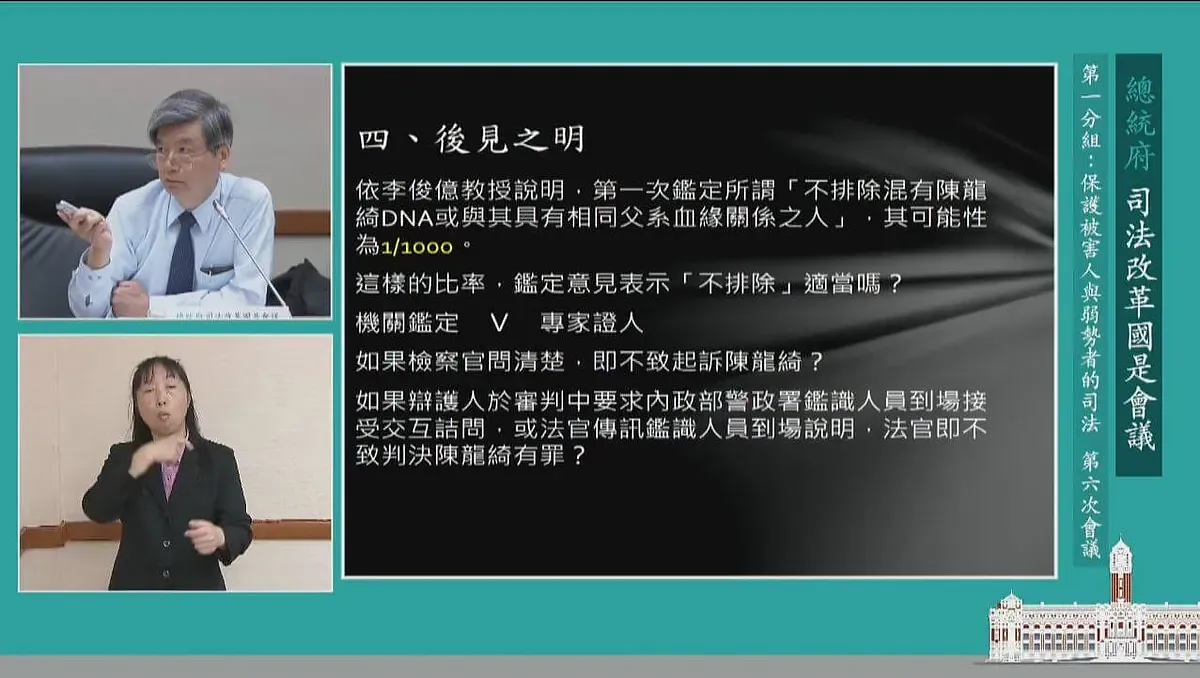
Brief Notes: The 6th Meeting of the 1st Division of the Presidential Office's National_Judicial_Reform_Conference
Last edited: 2026-08-29
- This meeting lasted approximately four and a half hours, focusing on the theme "Reducing Wrongful Convictions and Strengthening Remedial Mechanisms." It passed two proposals: the "Post-Verdict Remedial System" and the "Study on Establishing a Remedial Mechanism for Convictions Suspected of Being Improper Trials During the Period of Martial Law." Regarding the proposal on the "Post-Verdict Remedial System," following a report by Committee Member Chen Lung-chi, supplementary statements by Committee Members Huang Chih-hao and Li Chun-i, and feedback presented by representatives attending from the Judicial Yuan and Assistant Professor Chin Meng-hua of the National Chiao Tung University School of Law, the attending committee members discussed issues such as whether it is necessary for Taiwan to establish a criminal case review mechanism independent of the judiciary and its relationship with the current retrial system, and passed the following resolution: Not wronging any innocent person is an uncompromisable vocational duty of judicial justice. To reduce wrongful convictions and protect human rights, the judiciary's function of remedying the innocent after a conviction is finalized should be strengthened, and the remedial system for criminal cases after finalization should be perfected. To improve due process protections for finalized criminal judgments, it is recommended that the Judicial Yuan amend the retrial system under the Code of Criminal Procedure, granting petitioners the right to defense, the right to inspect case files, the right to state opinions, and the right to apply for the investigation of evidence, while also adding grounds for judgments that violate the law as a requirement for retrials, allowing citizens to directly seek remedies for illegal final judgments. To compensate for the infringement upon personality rights suffered by those acquitted through post-verdict remedies, the Judicial Yuan should consider granting appropriate restoration of reputation to the exonerated. To prevent judicial miscarriages and understand the factors behind them, it is recommended that the Judicial Yuan and the Ministry of Justice establish a judicial miscarriage research center to analyze cases where individuals were acquitted through post-verdict remedies and cases where individuals were acquitted after being prosecuted by prosecutors, studying the causes of miscarriages to avoid wrongful imprisonment. To increase avenues for wrongful conviction remedies and give misjudged innocent persons the opportunity to reopen trials, it is recommended that the government study the establishment of a "Criminal Cases Review Mechanism" that exercises its powers independently (such as the independent mechanisms in the United Kingdom and Norway, i.e., the Criminal Cases Review Commission), dedicated to investigating finalized conviction cases and applying for or prompting the opening of retrials for the innocent. Regarding the "Study on Establishing a Remedial Mechanism for Convictions Suspected of Being Improper Trials During the Period of Martial Law," following an explanation by Committee Member Huang Sung-li, a supplementary statement by Committee Member Mao Sung-ting, and feedback presented by guests attending from the Taiwan Association for Truth and Reconciliation, the attending committee members reached a high consensus on granting the right to remedy to individuals whose convictions for offenses such as rebellion or espionage during the period of martial law became final, in order to advance transitional justice, and passed the following resolution: To advance transitional justice, fulfill the requirements of due process, and grant the right to remedy to individuals whose convictions for offenses such as rebellion or espionage during the period of martial law became final, thereby enabling the parties concerned to pursue the truth, restore their reputation, and reconcile with the state, a study should be conducted to establish a remedial mechanism for convictions suspected of being improper trials during the period of martial law. This will obligate the state to sincerely confront the improper exercise of public authority under the historical background of past eras, actively heal the social and psychological trauma of victims of improper trials through appropriate legal channels, and achieve reconciliation and symbiosis: The government should legislate to create a special remedial pathway for individuals whose convictions under improper military trials during the period of martial law became final (hereinafter referred to as the convicted persons), and promptly study feasible remedial pathways and their responsible agencies that meet Taiwan's transitional justice needs. It is recommended to adopt the organizational form of a special committee, which should be composed of a considerable proportion of experts and scholars, attorneys, socially impartial figures, and other personnel equipped with an understanding of transitional justice. At the same time, to enhance safeguards in the review procedure and the necessity of leveraging the professionalism of judicial personnel, reference may be made to the legislative intent of the Statute for Compensation on Improper Rebellion and Espionage Trials during the Period of Martial Law, ensuring that individuals qualified as judges or prosecutors account for a certain proportion of the committee's members. The government should open up judicial remedial pathways by amending Article 9, Paragraph 2 of the National Security Act and Article 13 of the State Compensation Act, allowing the aforementioned convicted persons and their families to appeal through court procedures to seek vindication, compensation, and the recovery of confiscated property. To ensure the right of convicted persons or their families to access and utilize the remedies in items 1 and 2 above, the government should take appropriate measures to provide necessary assistance to convicted persons or their families. Examples of such measures include, but are not limited to: The government should actively promote advocacy after the legislation is completed so that it is widely known to society. The government should protect the right of convicted persons or their families to inspect relevant case files and archives. The government should provide necessary training for judicial personnel, attorneys, and others to assist convicted persons or their families. The government may establish or commission appropriate agencies and organizations to provide comprehensive legal consultation and aid.
- The next meeting is scheduled for May 23, during which the remaining issues of this division will be discussed together.
This article is an AI-generated translation of the original Chinese text. In the event of any discrepancy, the Chinese version shall prevail.