
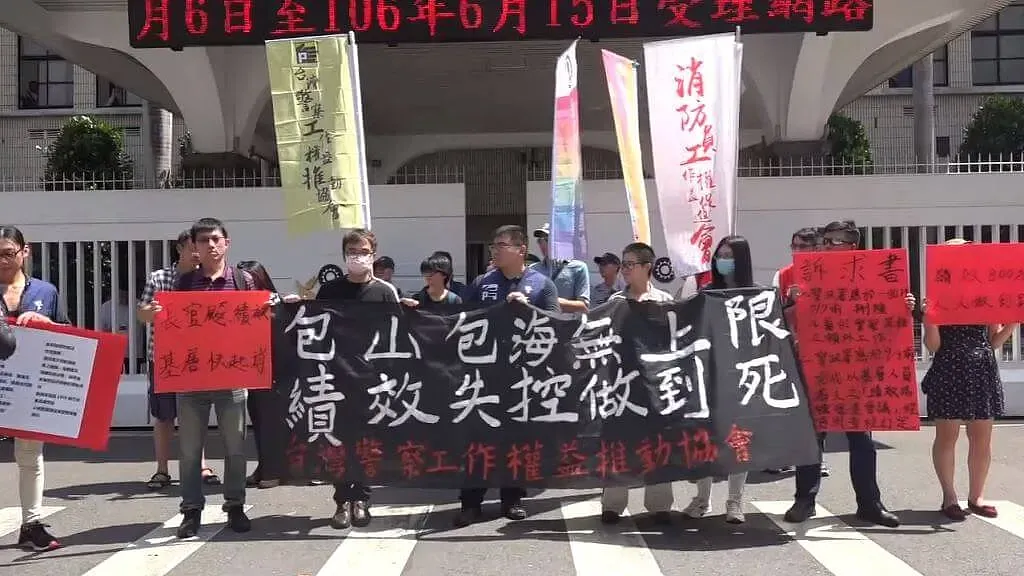
Press Release | Police Labor Union: "Endless Tasks and Out-of-Control Performance Metrics Drive Rank-and-File Officers to Their Deaths" Press Conference
Last edited: 2026-08-29
Ahead of Police Day on June 15, the Taiwan Police Trade Union once again gathered in front of the National Police Agency to demand labor reforms for frontline police officers. Addressing the severe overwork caused by redundant duties that cover everything and arbitrary performance metrics with vague targets, the association called on the National Police Agency to commit to improvements within a specified timeframe.
In April of this year, the National Police Agency publicly stated that it was doing its utmost to fill police staffing shortages to reduce officer overwork. However, the primary cause of police overwork is not merely a shortage of personnel. According to an analysis conducted by the Taiwan Police Trade Union in 2017, a more critical factor behind the heavy burden on police capacity is that police agencies have outsourced too many non-police duties and established an excess of redundant, miscellaneous tasks. Meanwhile, the formulation of performance targets is excessively arbitrary, keeping officers perpetually overwhelmed with work. Even if budgeted staffing levels were 100% fulfilled, the workload would still be insurmountable, and police officers would still be forced to work overtime every single day.
A Jack-of-All-Trades Master of None?
Under current practices, police agencies frequently take on tasks or new responsibilities outside their purview at the behest of elected representatives or on the whim of superior officers, phenomena that are frequently reflected in performance demands. The general public might assume that frontline police officers rotating shifts 24 hours a day can handle everything, thereby providing citizens with more diverse services. However, this malformed administrative division of labor and performance requirements leaves officers overwhelmed and inefficient simply trying to process these non-core, unreasonable duties and metrics, rendering police completely inaccessible to those who genuinely need their help. As officers voice exhaustion and collapse one after another, it is the public's rights that ultimately suffer.
According to Article 19 of the Administrative Procedure Act, "An administrative authority shall, for the purpose of exercising its joint administrative functions, render mutual assistance within the scope of its powers..." When other agencies request assistance from police agencies due to necessary causes, police agencies should naturally provide assistance within their capabilities. However, such "assistance" often ends up becoming "outsourced" work, such as avian influenza inspections and immediate care services. Police agencies forcibly take over the work of the Department of Health or the Social Welfare Department, absurdly becoming the primary entity for these health and social welfare tasks. Lacking the relevant professional skills for such specialized work, frontline officers find themselves performing tasks they do not understand, while other agencies are equally annoyed by police intervention. Who exactly benefits from this?
Reasonable Formulation of Performance Metrics Must Incorporate Frontline Officers' Feedback
Furthermore, frontline officers are frequently pressured to meet unreasonable or outright unfeasible performance demands, often having to conjure up cases out of thin air or concentrate solely on specific cases within just a few days. Busy dealing with these "scored" cases that concern their superiors, officers rush to churn out shoddy work to create a 700% or 800% performance achievement rate. Consequently, they have no time to handle "unscored" cases. It is likely due to this that the hoarding of cases, covering up of crimes, and dismissal of reports by police occur. Such management methods, detached from reality and blindly chasing the superficial appearance of soaring performance metrics, ultimately serve only as a vanity arms race for supervisors at all levels to boast about over tea. What follows is officers driven to extremes in handling cases, which in turn drags down the entire judicial system and even compromises citizens' rights. We ask again: who on earth benefits?
Everyone knows that good performance metrics do not equate to good public safety, except for the senior officers.
We believe that performance metrics should not be formulated excessively and arbitrarily. Their formulation must prioritize rationality, scientific rigor, feasibility, and the labor conditions of executing personnel, and unreasonable assessment items should be eliminated based on the opinions of frontline police officers. A genuine performance system is meant to test whether supervisors at all levels have properly grasped resource and manpower conditions, whether they possess the ability to allocate and effectively utilize limited resources, and whether they have methodologies and leadership skills. Being a supervisor is not like writing fiction; they cannot simply add performance requirements, rewards, and punishments on a whim without evaluating feasibility. The traditional performance system can essentially be described as an epitome of bureaucracy and a culture of falsification.
Taiwan Police Trade Union: Professionalization of Work, Setting Performance and Tasks Within One's Capabilities
In summary, while the National Police Agency has repeatedly promised to adopt our demands and reform the labor plight of frontline police officers, we have yet to see any dawn of hope within the police system. Various tasks remain merely one-way directives issued from the top down, disregarding whether frontline personnel can achieve them or inquiring about the genuine needs of frontline officers. Whenever brothers at their posts grow exhausted or fall injured or dead in the line of duty, police higher-ups merely romanticize them as models of "devoting one's utmost loyalty until death," which is utterly absurd. We demand that frontline police officers have the right to participate in the formulation of police policies, including the feasibility of undertaking various tasks and performance projects, to collectively decide their careers in the workplace.
Our Demands:
Frontline police work must return to its core duties, and redundant tasks must be eliminated: Return work that does not belong to the core duties of the police to other agencies, and cut redundant and miscellaneous tasks.
Establish a "Police Project and Performance Management Commission": In addition to requiring that at least half of the committee members be frontline police officers, a feedback mechanism for frontline officers must also be established. Frontline police officers should have the right to veto unreasonable performance systems; furthermore, the opinions of frontline personnel in police stations and criminal investigation brigades should form the basis for formulating performance metrics, rather than senior officers arbitrarily setting them on their own.
Regarding the above matters, the National Police Agency should consult with our association.
Organizer
Taiwan Police Working Rights Advocacy Association
Press Contact
Wu Tsung-che 0919224339
This article is an AI-generated translation of the original Chinese text. In the event of any discrepancy, the Chinese version shall prevail.