
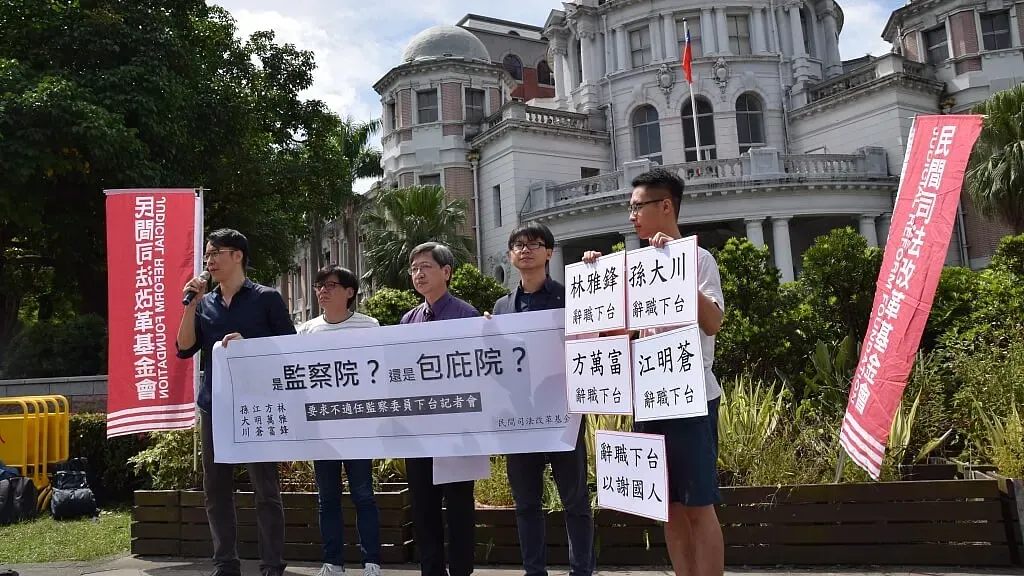
Control Yuan or Cover-up Yuan? ~ Press Conference Demanding the Resignation of Unfit Control Yuan Members
Last edited: 2026-08-29
On October 9, 2014, the Judicial Reform Foundation and the Taiwan Association for Innocence jointly petitioned the Control Yuan to investigate five major miscarriage-of-justice cases: the Chiang Kuo-ching case, the Su Chien-ho case, the Hsu Tzu-chiang case, the Cheng Hsing-tse case, and the Houfeng Bridge female fall case. They aimed to address the causes of severe forensic errors, review the criminal forensics system, and hold relevant forensic personnel accountable for illegal dereliction of duty. (See Note 1)
Contrary to the earnest demands of the public, the Control Yuan refused to investigate. The reasoning was that the disciplinary statute of limitations had exceeded 10 years for the Chiang and Su cases, while the Hsu, Cheng, and Houfeng cases were still ongoing in litigation. On June 17, 2015, we held a press conference protesting that "Erroneous Appraisals Cost Lives, Control Yuan Remains Indifferent and Inactive," pointing out the illegality of the Control Yuan's refusal to investigate, and hoping that the Control Yuan would not become a "dispensable" and "non-investigating" Yuan. (See Note 2)
Under public pressure, the Control Yuan successively published two investigation reports, pointing out that forensic pathologist Hsiao Kai-ping had violated professional conscience in both the Chiang Kuo-ching and Hsu Tzu-chiang cases, committing unforgivable forensic errors that cost Chiang Kuo-ching his life and wronged Hsu Tzu-chiang. However, what we never expected was that the four Control Yuan members—Lin Ya-feng, Fang Wan-fu, Chiang Ming-tsang, and Sun Ta-chuan—actually shielded forensic pathologist Hsiao Kai-ping and decided not to impeach him. (See Notes 3 and 4) Their methods of illegal shielding were as follows:
Illegally suspending investigations and helping drag out the statute of limitations
In 2010, Control Yuan members Ma I-kung, Shen Mei-chen, and Yang Mei-ling published an investigation report on the Chiang Kuo-ching case and issued a corrective measure to the Ministry of National Defense. In July 2011, the Ministry of National Defense disciplined 21 military officers, including three former Air Force Commanders-in-Chief. However, Lin Ya-feng, Fang Wan-fu, Chiang Ming-tsang, and Sun Ta-chuan—who took office as Control Yuan members on August 1, 2014—refused to investigate forensic pathologist Hsiao Kai-ping on the grounds that the Chiang Kuo-ching case had exceeded the 10-year statute of limitations. We must ask: The Chiang Kuo-ching case occurred in 1996; if there truly was an issue with the statute of limitations, why could previous Control Yuan members investigate? Why could the Ministry of National Defense discipline military officers? In truth, the four Control Yuan members simply did not want to investigate.
Furthermore, when we filed our report in 2014, the Hsu Tzu-chiang case was still well within the 10-year or even 5-year statute of limitations. Yet the four Control Yuan members claimed that cases under litigation could not be investigated. They dragged their feet until the Hsu case reached a final verdict last year, only to belatedly and sluggishly begin their investigation. Once the statutory deadline had passed through their delaying tactics, they hypocritically claimed that although forensic pathologist Hsiao Kai-ping had indeed acted unlawfully, impeachment was impossible because the statute of limitations had expired. Article 27, Paragraph 1 of the Enforcement Rules of the Control Act clearly stipulates: "Where the same act of the person under investigation in an investigation case is under criminal investigation or trial, the investigation shall not be suspended." We fail to understand on what grounds the four Control Yuan members suspended the investigation.
Ignoring subsequent unlawful acts to create the illusion of a completed statute of limitations
Article 20 of the Public Functionary Disciplinary Act stipulates that the statute of limitations for disciplinary action begins to run from "the date on which the act subject to disciplinary action is concluded." Taking the Chiang Kuo-ching case as an example, forensic pathologist Hsiao Kai-ping has yet to admit his mistake, and even filed a defamation lawsuit against Dr. Li Chun-i, the DNA forensic expert who vindicated the Chiang case. This litigation farce only ended on May 24 when the Supreme Court dismissed the appeal. (See Note 5) Forensic pathologist Hsiao Kai-ping's erroneous appraisal cost Chiang Kuo-ching his life, and he subsequently used malicious litigation to cover up his mistakes. All of these actions were capable of interrupting the statute of limitations, yet the four Control Yuan members chose to ignore them, thereby manufacturing the illusion that the statute of limitations had expired.
In the Hsu Tzu-chiang case, forensic pathologist Hsiao Kai-ping appeared in court on April 8, 2011, to undergo cross-examination and explain the appraisal report he produced in 2007. Hsiao Kai-ping's lies were exposed on the spot by defense attorneys, and the judgment of the seventh retrial determined that his report lacked admissibility as evidence. Therefore, the "date on which the act subject to disciplinary action is concluded" for Hsiao Kai-ping should be calculated from at least 2011. The four Control Yuan members completely omitted the 2011 cross-examination and chose to calculate the statute of limitations from 2007 as their reason for not impeaching forensic pathologist Hsiao Kai-ping. If this is not shielding, what is?
Downplaying the degree of illegality and misinterpreting the statutory limitations of the Public Functionary Disciplinary Act
The Public Functionary Disciplinary Act underwent major amendments in 2015. One of the key focuses was changing the three disciplinary sanctions of dismissal from office, removal from office, and deprivation of pension (retirement pay/military pensions) so that they are no longer subject to any operational time limits, freeing them from the constraints of the 10-year statute of limitations under the old law. Relaxing the disciplinary statute of limitations through these amendments was intended to solve problems where judicial cases requiring a very long time to be vindicated—such as the five major miscarriages of justice—could not be used to discipline personnel who acted illegally or were derelict in their duties at the time due to statutory limitations.
The Control Yuan's two investigation reports have already confirmed forensic pathologist Hsiao Kai-ping's actions of making erroneous appraisals that cost human lives. However, the four Control Yuan members stated that Hsiao Kai-ping's "dereliction of duty did not reach the extent warranting a disciplinary sanction of suspension from office or heavier; therefore, the 5-year statute of limitations most favorable to the party concerned under the amended Public Functionary Disciplinary Act of May 20, 2015 should apply, in order to conform with the legal system." The new law, which extended the disciplinary statute of limitations, was twisted by the four Control Yuan members into a provision to exculpate forensic pathologist Hsiao Kai-ping. If Hsiao Kai-ping had performed an accurate DNA analysis, Chiang Kuo-ching might still be alive today. If Hsiao Kai-ping had correctly interpreted the photographs, Hsu Tzu-chiang might have been acquitted long ago. For such an individual as Hsiao Kai-ping, the four Control Yuan members still concluded that his dereliction was not severe. Why should the people of Taiwan spend their money to support such "shielding" members?
The Control Yuan has long been criticized by society for its ineffectiveness—striking only at flies, not at tigers. The case of forensic pathologist Hsiao Kai-ping proves that the Control Yuan cannot even strike flies. Aside from Vice President Sun Ta-chuan, who has a literature background, the other three Control Yuan members are all veteran judges and prosecutors. Well-versed in laws and regulations, they could not possibly have misapplied the law. The only reasonable explanation is that they knowingly manipulated the law with the intent to shield him. In particular, the five major miscarriages of justice are judicial cases that successive Control Yuan members have strived to vindicate. The actions of these four Control Yuan members in shielding Hsiao Kai-ping have failed past Control Yuan members, failed the president who nominated them, and most of all, failed the people who pay their salaries. We demand that Lin Ya-feng, Fang Wan-fu, Chiang Ming-tsang, and Sun Ta-chuan immediately resign from their positions as Control Yuan members to apologize to the nation!
Notes
2014-10-09 Why Do Evidences Lie? Reforming the Appraisal System and Holding Derelict Personnel Accountable ~ Press Conference on Criminal Forensics System Reform
2015-06-17 Press Conference Protesting "Erroneous Appraisals Cost Lives, Control Yuan Remains Indifferent and Inactive"
Control Yuan Judicial Investigation 105-0014
Control Yuan Judicial Investigation 106-0016
Supreme Court Civil Ruling 106-Tai-Shang-1402
Time
June 26, 2017 (Monday) 09:30
Location
Main Entrance of the Control Yuan
Attendees
Lin Yung-sung, Chairman, Judicial Reform Foundation
Kao Jung-chih, Executive Director, Judicial Reform Foundation
Lo Shih-hsiang, CEO, Taiwan Association for Innocence
Press Contact
Kao Jung-chih, Executive Director, Judicial Reform Foundation — 02-2523-1178
This article is an AI-generated translation of the original Chinese text. In the event of any discrepancy, the Chinese version shall prevail.