
The High Prosecutors Office Prosecutor with a Half-Page Appeal Brief
Last edited: 2026-08-29
On March 18, 2011, the Prosecutorial Personnel Review Committee of the Ministry of Justice sanctioned three prosecutors, one of whom was Prosecutor Chen Ming-kuang of the Taiwan High Prosecutors Office. He was given four demerits for severe delays in handling cases. This news did not attract much attention at the time, but three months later, an elderly woman came to the JRF. She told me that Prosecutor Chen was the very person she had reported, but that her case should only have warranted one demerit for him. To her surprise, Chen ended up receiving four. She hoped the JRF could dig deeper into what exactly had gone wrong with this prosecutor.
I looked through the materials the elderly woman provided. She had filed a complaint for document forgery; the defendant was sentenced to six months in the first instance, acquitted on appeal, but the Supreme Court remanded the case, and the defendant was acquitted again on the first retrial. Upon receiving the retrial judgment, she immediately retained an attorney to draft a request for appeal, listing five major grounds, and submitted it to the Taiwan High Prosecutors Office on August 27, 2010, asking the prosecutor to appeal. Believing the case had long since been appealed to the Supreme Court, she was stunned to receive an official document from the High Prosecutors Office on November 29 stating: "Regarding the request for the prosecutor to file an appeal, upon review by the prosecutor handling this office's docket, the original judgment was found not to violate any law or regulation, and the request cannot be granted." Only then did she learn that the prosecutor at the High Prosecutors Office had abandoned the appeal.
A Reply Three Months After the Appeal Deadline, Citing Slow Typing
The elderly woman found this utterly unreasonable, because the appeal period is only 10 days—if the prosecutor genuinely believed the request for appeal lacked merit, he should not have waited three months to notify her of the decision to forgo the appeal. She suspected the prosecutor had actually let the case slip past the appeal deadline, and then, to cover up the error after the fact, simply closed the case by declaring the appeal request meritless. She decided to file a complaint with the Control Yuan, and on June 9, 2011, the Control Yuan notified her of its investigation results. It turned out the prosecutor handling the case was Chen Ming-kuang, who explained that he believed the retrial judgment contained no error or impropriety, which was why he had forgone the appeal—not because of any delay past the deadline. As for why it took three months to reply, he said it was because: "I was still new to using a computer to draft documents, so my typing was slow." In the end, the Prosecutorial Personnel Review Committee concluded that the delayed reply did indeed constitute negligence and issued Prosecutor Chen one demerit, and the Control Yuan approved the closing of the case.
The elderly woman could not accept "slow typing" as an excuse for the delay. As she put it: "There's a typing room right on the second floor of the High Prosecutors Office—if Prosecutor Chen couldn't type, couldn't he have asked someone else to do it? That's a truly pathetic excuse." She later discovered from the news that she was not the only victim, and decided to file a complaint with the JRF.
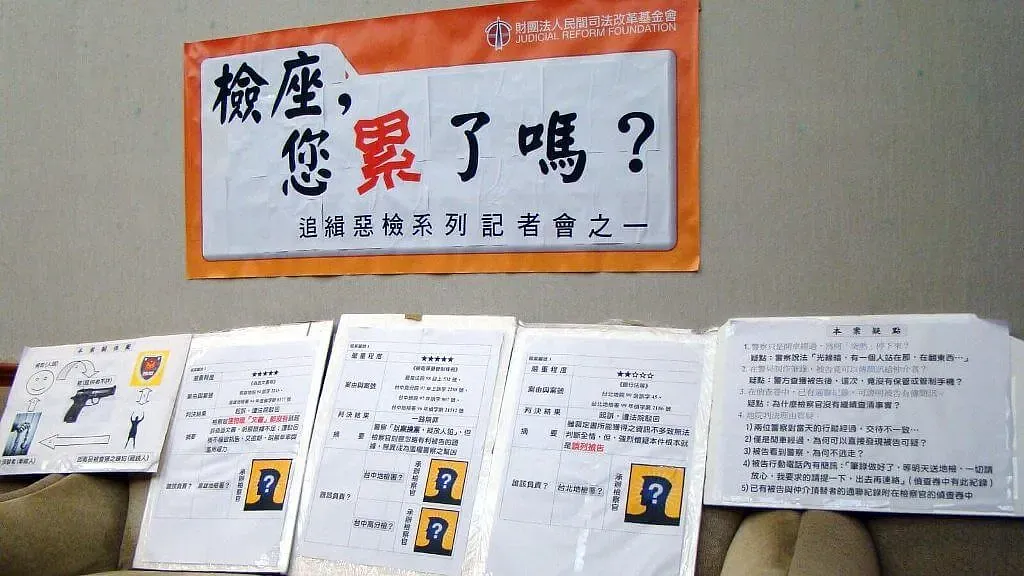
At the time, the JRF was running its "Pursuing Bad Prosecutors" project, comprehensively analyzing three years' worth of finalized not-guilty verdicts from the Supreme Court to review whether prosecutors had been negligent, and in the process uncovered problems with the High Prosecutors Office's poor functioning that urgently needed reform. Starting in late 2011, the "Pursuing Bad Prosecutors" project held four consecutive press conferences, publicizing 12 individual cases and demanding the establishment of quality-control mechanisms for prosecutorial indictments and appeals. This later coincided with Taiwan High Prosecutors Office Prosecutor Lin Hsiu-tao's decision to forgo an appeal in the Ker Chien-ming case, which triggered the leak scandal involving Prosecutor-General Huang Shih-ming, and prosecutorial system reform suddenly became a hot topic of public debate. But while public attention focused on whether Prosecutor Lin Hsiu-tao should have forgone the appeal, I often found myself thinking back to the elderly woman's case—how she, too, had had her appeal abandoned by Prosecutor Chen Ming-kuang, yet no one had paid any attention.
Case-Handling Negligence Was No Accident
"Three feet of ice does not form in a single day." As early as 1999, Prosecutor Chen Ming-kuang had already been investigated by the Control Yuan for attending a banquet linked to the manipulation of Taiwan Pineapple Corporation stock (pp. 3–7), and in 2002 he was again reprimanded by the Control Yuan for delays in handling official documents (p. 10). It is clear that Prosecutor Chen had a recurring pattern of negligence in handling cases, and the elderly woman's case was no isolated incident. Among the four demerits recorded against Prosecutor Chen in 2011, aside from the one demerit for the typing-delay case, the only other one I could find in public records was for shelving an official document from the Control Yuan for 475 days (p. 72); the reasons for the remaining two demerits remain unknown.
All four of these demerit sanctions were issued before the enactment of the Judges Act. After the individual case evaluation system under the Judges Act came into effect, the JRF compiled the Supreme Court judgments analyzed under the "Pursuing Bad Prosecutors" project and attempted to file individual evaluations against six prosecutors at the High Prosecutors Office, including Chen Ming-kuang, hoping that the Judges Act could effectively help the public hold prosecutors accountable.
The case for which Prosecutor Chen Ming-kuang was referred for evaluation by the JRF was Supreme Court Case No. 97-Tai-Shang-1217. Through the case file retrieved by the Prosecutor Evaluation Committee, we discovered that Prosecutor Chen's appeal brief consisted of a single A4 page—one that wasn't even half full of text—with no supplementary statement of reasons whatsoever. I thought to myself: "If Prosecutor Chen forwent the elderly woman's appeal because he believed the original judgment had no problems, then for this case—one he apparently believed warranted an appeal—why is the appeal brief only half a page long? Was the Chief Prosecutor of the High Prosecutors Office even supervising these cases at all?"
In the end, all six of these individual evaluation cases against High Prosecutors Office prosecutors were resolved as "not to be evaluated" on the grounds that they exceeded the two-year statute of limitations. One of the JRF's arguments was that for cases in which High Prosecutors Office prosecutors appeal to the Supreme Court, the evaluation limitation period should be calculated from the date the Supreme Court renders its judgment. However, the Prosecutor Evaluation Committee held that the limitation period begins running once the High Prosecutors Office prosecutor files the appeal brief, and that the time the Supreme Court spends hearing the case need not be counted toward the evaluation limitation period for the High Prosecutors Office prosecutor. On this basis, it resolved not to evaluate any of the cases reported by the JRF. (Prosecutor Evaluation Committee Case Nos. 103-Chien-Ping-Tzu 1 through 6)
A Major Loophole in the Prosecutor Evaluation System's Mutatis Mutandis Application of the Rules for Judges
The Judges Act provides that the evaluation limitation period begins running only after a judge issues a written judgment, and this makes sense. But prosecutors' evaluation limitation period is likewise calculated from the date the appeal brief or indictment is drafted—on the surface, this appears to apply the same standard as for judges, but in practice it drastically forecloses the possibility of evaluating prosecutors. This is because a judge's written judgment is made public immediately, whereas an appeal brief or indictment is not made public immediately unless the prosecutor sends it directly to the parties involved. The public can only assess the quality of an appeal brief or indictment once they see the judge's written judgment—and court proceedings typically take one to two years. Under the Prosecutor Evaluation Committee's method of calculating the limitation period, the vast majority of individual prosecutor evaluations will exceed the statute of limitations. This also highlights how the legislative design of applying the Judges Act mutatis mutandis to the prosecutor evaluation system overlooks the differences in how judges and prosecutors perform their duties—creating, through a merely formal application by analogy, a substantive loophole. Even setting this aside, for cases still within the 10-year disciplinary limitation period even after the two-year evaluation limitation period has passed, the Prosecutor Evaluation Committee could still refer the case to the Control Yuan for investigation—yet the Committee's passive attitude has meant that, in this respect, the Judges Act has been rendered utterly ineffective.
Recently, over a hundred prosecutors nationwide jointly signed a petition asking the Ministry of Justice to establish a "first- and second-instance rotation and practical experience" system, hoping to invigorate prosecutorial personnel management and improve the functioning and efficiency of the High Prosecutors Office. The dedication shown by grassroots prosecutors toward judicial reform on this front deserves public recognition. This appears to be a system that prosecutors themselves care a great deal about, but what the public cares most about is how an unfit prosecutor like Chen Ming-kuang—who infringes upon people's rights—can be properly held accountable, or even removed. Although Chen Ming-kuang retired from the High Prosecutors Office shortly after the Prosecutor Evaluation Committee's resolution, whether a better system could achieve better results is still worth pondering.
In any case, since the design of applying the Judges Act mutatis mutandis to the prosecutor evaluation system has already revealed fundamental difficulties in individual case evaluations, I believe that besides the option of remedying the situation by amending the Judges Act after the fact, another possible option would be to tailor-make a dedicated Prosecutors Act that accounts for the special nature of how prosecutors perform their duties. Detailed legislation based on the particular characteristics of prosecutorial duties, along with an oversight mechanism designed accordingly for prosecutors—rather than awkwardly applying the rules for judges by analogy—may be the only sustainable, long-term solution to the root of the problem.
※ This article was published in ETtoday on June 25, 2017.
This article is an AI-generated translation of the original Chinese text. In the event of any discrepancy, the Chinese version shall prevail.