
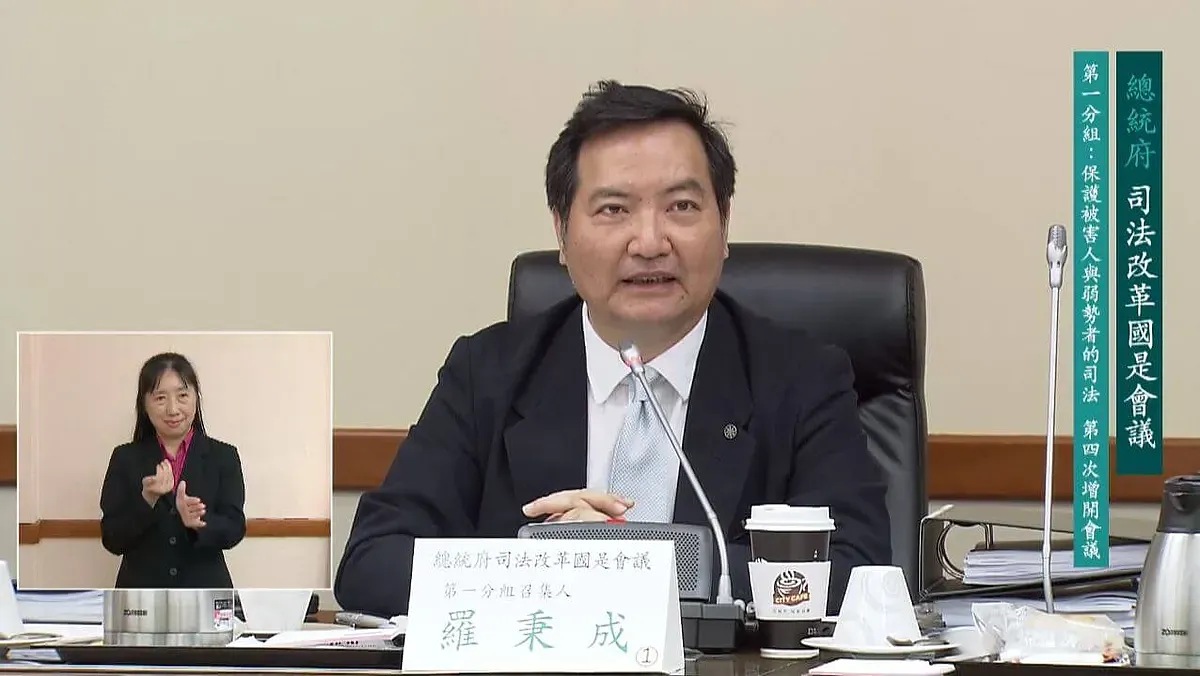
Brief Notes: 4th Extraordinary Meeting of the 1st Division of the Presidential Office's National Congress on Judicial Reform
Last edited: 2026-08-29
Lasting approximately eight hours, this tenth meeting of the 1st Division discussed proposals including "improving the criminal compensation legal system," "establishing 'best practical procedures for reducing erroneous judgments and implementing the presumption of innocence principle'," "implementing victim protection and elaborating capital punishment judicial procedures," "promoting the application and legalization of restorative justice," and "reviewing the balance between non-disclosure of investigations and the right of the accused to be informed of the investigation process."
Regarding the transitional justice proposal from the previous meeting—namely, "suggesting amendments to Article 9 of the National Security Act and Article 13 of the State Compensation Act"—since the 3rd Division also has a similar discussion item, should this division's resolution conflict with the 3rd Division's views, it will be submitted to the plenary meeting for discussion.
Regarding the proposal to "improve the criminal compensation legal system," attending members discussed whether the nature of criminal compensation should be deemed compensation or indemnity, whether personal conditions and accountability should be factored into the compensation amount, whether current compensation amounts are sufficient, whether compensation should be restricted to those whose personal freedom was previously restricted, and whether compensation methods should be limited to monetary compensation. The following resolutions were adopted:
To redress the harm suffered by innocent victims of judicial miscarriages, review existing criminal compensation laws and regulations, and establish a social reintegration mechanism for innocent victims:
Considering that innocent victims are inherently also victims of state public power, their protection should not be limited to monetary compensation; rather, spiritual and material support should also be provided to uphold or restore their dignity. The government should study and establish an innocent victim assistance mechanism, and consider integrating the crime victim protection mechanism and the innocent victim assistance mechanism to implement relevant social safety policies, improve the protection of innocent victims, assist victims in reintegrating into society, and enhance trust in the judiciary.
The government should review the current criminal compensation and indemnity legal system in accordance with the principle of the presumption of innocence, the intent of J.Y. Interpretation No. 670, and relevant opinions, ensuring that eligibility for criminal compensation and indemnity is not restricted only to circumstances where personal freedom has been limited or restrained. Pecuniary and non-pecuniary damages should be legislated and regulated separately. Non-pecuniary damages should include appropriate measures for reputation restoration, restorative settlement mechanisms aligned with the cultural sensibilities of the victims, and mental distress solatium. The government should promptly study and review the examination criteria set forth in Articles 4, 7, and 8 of the current Criminal Compensation Act regarding self-induced suspicion, attributable causes, and general social perceptions, so as to prevent innocent victims, after receiving an acquittal and vindication, from once again undergoing court examination regarding criminal suspicion or fault. Furthermore, considering that personal freedom has no hierarchy of value, the daily compensation amount should be calculated based on a fixed baseline sum (referencing, for example, relevant German legal systems); however, if the impact on the innocent victim's individual and household finances is severe and providing only a fixed baseline sum would be unfair, additional payments may be granted.
Regarding the proposal to "establish 'best practical procedures for reducing erroneous judgments and implementing the presumption of innocence principle'," attending members agreed that prevention is better than cure. Rather than reviewing how to provide compensation after the fact, priority should be given beforehand to perfecting practical procedures for reducing erroneous judgments. Consequently, the following resolutions were passed:
To reduce erroneous judgments and implement the principle of the presumption of innocence, we must learn from mistakes, avoid targeted assignment of individual responsibility, and instead focus on understanding the systemic or organizational factors leading to erroneous judgments. It is recommended to adopt optimal practices known to reduce the possibility of erroneous judgments:
Regarding eyewitness identification procedures:
Re-examine domestic regulations on identification procedures to ensure that "suggestive identification procedures or practical methods likely to lead to erroneous statements" are no longer utilized, and incorporate evidence-based identification methods and procedures. These include implementing single-blind administration (identification procedures must be conducted by police officers not handling the case and unaware of the suspect's identity), requiring witnesses to disclose their level of confidence during identification, and ensuring the fairness and appropriateness of the composition of the lineup.
The entire identification process must be audio and video recorded.
Regarding police interrogation procedures:
Re-examine current police interrogation (of suspects and witnesses) techniques and procedures to ensure that "methods discovered to increase the possibility of false confessions" are no longer utilized, and incorporate evidence-based interrogation techniques and procedures. This includes designing checklists that can reduce such biases and ensure police genuinely consider the possibility of innocence, as well as re-evaluating current police interrogation training workflows and operational methods.
Implement the requirement to audio and video record the entire police interrogation process to reduce the possibility of false confessions.
Regarding the proposal to "implement victim protection and elaborate capital punishment judicial procedures," since the majority of members present considered that the 5th Division had already reached a resolution on the elaboration of capital punishment sentencing, it was decided not to put it up for discussion, and the meeting materials will be provided for reference in policy development.
Regarding the proposal to "promote the application and legalization of restorative justice," after explanations by the proposing member and input from attorney Chen I-cheng of the Taiwan Bar Association and a representative from the Department of Protection Services of the Ministry of Justice, attending members discussed issues such as the practical effectiveness of restorative justice, sources of facilitators, and applicable case types, and adopted the following resolutions:
Rooted in a humanistic spirit and the principle of good-faith communication, and implementing the spirit of respecting cultural diversity, this aims to assist parties in healing trauma, restoring balance, and repairing fractured relationships, with the objectives of building a harmonious society and reducing crime. Justice is realized through the pursuit of truth, respect, consolation, accountability, and restoration. The following reforms and actions are recommended:
Legalize "restorative justice" to increase the legal basis for diversion measures at different stages, thereby providing guidance for judicial practice:
Amend the Code of Criminal Procedure and the Juvenile Justice Act to add legal bases empowering prosecutors and courts to facilitate mediation and relationship repair between offenders and victims.
Amend the chapter on moral reformation in the Prison Act to add a legal basis empowering prisons to facilitate mediation and relationship repair between offenders and victims.
Local prosecutors' offices and courts should have dedicated personnel responsible for administrative tasks such as case assignment, tracking, and management, ensuring stable manpower for the promotion of restorative justice, and independent budgets should be allocated for financial infusion.
Integrate protection organizations for crime victims and innocent victims, and structure training and supervision mechanisms for restorative justice facilitators:
Properly establish systematic, pragmatic, standardized curricula and plan practical simulation training hours based on the different stages of restorative justice progress, evaluating trainees' learning abilities at intervals to monitor facilitators' learning progress.
Establish internship and continuous supervision systems for facilitators.
Design differentiated curricula tailored to different backgrounds and objectives to help enhance the overall service capacity and quality of restorative justice, and establish a certification system for facilitators.
The Legal Aid Foundation should actively refer cases and promote restorative justice services.
Develop localized models of restorative justice within the correctional system: Correctional units in our country should more actively introduce and promote restorative justice and localize it, integrating restorative justice into the routine training of existing prison personnel. Personnel interested in further learning should be selected and dispatched to participate in facilitator courses, and prison volunteer training should be conducted to encourage the development and promotion of restorative activities and programs, particularly applied as counseling and preparation for inmates prior to their release and social reintegration.
Central and local education competent authorities should list restorative justice as a major educational policy: It is recommended that the central competent authority, the Ministry of Education, regularly commission or subsidize appropriate academic units to conduct empirical research data and project evaluations, promoting the application of school-based restorative justice suited for Taiwan in response to our national conditions and culture:
Promote it comprehensively and continuously on campuses as part of students' civic and legal education, support frontline teachers in practical implementation, and provide professional consultation and concrete assistance.
Central and local education competent authorities should establish expert committees responsible for drafting promotion plans and execution targets, incorporate restorative justice into annual administrative plans, allocate budgets, execute and review annually, and produce annual work outcome reports.
It is recommended that the government reference the practices of the International Institute for Restorative Practices (IIRP) to establish incentive mechanisms in funding and administration, enabling more colleges and universities to engage in campus restorative justice promotion, develop their own working models, teaching materials, and lesson plans, and cultivate relevant talent.
Provide tiered and classified training for frontline teachers and educational administrative personnel, aiming to train at least 5% of the nation's teachers annually, while incorporating relevant reward and evaluation standards. This should be supplemented by ongoing case discussions, supervision systems, and nationwide seminars to enable frontline personnel to continue growing.
Normal universities or universities of education should include restorative justice in their formal curricula during the teacher preparation stage, and arrange practical observation during the internship stage.
Establish a support platform for resolving campus conflicts: It is recommended that local governments cooperate with prosecutors' offices, bar associations, or indigenous tribes to hire experienced facilitators to provide consultation and be able to support schools when needed to help resolve campus conflicts.
In medical dispute mediation, adopt restorative justice as the ethos to replace dispute resolution models, rebuilding trust in the doctor-patient relationship through goodwill in dialogue.
Regarding the proposal to "review the balance between non-disclosure of investigations and the right of the accused to be informed of the investigation process," after input from the Ministry of Justice representative, attending members discussed issues such as the necessity of confidential investigations and the acquisition of information regarding the progress of investigation procedures by the accused or other litigation participants, and adopted the following resolutions:
Regarding enabling case parties (suspects/accused, victims/complainants) and their lawyers to understand investigation progress and obtain information during the investigative stage, the following reform measures are recommended:
The Judicial Yuan should study a system for the right of case parties to obtain information during investigations, legislating that, barring risks of collusion or destruction of evidence that would affect the purpose of the investigation, case parties and their lawyers should in principle be guaranteed the right to obtain information and the right to review files during investigations.
Investigative agencies such as the police, prosecutors, and investigative bureaus should, depending on the circumstances of the case and barring risks of collusion or destruction of evidence affecting investigative purposes, simultaneously inform defendants or suspects of the criminal charges and case details (such as the identity of the informant or accuser, and a summary of the events involved) when summoning them. The progress of the investigation should also be proactively communicated to case parties at appropriate times, or relevant information should be provided upon application by case parties or their lawyers (for example, when a case is closed with a summary conclusion or withdrawn).
Due to time constraints, Member Shih Ping-hui's proposal to "draft post-facto regulations such as the crime of obstructing justice" and Member Huang Chih-hao's proposal regarding the "review of the balance between non-disclosure of investigations and the right of the accused to be informed of the investigation process" were not discussed in time, and the meeting materials will serve as a reference for relevant agencies in formulating policies.
This article is an AI-generated translation of the original Chinese text. In the event of any discrepancy, the Chinese version shall prevail.