
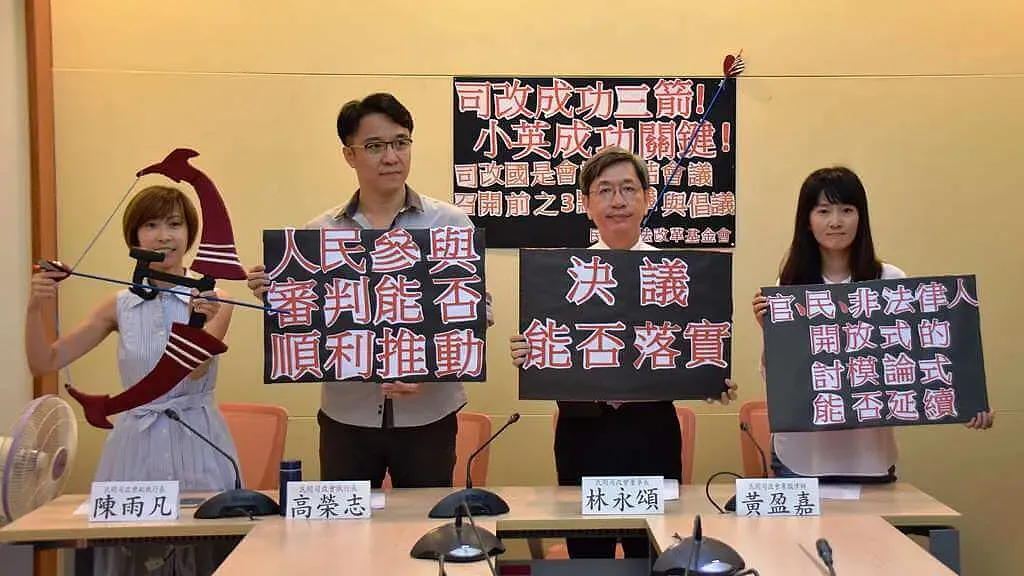
Three Arrows for Judicial Reform Success! President Tsai's Key to Success! ~ 3 Recommendations and Advocacy Prior to the National <div>Judicial Reform Conference Concluding Session</div>
Last edited: 2026-08-29
After spanning 10 months, the Concluding Session of the National Conference on Judicial Reform will be held tomorrow. The agenda and proposals for the concluding session have already been announced to the public, and the Judicial Yuan and the Ministry of Justice have successively proposed future judicial reform policies to be reported at the conference.
With people holding both expectations and fears of empty promises regarding judicial reform, the Judicial Reform Foundation held a press conference today (the 11th) in Room 103 of the Zhongxing Building to explain our observations over the past year and put forward three recommendations as the "three arrows" that are key to judging the success of President Tsai's judicial reform!
Whether Resolutions Can Be Implemented
Explanation
The 1999 National Judicial Reform Conference produced numerous resolutions as well as many progressive reform policies, but unfortunately, they could not be fully and concretely implemented afterward. We must learn from historical lessons; the key to whether this National Conference on Judicial Reform will succeed still lies in whether its resolutions can be subsequently implemented.
Of course, given the great number of subcommittee resolutions, it is understandable that the Judicial Yuan, the Ministry of Justice, and other competent authorities prioritize their implementation. Nevertheless, we believe that all issues and resolutions should be scheduled with a timeline. If they ultimately cannot be implemented, the reasons should be explained in detail, and corresponding political accountability should be assumed.
Specific Recommendations
The President should report to the public annually on the progress of judicial reform to fulfill her judicial reform political platform.
Many issues in judicial reform require cross-agency or even cross-branch coordination among the Yuan to be accomplished. We suggest that the government establish a cross-branch and cross-agency communication platform to facilitate the coordination of difficult judicial reform problems that require cross-branch and cross-agency comprehensive solutions.
Civil Society Monitoring Advocacy
Our pace of monitoring and advocacy will not stop with the conclusion of the National Conference on Judicial Reform. We will continue to advocate for and monitor judicial reform through methods such as proposing legal amendments, legislative lobbying, and legal education.
We will form the "Alliance for Civil Society Monitoring and Implementation of the National Conference on Judicial Reform," inviting members of the National Conference on Judicial Reform who care about judicial issues, individual members of civil society, or NGO organizations to join in constantly urging officials to implement the resolutions of the National Conference on Judicial Reform.
Whether Public Participation in Trials Can Be Smoothly Promoted
Explanation
The Judicial Yuan's previous push for the "observer-participation system" (ganshen zhi) fell short of success due to an arbitrary decision-making model. Relying solely on experts or scholars to endorse the Judicial Yuan, and stubbornly continuing to work behind closed doors when such endorsement failed, ultimately resulted in a bizarre system unique to Taiwan and unseen anywhere else in the world. It is no wonder neither the public nor the Legislative Yuan was willing to endorse it, leading to five years of stagnation and criticism from the Legislative Yuan's Budget Center for wasting resources.
When President Tsai Ing-wen took office, she particularly emphasized her political platform of allowing public participation in the judiciary. The subcommittee resolution summaries published by the Preparatory Committee in July, as well as the policy responses of the Judicial Yuan and the Ministry of Justice, all listed "promoting public participation in trials" as the primary focus. Coupled with the degree of importance attached by the public, this proves that the success or failure of "public participation in trials" will become an indicator policy for the success or failure of the Tsai administration's judicial reform.
Specific Recommendations
The President should actively coordinate with the Executive Yuan (Ministry of Justice), the Legislative Yuan, and the Judicial Yuan to pool wisdom and formulate policy directions regarding the system of public participation in trials, and make policy declarations to facilitate subsequent promotion.
The Judicial Yuan should learn the lesson from its previous forceful promotion of the "observer-participation system." It should no longer unilaterally make decisions before putting a draft into effect; instead, it should hold coordination meetings or public hearings with the utmost sincerity to broadly incorporate opinions from all sides.
Civil Society Monitoring Advocacy
This Association understands that different versions of the "public participation in trial system" each have their respective pros and cons, and opinions supporting different versions are grounded in reasons. At the same time, we also understand in good faith that supporters of all sides want to establish a "public participation in trial system" that "best suits Taiwan's national conditions." Therefore, this Association suggests that the government can pilot test multiple versions to obtain empirical experience in Taiwan. With more adequate information, a better final decision can then be made.
Should the officials still stubbornly proceed on their own course, make unilateral decisions, and elevate one system while rejecting others, after pooling wisdom through the civil society alliance, we do not rule out lobbying legislators, advocating the boycott of official policies, and alternatively proposing a rival draft version to counter the official one.
Whether Open Discussion Models for Officials, Citizens, and Non-Lawyers Can Be Sustained
Explanation
In the reform plans of the Judicial Yuan and the Ministry of Justice, it can be found that the Yuan and ministries have established several law amendment committees (e.g., the Criminal Procedure Act Research and Amendment Committee, the Special Law Formulation Committee for Labor Litigation Procedures, the Crime Victims Litigation Participation Bill Research Committee, etc.), or have already begun drafting bills (e.g., the Judges Act Amendment Proposal, the Court Organization Act Amendment Bill, etc.). However, the composition of these committees, whether representatives with different stances or even civil society figures are invited to join, and whether opinions different from the official stance can be incorporated into the amendment process remain unknown.
Since this National Conference on Judicial Reform adopted a different model from the past—namely, based on the political principle of open government, conducting work in an open, transparent, and participatory manner jointly by officials, the private sector, lawyers, and non-lawyers—we believe that future discussions of judicial reform resolutions in various amendment committees should also uphold the same spirit, conducted as far as possible in the open, transparent, and participatory manner of the National Conference on Judicial Reform.
Specific Recommendations
We call upon official law amendment committees to make public the roster of their members so that the outside world can examine whether participating members possess representativeness of different opinions, thus preventing law amendment from becoming an echo chamber. We further suggest that, following the model of the National Conference on Judicial Reform, open recruitment should be adopted, accepting recommendations of law amendment committee members from individuals or groups, so that non-lawyers or related groups can also join the discussions on law amendments.
The agendas and meeting materials of the law amendment committees should be disclosed publicly prior to meetings, and meeting resolutions should also be published immediately after meetings to meet the requirement of government procedural transparency and establish a channel for citizens concerned about the judiciary to express their opinions on amendment meetings.
Civil Society Monitoring Advocacy
The "Alliance for Civil Society Monitoring and Implementation of the National Conference on Judicial Reform" will pool everyone's strength to advocate for the official opening of channels for participation in law amendment groups, and continuously monitor the formation, formulation, and implementation of official law amendment meetings, amendment bills, or other reform policies, timely injecting civil society opinions.
With the conclusion of the Concluding Session, the National Conference on Judicial Reform temporarily draws to a period, which simultaneously signifies that the launch of judicial reform work is already an arrow on the bowstring. We expect the government to continue the discussion spirit of the National Conference on Judicial Reform, gradually implement the conference resolutions, and continuously march toward the direction of public participation in trials. Only by accurately shooting the "three arrows" of judicial reform can one hit the bullseye of judicial reform.
Attendees
Lin Yung-sung, Attorney / Chairman, Judicial Reform Foundation
Chen Yu-fan, Attorney / Deputy Executive Director, Judicial Reform Foundation
Huang Ying-chia, Attorney / Staff Attorney, Judicial Reform Foundation
Kao Jung-chih, Attorney / Executive Director, Judicial Reform Foundation
Press Contact
Kao Jung-chih, Executive Director, Judicial Reform Foundation — (02) 2523-1178
This article is an AI-generated translation of the original Chinese text. In the event of any discrepancy, the Chinese version shall prevail.