
Op-Ed: Ministry of Justice, yet to take the steps toward correctional reform?
Last edited: 2026-11-03
The National Consultative Conference on Judicial Reform held its concluding meeting on August 12. Setting aside the various controversies, many members put aside their other important work between March and June during the intensive group meetings to fully commit themselves to ensuring that crucial reform proposals became resolutions. Among these, a field that has long been neglected and struggled to secure resources achieved significant results during the conference: correctional (including juvenile and adult) system reform.
On August 8, the Presidential Office's National Consultative Conference on Judicial Reform website officially published the Ministry of Justice's response to the conference resolutions. Unfortunately, judging from the judicial reform plans and schedules proposed by the Ministry of Justice, it appears that the opportunity to leverage external reform forces to propel the correctional system forward was not seized. Reform seems to happen only when outsiders shout and insiders are given a push.
Juvenile Correctional Reform
Juvenile correctional reform won quite a few resolutions in this National Consultative Conference on Judicial Reform. The Ministry of Justice could have made good use of them, but the original reform priorities have almost vanished in the Ministry's response plans.
Contemporary correctional reform basically moves toward establishing "scientific and comprehensive case management." Simply put, a case management team assesses lawbreakers, understands their needs and the treatments suitable for them, and formulates individualized treatment plans. Treatment plans include the transition of living inside and outside correctional institutions, with the goal of enabling lawbreakers to reintegrate into social life and avoid recidivism. Furthermore, the effectiveness of treatment must be scientifically evaluated rather than merely providing psychological reassurance.
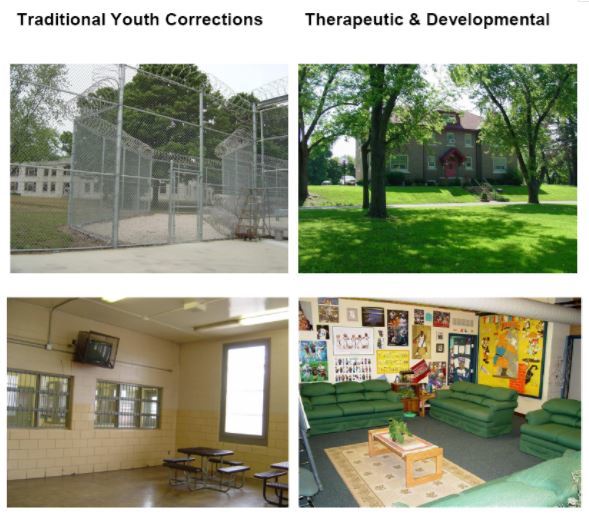
Figure: The Missouri Model is also a reformist approach in the United States. The left photo shows a typical American juvenile correctional facility, and the right photo shows a juvenile correctional facility under the Missouri Model. Images retrieved from the introduction by Missouri DSS Division of Youth Services.
During the National Consultative Conference on Judicial Reform, multiple proposals for juvenile correctional reform seemed complex, but the key was to gradually establish diverse treatment measures. To refine individualized treatment, a variety of different treatment options must be available for selection. One resolution in the National Consultative Conference on Judicial Reform was to "transform juvenile reformatory schools into correctional schools." Juvenile reformatories are institutions composed purely of correctional personnel, whereas correctional schools require the institutionalized introduction of educational resources into juvenile correctional institutions. However, the educational resources introduced here cannot merely replicate general school education; they must design special correctional education tailored to the specific characteristics of detained juveniles. This is also the reason why the National Consultative Conference on Judicial Reform resolved to establish a "Juvenile Correctional Education Research Center."
Correctional schools must also not remain in their current large scale, distinguishing their inmate population merely by juveniles serving criminal sentences versus those receiving reformatory education; instead, they must categorize a broader range of types. Juveniles with mental disorders, juveniles with high, medium, and low risks of recidivism, juveniles of different genders, etc., may require different combinations of diverse treatment. This is also the suggestion raised during the National Consultative Conference on Judicial Reform to "categorically establish juvenile correctional schools based on the traits and needs of the detained juveniles." In the vision of diversifying correctional school types, residential facilities with varying security levels may emerge; some residential facilities may lack high walls and fences, resembling family-style living where staff and juveniles live together. Given that such a diversified vision of juvenile correctional schools differs considerably from current practice, it is normal for the Ministry of Justice and the Agency of Corrections to be unfamiliar with it. It is recommended that they reference models already developed abroad, such as the "Missouri Model" in the United States.
Diverse treatments, as mentioned earlier, do not work simply because they are implemented; their efficacy requires scientific evaluation. This is why the National Consultative Conference on Judicial Reform suggested "developing a mechanism to evaluate the effectiveness of juvenile treatment." Efficacy evaluation requires tracking recidivism rates. While this may not necessarily be the best method, it is fundamental. Recidivism rates do not mean zero recidivism, but rather whether new methods are more effective at reducing recidivism compared to existing practices. With a comparison of recidivism rates, one can subsequently conduct a "cost-benefit analysis." A good juvenile correctional system requires resource investment, yet it is notoriously difficult for the correctional system to secure government resources. Cost-benefit analysis is a discursive tool that tells us how much social cost can be saved for society (reducing victimization costs and criminal justice expenditures) or how much social benefit can be increased (income earned and taxes paid by juveniles in their subsequent lives, etc.) by investing resources in juvenile correctional work, thereby helping to secure more resources. For how similar analyses can be conducted, refer to Appendix A in the report Reforming Juvenile Justice issued by the U.S. National Research Council.
Regrettably, in the Ministry of Justice's judicial reform plan, there are only the following fragmented reform contents that lack any discernible vision:
- Establish selection, recruitment, training, and attrition mechanisms for professional teachers and personnel in juvenile correctional schools.
- Perfect the systems for juvenile counseling and social reintegration:
- Promote diverse treatment mechanisms and strategic promotion for juveniles using drugs: In 2017, the juvenile reformatory schools in Taoyuan and Changhua were incorporated into the "Medical Service Plan for Drug and Alcohol Addiction Treatment in Correctional Institutions."
- Assist juveniles who do not continue their education or are pre-delinquent with vocational training and employment: Even the most basic transformation of juvenile reformatories into correctional schools is missing, let alone the diversified establishment of correctional schools and treatment effectiveness evaluation mechanisms.
Adult Correctional Reform
The basic direction of contemporary adult correctional reform also leans toward establishing "scientific and comprehensive case management." However, the condition of the adult correctional system is even worse than that of juveniles; realistically, living conditions meeting human dignity must first be established before moving forward, otherwise living in prison merely makes one feel that they do not count as a human being at all, let alone talking about effective treatment.
There was a resolution in the National Consultative Conference on Judicial Reform to "review the penal system and criminal policies, and reduce the number of detainees," which aims to resolve the most fundamental dilemma of adult prisons: overcrowding. Overcrowding is the primary cause of poor prison living conditions and the dilution of treatment resources. The current reform measure of the Agency of Corrections to cope with overcrowding is building more prisons—an unavoidable move because the Agency of Corrections cannot intervene in front-end criminal policies, namely how many people are sent to prison. However, the Ministry of Justice is different; it has the authority to adjust front-end criminal policies. Among the Ministry's reform plans is an item to "review the rationality of punishing drug use within five years of recidivism and the principle of 'one crime, one penalty.' Reviewing the policy of heavy penalties for drug crimes (disproportionality between sentence and culpability) and the competition between the Narcotics Hazard Prevention Act, the Pharmaceutical Affairs Act, and the Control Drugs Act." This is the review of criminal policies mentioned in the National Consultative Conference on Judicial Reform: avoiding unnecessary imprisonment for drug crimes or serving sentences that are excessively long and devoid of treatment significance. However, looking at the Ministry of Justice's explanation of the reform schedule, this part is missing. Furthermore, the review of the policy of heavy penalties for drug crimes contradicts the "New Generation Anti-Drug Strategy" heavily promoted by the Executive Yuan. In the New Generation Anti-Drug Strategy, there are plans to increase sentences for manufacturing, selling, and transporting drugs, lower the threshold for criminalizing the possession of Category 3 and Category 4 drugs, and criminalize repeated users of Category 3 and Category 4 drugs. All these criminal policies move in the direction of "increasing the number of detainees." Taiwan's criminal policy lacks an overall blueprint, contradicts itself, and lacks a back-end feedback mechanism, which deserves attention.
Other important resolutions in the National Consultative Conference on Judicial Reform included "improving humanitarian treatment, such as enhancing the ventilation and lighting equipment of cells" and "all prison measures must not infringe upon the human dignity of inmates, such as the position of food delivery ports, toilet facilities, and water and electricity supply, etc." These are all aspects of daily life that make people feel they are living like human beings. They seem minor, but they are very real. According to the opinion paper submitted by prison officer Lin Wen-wei (林文蔚) during the Consultative Conference, prison water in Taiwan is currently mainly drawn from groundwater, and the poor water quality easily harbors pathogens. To conserve water, water use is strictly controlled, and inmates must store water themselves for backup, yet no water is supplied at night, leaving often no water available in the rooms, toilets lack water tanks, and there is even no water to flush toilets. Cell ventilation is poor, and it is extremely stuffy in summer; rooms only have one exhaust fan and one ceiling fan each. Under energy-saving and carbon-reduction policies, fans are only activated when the temperature reaches 27 degrees Celsius, but must be turned off at 2:00 AM, and the exhaust fans at 5:00 AM. Among the Ministry of Justice's reform plans is an item to "review prison measures starting from the human dignity of inmates," though the specific content remains unclear, and this part is missing from the reform schedule explanation. Although this series of reform suggestions truly seems minor, it is hoped that the government will attach importance to them.
Finally, the National Consultative Conference on Judicial Reform also suggested "establishing an external prison visitation committee to regularly visit prisons and issue reports on matters related to correctional institutions, such as medical care, treatment, and improvement of basic living conditions." The establishment of an external visitation committee is a response to the closed nature of prisons, where actual living conditions inside are not easily known to the outside world. With an external visitation committee, regular supervision can be conducted and reports published. The establishment of an external visitation committee requires legal amendments to be incorporated. Among the Ministry of Justice's reform plans, there is an item stating "drafted amendments to the Prison Act and Detention Act (including judicial remedies for inmate treatment and parole decisions)," but it does not mention the establishment of an external visitation committee, nor is it mentioned elsewhere, and there is little indication of an intention to promote it.
This article worries that the Ministry of Justice might "consider" that similar mechanisms already exist, and thus sees no need to establish new ones. This is said because the American Institute in Taiwan's 2016 Country Reports on Human Rights Practices - Taiwan stated that Taiwan's prisons currently have "independent monitoring: authorities permitted independent nongovernmental observers to investigate prison conditions." Permitting independent nongovernmental observers to investigate prison conditions refers to something like an external visitation committee, formed by a team of nongovernmental personnel authorized to interview prison-related personnel and retrieve prison data, which prisons cannot refuse. But in reality, Taiwan does not permit independent nongovernmental observers to investigate prison conditions. It is unclear whether the AIT human rights report was misled by incorrect information, because although Taiwan currently has the Ministry of Justice's Human Rights Task Force and the Agency of Corrections' Prison Reform Task Force—both of which include citizen members—they are purely consultative in nature. Inside prisons, there are Parole Review Committees and Grievance Review Groups with some external members, but these members are selected by the prisons, casting doubt on their independence. In the administrative hierarchy, there are regional inspections by the Agency of Corrections and evaluations of prisons by prosecutors, but both tend to be formalistic and do not involve nongovernmental outsiders. The body that currently performs relatively well is the Control Yuan; however, the Control Members of the Judiciary and Prison Administration Committee have a vast array of matters to manage and do not regularly visit prisons to issue reports on correctional institution affairs. Taiwan currently indeed lacks an external visitation committee and does not permit independent nongovernmental observers to investigate prison conditions, making this reform exceptionally crucial.
Conclusion
National Consultative Conference on Judicial Reform—An Unmissable Correctional Reform Opportunity for the Ministry of Justice?
From the preceding explanations, it can be seen that the Ministry of Justice's judicial reform plan has omitted many important resolutions from the National Consultative Conference on Judicial Reform. Of course, the fact that the contents mentioned in this article are not currently in the Ministry of Justice's judicial reform plan does not mean the Ministry will not implement them; perhaps they are intended to be implemented but were simply not listed as priority items. This article suggests that the Ministry of Justice should explicitly respond one by one to whether each resolution from the National Consultative Conference on Judicial Reform will be implemented; if not, it should state so and provide reasons, rather than merely listing the Ministry's version of reform priorities. Furthermore, a considerable portion of the correctional reform resolutions in the Consultative Conference involves cross-ministerial and cross-Yuan coordination, extending beyond just the Ministry of Justice, and other units also need to respond to the conference resolutions. Such cross-Yuan and cross-ministerial mechanisms should also be properly established.
Although this article appears to criticize the Ministry of Justice for failing to fully take steps toward correctional reform, its greater intent is to remind the Ministry that the resolutions of the National Consultative Conference on Judicial Reform are well worth utilizing. For a long time, the correctional system has found it difficult to secure resources because the people inside are isolated from society, and inmates are perceived simply as "bad people" who can be locked away out of sight and out of mind. However, such a mindset cannot truly solve problems. In fact, the overwhelming majority of inmates will eventually return to society; figuring out how to genuinely help them re-enter social life and avoid recidivism is paramount. This National Consultative Conference on Judicial Reform has made correctional reform a vital link in judicial reform. Fully utilizing relevant resolutions to secure more resources for the correctional system and turning "social reintegration" from a slogan into reality is what must be done next.
※ Originally published by PNN PTS News Issues Center on Aug. 10, 2017
This article is an AI-generated translation of the original Chinese text. In the event of any discrepancy, the Chinese version shall prevail.