
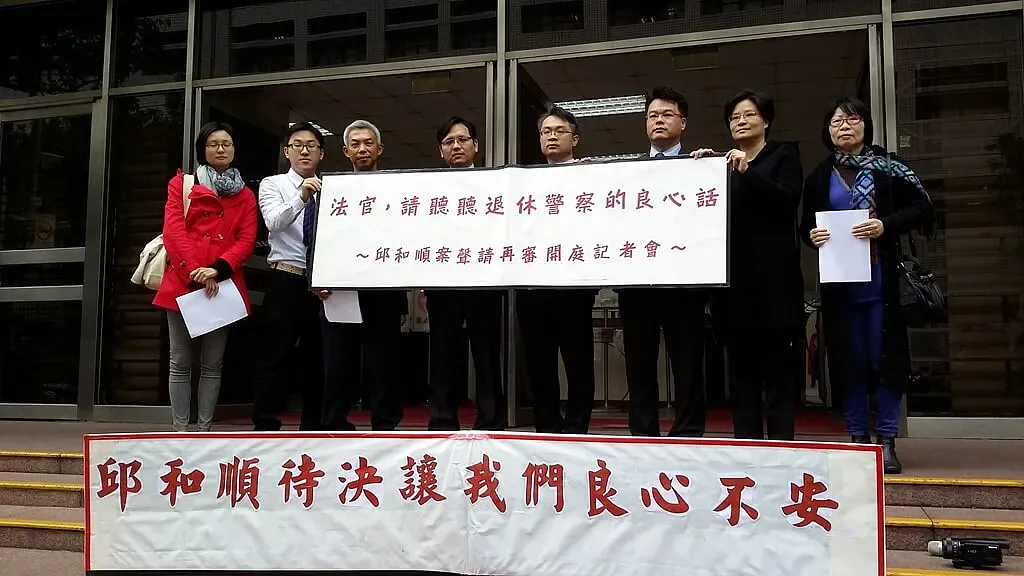
Do Not Let the Supreme Court Become an Obstacle to Wrongful Conviction Relief
Last edited: 2026-08-29
On July 15 of last year, the Prosecutor-General filed an extraordinary appeal against the final and binding judgment in the Chiou Ho-shun case, arguing that the original judgment violated the rules of evidence by using "confessions obtained through torture" and "voiceprint identifications that failed to meet scientific evidentiary standards" as evidence for conviction. Having been wrongfully imprisoned for 30 years for a crime he did not commit, Chiou Ho-shun also began, like the protagonist in the Nobel Prize-winning masterpiece Waiting for Godot, to wait in his prison cell for the Godot of his life.
After spending more than a year reviewing the case, the Supreme Court issued a press release on July 28 of this year summarily dismissing the appeal. Not only did the content fail to confront the issue of determining the voluntariness of the confessions in the Chiu case, but it also did not utter a single word about the controversy surrounding the voiceprint identification's violation of scientific evidentiary methods. Yet these two grounds are precisely the critical reasons why the Chiu case became a miscarriage of justice.
The Supreme Court's evasion of the core issues in the Chiu case highlights the dangers in how the judiciary identifies rules of evidence and the severe dysfunction of the system for providing relief to the innocent. Life is not a play, yet Chiou Ho-shun has spent his life waiting for a situation even more absurd than an absurdist drama.
There are two victims in the Chiu case: one is a woman whose torso was found, and the other is a child whose body was never recovered. Yet the facts established by the courts were all constructed upon the confessions of 12 defendants and the voiceprint identification of one of them. However, the truth is that the confessions originally made by the defendants were all subjected to police torture; the master tape of the ransom call used for voiceprint identification has long been lost, making it impossible to inspect its authenticity.
Although the original final judgment acknowledged that confessions obtained through torture could not be used as evidence, the standard it applied for determination was bizarre: confessions obtained through torture that were recorded were excluded, while those not recorded were used as evidence. This completely ignores the fact that torture not only harms the physical person but also generates severe psychological fear, causing all the confessions produced in the Chiu case to be tainted. To borrow a literary expression: every single confession in the Chiu case is riddled with holes.
Meanwhile, the bizarre logic demonstrated by the judges is akin to someone making a loaf of toast using poisoned flour—deeming only the few slices that caused the deaths of the unlucky ones as poisonous, while considering the parts that nobody happened to eat as non-poisonous. But this was clearly the exact same loaf of bread, kneaded with the same pair of hands, placed in the same baking mold, and baked at a high temperature using the same bag of flour! The co-defendants in the Chiu case were precisely forced, through the same consecutive series of police torture, to fabricate criminal confessions that did not belong to them.
The poisoned flour is the torture that tainted the confessions. When faced with a situation that can be judged by common sense alone, requiring no rigorous logical thinking or superhuman wisdom, the Supreme Court justices who dismissed the extraordinary appeal failed to understand it. How can we trust that they possess the awareness to shoulder the heavy responsibility of righting wrongful judgments and rectifying miscarriages of justice?
Wrongful convictions are far more numerous than imagined, and the judiciary should not be more absurd than a drama. At a time when the National Conference on Judicial Reform is being held, we solemnly call attention to the urgency of the issue of "improving the rules of evidence and relieving the innocent." Please let the Godot that the innocent "Chiou Ho-shuns" have spent time waiting for be a judiciary with the courage to point out that the entire loaf of bread is poisoned, rather than arbitrary judicial subjective conviction.
※ Originally published in the Apple Daily on August 12, 2017
This article is an AI-generated translation of the original Chinese text. In the event of any discrepancy, the Chinese version shall prevail.