
A Win-Win for the Public and Public Servants—Why Do We Need a Police Powers Act?
Last edited: 2026-08-29
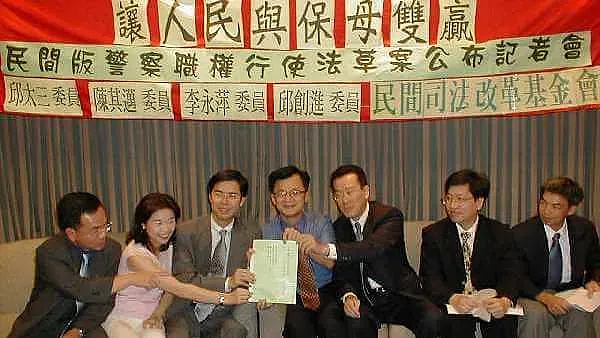
Legislator Chiu Tai-san, Legislator Chen Chi-mai, Legislator Li Yung-ping, Legislator Chiu Chuang-chin, and the Judicial Reform Foundation jointly held a press conference to release the citizen-drafted version of the Police Power Exercise Act. Other attendees included Attorney Ku Li-hsiung (JRF Board Member), Attorney Lin Yung-sung (JRF Board Member), Attorney Yu Po-hsiang (JRF Executive Committee Member), and Attorney Ma Tsai-chin (Police Reform Association Representative), who jointly called on the Legislative Yuan to pass this bill as soon as possible.
When daily news reports are consistently plagued by issues concerning police integrity, law enforcement practices, or institutional culture, the general public naturally harbors a deep sense of distrust toward the police. Yet, when faced with poor social security or even neighborhood disputes and conflicts, the public just as naturally shifts the blame onto the police. Therefore, what exactly is the scope of police authority? Upon what standards should the police execute the powers granted to them by laws? Is there a way to enable the police to meet the needs and expectations of the public while strictly adhering to the boundaries of their authority, avoiding the formation of new rights violations in the name of law enforcement? This is the most fundamental question. Surprisingly, police law enforcement to this day relies solely on two regulations—the Regulations on Police Duties and the Act Governing the Use of Police Weapons—which are low in legal hierarchy and lack principled norms. Consequently, how to codify and standardize the guidelines for police law enforcement and clearly delineate the boundaries of police authority has become the most crucial gap in the legal basis for police operations.
Following the promulgation of J.Y. Interpretation No. 535, it sparked quite a strong resonance in society. On one hand, some questioned whether Interpretation No. 535 would henceforth render the police incapable of arresting "bad guys" on the streets; on the other hand, it established Taiwan as a rule-of-law state predicated on the protection of the people's fundamental rights.
This outcome precisely highlights the dilemma of police law enforcement: Is there an inherent conflict between police law enforcement and human rights? How can the law strike a balance between law enforcement and human rights? How can we simultaneously protect the rights of the people and uphold the powers of the police? This is precisely the original intent behind the drafting of this bill.
The Judicial Reform Foundation spent nearly two years drafting this proposed Police Power Exercise Act. On one hand, it aims to resolve the recurring human rights violations caused by police law enforcement; on the other hand, it grants statutory powers to the police so that the exercise of police authority has a clear legal basis. This prevents the police and the public from being in an antagonistic power dynamic, stops the police from overstepping their boundaries, and simultaneously allows them to effectively perform their duties. Therefore, we call this a win-win bill for both the people's nanny—the police—and the citizens.
Examining police duties, one finds that almost all problems that other administrative agencies cannot or will not handle are ultimately dumped onto the police, particularly the abstract and vague role of "maintaining public order." The result of executing this vague mission manifests as the large-scale spot checks, improper identity checks, and other controversies and antagonistic police-public tensions frequently seen in the news. On one hand, the police vent their grievances, feeling that their mission is heavy and complex yet lacking the trust and support of society; the public likewise voices hardship because the police are nowhere to be found when needed, yet subject them to intrusion when not needed. Under this dilemma, the Police Power Exercise Act attempts to become a balancing point between "public interest and individual liberty," resolving the complex dynamic where the public and the police are simultaneously antagonistic yet dependent upon one another.
Regarding the substantive content of the draft, it can be roughly divided into the following key areas:
First, police actions of a highly intrusive nature are restricted to activities aimed at investigating or preventing crimes. Furthermore, the draft limits the scope of police activation to three types of actions: police tailing/surveillance, the employment of informants, and undercover police detectives.
Second, legal conditions are imposed on spot-check measures conducted by the police for the purpose of "public order." It explicitly dictates under what circumstances the police may verify a person's identity, as well as the methods of verification (such as presenting identification or inspecting objects). Only when identity cannot be confirmed through the aforementioned methods are the police granted the power to take further forensic measures (such as photographing or fingerprint collection). By distinguishing different levels of severity, police spot-check duties can employ varying methods depending on the severity of the specific situation.
Third, it provides regulations on how data concerning privacy must be protected and used after the police lawfully acquire relevant personal information.
Fourth, it outlines the remedies available if violations of people's rights still occur pursuant to this Act, including administrative litigation and the right to state compensation or indemnity, to prevent the protection of rights from becoming a mere formality.
Considered from the dual perspectives of practical reality and legal spirit, as well as law enforcement and human rights, the Police Power Exercise Act was finally born. Beyond hoping that the support of legislators will bring about the legislation of this Act at an early date, we also hope this bill will imbue Taiwan's claim of being a human-rights and rule-of-law state with more concrete substance, with the ultimate expectation naturally being the establishment of a free nation that equally values human rights and the rule of law.
This article is an AI-generated translation of the original Chinese text. In the event of any discrepancy, the Chinese version shall prevail.