
Seminar Records | Clear Rewards and Punishments to Boost Police Case-Solving Performance | Promoting the Rationalization of Police Performance Evaluation
Last edited: 2026-08-29
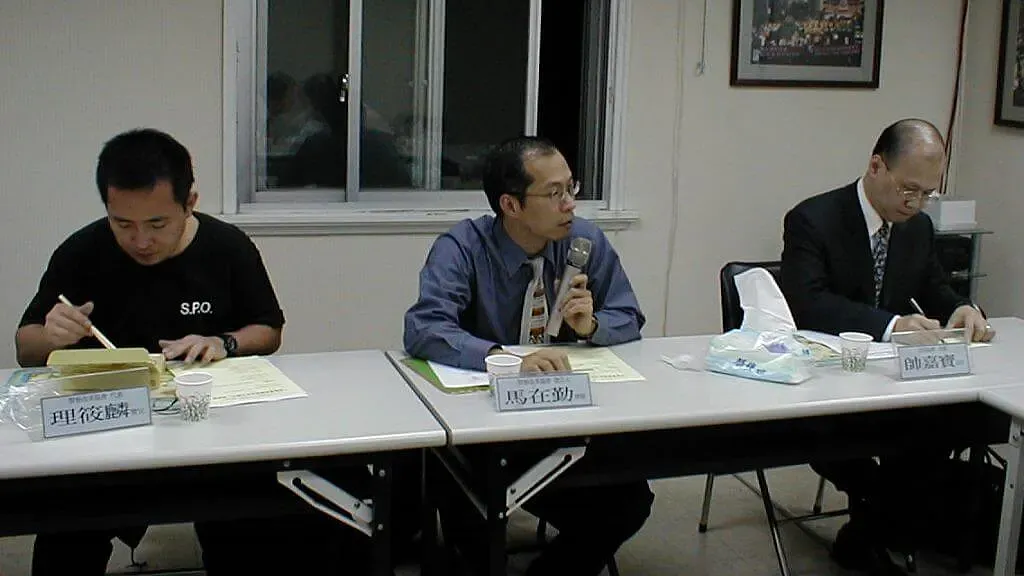
To better understand the police performance evaluation system and supervise the police in combating illegality while safeguarding legitimacy, the Action Committee of the Judicial Reform Foundation specially held this seminar on April 7, 2003, inviting experts from various fields to pool their wisdom.
Moderator Lin Yung-sung, Attorney at Law (Judicial Reform Foundation)
Panelists
Shuai Chia-pao, Judge (Taiwan Judges Association)
Chen Rui-jen, Prosecutor (Prosecutor Reform Association)
Ma Tsai-chin, Attorney at Law (Police Reform Association)
Li Hsiao-lin, Police Officer (Police Reform Association)
Officer X (Name withheld at the individual's request)
Chen Tung-ho, Secretary-General (Chinese Association of Police Administration)
Lin Yung-sung
The JRF is quite concerned about the reform of judicial police performance, including both police officers and Investigation Bureau personnel. Regarding the performance of judicial police officers, when should it be calculated? At the time of transfer (referral)? At the time of indictment? At the first-instance judgment? Or when the judgment becomes final? If a case is transferred by the police to the prosecutors and subsequently handled with a non-prosecution disposition, should the handling police officer still receive performance points? Is this appropriate? Especially in current criminal litigation practice, prosecutors often need the assistance of judicial police. If performance points are given to the police beforehand upon transfer, will it be difficult for the trial prosecutor to ask the original case-handling police for assistance after the indictment? Since there are many practical situations that we at the JRF do not understand, we have invited everyone here to brainstorm and construct a good proposal to lobby the National Police Agency or the Bureau of Investigation. Our focus is on hoping that the performance system can genuinely urge the police to do their jobs well.
Performance, Points, and Evaluations
Officer X
First of all, evaluation, performance, and points are three different things.
Evaluations are rolled out by superior officials, possibly officials from the Ministry of the Interior or the National Police Agency. They are plans proposed to achieve a specific goal during a certain stage. Evaluations are conducted within the timeframe of this plan. For example, the current security project aiming for zero crime growth is one.
Performance applies to all police officers, including administrative, traffic, and criminal police. There are many varieties; for instance, issuing traffic tickets is the performance of traffic police, and household registration checks belong to the performance of administrative police.
Points also exist across various types of police. The calculation method for criminal police points divides precinct divisions into three levels, and criminal personnel of each level are required to reach a certain number of points every six months—meaning solving a certain volume of cases. After reaching the points: first, he can continue to work as a criminal investigator; second, he will not receive a demerit. Because that is a basic requirement, there are no rewards granted upon achieving it.
Bonuses, on the other hand, target individual cases, but in reality, very few cases come with bonuses. Most are awarded only when superiors are grandstanding, and they must be major cases such as theft, firearms, or drugs. As for rewards for solving cases—namely administrative commendations—they are mostly granted after indictment; one must obtain the written indictment to apply for commendations and merit awards.
Therefore, criminal police officers solving cases will receive three types of rewards: first, administrative rewards; second, points; and third, bonuses. Points are given as soon as a case is solved, rewards must wait for the indictment, and bonuses depend on luck. That is the general principle.
Timing of Point Calculation and Point Deduction System
Ma Tsai-chin
I believe that postponing the starting point of point calculation until after the first instance runs counter to the very purpose of granting points. Because calculating points is meant to achieve prompt rewards and prompt penalties; if dragged out too long, the effect will be greatly diminished. Therefore, I think it is fine to grant rewards first in point calculations. If it is later discovered during the trial that procedural regulations were violated, points should be deducted back. This way, the police will comply with case-handling procedures to avoid point deductions.
Secondly, I believe that to improve the performance system, we must first clarify whether we prioritize substantive justice or procedural justice?
If it is substantive justice—meaning judging performance based on whether the case ultimately results in a conviction or acquittal—I think that is beyond the police's capability. Because substantive justice is very hard to ascertain, much like a case resulting in a conviction at the first instance and an acquittal at the second instance, should the first-instance judge be disciplined?
Therefore, our focus should center on "procedural justice." Only when encountering situations where the police fail to comply with regulations during case handling should points be deducted. If the police strictly follow the Code of Criminal Procedure during case handling, even if the convictions differ between the first and second instances, I believe the police bear no responsibility.
Chen Rui-jen
First, I do not believe the performance system should be canceled; it has certain functions.
Second, making it so that performance is counted only at the first instance has very low feasibility. As I understand it, the current practice of the Investigation Bureau is to grant some points upon transfer and some upon indictment, similar to an installment payment method. I think this approach is quite good and makes sense. Judicial police actually care about three things: points, administrative rewards (commendations), and bonuses. Therefore, I believe these three things can be granted at different stages: points can be given upon transfer, rewards can be considered upon indictment, and bonuses can be given when the first-instance judgment is reached.
As for point deductions, they should be discussed after the judgment becomes final; otherwise, I believe it might influence prosecutors or judges during the trial process. The nature of point deductions should resemble individual case reviews and will not apply to every case. I think the point deduction system can be designed to empower certain individuals to initiate it, and after the judgment becomes final, review the flaws in police case-handling discovered during the trial. This is more feasible.
Ma Tsai-chin
The reason why the Investigation Bureau can calculate performance so simply is because they have a small staff. The police have over 80,000 personnel. Frequently, a single case involves both the security squad and the police substation, and everyone wants commendations, making it very complicated and difficult to divide evenly.
Shuai Chia-pao
From a judge's perspective, the problem with the performance system is the desire to establish a mechanism ensuring that the police or prosecutors care about the win or loss of litigation cases. My personal view is that performance can be divided into toil (hard work) and merit (achievements). When the police solve a case, it fundamentally has a deterrent and crime-prevention effect, which is toil. But I believe this is just the most basic work of the police, and there should be no distinction made for each case—meaning points should not differ at this stage. Then, once the prosecutor files an indictment, it is time to calculate merit, because prosecutors will demand evidence supplementation by then.
During the trial, if the judge makes a written request to investigate additional evidence, but the police fail to fulfill it or flaws appear, point deductions can be applied then. I believe point deductions during trial can be treated as an exception; in principle, police responsibility ends with the prosecutor's indictment. Regarding bonuses, I think they can be given like year-end bonuses once the case is finalized. Even though the money will be disbursed quite late, I think that is fine. The bonuses for all cases of a police officer can be distributed all at once at the end of the year, or an honor roll can even be established, and so forth.
Lin Yung-sung
Let me raise a question: Is it a good thing to frequently give bonuses to public officials performing official duties?
In addition, since no one likes to offend others, how to decide on point deductions is also a difficult problem. Granting bonus points also has risks; in the future, if the police catch two drug users, in order to earn higher performance points, they might forcefully frame it as two drug traffickers. This is also a problem.
Chen Tung-ho
Actually, regarding postponing the starting point of performance calculations until after the first-instance sentencing, we have also discussed it in the past. But I believe the caliber of frontline police officers cannot sustain such a long-delayed performance calculation method. Although this is an internal police problem, I must still voice it because this difficulty genuinely exists.
Regarding today's topic, I propose two fundamental perspectives:
First, if the caliber of frontline police officers is sufficient, and all flaws in case-handling procedures are minimized, then the performance system ceases to be a problem, or at least the problems will be reduced.
Second, if the performance system were less important, the potential harm it causes might be even smaller.
Officer X
Regarding the point deduction issue just discussed, actually, as long as a prosecutor returns a case, the handling police officer gets points deducted. Moreover, concerning the timing of awarding points, the rewards for criminal personnel are actually the least compared to traffic and administrative police. Therefore, continuously delaying rewards for criminal personnel will deal a heavy blow to morale, and no one will want to be a criminal investigator in the future.
This situation is severe, so rather than fussing over points, I think we should care about the evaluation system. Many cover-ups of cases or improper interrogations stem from evaluations.
Because evaluations are not met, everyone from frontline officers to precinct chiefs faces disciplinary action. Thus, everyone is under immense pressure, and falsifications and case cover-ups emerge.
Urging the Police Through the Performance System
Ma Tsai-chin
Another key point is how to implement this oversight mechanism? Will prosecutors examine flaws in the police's case-handling process simultaneously when indicting? Right now, when prosecutors see case-handling flaws, they mostly turn a blind eye. Otherwise, if a lawyer writes a formal document to the police, it inevitably sinks like a stone in the ocean. Therefore, I believe there needs to be a supervision mechanism: it is fine for the police to receive rewards first, but when problems arise during cross-examination later, there must be a punishment system so that the police will be vigilant when handling cases.
So I think we need to give the police a motivation, with someone pursuing accountability for their responsibilities, in order to generate psychological compulsion. The American exclusionary rule, for instance, is a great system; discovering police violations should lead to transferring the offending police officer. This is the fairest standard.
Lin Yung-sung
May I ask which judge would proactively issue an official document to the police demanding disciplinary action? What mechanism can achieve such supervision?
Shuai Chia-pao
For judges, in many cases where the police have problems, you have to look very closely to find them. But once found, most of the time no one pays attention, and over time one stops caring about this issue.
Chen Rui-jen
The performance system actually involves two key factors: procedural justice and police-prosecutor interaction. What prosecutors and judges feel most deeply is that as long as a case is not listed under evaluation targets, whenever they want to ask the police for help, the police usually drag their feet. This is one of the problems.
Furthermore, I strongly doubt whether procedural justice can be safeguarded by the performance system. Regarding the point deduction system just mentioned, I doubt the extent to which it can urge the police.
Lin Yung-sung
Let me summarize several key questions:
First, should the timing for calculating performance be changed?
Second, should performance be paid out in stages?
Third, is there the issue of deducting points back (point deductions)?
Fourth, how should the problems of the evaluation system be resolved?
Establishing a Point Deduction System Based on Pre-trial Procedures
Officer X
I think a point deduction system is difficult. Because if we have to wait until the judgment becomes final to deduct points, but by the time the case-handling flaw occurred, that police officer had already met the year's qualifications, how do you deduct? How can this be retroactive?
Ma Tsai-chin
This forms a continuous process, just like ticking an unexploded bomb every time, waiting to see when it blows up. If you dare to do this, you should bear the consequences, so I don't see any problem.
Lin Yung-sung
May I ask what the standard for point deduction is?
Ma Tsai-chin
Actually, the current police reward and punishment system covers everything. Failing to audio or video record results in a major demerit—this is very serious, yet no one cares.
Chen Rui-jen
I think we can integrate it with the exclusionary rule in pre-trial procedures. Don't we have pre-trial conferences after prosecutors file indictments? Pre-trial conferences investigate whether evidence exclusion issues exist. If evidence is excluded during that stage, the responsible police officer should have points deducted. This shouldn't be controversial.
Lin Yung-sung
Does this mean we should visit the National Police Agency, Judicial Yuan, or Bureau of Investigation and ask them to establish such a system?
Chen Rui-jen
I suggest that the Judicial Yuan compile statistics every month on cases involving evidence exclusion issues and formally send them to the National Police Agency, which will then handle them based on that data. The Judicial Yuan's statistics or research and evaluation office should design a system so that the police will be more convinced. I think the Judicial Yuan should be willing, because this falls under publicizing their administrative achievements, and they should be quite happy to do it.
Li Hsiao-lin
We can treat it as supporting measures for the September 1st exclusionary rule and jointly urge the National Police Agency.
Lin Yung-sung
Regarding the disciplinary effect of point deductions, I think we civic groups should intervene. However, whether it is minor like point deductions or severe like demerits or referral to the Public Functionary Disciplinary Sanction Commission, all are acceptable.
Rewarding Police Assistance to Prosecutors
Chen Rui-jen
I heard that in the Investigation Bureau, assisting prosecutors with court presentation (trial attendance) for public prosecution cases has a point-addition system.
Lin Yung-sung
Therefore, we should consider encouraging judicial police to assist prosecutors in court attendance, and even grant point additions to police officers who attend court.
Officer X
I think it's feasible.
Improving the Quality and Quantity of Criminal Personnel
Chen Rui-jen
It was mentioned earlier that because the police have a complex organization, calculating performance is more complicated than for the Investigation Bureau. I think this should be reformed. Tracing its cause, it is harmed by the evaluation system. Once a precinct chief gets nervous, they force all police officers to handle criminal cases—security squads join in, and uniformed officers join in too. Actually, criminal cases should just be handled by criminal personnel!
Therefore, I believe the quantity of criminal personnel should be increased, at least doubling the number. This can start by adjusting the proportion of various police types; in the future, personnel could be reallocated from the Special Police Corps, but because their caliber is uneven, it does not seem to solve the problem.
Ma Tsai-chin
Regarding the problem of our country's disproportionately low ratio of criminal personnel, the National Police Agency already has a consensus to increase criminal investigators, but it is currently stuck on budget issues. Administrative units will definitely support expanding the establishment, but the problem is a lack of money. Local governments lack funds and cannot support so many criminal personnel.
I also believe that non-criminal personnel handling criminal cases indeed causes many problems. Things like kidnapping prostitutes for ransom were caused by uniformed officers.
Lin Yung-sung
Both the quality and quantity of criminal personnel should be increased, and welfare and compensation should also be improved.
Reform of the Evaluation System
Lin Yung-sung
As for the problems caused by evaluations?
Ma Tsai-chin
Well, you use the media to scold them! Scold them harshly until they feel that playing these gimmicks is useless, and next time they won't play it. That's the only way.
Li Hsiao-lin
Just like the Ministry of the Interior's claim this time about zero criminal case growth, it was actually hammered out through bargaining. They originally talked about minus 20%, but after saying it couldn't be achieved, it was beaten down to zero. In fact, as soon as this project was designed, the Ministry of the Interior had long since determined it was definitely achievable, but they didn't expect frontline officers to be drilled to extremes, resulting in a system riddled with loopholes.
Chen Rui-jen
I think a national public security conference mechanism can be established. Public security policy should not be decided by a single Minister of the Interior; opinions from many people should be consulted, elevating decision-making to a high level, and lawyers and civic groups can even be invited to participate.
Encouraging Police to Target the Root Causes of Crime
Chen Rui-jen
In addition, as an aside, I believe another flaw of the performance system is that it does not encourage the police to pursue the roots of crime. The police are only willing to bust downstream drug dealers rather than kingpin drug lords, because setting up informants for the latter takes a long time, whereas busting downstream minor peddlers yields points and is much easier.
Therefore, I am wondering if we should design a point-addition method to encourage the police to capture the roots of crime. Both the Witness Protection Act and the Narcotics Hazard Prevention Act share similar concepts: providing information during investigation about other accomplices, upstream or downstream criminals, or related criminal networks, thereby enabling prosecutors to prosecute. Transplanting this concept into the performance system will encourage the police to catch the big fish and chop off the roots of crime, which is more beneficial to society.
Officer X
Actually, the police do have this mechanism; major criminal cases are tracked by dedicated personnel at the Criminal Investigation Bureau, and during that period, they do not need to calculate points and can focus on tracking major cases. So it is not that there is no mechanism to crack major cases, but rather whether people are willing to pursue them.
Furthermore, the police have an unwritten rule: units like the Criminal Investigation Corps and the Criminal Investigation Bureau do not chase minor cases, leaving them to precinct criminal investigators. Thus, case handling is like having market segmentation.
Chen Rui-jen
Actually, I think establishing ad hoc task forces to handle major cases is problematic, because the situation seems to become overused, with some police officers begging prosecutors to persuade superiors to set up task forces. Therefore, I still hope there can be a point-addition method to incentivize all police officers to want to capture major cases, providing them with motivation so that the benefits to society are maximized.
Conclusions
The points that police should be credited with when solving a case should be calculated upon transfer, but in the future, point-deduction means can be utilized to reclaim points from personnel with flawed case handling.
Using the exclusion of evidentiary capability in pre-trial conferences as a standard, we hope the Judicial Yuan and the National Police Agency establish a cooperative model to formulate police case-handling reward and punishment standards.
Establish a system where police assisting in court attendance receive point additions.
Enhance the quality and quantity of criminal investigators and increase their compensation.
Leverage media power to criticize the problems generated by the evaluation system.
This article is an AI-generated translation of the original Chinese text. In the event of any discrepancy, the Chinese version shall prevail.