
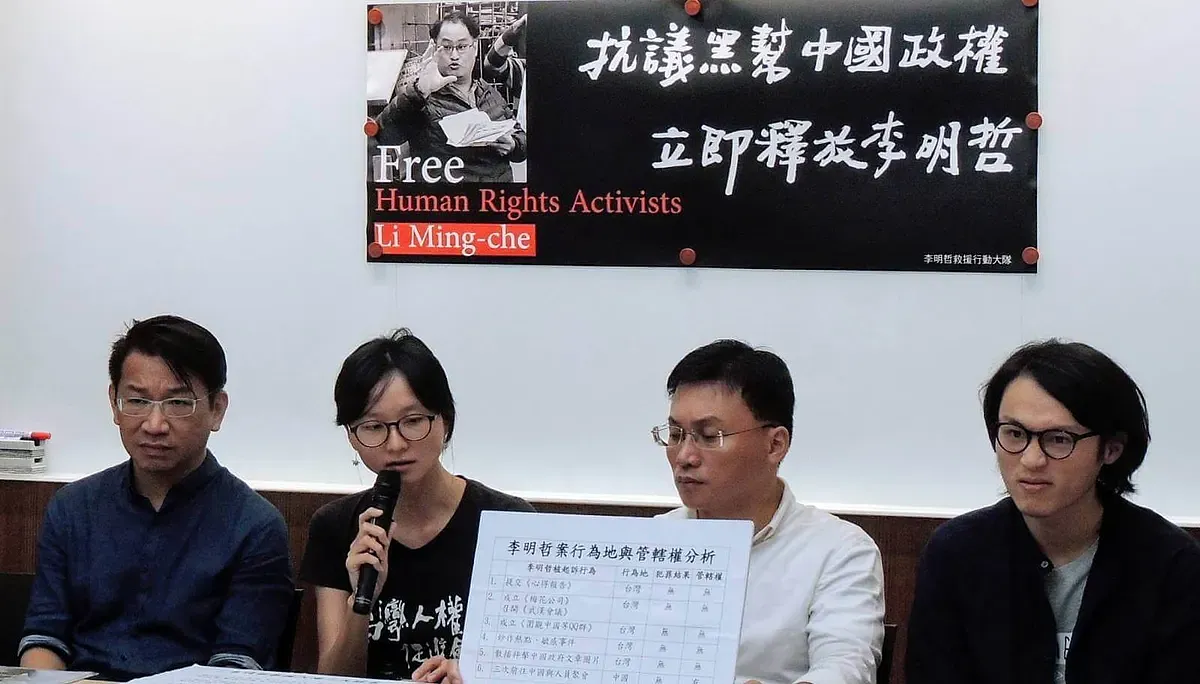
The Li Ming-che Case May Have Already Been Secretly Sentenced - Press Conference on the Sentencing in the Li Ming-che Case
Last edited: 2026-08-29
Today marks the 197th day of Li Ming-che's enforced disappearance. With the Mid-Autumn Festival approaching, he remains unable to reunite with his family. According to the trial proceedings on September 11, Li was formally prosecuted on August 4. Under Article 202 of the Chinese Criminal Procedure Law, the court is required to pronounce judgment within two months of accepting the case, which means the two-month period expires tomorrow (the 3rd). To date, the Yueyang Intermediate People's Court has neither announced a sentencing date nor extended the trial period. Based on recent cases involving the crime of "subversion of state power" in China, the Li Ming-che case may have already been secretly sentenced.
| Sentencing Date | Defendant | Charge | Pattern of Secret Sentencing | |
|---|---|---|---|---|
| 1. | 2017/4/28 Suspended sentence of 4 years | Li Ho-p'ing | Subversion of state power | No date announced, family and lawyers not notified. After a secret trial and sentencing, it was announced on Weibo. |
| 2. | 2016/6/1 Imprisonment of 5 years | T'ang Ching-ling | Incitement to subvert state power | No date announced, family and lawyers not notified. The judgment was mailed to the detention center for the defendant. |
| 3. | 2015/4/- Imprisonment of 4 years | Chao Feng-sheng | Incitement to subvert state power | No date announced, family and lawyers not notified. The judgment was mailed to the detention center for the defendant. |
Article 196 of the Chinese Criminal Procedure Law stipulates: "The pronouncement of judgments shall be public in all cases." Regarding this, Article 247 of the "Interpretations of the Supreme People's Court on the Application of the Criminal Procedure Law" states: "Where a judgment is scheduled for pronouncement at a fixed time, the time and place of the pronouncement shall be publicly announced in advance, the parties shall be summoned, and the public prosecutor, statutory agents, defenders, and litigation agents shall be notified." Since China publicly tried Li Ming-che, why has it delayed scheduling a public pronouncement of the judgment? Is this the so-called "strictly handling cases according to statutory procedures," or are there unspeakable dealings behind the scenes?
October 1 to 8 is a Chinese national holiday. According to Article 154 of the General Principles of the Civil Law of the People's Republic of China, when the last day of a period falls on a holiday, the day following the holiday shall be regarded as the last day. Therefore, the final deadline for the sentencing in the Li Ming-che case is next Monday (the 9th). The family and the rescue team have repeatedly expressed their desire to personally attend and hear the judgment. We demand that the Taiwanese government immediately contact China to confirm whether the Li Ming-che case has already been sentenced or when it will be sentenced, and immediately arrange for the family and the rescue team to travel to China to attend the public pronouncement!
If a Sentence Has Already Been Handed Down, the Taiwanese Government Must Ensure Li Ming-che's Right to Appeal!
After Li Ming-che was formally prosecuted, the Yueyang Intermediate People's Court held a pre-trial meeting on August 11 attended only by the prosecution and defense. On the spot, the Chinese government-appointed lawyer waived two of Li Ming-che's most crucial rights on his behalf: the "objection to jurisdiction" and the "objection to the exclusion of illegally obtained evidence." Chinese government-appointed lawyers may turn their backs on Li Ming-che, but the Taiwanese government must not turn its back on Li Ming-che's rights—especially since the "objection to jurisdiction" directly concerns the interests of all Taiwanese people.
The Chinese crime of "subversion of state power" penalizes acts of subverting state power, and does not require the occurrence of a result of subverting state power as a constitutive element. In criminal jurisprudence, this is known as a "conduct crime" rather than a "result crime." According to Article 6 of the Chinese Criminal Law, either the criminal act or its result must occur within Chinese territory for China to have jurisdiction. Furthermore, under Article 8 of the Chinese Criminal Law, for crimes committed outside Chinese territory against China, if the law of the place where the crime was committed does not punish such acts, China has no jurisdiction. An analysis of the place of commission and jurisdiction in the Li Ming-che case is as follows:
| Acts Charged Against Li Ming-che | Place of Commission | Criminal Result | Jurisdiction | |
|---|---|---|---|---|
| 1. | Submitting a "Reflection Report" | Taiwan | None | None |
| 2. | Establishing the "Plum Blossom Company" Convening the "Wuhan Meeting" |
Taiwan | None | None |
| 3. | Establishing "Watch China QQ Groups, etc." | Taiwan | None | None |
| 4. | Hyping up hot topics and sensitive incidents | Taiwan | None | None |
| 5. | Disseminating articles and images criticizing the Chinese government | Taiwan | None | None |
| 6. | Traveling to China three times to meet with individuals | China | None | Yes |
The vast majority of the criminal facts charged against Li Ming-che took place in Taiwan and constitute lawful activities in Taiwan; China cannot assert jurisdiction. By arranging for a lawyer to waive the objection to jurisdiction, China is attempting to pull Taiwan into its judicial jurisdiction. Once the Li Ming-che case becomes a precedent, any Taiwanese citizen who expresses speech in Taiwan that is unappealing to China could potentially be arrested and sentenced upon entering China. This is not merely Li Ming-che's problem; it is the problem of all Taiwanese people. The Taiwanese government should immediately engage with China to protest the illegal and improper assertion of jurisdiction in the Li Ming-che case.
Equally serious is that Chinese national security authorities subjected Li Ming-che to "46 statements of confession and defense" and "24 handwritten materials." Such an abundance of confessions was obviously the result of torture and coerced confessions. A genuine confession of guilt requires only a single statement. The mental and physical suffering caused by China's prolonged secret detention of Li Ming-che constitutes "torture and other cruel, inhuman or degrading treatment or punishment" under international law, and his confessions lack evidentiary capacity in legal terms. China's arrangement for a lawyer to waive the objection to the exclusion of illegally viewed/obtained evidence merely serves to shield the illegal abuses of power by national security units from investigation. China is a state party to the United Nations Convention against Torture. The Taiwanese government should file a complaint against China with China and the United Nations Committee Against Torture, demanding an investigation into whether Li Ming-che was subjected to torture and whether his confessions were made of his own free will.
In the face of the judgment that is imminent or may have already been rendered against Li Ming-che, the Taiwanese government should immediately initiate negotiations regarding jurisdiction, request an investigation into torture, provide the relevant documents to Li Ming-che and his family, and assist him in filing an appeal based on these grounds to safeguard his right to appeal. The Taiwanese government's rights to contest jurisdiction and investigate torture will not disappear simply because Li Ming-che pleaded guilty or waived objections. On the contrary, only through the Taiwanese government's active contestation of these rights can Li Ming-che possibly secure his release, repatriation, or other favorable outcomes—which is precisely what his family has consistently expected the government to do. Even if Li Ming-che is forced to waive his appeal or misses the appeal deadline, resulting in a finalized sentence, the Taiwanese government must continue to negotiate on these rights for the sake of Li Ming-che's and all Taiwanese people's rights and interests until China releases or repatriates Li Ming-che.
Tsai Ing-wen: Not a Single One of My Citizens Should Have to Apologize for Their Identity
On January 16, 2016, President Tsai Ing-wen promised the people of Taiwan in her victory speech: "For as long as I am president, I will strive to ensure that not a single one of my citizens has to apologize for their identity." Today, Li Ming-che is being forced not just to apologize, but to confess to a crime. Safeguarding Li Ming-che's rights means safeguarding the rights of the people of Taiwan. We call upon President Tsai to fulfill her promise to the Taiwanese people and demand that the Taiwanese government take the following actions:
-
Confirm whether the Li Ming-che case has already been sentenced, or when it will be sentenced.
Arrange for the family and the rescue team to travel to China to attend the public pronouncement!
-
Immediately engage with China to contest the illegal and improper assertion of jurisdiction in the Li Ming-che case!
Demand that China and the United Nations investigate whether Li Ming-che was subjected to torture and coerced confessions!
-
Provide negotiation documents to Li Ming-che and his family, and assist in filing an appeal!
Press Conference Attendance
[Time] Monday, October 2, 2017, 10:00
[Location] Room 101, Zhongxing Building, Legislative Yuan (No. 3-1, Sec. 1, Jinan Rd., Zhongzheng Dist., Taipei City)
Chair: Chiu I-ling / Taiwan Association for Human Rights
Cheng Hsiu-chüan / President, Wenshan Community College
Hsiao I-min / Judicial Reform Foundation
Sung Cheng-en / Ph.D. Candidate in Law, University of Oxford
Ch'en Kuan-yu / Economic Democracy Union
Lin Nan-hua / Democracy TAIWAN
Huang I-pi / Covenants Watch
Yu Mei-nu / Legislator
Hsu Yung-ming / Legislator
Press Contact
Chiu I-ling / Taiwan Association for Human Rights 02-25969525
This article is an AI-generated translation of the original Chinese text. In the event of any discrepancy, the Chinese version shall prevail.