
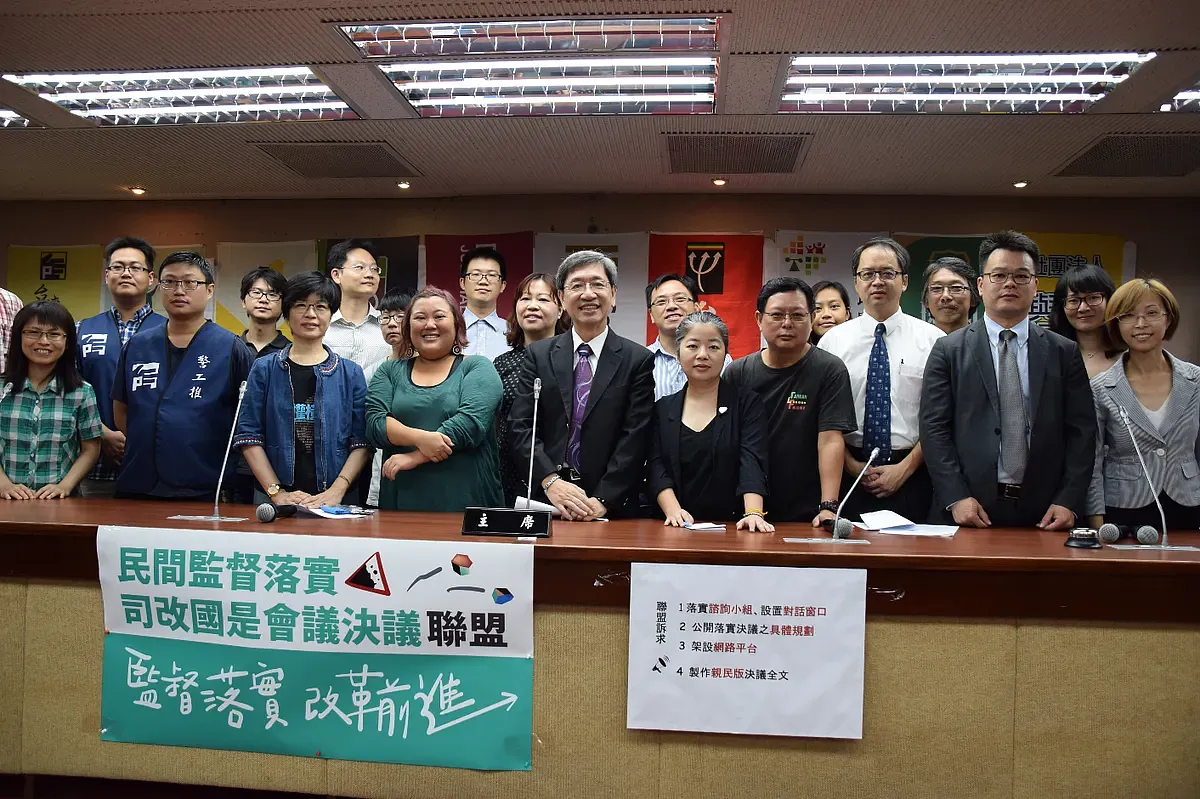
Monitoring Implementation and Advancing Reform ~ Press Conference on the Establishment of the "Alliance for Civilian Monitoring and Implementation of the National Szu-Kai Conference Resolutions"
Last edited: 2026-08-29
After running for over 10 months, the Presidential Office's National Conference on Judicial Reform concluded following its summary meeting on August 12. However, the work of judicial reform is only just beginning.
NGO groups and members of the National Conference on Judicial Reform who have long cared about various issues have therefore jointly formed the "Alliance for Civil Society Monitoring and Implementation of the National Conference on Judicial Reform."
Today (October 6), the Alliance held a press conference for its establishment in Room 202 of the Legislative Yuan's Red Building, proposing three recommendations regarding how the government should implement the resolutions:
The President should direct or coordinate government ministries and agencies to establish policy dialogue windows, and implement the "Consultative Group" to assist official-civilian continuous dialogue.
The National Conference on Judicial Reform is a policy declaration made by the President upon taking office, carrying the public's expectations for judicial reform and being of utmost importance. The President must not only be responsible for policy quality, but also has the obligation to respond at any time to society's doubts and suggestions regarding reform proposals. We recommend that the President direct or coordinate the competent authorities involved in the resolutions to designate dialogue windows, responsible for external communication and liaison concerning the implementation of resolutions. In addition, the President should also fulfill the commitments made during the summary response by establishing and implementing the function of the consultative group as a channel for continuous dialogue between the public and officials. On the one hand, this will gather civilian monitoring opinions; on the other hand, through the windows of competent authorities, it will continuously assist official-civilian dialogue to ensure that the resolutions of the National Conference on Judicial Reform are implemented.
Government ministries and agencies should publicly and concretely explain their plans for implementing the resolutions, and invite civil society organizations to participate in the amendment or policy groups established in response to the National Conference.
This National Conference on Judicial Reform adopted a completely different implementation method from the 1999 National Judicial Reform Conference, placing emphasis on openness, transparency, and expanded participation. We believe that in the future, when various government ministries and agencies plan reform proposals in response to the resolutions of the National Conference on Judicial Reform, they should also uphold the same spirit: competent authorities should publicly disclose their specific plans for executing the resolutions of the National Conference, including information such as budget allocation, execution priorities, execution methods (such as submitting draft amendments or revising internal administrative rules), schedules, and responsible internal units, so that society may understand their schedule settings, resource allocations, and potential difficulties they may encounter.
Furthermore, based on the reform proposals already put forward by the Judicial Yuan and the Ministry of Justice, it can be seen that the court and the ministry have established several law amendment committees. It is recommended that they should also adopt the open spirit of the National Conference, invite external scholars, experts, or representatives of NGOs concerned with specific issues to participate, and timely disclose the contents and progress of the groups, so as to pool wisdom and reduce resistance to policy implementation.
The authorities should set up an online platform to expand public participation, and at the same time produce plain-language versions of the full text of resolutions or planning reports.
Since the scope of resolutions made by the National Conference on Judicial Reform may involve the competencies of multiple ministries and agencies simultaneously, to enable the public to comprehensively grasp the progress of each competent authority, we recommend that the authorities set up an online platform and design a consistent way of presenting execution progress to consolidate and house the progress of various ministries and agencies in implementing the resolutions.
Given that many resolutions made by the National Conference on Judicial Reform are still presented in professional legal terminology, which greatly raises the threshold for public comprehension, it is recommended that the authorities translate them into plain language and produce versions in other languages such as English, Thai, and Vietnamese. This will ensure that all groups potentially affected by the resolutions (such as new immigrants and inmates) can fully understand the content of the resolutions, making it possible for them to further monitor whether the authorities are implementing the resolutions.
Every session of the National Conference was discussed through the time and energy devoted by the members, and each resolution carries the participants' wonderful vision for reform. How to weave these commitments into a judicial reform blueprint that guides the direction of Taiwan's progress for the next twenty or thirty years is something the government must ponder and be responsible for. The "Alliance for Civil Society Monitoring and Implementation of the National Conference on Judicial Reform" will pool collective strength to continuously monitor government legislative amendment meetings, amendment drafts, and the formulation and implementation of other reform policies. It also expects the President to properly receive society's aspirations for judicial reform and hand in a brilliant scorecard for judicial reform.
Members of the "Alliance for Civilian Monitoring and Implementation of the National Szu-Kai Conference Resolutions"
(Sorted by stroke count, and continuously growing)
Institutional Members (21)
Covenant Watch
Red Heart Association, R.O.C.
Catholic Diocese of Hsinchu Vietnamese Migrant and Immigrant Workers Office
Taichung Bar Association
Taipei Bar Association
Taiwan Association for Human Rights
Taiwan Alliance for Advancement of Youth Rights and Welfare
Taiwan Forever Society
Taiwan Labour Front
Taiwan Association to End the Death Penalty
Taiwan Police Rights Association
Association for Democratic and Legal Education, Taiwan
Judicial Reform Foundation
Legal Aid Foundation
Nanyang Taiwan Sisterhood Association
Taiwan Association for Innocence
Indigenous Youth Front
Open Culture Foundation
The Garden of Hope Foundation
Environmental Jurists Association
Environmental Rights Foundation
Individual Members (14)
Wang Wei-Chun (National Conference Member)
Li Nien-Tsu (National Conference Member)
Li Chun-I (National Conference Member)
Lin Wen-Wei (National Conference Member)
Lin Meng-Huang (National Conference Member)
Lin Chang-Ching (National Conference Member)
Chi Hui-Jung (National Conference Member)
Sun I-Hsin (National Conference Member)
Chen Yao-Hua (National Conference Member)
Huang Chih-Hao (National Conference Member)
Liu Pei-Yuan (National Conference Member)
Tsai Po-Fang (National Conference Member)
Lu Ying-Chieh (National Conference Member)
Lai Yueh-Mi (National Conference Member)

Attending Representatives
Huang Yi-Bi / Executive Director, Covenant Watch
Lai Yu-Fen / Social Worker, Catholic Diocese of Hsinchu Vietnamese Migrant and Immigrant Workers Office
Lin Hsin-I / Executive Director, Taiwan Association to End the Death Penalty
Lin Chun-Hung / Standing Director, Taipei Bar Association
Hung Chung-Yen / Deputy Secretary-General, Taiwan Forever Society
Wu Tsung-Che / Standing Director, Taiwan Police Rights Association
Wang Lun-Yu / Director, Taiwan Police Rights Association
Sun Yu-Lien / Secretary-General, Taiwan Labour Front
Yeh Ta-Hua / Secretary-General, Taiwan Alliance for Advancement of Youth Rights and Welfare
Lo Shih-Hsiang / Executive Director, Taiwan Association for Innocence
Savungaz Valincinan / Taiwan Indigenous Peoples Policy Association
Li Yueh-Lin / Executive Director, Association for Democratic and Legal Education, Taiwan
Lin Yung-Sung / Chairman, Judicial Reform Foundation
Chen Yu-Fan / Deputy Executive Director, Judicial Reform Foundation
Su I-Shih / Director of Legal Affairs Department, Legal Aid Foundation
Lai Wei-Li (Kai Limadjakan) / General Convenor, Indigenous Youth Front
Chang Yu-Yin / President, Environmental Jurists Association
Lin San-Chia / Chairman, Environmental Rights Foundation
Kuo Hung-Yi / Staff Attorney, Environmental Rights Foundation
Press Contacts
Judicial Reform Foundation / Deputy Executive Director Chen Yu-Fan (02)2523-1178
This article is an AI-generated translation of the original Chinese text. In the event of any discrepancy, the Chinese version shall prevail.