

The New-Generation Anti-Drug Strategy: Aspirations, Yet to Arrive
Last edited: 2026-08-29
Introduction
In May 2017, the Executive Yuan proposed the "New-Generation Anti-Drug Strategy," claiming to adopt a next-generation mindset for comprehensive anti-drug efforts. The strategy is divided into five core components: anti-drug strategies, drug refusal strategies, drug suppression strategies, drug rehabilitation strategies, legislative amendment proposals, and inter-agency cooperation. It expects to achieve goals such as a year-on-year decline in new drug users, a decrease in drug abuse and related crimes, and a tangible sense of public security for the people. Furthermore, the Executive Yuan announced that NT$10 billion would be allocated over the next four years (2017–2020) for anti-drug operations, mobilizing departments including the Ministry of Justice, the National Police Agency, the Ministry of Health and Welfare, and the Ministry of Education. Massive funding and cross-ministerial mobilization symbolize the government's determination and ambition to showcase its anti-drug resolve to the public.
We understand the government's ambition, but it is imperative to verify whether the planned strategies can actually achieve their intended goals. Because this entire strategy involves the commitment of massive resources and may impact the lives and health of many individuals, this article will conduct a critical review of the "New-Generation Anti-Drug Strategy" and put forward recommendations for improvement to ensure that this four-year administrative plan truly succeeds.
This article approaches the discussion from two main aspects: "methodology" and "substantive content." Taiwanese public policy planning has historically neglected methodology, accustomed to making decisions based on political intuition; this article hopes that this aspect will receive greater attention. Regarding substantive content, part of it addresses issues within the drug suppression strategy of the new-generation strategy. While these are recurring old problems, their persistent reappearance compels us to address them. Another issue is the absence of "evidence-based" prevention strategies and anti-stigmatization strategies. Although these two areas have been raised in various public policy discussions, they failed to enter the policy framework, which is highly regrettable.
I. Methodological Issues
 ※ Click to enlarge
 ※ Click to enlarge
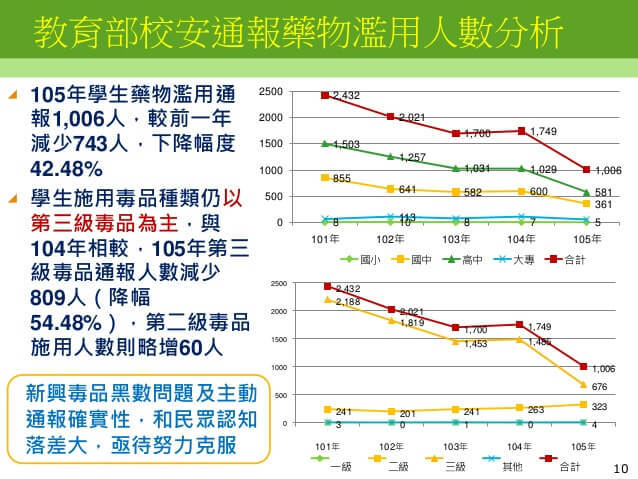
Related figures indicate that Taiwan's drug abuse situation is gradually improving, yet the report also states that "the problem of the dark figure of emerging drugs and the authenticity of proactive reporting show a large gap with public perception, which urgently needs to be overcome."
There are several issues here. First, looking solely at the 2014 National Substance Use Survey fails to reveal long-term trends in the prevalence of drug abuse; it is impossible to know whether the current situation has worsened or improved compared to when the survey was conducted. Furthermore, while there are certainly unreported dark figures in student drug abuse reports, the overall trend shows a year-on-year decrease. Unless variables causing the decrease in reporting can be identified and controlled for, it cannot be deduced that student drug abuse in our country is worsening. Based solely on the reduction in long-term reported numbers, one might even feel that student drug abuse has improved. Third, while the public perceives drug abuse as severe, this sentiment needs to be verified through empirical data. If public perception is a misunderstanding, it must be clarified; if public perception is grounded in reality, evidence must be presented in the report. Otherwise, our nation's drug policy will resemble blind men touching an elephant: guessing it is severe based on feelings, formulating responses based on feelings, and claiming the strategy is effective based on feelings, all without any evidence to prove whether these "feelings" are true.
-
Results Chain
A "results chain" is a thinking tool that breaks down an undertaking from resource input to the achievement of results into different links, helping people think through the logical connections between these links and consider what resources must be invested and what actions must be taken to achieve specific outcomes.
The results chain model is as follows:
Inputs Activities Outputs Outcomes Impact
- Inputs: Resources invested by the organization, including financial and human resources.
- Activities: Tasks and actions undertaken to transform inputs into outputs.
- Outputs: Products or services generated by the organization's activities; compared to "outcomes" and "impact," the organization has greater ability to determine and control this part.
- Outcomes: The specific changes produced by the organization's outputs on the targeted individuals, objects, or matters.
- Impact: Long-term societal changes resulting from the accumulation of outcomes.
Results chain thinking can be applied to a specific program or to overall policy planning, whether on a large or small scale, with the goal of aiding logical thinking. Depending on the subject matter, the same element may be categorized into different stages. Sometimes the distinction between "outcomes" and "long-term impact" is unnecessary, depending purely on whether short-term or long-term effects need to be subdivided in the reasoning.
For example, if the New-Generation Anti-Drug Strategy lists "reducing health damage to drug users" as one of its work objectives, its specific content must be clearly articulated. At the same time, outcomes must be concretely measurable, which means establishing "indicators." Examples include lengthening the average duration between relapses for drug users, decreasing the prevalence of drug abuse-related illnesses among drug users, and reducing the number of overdose deaths. Indicator design should not be unilaterally decided by higher authorities, because drug users themselves and frontline practitioners often understand the problem better; thus, their opinions should be incorporated. Researchers should also be included in indicator design to address measurement issues. Although a results chain serves as a thinking tool initially, outcomes must ultimately be genuinely measured to provide feedback into policy thinking.
Equipped with the results chain as a thinking tool, we can attempt to examine which link in the chain certain "expected benefits" of the "New-Generation Anti-Drug Strategy" actually fall under.
 ※ Click to enlarge
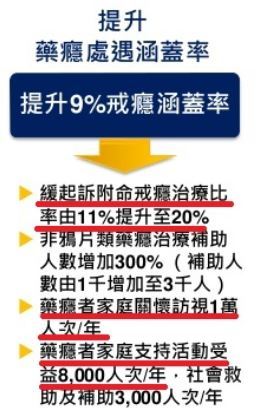
In the image, we can see that one of the expected benefits of rehabilitation is "increasing the proportion of suspended prosecution with conditional addiction treatment from 11% to 20%," along with "family care visits for drug addicts at 10,000 person-times/year, and beneficiaries of family support activities for drug addicts at 8,000 person-times/year." From the perspective of the "rehabilitation" strategy, it is reasonable to assume that the expected outcome is "reducing health damage to users," yet no specific indicators have been set for this. As for the two expected benefits cited earlier, strengthening the conditional suspension of prosecution leans more towards an "activity," because suspended prosecution functions similarly to a diversion measure in rehabilitation strategy—shifting drug users from the criminal justice system to the treatment system so they receive certain assistance, though it cannot directly make users quit drugs on its own. Meanwhile, family care or support activities for drug addicts lean more towards "outputs," meaning the actual addiction treatment services provided. From strengthening the application of suspended prosecution (activity) to providing addiction treatment services (output), and ultimately to reducing health damage to users (outcome), we can then evaluate whether related practices are effective or what adjustments need to be made at various links.
The results chain tool helps us connect the work of different departments and review the logical relationships between practices working backward from outcomes. If we elevate the level of analysis to the overall strategy rather than conducting results chain thinking separately for each dimension, we find that from an outcome perspective, contradictions may exist between the "drug suppression strategy" and the "rehabilitation strategy" within the New-Generation Anti-Drug Strategy.
Examining the "drug suppression strategy," its assigned mission is to apprehend suppliers and consumers of illicit drugs as comprehensively as possible—the so-called "zero dead zones in anti-drug efforts." "Apprehending crimes" can be considered the law enforcement "result" of enforcement agencies, but viewed from the broader anti-drug strategy, it is not the ultimate desired outcome. Judging from the report's "expected benefits of the new anti-drug strategy," the ultimate desired outcome of "zero dead zones" may be to drive down the "number of drug crime population figures" by "forcing out the dark figures."
Putting aside the number of drug traffickers for a moment and focusing solely on the reduction of the "drug-using population," moving from "zero dead zones in anti-drug efforts" to a "reduction in the drug-using population" requires certain causal assumptions, such as:
- Drug users, upon being apprehended, are referred to institutional (including detention centers, prisons) or non-institutional treatment systems, where they receive good assistance and consequently stop using drugs.
- Drug users entering detention centers or prisons find the conditions in these institutions so distressing that they dare not use drugs again.
- By arresting existing drug users and sending them to prison, potential users who have not yet used illicit drugs are deterred by these cautionary examples and refrain from using drugs.
In short, the results chain tool helps us work backward from outcomes to examine the interrelationships among different components of the New-Generation Anti-Drug Strategy and whether the settings of various strategies are appropriate. Unfortunately, the current New-Generation Anti-Drug Strategy shows no evidence that the government has pragmatically evaluated the capacity limits of backend systems when planning frontend law enforcement actions.
-
Outcome Evaluation
After a policy is implemented, its effects need to be evaluated to provide feedback for policy formulation. This idea is simple yet extremely important; otherwise, flawed policies may continue to be implemented due to political considerations. While many aspects require evaluation post-implementation, this article argues that Taiwan's drug policy most urgently needs "outcome evaluation."
Outcome evaluation differs from the KPIs (Key Performance Indicators) currently popular in government. KPIs essentially measure organizational performance; viewed through the results chain model, they at best set indicators demanding specific outputs. Theoretically, the government should formulate KPIs from a results chain perspective regarding what actions achieve desired outcomes and long-term impacts. However, because outcome evaluation is undervalued in Taiwan, the setting of KPIs sometimes degenerates into KPIs that are neither K nor P (meaningless) set by various ministries themselves.
Aside from primarily measuring outcomes rather than direct organizational performance, outcome evaluation differs fundamentally from KPIs in another key aspect. In Taiwan's government, civil servants currently use KPIs as their administrative report cards; thus, setting overly difficult KPIs causes them trouble, leading them to set safe, easily achievable KPIs to avoid reviews when targets are missed. The concept of outcome evaluation is different. Because outcomes are not factors directly controllable by an organization, outcome indicators cannot be directly mandated for the organization—for instance, one cannot mandate a 1-percent drop in drug abuse prevalence this year. The purpose of outcome evaluation is to understand real societal changes, explore whether a specific policy exerted its anticipated influence, and further understand the reasons behind successes or failures, thereby feeding back into policy formulation. It is not used directly as a basis for rewarding or punishing civil servants. For example, if the reason for failure is insufficient resources impairing a unit's operations, the conclusion might even be to allocate more resources to enable true functioning, rather than punishing the unit's personnel.
Outcome evaluation must never be planned only after a policy has been implemented; "evaluation" must be conceptualized at the very outset of policy formulation. This is because outcome evaluation is fundamentally scientific research, and the formulation of concrete administrative plans must incorporate research design elements from day one; otherwise, the final evaluation cannot meet the requirements of research rigor. Here, continuing our previous discussion of the "expected benefits of the new anti-drug strategy," this article provides an example of how to conduct research design.
 ※ Click to enlarge
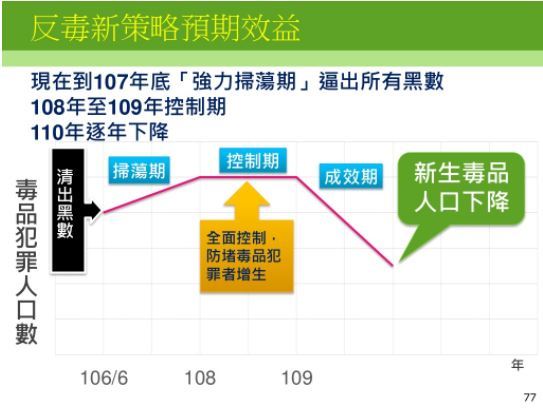
This chart is used by the government to illustrate the anticipated effectiveness of the new anti-drug strategy. It implies that once law enforcement agencies heavily crack down on drug crimes, un-offending individuals will be deterred from committing crimes, and apprehended offenders will cease offending. Initially, as crackdowns intensify, previously undiscovered dark figures of crime will be uncovered, causing a short-term rise in apprehended drug crime numbers; once individuals are rounded up, the numbers will subsequently decrease.
It must first be clarified here that inferring the effectiveness of anti-drug strategies solely from changes in the drug crime population is methodologically insufficient. First, overall changes in the drug crime population are influenced by too many potential variables, with government actions being only one possible variable. In Taiwan, changes in the drug crime population are most likely directly correlated with changes in law enforcement priorities. Given the current performance-oriented law enforcement style of the police—cracking down aggressively when performance targets are set and slacking off when they are not—it is foreseeable that creating fluctuations in the drug crime population can be achieved simply by adjusting priority performance items.
Second, can changes in the number of apprehended drug criminals be used to infer changes in the actual drug crime population in society (including un-apprehended individuals)? This is questionable. Estimating the true population of drug crimes should be divided into two major dimensions: drug supply crimes and drug use crimes. Methods for estimating the true population of drug supply crimes are currently severely lacking; while some methods exist to estimate the scale of illicit drug markets, methods for estimating the number of illicit drug suppliers remain elusive. However, if overall policy goals include "reducing health damage to users" and "reducing opportunities for users to commit other crimes," the pursued outcome might not be a reduction in the number of drug suppliers, but rather questions such as: "Does law enforcement make specific types of illicit drugs harder to access for young people?" and "Does law enforcement affect the retail price and purity of illicit drugs, and what impact do these results have on users?" Such information can potentially be obtained by surveying drug users or target populations.
As for estimating the number of drug users, epidemiology utilizes surveys on the prevalence and incidence of drug abuse to understand the proportion of the population using illicit drugs within a specific period, as well as the proportion of first-time illicit drug users (i.e., the "new drug user population"). While drug abuse surveys always suffer from underreporting and concealment, epidemiology has also developed estimation methods. Even if estimation results are underestimated, methods other than counting law enforcement apprehensions can be developed to monitor changes in the illicit drug-using population, thereby enabling cross-validation.
Third, these aggregate numerical changes are actually difficult to use directly for inferring the effectiveness of forceful crackdowns; a more appropriate approach is to observe "trends" through figures revealed by regular surveys. How these trends should be interpreted is another matter entirely.
A better approach to examining the effectiveness of anti-drug strategies is to analyze the three causal assumptions for achieving expected benefits derived from the "expected benefits of the new anti-drug strategy" chart mentioned earlier in this article:
- Drug users, upon being apprehended, are referred to institutional (including detention centers, prisons) or non-institutional treatment systems, where they receive good assistance and consequently stop using drugs.
- Drug users entering detention centers or prisons find the conditions in these institutions so distressing that they dare not use drugs again.
- Individuals who have not yet used drugs are deterred from doing so out of fear of imprisonment.
Assumptions 1 and 2 are easier to test than assumption 3 because their target group is relatively clear: drug users apprehended by law enforcement. Furthermore, assumptions 1 and 2 can be viewed as opposing policy choice hypotheses. Assumption 2 closely resembles current conditions in Taiwan's detention centers and prisons—namely, overcrowding, poor living conditions, and insufficient treatment resources—so we can view it to some extent as a control group. Assumption 1 can be regarded as the experimental group, where drug users are kept in communities or provided with life-dignifying living conditions within institutions alongside evidence-based treatment. We can then observe whether differences in outcomes arise between the different approaches. Considering that resources cannot be put in place immediately, a "model treatment" design can be implemented in reality. For instance, establishing model treatment teams, model rehabilitation centers, or model prisons equipped with adequate resources, while capping caseloads at levels where they can provide quality service. As for which drug users are selected for model treatment, they can be categorized beforehand based on background factors such as gender, age, drug use history, criminal record, family status, and employment status, with random assignment within the same category. If experimental designs with random assignment are difficult to implement beforehand, collecting data post-hoc to see whether outcomes differ when drug users with similar traits are assigned to different groups is also a viable approach.
Regarding what constitutes the "effect" of treatment, newer addiction research views addiction as a brain disorder, recovery as a prolonged process, and relapse as an inevitable part of the process. It is also possible that an individual may never completely overcome addiction yet still maintain a certain quality of life and health (disease management), much like any chronic disease. Therefore, aside from complete cessation, "effects" can also include the duration of drug-free periods, or crimes committed for or due to drug use. Other functional aspects of life may include school and work attendance. Currently, the New-Generation Anti-Drug Strategy appears to view subsequent drug use through a "recidivism" lens, pursuing complete cessation, which is why its goal is a reduction in the drug-using population. It is recommended that policy goals be adjusted toward a more pragmatic direction.
Rigorous testing of assumption 3 is extremely difficult. Given the New-Generation Anti-Drug Strategy's mandate for comprehensive crackdowns, what can be observed is whether rising arrest rates are accompanied by a declining incidence of drug abuse. An optimal design would involve two independent, non-interfering regions with similar demographic structures and baseline arrest rates, where Region A increases arrests while Region B remains unchanged, observing changes in the incidence of drug abuse in both. In Taiwan, conditions for such observations are scarce; at best, one can examine changes in arrest rates and drug abuse incidence before and after the implementation of comprehensive crackdowns, while monitoring whether other systemic variables show significant changes. All of these require collecting data prior to policy implementation to establish a baseline for monitoring trends.
In short, our nation's public policies almost completely lack the concept of outcome evaluation, and the New-Generation Anti-Drug Strategy is no exception. This has caused Taiwan's anti-drug policies to resemble blind men fumbling around for a long time, heavily swayed by political considerations. For outcome evaluation to be conducted, research design considerations must be incorporated during the policy planning stage; it is impossible to suddenly decide to do it at the end. Finally, it must be stated that outcome evaluation requires resources—for instance, the aforementioned surveys on drug abuse prevalence and incidence both require resource investment. Our government has not truly invested resources in policy evaluation, and it is hoped the government will recognize this deficiency. Investing resources in evaluation should not be understood as unilaterally increasing the government's financial burden; establishing rigorous evaluation mechanisms can prevent or abandon ineffective or even harmful policies, channeling resources instead into effective ones. In the long run, establishing evaluation mechanisms may be more cost-effective.
The planning and evaluation of public policies actually have established methodologies. Such methods can assist the government in formulating more pragmatic and appropriate policy plans, rigorously examining policy effectiveness, and verifying whether initial resource allocations are reasonable in order to determine whether policy adjustments are necessary. Among them, three concepts—"needs assessment," "results chain," and "outcome evaluation"—hold significant reference value for the planning and evaluation of our nation's substance abuse prevention and control policies, as they highlight methodological gaps in Taiwan's drug control policies.
Needs Assessment
A needs assessment is used to understand the nature and condition of health or social problems within a community in order to propose appropriate responses. Needs assessments are rooted in research to plan programs and allocate resources, rather than relying solely on subjective judgment or political considerations. When designing research for a needs assessment, the opinions of stakeholders (simply put, the people affected by the response measures) should be gathered [1] so that the research can address the concerns of these individuals. In the planning of drug abuse prevention policies, the voice of one particular group of stakeholders is critically important yet consistently absent: "drug users."
As the international community increasingly emphasizes viewing the problem of drug abuse from a public health perspective, the use of illicit drugs (narcotics) has been redefined from a criminal issue into a health issue, and drug users have been redefined from criminals into patients, or even ordinary citizens—people who have the right to live healthy lives. This shift has prompted policies to consider how to help drug users live healthy lives, and even how to help them overcome addiction or the harms of drug abuse. Taiwan is also gradually moving down this path; we can observe this shift in mindset from the declaration in the "New-Generation Anti-Drug Strategy" that "drug users hiding in every corner have access to assistance channels at any time."
If Taiwan gradually acknowledges that habitual drug users can be regarded as chronic disease patients and that drug users possess the right to a healthy life, then incorporating the voices of drug users becomes essential during the formulation of drug policies. For example, why do drug users use drugs? What impacts do drugs have on their lives or health? What kind of assistance do they hope the state and society can provide? Truly understanding the conditions and needs of drug users during the policy planning stage makes it more feasible to formulate policies that genuinely assist drug users, or at least avoid inadvertently causing greater harm to them. For instance, some individuals use cannabis because they suffer from psychiatric disorders; despite taking various psychiatric medications, their symptoms remain severe and are only alleviated by cannabis. How should such an individual be handled upon being apprehended? Should they be ordered to stop using cannabis and suffer from the symptoms of their psychiatric disorder? Or should they be arrested and imprisoned if they do not comply? Similar needs have not been properly addressed in current drug policies.
As mentioned earlier, needs assessments are grounded in research rather than subjective judgment or political considerations, and thus they typically employ common research methods. For example, sample surveys are used to understand the prevalence of drug use; field research is conducted to understand drug use patterns and experiences; and focus group interviews are held with frontline personnel in healthcare, social services, and criminal justice to understand the consequences of drug use. Each of these research methods has its own potential and limitations, and understanding these limitations is particularly important as it allows us to be more cautious in our judgments and recognize the necessity of self-correction (in case of missteps).
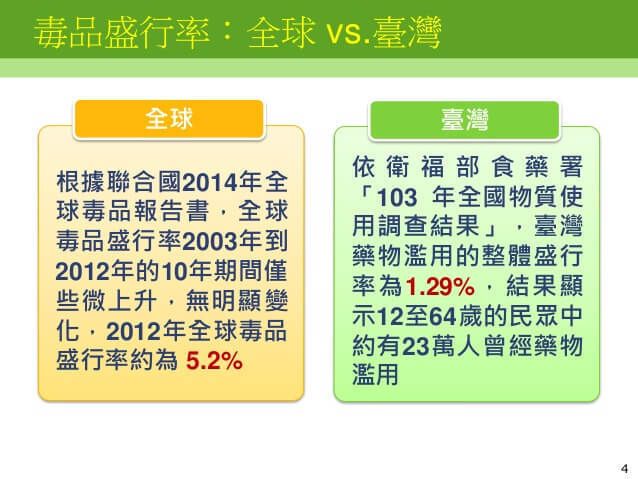
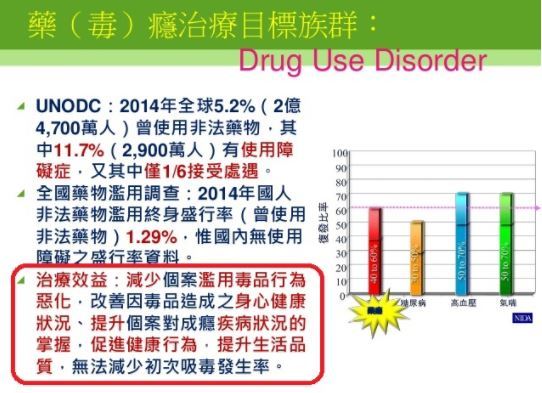
Unfortunately, within the "New-Generation Anti-Drug Strategy," how to ground empirical data collection in research methods to understand the problem does not appear to be valued. At the very outset, the report cites the Ministry of Health and Welfare's Food and Drug Administration's "2014 National Substance Use Survey Results" and the United Nations 2014 World Drug Report, seemingly indicating that Taiwan's drug abuse problem is not very severe (left figure). It subsequently cites the Ministry of Education's school safety reporting data on the number of drug abusers, pointing out a year-on-year decrease in reported numbers (right figure).




II. Substantive Content
 ※ Click to enlarge
The New-Generation Anti-Drug Strategy does differ from past approaches in certain concepts and content, particularly regarding the "rehabilitation strategy." Although the heading remains "rehabilitation strategy," a review of the content reveals that the emphasis has shifted from "addiction recovery" (complete cessation) to "health promotion" (potential continued use coupled with harm reduction). This is a pragmatic direction focused on drug users, aligning with contemporary addiction research that views addicts as chronic disease patients.
Certain politicians manipulate drug policies to capture media headlines, such as Minds Alliance Chairperson Hsu Hsin-ying questioning the Ministry of Health and Welfare as a major loophole in anti-drug efforts, pointing out that the MOHW stated "(medical rehabilitation) does not reduce the incidence of drug use." Ignoring the public's desire to stay away from drugs is where the real problem lies. Strictly speaking, the "incidence" of drug use refers to the proportion of the target population consisting of "first-time illicit drug users" within a specific period. To lower the incidence, various evidence-based prevention strategies should be employed to prevent people from using drugs or delay their age of first use, rather than relying on "rehabilitation"—because if a person does not use drugs in the first place, what drugs are they supposed to quit? As for the spillover effect where a user quitting drugs exerts interpersonal influence to reduce drug use among others, this can at best be seen as a secondary ripple effect of addiction treatment, but it cannot be the primary goal.
Additionally, the Minds Alliance also sensationalized harm reduction strategies, criticizing the Ministry of Health and Welfare's Centers for Disease Control for subsidizing the printing of the "Recreational Drug Harm Reduction Manual" as teaching people how to take drugs, arguing that such safe drug use concepts represent a major loophole in anti-drug work and waste taxpayers' money. However, if one genuinely cares about the health of drug users, telling them how to protect themselves and those using with them when immediate cessation is impossible is an extremely crucial practice. In the case of the W Hotel model overdose death, if those present had understood the concepts of safe drug use, the outcome might have been different. Internationally, a mother whose daughter died from improper Ecstasy use pragmatically and thoughtfully hopes the government will promote knowledge of safe drug use.
If there is any shortcoming in the overall planning of the "rehabilitation strategy," it is that the direction is overly medicalized. Modern medicine relies heavily on medication administration; however, aside from opioids like heroin which have substitution therapies, other popular illicit drugs such as amphetamines, ketamine, or various emerging addictive substances lack substitution treatments. Under these circumstances, approaches like social support and life reconstruction programs become even more vital. The training of professional personnel must also place greater emphasis on talents other than physicians to achieve truly diverse treatment modalities.
In fact, the areas of the New-Generation Anti-Drug Strategy with more problematic content are the "drug suppression strategy" and the "prevention strategy," while a critically important yet completely absent element is the "anti-stigmatization strategy."
Drug Suppression Strategy
The fundamental problem with our nation's drug suppression strategy is that it is deeply influenced by political considerations and disregards evidence.
-
Punitive Criminal Policy
Taiwan's drug suppression strategy has long been deeply affected by political considerations. The premise of a drug suppression strategy is to categorize certain behaviors within the scope of criminal punishment, which subsequently justifies enforcement agencies' anti-drug actions; thus, it is inherently a criminal policy. However, our nation's criminal policy has consistently exhibited a punitive leaning, making it rare to see behaviors removed from the scope of criminal punishment (decriminalization), but very common to see behaviors incorporated into criminal punishment or penalties increased. Particularly within Taiwan's drug abuse countermeasures, "decriminalization" is a taboo word; anyone perceived to have policy influence who makes suggestions even slightly touching upon "decriminalization" faces intense attacks. For instance, this occurred when former Legislator Ku Li-hsing (Kuo Li-hsing) proposed legislative amendments to prioritize medical treatment for drug use, and when Judicial Reform National Consultative Conference member Lin Wen-wei proposed the complete decriminalization of simple illicit drug use. Government officials are also extremely cautious to avoid touching upon the issue of decriminalization, repeatedly insisting to interviewing media that decriminalization is impossible in Taiwan at present.
It is one thing to conclude that decriminalization is inappropriate after careful deliberation, evidence review, and thorough discussion; it is entirely another when the government refuses to touch decriminalization out of political pressure, only expressing intent to increase penalties, expand criminalization, or forcefully crack down on drugs—which is purely politically driven.
In the case of the New-Generation Anti-Drug Strategy, when facing drug abuse, the proposed drug suppression strategy remains heavily punitive: "increasing penalties and fines for manufacturing, transporting, and selling drugs."
It must be pointed out that research has long indicated that the belief that severe punishments can effectively deter drug-related crimes lacks evidentiary support. Indeed, some studies explicitly show that criminal penalties inflict severe harm on individuals' health, families, and employment. Furthermore, approaches like raising statutory minimum penalties for drug supply crimes—demanding longer prison sentences for everyone involved in supply regardless of gravity—run the risk of violating the principle of proportionality. Many low-level suppliers are themselves involved in supply to support their own drug use; the effective approach is to help them address their drug problems, not to lock them up for extended periods. Consequently, raising statutory minimum penalties can be described as a political show deceiving the public, failing cost-effectiveness, and severely wasting taxpayer money.
Additionally, the use of Category 3 and Category 4 drugs currently incurs administrative rather than criminal penalties; future plans involve subjecting habitual users to physical and mental counseling education, with criminal penalties imposed upon failure to complete or re-offense.
This chart illustrates the government's belief that the effective solution to current Category 3 and 4 drug abuse lies in using criminal penalties as a deterrent and as a backing for treatment. However, current research indicates that the key to improving addiction problems lies in the ability to provide evidence-based, high-quality treatment or interventions, not criminal punishment. If the government cannot reliably establish such a healthcare service system, what utility is there in using criminal penalties as a backend threat to compel drug users to accept treatment?
-
Firework-Like Crackdown Operations
Aside from problems within criminal policy itself, law enforcement agencies' actions to combat drugs are also laden with political theatrics.
For example, China Times Electronic News reported on July 12, 2017:
Asphyxiating Drug Crackdown Commences: Taiwan High Prosecutors Office Warns Drug Dealers: "We Have Targeted You"
Recognizing that the drug problem has been elevated to a national security level, the Taiwan High Prosecutors Office integrated six major drug suppression systems—prosecutors, police, military police, investigators, coast guard, and customs—dividing the nation into eight joint-defense regions. Starting today, a two-month "asphyxiating drug crackdown operation" is underway in hopes of eradicating drug dealers from every community, warning drug dealers not to harbor wishful thinking: "Prosecutors and police have targeted you and will launch intensive strikes to find you during this period." …
Statistics indicate that from May 31 to June 2, national prosecutors, military, and police executed the first joint military-protection project and the third wave of root-tracing and stump-eradication operations, mobilizing judicial police 2,343 person-times, applying for 260 search warrants, apprehending 90 drug kingpins and 711 drug users, and seizing over 48 kilograms of various categories of drugs alongside cracking 1 major illicit drug manufacturing factory case.
This operation belongs to the "regular and irregular nationwide massive drug crackdowns" component of the New-Generation Anti-Drug Strategy. Here, we see enforcement agencies launching a "two-month asphyxiating" drug crackdown, which on the surface demonstrates the government's determination to combat drugs. But what happens after two months? Returning to a "breathing" drug crackdown where everyone takes a breather—is that what is meant? In reality, given the strain on Taiwan's police force and mutual crowding-out of duties, taking a breather is indeed all that can be managed. This can be seen in the United Daily News report on September 6, 2017:
The police circle demonstrated its resolve against fraud, successively launching new measures since July; while successfully intercepting fraud and recovering victims' deposits, frontline personnel were "driven" to the point of exhaustion by fraud-prevention duties…
A senior police officer bluntly stated that the National Police Agency's "combating fraud and drugs" initiative awards 5 commendations for apprehending online fraud couriers on duty—higher than the maximum 3 commendations for catching drug offenders in flagrante delicto. Police fraud-prevention duties are "placed first," completely overshadowing summer youth protection projects and drug enforcement.
柏 From July to September, the drug crackdown stepped down from the stage of priority duties and took its final bow.
In fact, current research shows that short-term, surprise, large-scale drug crackdowns are ineffective in the vast majority of cases, with only rare exceptions. Approaches more likely to achieve success apply before an illicit drug market has stably established itself, a condition Taiwan no longer appears to fit. Considering that forceful crackdowns cannot be sustained, a better approach is to maintain steady law enforcement. While this cannot completely eradicate the presence of illicit drugs in society, it ensures that illicit drug suppliers know they must maintain a secretive and low-profile operation, preventing illicit drugs from becoming overly accessible.
Prevention Strategy
Within the New-Generation Anti-Drug Strategy, one policy guideline is "reducing demand." This guideline is a vital component of international substance abuse countermeasures (including illicit drugs, tobacco, alcohol, etc.), encompassing both "prevention" and "treatment/intervention." Such a framework is also visible in the New-Generation Anti-Drug Strategy, making the strategy's self-proclaimed "newness" understandable. However, it is perplexing that in terms of substantive content, "prevention" has completely vanished, and the focus of the "drug refusal strategy" seems to have morphed into "zero drugs on campus."
Although the Ministry of Education's report on the "drug refusal strategy" spends considerable space discussing risk factors for adolescent drug abuse, it completely fails to address how to implement preventive measures targeting these risk factors before adolescents come into contact with illicit drugs. Instead, the focus is placed on screening out drug-using students as thoroughly as possible, followed by individual tracking and counseling.
The importance of prevention strategies in the framework contrasts with their absence in substantive content, likely because the lead ministry (or the handling officials actually planning this part) is less familiar with the subject. Between July 25 and 27, 2017, the NTU CTBC Children and Family Research Center held a series of forums titled "Summer Forum: International Symposium on Child and Adolescent Drug Prevention Strategies—Exploring Diverse Models," centered around introducing evidence-based preventive measures. Here too, one can see that while prevention strategies are understood by few domestically, they may receive increasing attention in the future. Because this component represents a crucial development in international substance abuse countermeasures, this article believes it warrants a brief introduction.
Contemporary substance abuse prevention strategies hold that substance abuse is not an individual's free choice, but rather a risk behavior that emerges when individuals encounter unmanageable problems during specific developmental stages. As humans progress from infancy, childhood, adolescence, youth, to adulthood, different developmental stages entail distinct tasks that must be navigated. For instance, early childhood requires developing secure attachment relationships with caregivers. Middle childhood largely requires remaining in school and interacting with peers; during this stage, not only does the family remain important for a child's development, but the influence of schools and peers also gradually grows, with social skills and pro-social attitudes serving as important protective factors. Early adolescence, aside from the continued importance of family, school, and peers, also involves adolescents beginning to experiment with adult roles and responsibilities, trying out independence, and making various decisions. Plasticity is very high at this stage, but harmful behaviors also easily emerge. In youth and adulthood, most individuals begin working, making the provision of measures in workplaces, communities, and medical institutions increasingly important.
Ultimately, prevention strategies involve using various methods to help individuals successfully navigate different developmental stages, centering around "people" rather than "drugs." Nor do prevention strategies guarantee that people will "never touch" illicit drugs—avoiding them is ideal, but delaying age of first use (since earlier use carries greater health risks) or preventing the development of various disorders post-use is equally crucial.
In contemporary times, prevention strategies strongly emphasize evidence-based approaches, adopting measures shown to be effective by evidence while avoiding ineffective or even harmful ones. This is extremely important, yet unfortunately, the New-Generation Anti-Drug Strategy shows no awareness of it whatsoever. The United Nations' "International Standards on Drug Use Prevention" has already pointed out that subjecting adolescents to random drug testing in schools is ineffective or even harmful, yet our country lists it as a key item—surely this requires re-examination?
Furthermore, the UN International Standards on Drug Use Prevention list a series of evidence-supported preventive measures, such as parenting skills, self-management, and social skills. This series of preventive measures is categorized according to developmental stage, implementation setting, and target audience. Taiwan could actually conduct a needs assessment first, reference and utilize them as needed, and subsequently conduct evaluations to confirm whether specific preventive measures are equally applicable in Taiwan.
Anti-Stigmatization Strategy
The anti-stigmatization strategy is completely absent from the New-Generation Anti-Drug Strategy, which is regrettable yet unsurprising. From the New-Generation Anti-Drug Strategy's absolute avoidance of the decriminalization issue, to the involuntary screening methods like drug testing that force drug-using students to surface on campus for management, to frontend search-and-arrest operations conducted without regard for whether backend systems possess sufficient absorption capacity—all these instances reveal a basic framework rooted in societal fear and the management of feared objects. The priority is to appease fear, followed by introducing assistance to drug users under the premise of avoiding public outcry.
An anti-stigmatization strategy is a vitally important component in improving the plight of drug users, because incorrect perceptions lead to inappropriate treatment, which in turn inflicts harm. At the institutional level, defining drug users' repeated drug use behavior as "recidivism," viewing drug users as incorrigible, and subjecting them to harsher punishments also constitutes a form of stigma. According to contemporary drug abuse research, people's contact with illicit drugs and subsequent progression to addiction is not purely a choice of free will; rather, various internal and external risk and protective factors shape individuals' differing conditions, culminating in addiction. Once addiction develops, much like a chronic disease that relapses, subsequent illicit drug use is a normal condition; even when progressing toward recovery, reuse remains normal. Under such circumstances, treating drug users as individuals unwilling to reform and punishing them severely provides little help and may actually inflict greater harm upon them.
The problem of drug stigma occurs not only at the institutional level but also in how professionals treat drug users. In Taiwan, this is a crucial area if treatment or intervention quality is to be elevated. Research by Chen Wen-ju and Cheng Li-chen points out the following phenomena in Taiwan's medical settings: drug users who are clearly amphetamine users are nevertheless required to take methadone; individuals who have ceased drug use but seek psychiatric care for sleep disorders and depression are advised to take methadone to prevent relapse. In short, there is a presupposition that "being drug-free cures all ailments," and the sole magical remedy provided is methadone.
Stigma not only causes others to inflict unnecessary harm on drug users, but also causes drug users to harm themselves. A common problem is the fear of seeking assistance—fear of seeking help not only from professionals but also from people around them regarding the problems they face.
One item in the New-Generation Anti-Drug Strategy is "zero drugs on campus," which argues for strengthening campus drug testing to screen out drug-using students and punishing failure to report. This is a classic example of the dilemma of stigma. The rationale behind this policy demand likely stems from widespread public anxiety over campus drug abuse, questioning whether schools' reported numbers of drug abuse cases are too low and suspected of concealment. But let us think: if schools truly conceal cases, why would they do so? A well-intentioned assumption is that schools protect students, fearing that exposure of drug use will harm them; a more selfish assumption is that schools protect their reputation and prefer handling matters internally without outside awareness or intervention. If the core of the problem is recognized as stigma, the conceived strategy shifts away from drug testing, screening, and punishing concealment, and toward considering how to establish mechanisms allowing drug-using students and schools to seek help and cooperation with "peace of mind." The previously mentioned prevention strategy serves as an excellent entry point for cooperation because it does not target drug use alone, but rather helps individuals successfully navigate different developmental stages and avoid various risk behaviors, thereby bypassing the immediate predicament of drug stigma.
If anti-stigmatization is important, what practices can be adopted? In Taiwan, decriminalization may be a vital component, as criminal punishment itself carries a strong stigmatizing effect. Drug use is a crime punishable by imprisonment, do not associate with criminals, and finding a job is difficult once you have a criminal record—these are all harsh realities. Another approach is altering terminology; words like "poison" (毒品) evoke immediate fear, and once people feel fear, the space for empathy and rational communication shrinks drastically. Avoiding the term "poison" and adopting narratives such as "controlled substances," "illicit drugs," or "addictive substances" are all viable choices. Furthermore, decriminalization and the adjustment of drug terminology may themselves be the results of successful anti-stigmatization strategies.
The aforementioned represent the strategies most frequently raised in anti-stigma advocacy in Taiwan. Additionally, the National Academies of Sciences, Engineering, and Medicine in the United States released a report in 2016 titled "Ending Discrimination Against People with Mental and Substance Use Disorders," which compiles evidence-supported anti-stigma strategies. While this article does not intend to introduce every strategy mentioned therein, it will focus on two: "contact-based programs" and "protest strategies."`
"Contact-based programs" are considered effective in reducing stigma, with repeated contact proving far more effective than one-off encounters. The concept of "contact-based programs" is rarely invoked in Taiwan, but essentially, it involves individuals who have psychological or substance use disorders and have learned to coexist with them explaining to others the challenges they face and how they cope with these difficulties. The underlying logic is that ordinary people who do not experience stigma rarely have opportunities for deep contact with stigmatized individuals, making them prone to stereotyping the stigmatized, which breeds distrust or fear. While such programs aid in de-stigmatization, it must simultaneously be pointed out that "coming out" carries risks for the stigmatized. Especially in Taiwan, disclosing your drug use and sharing your challenges and coping mechanisms with others could result in your subsequent arrest. Such self-disclosure and sharing activities happen privately in Taiwan, but are likely very difficult to conduct publicly.
Regarding whether protest as an anti-stigma strategy is effective, existing evidence shows positive effects in some instances alongside unintended consequences in others. Protests can raise stakeholders' awareness of the harmfulness of stigma and rally stakeholders together. The goal of protests may be to demand the protection of certain rights or to raise public awareness of specific issues. However, protests can sometimes reinforce negative public opinion.
A famous case of utilizing protest as an anti-stigma strategy is Canada's "Vancouver Area Network of Drug Users" (VANDU) [2]. In the Downtown Eastside of Vancouver, Canada, during the 1990s, health problems stemming from drug use deteriorated rapidly, with overdose deaths, HIV, and hepatitis C rates surging. Faced with this situation, citizens and politicians largely adhered to traditional views—treating drug use as a criminal offense and emphasizing mandatory cessation. However, some social activists argued that safe injection sites should be provided for drug users to improve conditions. A safe injection site allows drug users to inject drugs safely under medical supervision; this harm reduction practice effectively reduces overdose deaths and infections from unclean needles, but because it implicitly tolerates illicit drug use, it remains highly controversial. Activists established an illicit safe injection site privately, which received informal support from the local official public health control center.
Amid the ongoing movement, VANDU was born in 1997. VANDU is a drug user rights advocacy organization composed of drug users and individuals concerned with their health, aiming to empower drug users to design and implement harm reduction measures themselves. To alter the demonizing narrative surrounding drug users, they advocated for continuous participation in community meetings, protests, education, and fearless resistance against oppression. In 1998, Vancouver Mayor Philip Owen held an international forum on drug treatment and crime prevention, inviting numerous international experts but failing to invite actual drug users to participate. VANDU members showed up uninvited to explain the problems of a conference featuring experts without drug users. Consequently, VANDU was subsequently invited to government-held drug abuse conferences where they exerted influence. Through collective efforts, Vancouver established North America's first legal supervised injection site, Insite, in 2003. The establishment of Insite effectively reduced overdose deaths and needle-borne infections. However, after the Conservative Party came to power in Canada in 2006, Insite's legal existence faced severe challenges as Conservatives argued against spending a single penny of taxpayer money to subsidize drug users. To protect Insite, VANDU joined litigation initiated by other organizations and drug users, culminating in a 2011 Supreme Court ruling that the Canadian government could not revoke Insite's legal status.
Throughout the movement, a heroin addict named Dean Wilson bravely stepped forward. As a member of VANDU, his story was made into the film *FIX: The Story of an Addicted City*, and he served as a plaintiff in the lawsuit to preserve Insite. He testified in court about his addicted life, demonstrating that addiction is a chronic disease requiring diverse approaches to assist addicts, with harm reduction being a crucial one. While Wilson's public emergence galvanized greater reform momentum, he simultaneously faced personal attacks and harassment.
In short, the absence of an anti-stigmatization strategy within the New-Generation Anti-Drug Strategy is regrettable. The "contact-based programs" and "protest strategies" mentioned in this article are rarely discussed in Taiwan, yet they hold significant inspirational value. The common thread between contact-based methods and protest strategies is the visibility of drug users, which is hard to fathom yet crucial in Taiwan. While the government is unlikely to proactively foster protests, this article hopes that by introducing such foreign practices, drug users will realize they can organize to assert their right to live a healthy life, allowing others to witness their human faces and fighting for their right to speak. It is also hoped that non-users, experts, and the government will recognize the importance of such practices, affording at least some space for such organizations and willing individuals. What the government is more likely to promote is "contact-based programs"; currently, one group of drug users more likely to attain visibility consists of heroin addicts receiving methadone substitution therapy. Might there come a day in Taiwan's educational settings where success stories are no longer limited to former addicts sharing how they completely distanced themselves from drugs, but also include heroin addicts currently receiving methadone therapy sharing with students how they coexist with addiction, the various facets of their lives, their struggles, and how they confront them? Hopefully, one day Taiwan will be prepared to undertake this.
Conclusion
Aspirations, Yet to Arrive: The New-Generation Anti-Drug Strategy
Although the "New-Generation Anti-Drug Strategy" proclaims itself "new," closer inspection reveals it is insufficiently "new." More accurately, it is a hybrid of old and new elements, representing an anti-drug strategy in transition. Viewed from the long-term development of Taiwan's drug abuse prevention policies, current practices certainly exhibit some progress compared to the past, but they fall far short of qualifying as a "new generation." This article puts forward areas for improvement and attention in the methodology and substantive content of the New-Generation Anti-Drug Strategy, hoping that one day, a truly new-generation drug abuse prevention strategy will arrive.
Supplementary References
Supplementary references are citations of research cited within the article. Because certain contents overlap across multiple documents and some literature is cited frequently, individual in-text citations were omitted to avoid reading difficulties. Friends interested in delving deeper into the topics discussed in this article may consult them directly.
-
IDPC (2017). IDPC Drug Policy Guide.
This literature features a clear framework for drug abuse prevention policies with rich citations. Its foundational stance prioritizes human rights followed by evidence. Highly recommended for human rights workers interested in drug abuse prevention.
-
Babor et al (2009). Drug Policy and the Public Good. Oxford.
Strang et al (2012). “Drug policy and the public good: evidence for effective interventions.” The Lancet 379(9810).
Published by Oxford, *Drug Policy and the Public Good* is an exemplary work collecting and organizing drug abuse prevention policies from various countries from a public health perspective, analyzing and commenting on them through an evidentiary lens. Compared to the explicit human rights advocacy angle of the IDPC Drug Policy Guide, this book places greater emphasis on rigorous evidentiary review. The 2012 article "Drug policy and the public good: evidence for effective interventions" published in *The Lancet* is essentially an executive summary of the original book. Readers lacking time to read the book can consult this article and trace back to the book for deeper exploration.
-
CICAD (2009). How to Develop a National Drug Policy.
This literature primarily introduces policy thinking tools that can assist in constructing a nation's drug abuse prevention policy. It contains numerous tools, of which this article selects only those deemed most critical for Taiwan's public policy thinking, without exhaustive introduction.
-
NRC (2001). Informing America's Policy on Illegal Drugs: What We Don't Know Keeps Hurting Us.
This book is a major publication evaluating U.S. drug abuse prevention policy issued under the name of the U.S. National Research Council (abbreviated as NRC herein). Its contents comprise the final report of the Committee on Data and Research for Policy on Illegal Drugs, which found that the U.S. "War on Drugs," implemented for many years with massive resource investments, lacked sufficient evidence to evaluate its effectiveness. The report offers numerous recommendations for data collection and research directions, providing valuable reference for those pondering how Taiwan should evaluate its drug abuse prevention policies. Regarding the aftermath and policy recommendations of the U.S. mass incarceration phenomenon triggered by the "tough on crime" policies sharing the same lineage as the "War on Drugs," see also the 2014 NRC book *The Growth of Incarceration in the United States: Exploring Causes and Consequences*. These books are directly downloadable for free online, making them highly accessible.
-
Caulkins et al (1997). Mandatory Minimum Drug Sentences: Throwing Away the Key or the Taxpayers' Money?.
This report is a vital study exploring the issue of setting statutory minimum penalties for drug supply crimes, analyzing the cost-effectiveness of mandatory minimum sentences through economics. The report finds that raising statutory minimum sentences incurs extremely high costs while generating low marginal benefits, meaning such policies essentially waste taxpayers' money. It recommends adopting more cost-effective approaches to address drug abuse problems.
Notes- Note: Gathering stakeholder opinions does not mean conducting a general opinion poll (which is practically impossible), but rather auditing actors from different positions who might be affected by measures, inviting actors capable of appropriately reflecting specific positions to provide input. The emphasis is on diversity to avoid blind spots in research design.
- The content in the text refers to the social movement trajectory surrounding the promotion of Vancouver's safe injection site, Insite; a more complete account of the movement can be found in the article "Inside Insite: How a Localized Social Movement Led the Way for North America’s First Legal Supervised Injection Site." Aside from VANDU, many other important actors were involved, but due to narrative focus, only VANDU's role is highlighted.
- The concepts in this article originated from the "evidence-based" judicial reform research philosophy advocated by Attorney Huang Chih-hao (Huang Chih-hao). This concept was proposed by Attorney Huang based on his psychological science research and legal practical experience during our interview with him.
-
IDPC (2017). IDPC Drug Policy Guide.
This article is an AI-generated translation of the original Chinese text. In the event of any discrepancy, the Chinese version shall prevail.