
The Metrics of Success and Failure for the National White Paper on Judicial Reform: A Comparative Analysis with the JRF's '2016 National Judicial Reform Movement'
Last edited: 2026-08-29
Introduction
On October 25, 2016, the author was invited to deliver a lecture for the course "Contemporary Human Rights Issues" under Soochow University's Human Rights Program, focusing on the approach of the Judicial Reform Foundation (JRF), a corporate foundation and civil NGO, in monitoring the government. Over the past twenty-odd years, the JRF has intervened and spoken out on judicial human rights issues from three perspectives: "redressing wrongful convictions, monitoring the judiciary, and improving the judicial system." Most of its approaches have adopted a stance of confrontation and monitoring to compel official authorities to carry out judicial human rights reforms.
Among these, the judicial human rights campaigns that most easily resonate with the public are the assistance and rescue in wrongful conviction cases. Whether the JRF's past rescues of the Su Chien-ho (蘇建和) trio — known in English as the "Hsichih Trio" — Chiang Kuo-ching (江國慶), Hsu Tzu-chiang (徐自強), or Chiou Ho-shun (邱和順), each case has highlighted unreasonable human rights realities through individual cases, thereby driving numerous institutional reforms. Consequently, we came to realize that constructing a sound judicial system is the best way to reduce wrongful convictions. As the judicial system has eagerly sought to break away from political interference, demanding a high degree of independence that has gradually yielded results, the accompanying self-discipline has fallen far short. Therefore, monitoring judicial personnel has always been a core task of the JRF.
However, leading up to the 2016 presidential election, all candidates promised before the election to carry out large-scale judicial reform. President-elect Tsai Ing-wen (蔡英文) further advocated convening a deliberative National Congress on Judicial Reform, providing a venue for official-civil interaction and cooperation. Therefore, in addition to its original three core working axes, the JRF proactively took the lead by dedicating the entire year of 2016 to researching and practically testing a potential model for this upcoming deliberative congress. Its aim was to trial a prototype for subsequent judicial reform congresses, termed the "National Judicial Reform Movement."
This "prototype" of the "National Judicial Reform Movement" can be described as an attempt by the JRF to "build on the past and inspire the future": in terms of social movement strategy, we continued to exert pressure by promoting this "prototype," expecting that official implementation of the congress would at least meet the most basic standards of a civil society NGO. At the same time, we pointed out that if such a deliberative and people-participatory national congress is operated properly, the historical role of civil NGOs in monitoring the government might transform into a model of cooperation and assistance.
Regrettably, while the National Congress on Judicial Reform, which officially began preparatory meetings on November 25, 2016, did reference this "prototype," it can hardly be said to have unfolded based upon it. Perhaps it is still too early to conclude its success or failure; after all, the National Congress on Judicial Reform is currently in full swing, and how it will develop hereafter warrants further observation.
This article will explain the JRF's experiences and insights from trial-running the "prototype" of the "National Judicial Reform Movement" throughout 2016. Finally, although the Presidential Office-coordinated National Congress on Judicial Reform has yet to conclude, this article will attempt to compare the differences between the civilian-made "prototype" and the official congress — particularly pointing out major procedural differences between the two — and explain how the criticisms received by the officials thus far may be related to underestimating some of the difficulties we encountered when trial-running the "prototype."
I. The "Prototype" of the National Judicial Reform Movement
Three Major Characteristics
The 2016 National Judicial Reform Movement envisioned by the JRF was not only influenced by the trends of "deliberative democracy" and "open government" but also sought desperately to avoid repeating the mistakes of the National Judicial Reform Conference convened by the Judicial Yuan in 1999. Therefore, through collective brainstorming, we established the three core characteristics that our National Judicial Reform Movement should possess: "Expanded Participation, Openness and Transparency, and Rule of Law Education."
"Expanded Participation" means that judicial reform involves universal participation and is no longer merely the "internal family business" of legal professionals; "Openness and Transparency" hopes for a public policy discussion model of "open government," with deliberative meetings taking openness and transparency as their principle; "Rule of Law Education" is both a means and an end. By making "Rule of Law Education" a goal, the process would incorporate educational significance, expecting that "the progression of the discussion must be comprehensible to the general public," running consistently through all three stages.
Expanded Participation
Dissatisfaction and criticism toward the judiciary have almost evolved into a Taiwanese "national movement." If we were to repeat the 1999 National Judicial Reform Conference — consisting solely of judges, prosecutors, defense attorneys, and academics as the main pillars meeting behind closed doors — the worse outcome might once again be turf wars and academic-practical disputes among legal professionals, leaving the people with no say, no interest, and no ability to participate, reducing it merely to "a storm in a teacup." A better outcome would probably only yield several thick volumes of meeting minutes filled with legal jargon that the general public neither easily understands nor is able to substantively participate in discussing, neither of which is conducive to mutual communication and dialogue.
In fact, expanded participation itself is also an important method for "solving judicial problems." Precisely in the modern era of highly developed internet and social media, everyone can become a "self-media"; as long as one can and dares to speak, one can attract people and catch the public eye. Many so-called judicial "problems" are caused by poor communication between the legal community and the general public. Rather than calling it a "judicial problem," it is better to describe it as a problem of "poor communication." Therefore, if we can allow those in Taiwanese society who care about judicial reform to exchange opinions as much as possible through expanded participation, this might just be a good beginning.
Our goal is specifically placed on "maximizing the possibility of participation," categorizing participants to include legal professionals / non-legal professionals; judges, prosecutors, attorneys, and academics within the judicial sector / non-professionals closely related to the judicial sector (e.g., forensic pathologists, forensic scientists, psychologists); and officials / social movement groups / general citizens / internet netizens. Bringing so many people and types of people together to discuss requires that the design and arrangement of the discussion methodology is a profound discipline in its own right, which touches upon our second major characteristic: "Openness and Transparency."
Openness and Transparency
Aside from the necessity of convening physical meetings, "maximizing the possibility of participation" requires leveraging the internet to facilitate communication. The internet makes non-physical interaction a possibility. Therefore, designing ways for "everyone," as long as they are willing, to express opinions — and opinions that are effective communication and make contributions — has become an extremely critical core task.
To make this communication effective, we self-imposed a requirement that discussion materials must be published online in advance, that meetings must not only be livestreamed in full audio and video but also feature a simultaneous online chat room for text-based broadcasting, and that text-broadcasting editors must be assigned to promptly reflect opinions from online participants into the physical venue, thereby maximizing the possibility of participation. Verbatim transcripts of the meetings are also produced and published online alongside the audio and video to achieve the goal of openness and transparency.
Beyond being a means to make "expanded participation" a possibility, "Openness and Transparency" also possesses the value of winning the trust of the general public and turning the movement into a "national movement." If official authorities adopt this model, it becomes an approach of "open government and joint decision-making between officials and citizens," which can avert criticisms of unilateral official decision-making and grant the congress a stronger basis of democratic legitimacy. Furthermore, if a consensus can be reached during discussions to form resolutions, it can be anticipated that these resolutions will face fewer obstacles when implemented in the future.
Rule of Law Education
The deficiency of "Rule of Law Education" is itself a "judicial problem." So-called "judicial problems" partly stem from communication failures with the public, and partly from the public's insufficient awareness of the rule of law, leading to misplaced expectations of the judiciary. When these misplaced expectations are dashed, dissatisfaction ensues. To enable ordinary people without professional legal knowledge to participate in this process, the design itself must foster an encouraging atmosphere for discussion and lower the threshold for participating in debates.
Therefore, we believe that providing adequate information prior to deliberation is important, including designing ways for ordinary people without legal backgrounds to participate, and communicating information in plain, understandable, and easily readable language — all of which require special consideration. Meanwhile, if "Expanded Participation" and "Openness and Transparency" succeed smoothly, the goal of universal "Rule of Law Education" can be even further advanced.
If citizens who raise judicial problems can successfully link the three stages of "Problem → Cause → Solution" (detailed below), they can obtain answers to their problems on the one hand and increase their legal knowledge on the other. If this can gradually bridge the actual gap between rule-of-law concepts and the judiciary, perhaps wrongful blame against the judiciary will decrease, which in itself constitutes the resolution of a judicial problem.
Three Stages: "Problem → Cause → Solution"
We broke down the entire process into three stages — "Problem → Cause → Solution" — based on the following considerations:
First, if everyone understands and accepts that a major problem causing public distrust in the judiciary is the gap and estrangement in dialogue between the judicial system and the public, then an important outcome of this process must be to respond to criticisms from the media or the public. After the first stage of "collecting problems," we roughly synthesized them into 33 problems. Although we cannot guarantee they completely exhaust all judicial problems, we surmise they encompass them to the maximum possible extent. The second stage involves conducting causal analyses based on these problems. If the analytical reports are detailed and complete, any future doubts raised by the public or the media against the judiciary can be self-linked from the first stage to the second stage to find the causes of the problems, rather than crudely attributing them to "judges taking bribes" or "dinosaur judges/prosecutors" — an overly convenient and simplified fallback.
Secondly, based on judicial reform experiences from 1999 to the present, legal professionals are most adept at leaping straight to "solutions" while easily locking horns, turning matters into doctrinal or ideological disputes. Therefore, we hope that when proposing "solutions," we can trace backward and take into account the "problems" raised and most cared about by the public. We also optimistically hope that after analyzing the "causes" of the problems, legal professionals should be able to achieve a fairly high level of consensus. Moving forward on the solid foundation of already achieving a high degree of consensus on these "problems and causes" might make it easier to step away from the sectional interests of legal professionals and escape doctrinal or ideological disputes, thereby finding "solutions" with a high degree of consensus.
Collecting Problems
To enable ordinary citizens to participate, we designed the first stage as a method of "raising problems." The people and media in Taiwan often feel that the judiciary has "many problems." Therefore, we believe the first step should be to confirm the "problem consciousness" of all parties: taking the raising of problems as the starting point and solving problems as the end point.
Our thinking is simple: while patients may not understand high-level medical science, they can at least point out where it hurts and where they feel uncomfortable, pointing out a possible entry point for the treating physician or expert.
Of course, it is foreseeable that the public has many opinions about the judiciary, leading to a myriad of problems being raised. While some people express themselves well with clear problems, others try to express opinions that are insufficiently clear. We specifically designed a message board and arranged patient and sincerely communicating "editors" to deeply explore these opinions until confirming the core of the other party's problem. Once the other party also considers their meaning to have been fully presented, their "problem" is transferred into a "problem option" and placed in the voting area.
The voting area pre-loaded about 10 of the most frequent judicial complaints encountered by the JRF's Complaint Center, combined with the aforementioned judicial problems raised by the public. Through progressive exploration and synthesis, a total of 33 judicial problems ultimately took shape. The presentation of these problems was not constrained by strict logical mutual exclusivity; rather, they were collected as comprehensively as possible because the goal of this stage was to pinpoint problems. Subsequent causal analyses of the problems would later handle similar or closely related problems in a consolidated manner.
To allow those who did not raise problems to participate as well, the problems proposed in the voting area were opened up for everyone to vote on, hoping thereby to ascertain the public's priority ranking regarding the importance of these issues. As the JRF is a civilian foundation with limited resources, understanding the priority ranking of problems also facilitates determining the priority order for subsequent causal analyses.
Analyzing Causes
The second stage is to analyze the problems gathered in the first stage, hoping to uncover the causes of these judicial problems. Analyzing the causes of problems requires consulting the opinions of experts in relevant fields. Simultaneously, to balance the goals of expanded participation and rule of law education, we still needed to construct a methodology that ordinary people could understand and participate in.
Consequently, we decided to first produce an initial text to facilitate focused discussion, which also served as preparation for the physical meeting. It was foreseeable that waiting until the physical meeting to discuss potential causes of problems would lead to a cacophony of differing opinions, requiring a prolonged period to reach a certain degree of consensus.
However, the cost of physical meetings is extremely high, including the time cost of attendees and the resource costs of the meeting itself. Therefore, a physical meeting is best treated as a "confirmatory" session, starting with an initial report as the discussion text to quickly confirm, within a very limited time, whether people have supplementary, deletion, or revision opinions regarding a problem's causal report. Only then can such a physical meeting be efficient.
As for this causal analysis report serving as the initial text, we hoped for diversified sources of information and thus did not adhere to overly rigid academic formats. Specifically, this generally involved interviewing experts in relevant fields, collecting key literature, and synthesizing them via staff members. One of the reports was even authored primarily by a judge, summarizing the opinions of nearly one hundred judges and prosecutors.
When convening the physical meeting, to facilitate focused discussion, in addition to the initial report prepared and distributed in advance to all attending members, we further decided to adopt a "mind map" approach so that everyone could rapidly exchange opinions within an effective timeframe. Moreover, attendees were predominantly invited NGO representatives who have long cared about social issues. Although the meeting did not adopt voting to form resolutions, it deliberately maintained a model where "non-legal professionals constituted the majority," precisely to prevent legal professionals from steering the entire rhythm of the meeting, thereby aiding in achieving the goal of "expanded participation."
Proposing Solutions
The third stage is to propose solutions targeting the causes after analyzing the problem causes. In fact, proposing various policies as solutions is the area where legal professionals excel most. As early as the 1999 National Judicial Reform Conference, there were many broad and foundational policy recommendations. However, over a decade of experience shows that without legal professionals repeatedly confirming and analyzing between "problems and causes," policy solutions frequently devolve into academic and ideological disputes, which is truly regrettable. We believe that if "solutions" can be tightly linked to judicial "problems" and "cause analyses," "solutions" are more easily consensual because they are grounded in "cause analyses," avoiding talking at cross-purposes due to an inability to verify the context of "problems and causes." At the same time, "solutions" can better align with the problem consciousness originally raised by the public.
II. Key Factors of Success and Failure
Naturally, in organizing this National Judicial Reform Movement, we encountered numerous difficulties and identified several key factors that could sway its success or failure.
Formulating "Open" Ground Rules: How Problems Were Collected, How Cause Analyses Were Initially Drafted, and How Potential Solutions Were Proposed
The first difficult challenge we faced was how not to be criticized for "manipulating issues." Having been established for over twenty years, the JRF naturally has core advocacy issues or prioritized concerns, and even holds specific stances on certain issues. However, this movement was more akin to a model of "building a platform and inviting everyone to attend." If it were criticized from the outset for "manipulating issues," even starting would face insurmountable hurdles.
Therefore, our approach was to strive to maintain "openness," allowing anyone who thinks there is a problem with the judiciary to enter this platform. However, the difficulty encountered in doing so is that issues become overly "divergent," with a colorful array of problem contents ranging from personal emotions and feelings to mixed facts and experiences, necessitating "convergence."
Consequently, we designed a "discussion board" and assigned an "editor" to interact with questioners. The skill and competence of this "editor" impacted the success or failure of the first stage: whether they could engage in good communication and dialogue with questioners, whether their EQ was high enough to smoothly handle sometimes deliberate provocations and attacks, and whether they assisted questioners in further clarifying their problems.
At the same time, we also designed a "voting area," throwing about 10 problems we initially drafted together with the problems clarified by questioners into the voting area, open for everyone to vote on. The final vote counts determined the priority order for entering the next stage. All these demonstrated our desire to prioritize the issues cared about by participants rather than the issues cared about by us.
Of course, similar challenges arose in the second and third stages: causal analysis could not solely write about causes we cared about, and proposed solutions could not solely write about solutions we wanted to propose. Nevertheless, taking the lead in producing an initial report and turning the report into a "mind map" were methods necessitated for the efficient conduct of the discussions.
To dispel this doubt, the working meetings preceding the formal session were recorded in audio and video with verbatim transcripts published online, allowing everyone to understand the context of our causal analysis of problems. Furthermore, after undergoing three working meetings, the full text of the initial report was also published online so that all formal attendees and everyone else could read it in advance.
More importantly, during the second stage of the physical formal meeting, in addition to full audiovisual livestreaming, a text-broadcasting moderator was appointed to synthesize opinions from online participants and promptly feed them into the physical meeting. This combined "physical" and "virtual" formats, preserving "openness" and the "possibility" for everyone to participate.
This "openness" and "possibility of participation at any time" running through all three stages were precisely the key factors enabling the platform to avoid criticisms of "manipulating issues" and served as the primary driving force compelling people to be willing to participate.
Discussion Method: The Cyclical Process of "Divergence, Convergence, Re-Divergence, and Re-Convergence"
Inviting the entire populace to participate and voice opinions is a wonderful thing, but everyone's opinions will be extremely divergent, requiring convergence to focus discussion. However, the method of convergence must also be conceived and properly designed to avoid falling into criticisms of "manipulating issues." Proposing problems in the first stage was the stage where the general public could participate most. Aside from assisting questioners in presenting problems accurately through the aforementioned "editor," faced with 33 kaleidoscopic problems, our convergence method was to determine priority order via "voting" to facilitate entering the second stage.
The causal analysis in the second stage required someone to first draft an initial analysis report. Keeping the sources of information as open as possible made it very divergent, and the report's presentation contained substantial content, which was unconducive to conducting discussions. Therefore, we adopted a "mind map" approach to converge, depicting the causes mentioned in the report in a single chart to facilitate focused discussion and serve as foundational information for the third stage.
The third stage was to propose potential solutions based on the causal analysis of the second stage's "mind map." This third stage was originally scheduled to begin at the end of 2016. Due to the JRF's limited resources and the official National Congress on Judicial Reform having already begun preparations, only the collation of police-related solutions concerning "judicial miscarriages causing secondary trauma to parties" has been carried out thus far.
Explaining the Effect of Resolutions: Mitigating Potential Pressure and Challenges Arising from Insufficient Representation Through the Possibility of Participation and the Consultative Nature of Resolutions
Because the National Judicial Reform Movement trial-run by the JRF lacked official colors, the resolution effect amounted roughly to "solely for the reference of all sectors." Aside from serving as reference materials, it probably could not bind anyone, and thus avoided procedural disputes over "conference representatives" and "resolution methods."
In contrast, looking back at the National Judicial Reform Conference held in 1999, as it was an official conference spearheaded by the Judicial Yuan, fierce disputes arose simply over how to arrange conference representatives and who should attend to possess "representativeness." Meanwhile, the resolution methods and the binding force after resolutions were also focal points of endless debate in 1999.
We deliberately adopted a model where non-legal professionals constituted the majority, aiming to end the practice of legal professionals entirely dominating meetings, thereby genuinely interacting and communicating with the public to resolve the issue of insufficient communication and interaction between the judiciary and the people. Simultaneously, maintaining "openness" and "the possibility of participation at any time" across all three stages also eliminated the endless disputes over "representativeness" seen in 1999. Exactly because "anyone" could join via the internet at "any time," there was no issue of having to "represent whom" through "whom."
Finally, the issues of resolution methods and resolution effects needed to be resolved. Because the 1999 conference adopted "voting" to make resolutions (thereby looping back into disputes over representativeness and representative counts) and granted the President of the Judicial Yuan and the Minister of Justice "veto power," reviewing past meeting minutes reveals that whenever controversial issues were faced, the Minister of Justice would cast a dissenting vote, causing motions to fizzle out — which felt deeply regrettable.
Therefore, we believe that forming consensus-based conclusions through expanded participation and transparent discussion methods is the best resolution model. If successful, the government's subsequent promotion of policies would rest on an extremely strong foundation of legitimacy with fewer opposing voices. If a consensus still cannot be reached, it indicates that controversy remains significant; but at least sufficient discussion has taken place during the process. Even without a formal resolution, a consultative effect will have been achieved, allowing the government to anticipate potential obstacles to policy implementation in the future and ideally prepare coping mechanisms and improvements in advance.
III. Comparison Between the Civilian "Prototype" and the Official Congress: Conclusion in Lieu of Epilogue
Different Methods of Problem Convergence
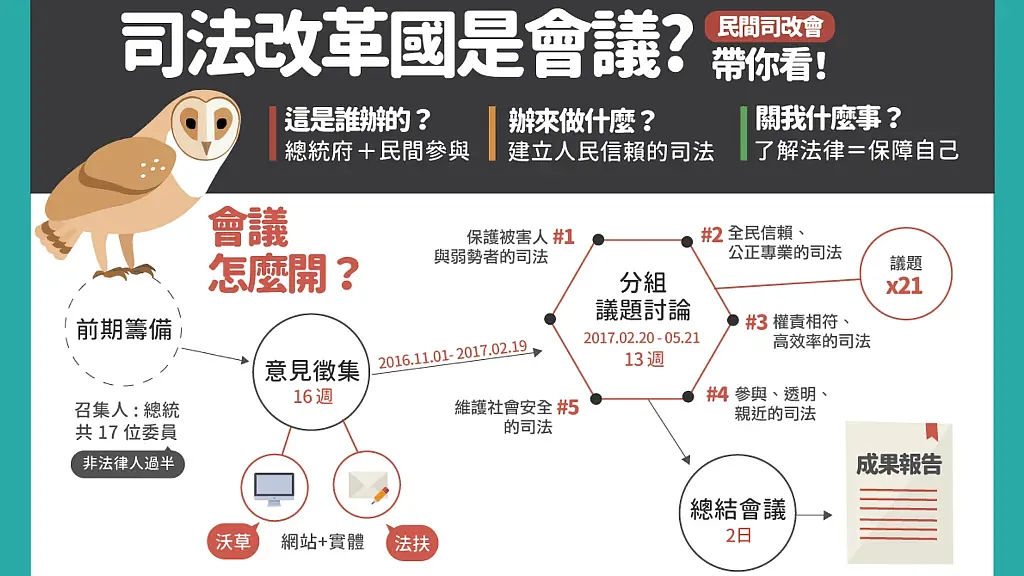
The official National Congress on Judicial Reform officially commenced its first preparatory meeting on November 25, 2016, with President Tsai Ing-wen personally serving as the congress's convener. In fact, official authorities had already officially announced the collection of public judicial opinions starting November 1. The primary platform for collection was the Presidential Office website, though opinion collection was not limited to the internet; citizens could express opinions by writing letters, official documents, phone calls, or even through Legal Aid Foundation offices across various regions. This was similar to the JRF's first stage in openly soliciting opinions from the general public.
However, as noted earlier, such a process of "collecting opinions from the public" is bound to be a "divergent" process, especially when led personally by the President, which inevitably mobilizes considerable societal energy. In short, public opinions would pour in endlessly, leaving staff members tasked with sorting opinions overwhelmed. Perhaps precisely for this reason, the Presidential Office did not set up an "editor" like the JRF to interact with the public. Furthermore, when subsequently "converging" problems, there was no mechanism allowing the public to participate in the process of clustering issues. Due to insufficient degrees of openness and transparency, all of these easily invited criticism.
The adoption of this different approach by the officials may stem from several reasons: First, government agencies lack the freedom and flexibility of civil NGOs. When interacting with the outside world, if an "editor" encounters uncertain issues, they typically need to submit official memos to inquire about appropriate answers. If public inquiries are miscellaneous and numerous, memo ping-pong renders the expression of opinions extremely inefficient. Moreover, the job of an editor itself is a specialty, and acting externally as the institutional facade means that careless remarks can damage the agency's reputation. Therefore, unless editors are fully authorized, decision-makers must personally step onto the front lines to serve as editors. Yet those with decision-making authority are unlikely to spend all day hanging out online interacting with the public, making the possibility of personally serving as editors low. Inefficiency and fear of triggering controversies cause government agencies to shrink back from establishing front-line "editors."
Second, an NGO like the JRF can allow issues to develop freely and even leave the sequencing of issue discussions entirely up to the public. Official practices are typically more conservative and may worry that certain issues will spiral out of control, especially since, ultimately, President Tsai Ing-wen must bear overall responsibility for the success or failure of the National Congress on Judicial Reform, compounded by pressures from established schedules. No matter how flexible they might be, the scale of issues would still be controlled within a manageable scope.
As such, to prove the legitimacy of their approach, the authorities needed to demonstrate that all problems raised by citizens had already been included in the issues compiled by the staff. Subsequent developments showed that critics indeed began pointing out certain issues that should have been included in discussions but were omitted. The official response to such attacks was to state that all issues could be brought up for discussion again, which maintained a certain degree of "openness" and somewhat mitigated criticisms of "manipulating issues." However, observing from the dimension of "maintaining the possibility of participation at any time," it appeared that only preparatory committee members and subcommittee members could directly propose new issues. Once the first stage ended, the public seemed "disconnected" from the official congress and could no longer participate in expressing opinions at any time; public opinions could no longer enter this platform, representing yet another facet of insufficient participation.
Different Degrees of "Expanded Participation and Openness and Transparency"
The official National Congress on Judicial Reform also adopted the model where "non-legal professionals constitute the majority," sharing the same mindset as the JRF in hoping that judicial reform would not be exclusively dominated by legal professionals. However, several subcommittee meetings down the line, the results were less than satisfactory. We can find that this strongly correlates with whether the moderator paid special attention to the needs of non-legal professionals and fostered a friendly and discussion-friendly environment for them.
At the same time, whether meeting materials were prepared so that non-legal professionals could fully absorb them had an absolutely critical impact. Unfortunately, legal professionals locked horns over the selection of issues and the priority of discussions, compressing the time available for staff to prepare materials and reports. Overly tight schedules, an excessive number of issues, and the absence of pre-meeting "issue convergence" work all placed non-legal professionals in a hostile discussion environment. An abundance of issues might not have been a major problem in itself, but serving up un-converged issues directly into meetings rendered proceedings and discussions inefficient, meaning that the threshold for non-legal professionals to step into participatory discussions was not preemptively leveled, severely undercutting the efficacy of the "non-legal professional majority" participation model.
Furthermore, a feature of the JRF's civilian-version prototype was its use of real-time audiovisual livestreaming alongside text broadcasting to spark public interest, using online "editors" of text broadcasts to allow citizens participating online to instantly reflect their own opinions into the venue, making expanded participation a possibility for everyone. This approach simultaneously resolved issues of "representativeness" because, conceptually, "everyone in the country" could express opinions, or even if they could not participate via the internet right away, they could express opinions online before or after the meeting.
However, because the officials did not adopt livestreaming and only posted audiovisuals and verbatim transcripts after meetings, while this may have achieved the goal of "openness and transparency," it evidently retained reservations regarding "expanded participation." Consequently, 1999's disputes over "representativeness" and institutional turf wars predictably re-emerged. Linked to this was the resort to voting for resolutions; whether thorough discussion and reasoning were thereby eroded, relapsing into the position-driven voting model of 1999, warrants further observation.
Official Integration of "Causes" and "Solutions" Is Unfavorable to Discussion
Finally, the official approach evidently merged the second and third stages of the JRF model into a single discussion. Official authorities organized issues gathered from initial public opinion collection through staff and the preparatory committee, and without convergence via initial reports, threw them directly into various subcommittees for discussion. Aside from failing to divide discussions into two stages of "causes" or "solutions," no intended outcomes of the discussions were preset either.
We worry that this approach may fall into the pitfalls we observed in the 1999 National Judicial Reform Conference. Because legal professionals are eager to propose "solutions" for all issues without first moving backward to confirm and analyze the "causes" of problems, non-legal professionals find it difficult to get a word in edgewise. Furthermore, legal professionals easily fall into doctrinal and ideological disputes, constantly agitating that the "solutions" they propose are the sole correct answers. If matters thus devolve into petty bickering and repeat the mistakes of 1999, it would truly be a regrettable waste of another fine opportunity for reform.
This article is an AI-generated translation of the original Chinese text. In the event of any discrepancy, the Chinese version shall prevail.