
An Agreement in a Parallel Universe ~ Hopes that the Convention on the Rights of Persons with Disabilities Marks the Beginning of the Government's Awakening to Disability Consciousness
Last edited: 2026-08-29
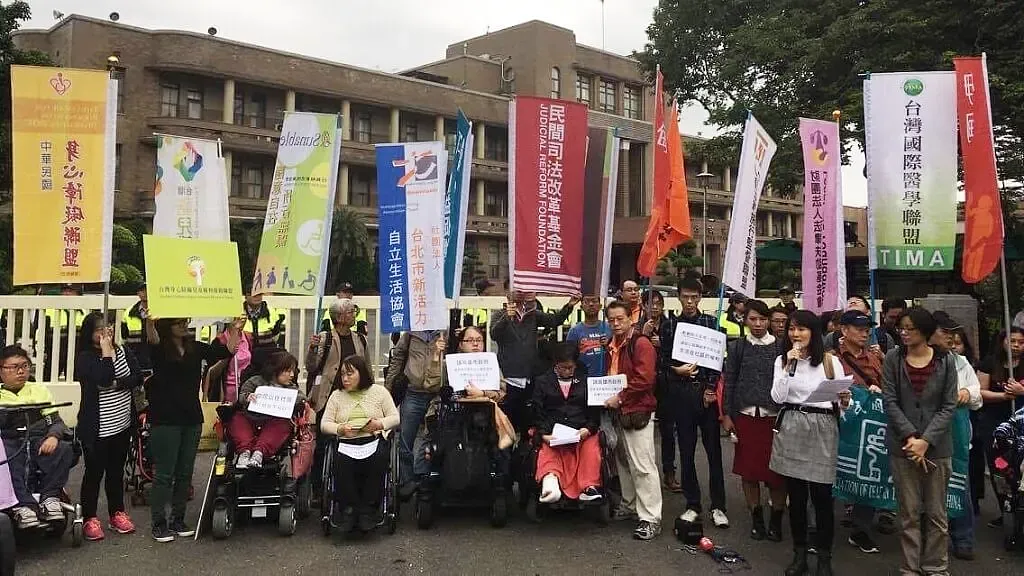
Joint Press Conference by Civil Society Organizations Following the Presentation of Concluding Observations and Recommendations from the Initial CRPD State Report International Review
Joint Statement
Overall, government officials lack human rights literacy and failed to comprehend the committee members' inquiries during the review. The members' questions precisely targeted the limitations of current policies and regulations; however, officials invariably responded in accordance with existing regulations, repeating old refrains without gaining new concepts or perspectives through the CRPD review. It is recommended that government officials hold internal seminars following the review to carefully study the true meaning behind the committee members' questions.
During the review process, government units repeatedly boasted about how many programs they have implemented and how many services they provide. On one hand, they clearly fail to recognize the shortcomings in current laws (such as why persons under guardianship should not be deprived of their right to vote, and why forced hospitalization violates the CRPD); on the other hand, they are unwilling to admit the massive gap between the needs of persons with disabilities and the government's capacity. While some gaps are indeed attributable to resource scarcity, many more involve the government's administrative direction (such as replacing institutionalization with community-based services). The policy-making process and administrative outcomes of the government must be subject to monitoring, and such monitoring mechanisms must ensure the full participation of persons with disabilities.
Persons with disabilities have unmet needs, which include various support services, education, and employment guarantees that the government ought to provide. The government must face the reality that many persons with disabilities are unable to attain basic dignity, and this fact should prompt the government to comprehensively review its tax policies and budget to ensure that everyone enjoys basic human rights and dignity. The government's overall tax revenue is insufficient, ranking at the bottom among economically developed countries, which causes various needs to crowd each other out and results in social injustice.
The government should establish an independent National Human Rights Commission at an early date to monitor the realization of all rights for persons with disabilities.
The Executive Yuan level should strengthen its coordination capacity. The Executive Yuan should possess adequate human resources with expertise in human rights regarding human rights affairs to ensure that the government complies with human rights principles such as full participation, equality and non-discrimination, accountability, and remedies. The Executive Yuan should consolidate currently fragmented human rights-related affairs and establish a "Department of Human Rights" to enhance the human rights competence of all ministries and commissions, and to grant full participation to children, women, indigenous peoples, and others facing multiple and intersecting discriminations.
Thematic Statements
Access to Justice
Judicial personnel in our country generally lack sufficient understanding of persons with disabilities, leading them to easily overlook the plight of persons with disabilities in litigation, fail to perceive the needs of persons with disabilities at the earliest instance, and immediately provide necessary assistance in litigation. Furthermore, the accessibility equipment in courts and prosecutors' offices remains inadequate, and there is a shortage of funds for psychiatric evaluations, all of which still await improvement.
Moreover, even though our country has explicitly granted domestic legal effect to the two Covenants and the Convention on the Rights of Persons with Disabilities, in judicial trial practice, courts at all levels still harbor many doubts in the application of laws regarding whether the aforementioned covenants provide sufficient guarantees for the right to life of persons with psychosocial disabilities. Consequently, during trials and related evidence-investigation procedures, courts often invoke the reasoning that the aforesaid covenants do not prevent courts from sentencing persons with psychosocial disabilities to death, or — contrary to strict medical evidence — narrowly restrict the determination of psychosocial disabilities, thereby subjecting defendants to capital punishment as individuals without psychosocial disabilities. These actions represent deliberate evasion of the aforementioned covenants by judicial practice.
Regarding prison reform, in addition to promoting a lawful, reciprocal, and fair platform for grassroots labor unions to protect labor and lawful education and to supplement resources, laws that infringe upon prison discipline and inmates' labor, as well as draconian laws that deprive persons with disabilities of basic living guarantees, must be immediately repealed and their rights restored. Furthermore, correctional institutions that are unfit and difficult to reform must be phased out, remote areas must be provided with adequate medical resources, and domestic correctional institutions must be thoroughly inspected to address and implement deficiencies.
We found that at the convention review meeting, government representatives gave evasive answers to the committee members' inquiries, or merely read out current laws in response, causing the meeting to lose focus and leaving us deeply disappointed. We hereby call upon competent authorities such as the Judicial Yuan and the Ministry of Justice to comprehensively review existing laws, establish monitoring mechanisms, and actively train judicial personnel in order to provide an equal and friendly judicial environment for persons with disabilities and truly fulfill the requirements of the Convention on the Rights of Persons with Disabilities.
Liberty and Security of Person
The government must fully implement Article 14 of the CRPD and confront the abolition of systems for emergency placement, forced hospitalization, and mandatory community treatment, turning what is currently the sole option into one of many choices. The government should construct and provide peer support services for persons with psychosocial disabilities, including peer support specialists and peer workers. Moreover, the government should provide non-medical crisis-period services offering diverse support when persons with psychosocial disabilities experience or exhibit mental crises, including community support, peer support, family support, and safe spaces. This will assist individuals in living with necessary support within their families and communities without losing their personal liberty, while granting patients greater autonomy and more interaction with their families; it will also assist families in obtaining more opportunities for emotional support from families of other patients while serving as economic pillars. At the same time, community support should foster closer interaction in the relationship between patients and families rather than confrontation.
Establishing community support services for persons with psychosocial disabilities admits of no delay, such as: 24/7 outreach emergency crisis response teams provided in the community, family support services, and peer support services, so as to provide channels for patients or families to seek assistance, along with the supportive services necessary for living and personal development in the community.
Prior to fully abolishing forced hospitalization and constructing comprehensive support, the Mental Health Act must strengthen due process regarding personal liberty and humane treatment, and provide diverse support networks and immediate support channels for families.
The government must fully implement Article 5 of the CRPD to completely eradicate discrimination by the state and society against persons with disabilities. In particular, persons with psychosocial disabilities have long lived under stigma and discrimination, which affects their enjoyment of all rights, including living in the community. We hereby call upon the government to not only thoroughly review and amend discriminatory regulations, but also ensure that competent authorities effectively execute reviews and penalties for discriminatory cases, and prevent laws such as the People with Disabilities Rights Protection Act and the Mental Health Act from becoming dead letters. Particularly when media reports involve discrimination or inappropriately guide readers and viewers to link crime, violence, and danger with persons with psychosocial disabilities to a certain degree, the stigma against persons with psychosocial disabilities is exacerbated and rendered more prone to occurrence. The government has a responsibility to prevent such incidents from continuing to happen.
Sign Language Is Not Only Accessible Information But Also Deaf Culture
Here we reiterate the deficiency of the Taiwan Sign Language environment: currently, most hearing teachers in schools for the deaf "do not know sign language." We insist that "Taiwan Sign Language" become the primary language used in schools for the deaf, rather than manually coded Chinese! Everyone in schools for the deaf should possess basic proficiency in using Taiwan Sign Language.
The Ministry of Education should immediately cease investing massive resources in promoting "manually coded Chinese" and must promptly correct this by promoting the teaching and use of "Taiwan Sign Language" and "Written Chinese," enabling Deaf people to attain bilingual proficiency in Taiwan Sign Language and Written Chinese to increase their competitiveness and equality. It should actively cultivate a talent pool of Deaf teachers and restore the opportunities and capacity of Deaf people to participate in Deaf education reform. What the Ministry of Culture needs to do is not collection and preservation, but the active promotion of Taiwan Sign Language.
We demand that when government departments host educational expert meetings or related policy meetings concerning Deaf people, they must invite Deaf representatives whose first language is Taiwan Sign Language to participate and guarantee their right to speak, with the participation rate of Deaf people reaching at least one-third.
Pursuant to Article 30, paragraph 4 of the CRPD, "Participation in cultural life, recreation, leisure and sport," which stipulates that "Persons with disabilities shall be entitled, on an equal basis with others, to recognition and support of their specific cultural and linguistic identity, including sign language and deaf culture," the government should restore to Deaf people whose native language is Taiwan Sign Language the right to equally participate in government meetings, and legislate or amend laws to protect their rights in compilation and editing, interpretation, teaching, and tiered sign language translation competency assessment.
Rights of Children with Disabilities
Discussions in Taiwan concerning children with disabilities generally focus on care and medical treatment, rarely considering the dimensions of self-advocacy rights and needs of children with disabilities. We hope the state will take as its goal the service and assistance of children with disabilities so that their physical and mental well-being receives proper care and educational growth, while helping caregivers acquire adequate caregiving capacity and knowledge.
Children are the future masters of the country, and children with disabilities are no exception; yet, the plight of children with disabilities places them in a double-disadvantaged position. We hope the state will squarely face the needs, development, and human rights of children with disabilities, treat them as independent individuals, and strive to eliminate barriers so that they, too, can equally participate.
Adequate Standard of Living and Social Protection
Article 28 of the Convention on the Rights of Persons with Disabilities — Adequate Standard of Living and Social Protection — stipulates that persons with disabilities shall have access to adequate food, clothing, housing, and the continuous improvement of living conditions. However, persons with disabilities in Taiwan who reach the age of 20 are still not regarded as independent individuals exercising their rights. Safeguarding basic human rights relies on the support of numerous social welfare services, but service design and subsidies are determined by family economic or labor conditions; consequently, they cannot enjoy the right to live equally like ordinary people. This causes annuities and allowances for persons with disabilities in Taiwan to fall below NT$5,000 per month, while the subsidy threshold for low-income households is tied to family finances based on the reciprocal obligation of support under our Civil Code. This fails to conform to the current reality of modern nuclear families, aging, and diverse family compositions. Therefore, we advocate that economic subsidies for persons with disabilities should be calculated to meet basic adequate needs, without means-testing, to prevent living subsidies from being lost due to earned income, which would create a disguised disincentive preventing persons with disabilities from entering the labor market, thereby aligning with the spirit of the Convention on the Rights of Persons with Disabilities.
Independent Living and Inclusion in the Community
Persons with disabilities struggle to secure stable incomes, and their daily living expenses are higher than those of ordinary people. Many services provided by the government must be "purchased at high prices," making it difficult to acquire support services for personal needs or to determine the kind of life they wish to lead. Coupled with the fact that these services are fraught with restrictions and fragmented, failing to meet actual needs, we therefore demand that the government must not provide high-priced services so as to prevent the creation of class divisions and discrimination within the disability community. The service provision process should emphasize individualized design, with particular support given to community living, such as personal assistants for community living and home care workers. There should be no hourly limits; rather, individualized human support should be provided according to actual needs, and out-of-pocket expenses must not render persons with disabilities unable to afford service utilization. Social housing, rental subsidies, and barrier-free space renovations should be supported with subsidies so that persons with disabilities residing in the community can "live in them affordably, rent them affordably, and use them successfully!"
Accessibility
Accessibility is a prerequisite for persons with disabilities to achieve independent living and full, equal participation in society. The government should put forth a comprehensive accessibility plan, budget, and timeline. The government's concept of "accessibility" has been restricted solely to the physical environment, and regulations for existing buildings cover only specific types of structures. Environments, facilities, exhibitions, services, and other places open to use or to the public beyond buildings — along with transportation — must be fully accessible. The provision of information must take into account both substantive and formal accessibility, including the development of important communication professional personnel and the application of assistive technologies such as sign language, speech-to-text, subtitles, T-coils, audio description, and e-books. Play environments and facilities of utmost importance to children's social participation should be comprehensively inclusive, and state construction should be comprehensively reviewed and required in accordance with the spirit of the convention. When formulating accessibility standards, the government should categorize them from the perspective of the complete life aspects of persons with disabilities, aiming to ensure that everyone can participate and use them by choice, rather than bestowing accessibility needs like petty favors based on unreasonably low proportions such as a minority or one percent.
Co-signing Organizations
Covenants Watch
LIMA Taiwan Indigenous Youth Group
Three Deaf Two Hearing Group
Taipei New Vitality Independent Living Association
Barrier-Free Association of Taipei
Taiwan Association for Human Rights
Taiwan Indigenous Peoples Policy Association
Taiwan Alliance to End the Death Penalty
Taiwan Association for Prisoners' Rights
Taiwan Transcend Epilepsy Care Alliance
Taiwan Association for Children's Rights of Persons with Disabilities
Taiwan Queer Rights Promotion Alliance
Taiwan Access for All Association
Hand Angel
New Taipei City Rehabilitation Friendship Association
Judicial Reform Foundation
Legal Aid Foundation
This article is an AI-generated translation of the original Chinese text. In the event of any discrepancy, the Chinese version shall prevail.