
Controversial Judge Elected, Tarnishing the Judges Evaluation System
Last edited: 2026-08-29
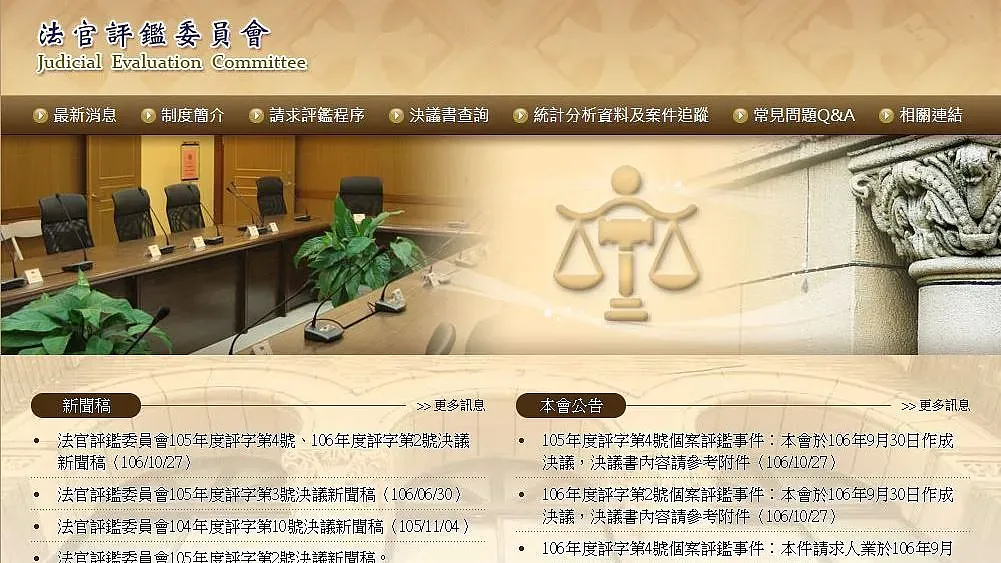
Photo / Retrieved from the official website of the Judges Evaluation Commission
Recently, the results of the ballot for judge representatives to the Judges Evaluation Committee were released. Surprisingly, Judge Lin Chou-fu (林洲富) won the highest number of votes to become a member of the next Committee, meaning he secured the most "public opinion" support from fellow judges. Why is Judge Lin's election controversial?
Under the framework of the Judges Act, the Judges Evaluation Committee is responsible for the judges evaluation system and functions to weed out or penalize incompetent judges. The Committee is composed of 11 members, including 3 judges, 1 prosecutor, 3 attorneys, and 4 scholars and impartial members of society. Among them, the judge representatives on the Committee are elected through a general ballot by all judges and serve a two-year term.
Around 2010, a major judicial ethics and discipline scandal erupted, causing public trust in the judiciary to plummet to unprecedented lows. Supreme Court Judge Hsiao Yang-kuei (蕭仰歸) lobbied for his son's hit-and-run case and was penalized by the Commission on the Disciplinary Sanctions of Functionaries with "suspension from office for 6 months." High Court Judge Kao Ming-che (高明哲), who accepted the lobbying, was also penalized by the Disciplinary Commission with a "demotion by two grades in official rank."
The resolution of the Disciplinary Commission stated that Hsiao Yang-kuei first lobbied the presiding judge of the first instance trying his son's case, but the presiding judge remained unmoved and delivered a guilty verdict. After the case was appealed to the High Court, Hsiao Yang-kuei lobbied Kao Ming-che, the presiding judge of the second instance handling the case, asking him to acquit his son.
After being lobbied, Presiding Judge Kao Ming-che, while deliberating the case with two other judges, learned that the assigned judge Kao Yu-shun (高玉舜) expressed intent to deliver a "guilty verdict." Kao Ming-che immediately stated that "what Hsiao Yang-kuei wants is an acquittal." As their opinions clashed irreconcilably, Kao Ming-che proceeded to draft the "acquittal" judgment himself. The crucial accompanying judge, Lin Chou-fu, signed the judgment changing the verdict to "acquittal," and thus the deliberation of this case ultimately concluded with a 2-to-1 result, finalizing the acquittal.
Must Have the Courage to Denounce Unlawful Acts
During the deliberation, Kao Ming-che mentioned to Kao Yu-shun and Lin Chou-fu that Hsiao Yang-kuei had lobbied him, a fact that was verified and established by the Disciplinary Commission. However, when testifying during the prosecutor's interrogation, Lin Chou-fu "denied" that Kao Ming-che had mentioned Hsiao Yang-kuei's lobbying during their deliberation. Consequently, the Disciplinary Commission determined that this part of Lin Chou-fu's testimony was untrustworthy.
Whether Lin Chou-fu was "influenced" by Kao Ming-che to sign the acquittal judgment remains unknown. However, during the deliberation, Lin Chou-fu learned of Hsiao Yang-kuei's lobbying of Kao Ming-che, yet not only failed to report it to his superior, the President of the High Court, but also denied having heard about the lobbying. With his statements deemed untruthful by the Disciplinary Commission, Lin Chou-fu's conduct arguably went beyond a mere ethical or disciplinary lapse.
Judging by this incident, Judge Lin Chou-fu's moral standards are arguably too low, making him unsuited to serve as a member of the Judges Evaluation Committee, and he should "know when to gracefully step down." Serving as a member of the Committee requires even greater moral courage to denounce unlawful peers when handling judge evaluation cases, rather than engaging in complacent protectionism. Given his past performance of turning a blind eye to witnessed wrongdoing, how can one expect him to make decisions penalizing incompetent judges?
Corroborating the Failure of Judicial Self-Discipline
Judge Lin Chou-fu's election to the Committee demonstrates that the judicial community still harbors a mindset of examining judges using the "lowest standards," hoping someone within the Committee will speak up for judges, thereby corroborating the failure of judicial self-discipline under insular departmentalism. Having such a judge serve as an evaluation member obliterates the painstaking efforts of judges who have been striving from within for self-reflection and reform over the past few years. On one hand, the Judicial Yuan flies the banner of judicial reform, yet on the other hand, it allows such a person to serve as an evaluation member — how can this possibly boost public trust in the judiciary?
※This article was published in the Apple Daily on 2017/11/16
This article is an AI-generated translation of the original Chinese text. In the event of any discrepancy, the Chinese version shall prevail.