
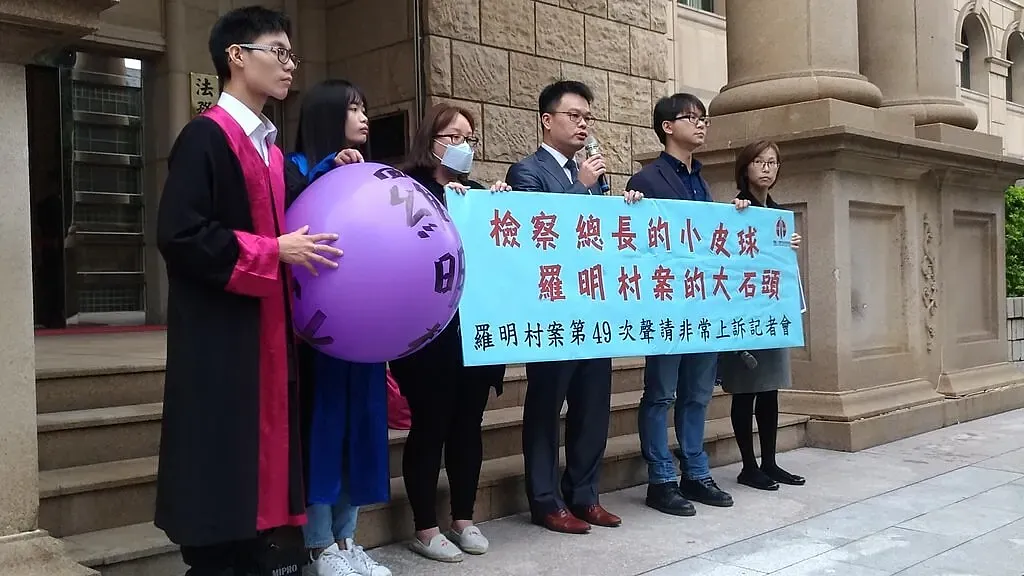
The Lo Ming-ts'un Case: A Miscarriage of Justice Tossed Around Like a Ping-Pong Ball
Last edited: 2026-07-27
Lo Ming-ts'un is the former head of the Criminal Investigation Division at the New Taipei City Police Department's Hsinchuang Precinct. He was convicted of taking bribes in breach of official duties and sentenced to 13 years in prison. The court determined that while serving as the division head in 1997, he accepted bribes to cover up a substitute-suspect shooting case. However, this case is, in fact, a miscarriage of justice.
-
The case lacks physical evidence and relies primarily on testimonies obtained through improper interrogation to secure a conviction.
The basis for conviction in this case rests mainly on the testimonies of individuals involved in the substitute-suspect shooting case, who claimed that Lo Ming-ts'un accepted money to shield the true perpetrator of the shooting and allowed someone else to take the fall. However, prior to being brought to the investigation station for questioning, those involved admitted to the substitute-suspect plot but did not once mention that Lo Ming-ts'un accepted money to cover it up. Later, after the case entered the court system, they all retracted their statements, testifying that Lo Ming-ts'un never took bribes nor knew anything about the substitution, and that they had only cooperated and given those statements because they were threatened and induced by investigators.
-
Lo Ming-ts'un had an alibi for the time the court determined he met with the briber.
Despite obvious flaws in how the testimonies were obtained, the court nevertheless relied on them to conclude that Lo Ming-ts'un accepted bribes and provided a cover-up. Even more unreasonably, Lo Ming-ts'un had an alibi for the exact time the court claimed he met with the briber.
The court asserted that Lo Ming-ts'un met with the briber at a teahouse on the evenings of November 7 and November 9, 1997. However, on the evening of November 7, 1997, Lo Ming-ts'un was attending a meeting at the Hsinchuang Precinct, which is corroborated by his signature in the meeting records. Following the conclusion of the meeting that night, Lo Ming-ts'un also had a firearm checkout record at 22:00. Furthermore, on November 9, Lo Ming-ts'un went out to investigate a case with two other police officers at 16:00, and there were no records of him leaving again after his return, as evidenced by the sign-in/sign-out logbook.
-
The lie detector test report used by the court as corroborating evidence for the conviction is flawed.
In this case, the court also used the fact that Lo Ming-ts'un failed a lie detector test to deem his defense—that he never took bribes and knew nothing about the substitute-suspect plot—unworthy of belief. However, the original lie detector procedure was riddled with flaws. The most obvious flaw was that, due to a heart condition, Lo Ming-ts'un was physically unable to complete the entire lie detector procedure, yet the polygraph examiner subsequently forged Lo Ming-ts'un's signature on his behalf.
It Should Have Resulted in a Final Acquittal, but a Twist of Fate Turned It into a Conviction
Lo Ming-ts'un was found guilty in the first and second instances, but the third instance (Supreme Court) revoked the judgment and remanded the case. During the retrial (first remanding instance), his case reversed and he was acquitted. The turning point of this reversal was that the retrial court examined the video recordings of the interrogation at the investigation station and the lie detector test, allowing the court to squarely face the flaws in the interrogation and polygraph processes.
After the retrial acquittal was handed down, Lo Ming-ts'un initially believed that the prosecutor had appealed past the deadline and that his acquittal had thus become final. Unexpectedly, the Supreme Court revoked and remanded the case once again, and the second remanding instance court completely disregarded the evidence favorable to Lo Ming-ts'un, convicting him once more. Finally, Lo Ming-ts'un's appeal to the third instance was dismissed, making his conviction final.
Unwilling to accept this miscarriage of justice and imprisonment, Lo Ming-ts'un fled overseas, and his family sought assistance from the JRF. Due to the numerous flaws in this case, the JRF assisted Lo Ming-ts'un in filing a petition with the Control Yuan. In April 2013, the Control Yuan issued an investigation report concluding that improper interrogation had occurred in this case and that the prosecutor's appeal may have been filed past the statutory deadline.
Regarding the prosecutor's overdue appeal, the Control Yuan cross-referenced the timestamps of when everyone received the judgment, reviewed the logbooks recording the delivery times, and interviewed court bailiffs. It concluded that the retrial acquittal judgment was dispatched as early as January 28, 2002, and the bailiff placed the judgment on the prosecutor's desk where it was accessible. Yet, the prosecutor refused to sign for it, dragging it out until February 18, 2002, before finally signing, and did not file an appeal until February 25. The prosecutor's ability to sign for the judgment yet intentionally delaying doing so was an old, ingrained practice in Taiwan regarding the留置送達 (service by leaving the document at the recipient's residence/office) of judgments. The rationale was to allow victims sufficient time to petition the prosecutor to appeal, but in practice, it served to circumvent the statutory unalterable period for appeals. According to the law, the appeal period is 10 days. The prosecutor in this case effectively received the judgment on January 28, 2002, and therefore should have filed an appeal by February 7, 2002. Because the appeal was not filed within the statutory period, the case should have been finalized as an acquittal.
A Miscarriage of Justice Treated Like a Ping-Pong Ball: We Hope the Prosecutor-General Will Courageously Receive the Serve!
After fleeing abroad, Lo Ming-ts'un continuously drafted applications for extraordinary appeals to the Prosecutor-General—this was how he maintained his will to survive. Following the Control Yuan's release of its investigation report, Lo Ming-ts'un once again petitioned the Prosecutor-General for an extraordinary appeal. The Prosecutor-General rejected his application, telling Lo Ming-ts'un that he should instead petition the court for a retrial. Acting on the Prosecutor-General's suggestion, Lo Ming-ts'un petitioned the court for a retrial. Although the court acknowledged that the new evidence presented by Lo Ming-ts'un was sufficient to initiate a retrial, it simultaneously held that since Lo Ming-ts'un should have long been acquitted under the law, there was no longer a legal basis to initiate a retrial. Consequently, the court dismissed his application and suggested that he instead petition the Prosecutor-General for an extraordinary appeal. The case was thus kicked back and forth like a ping-pong ball, leaving the applicant completely at a loss as to what to do.
To understand why this case has been kicked around like this, one must first understand the post-conviction relief channels and which circumstances warrant which channel. In Taiwan, after a defendant is convicted with finality, there are two main avenues of relief: retrial and extraordinary appeal.
- Petitions for a retrial are handled by the court and primarily address errors in the factual determinations of a judgment. A common ground for a retrial petition is the discovery of new evidence sufficient to overturn the original judgment.
- Petitions for an extraordinary appeal are handled by the Prosecutor-General and primarily address judicial proceedings that violate the law. Situations that do not involve factual disputes and are purely legal errors are typical cases handled via extraordinary appeals.
Lo Ming-ts'un's case presented the following scenario: After the judgment became final, new evidence was discovered proving that the original judicial proceedings violated the law. Should one pursue a retrial or an extraordinary appeal in this situation?
When Lo Ming-ts'un petitioned the Prosecutor-General for an extraordinary appeal on the grounds that the prosecutor's appeal was overdue, the Prosecutor-General rejected him. The reasoning was that whether the prosecutor's appeal was overdue involved the investigation of new evidence and should not go through an extraordinary appeal, but rather a retrial. However, when Lo Ming-ts'un petitioned the court for a retrial, the court also rejected him, reasoning that because the prosecutor's appeal was overdue, the case should have already been finalized as an acquittal during the first retrial instance. The courts in subsequent instances should never have rendered a judgment at all, making those judgments violations of the law. Furthermore, if the appeal was overdue, the original retrial-acquittal judgment would have long been final, rendering all subsequent judgments entirely void—leaving no valid judgment left to be the subject of a retrial. Under such circumstances, the unlawful judgments that should never have existed in the first place must be revoked through the extraordinary appeal procedure.
For ordinary citizens, the bottom line is that the case had procedural errors and was wrongly judged, so there must be a way to seek relief. Taiwan established both retrial and extraordinary appeal remedies not for courts and the Prosecutor-General to play ping-pong with each other. Now that the court has explicitly pointed out that Lo Ming-ts'un's case should pursue an extraordinary appeal, we hope the Prosecutor-General will attach importance to the legal interpretations put forward by the court, file an extraordinary appeal for this case, and stop letting it remain a judicial ping-pong ball that no one is willing to handle.
This article is an AI-generated translation of the original Chinese text. In the event of any discrepancy, the Chinese version shall prevail.