
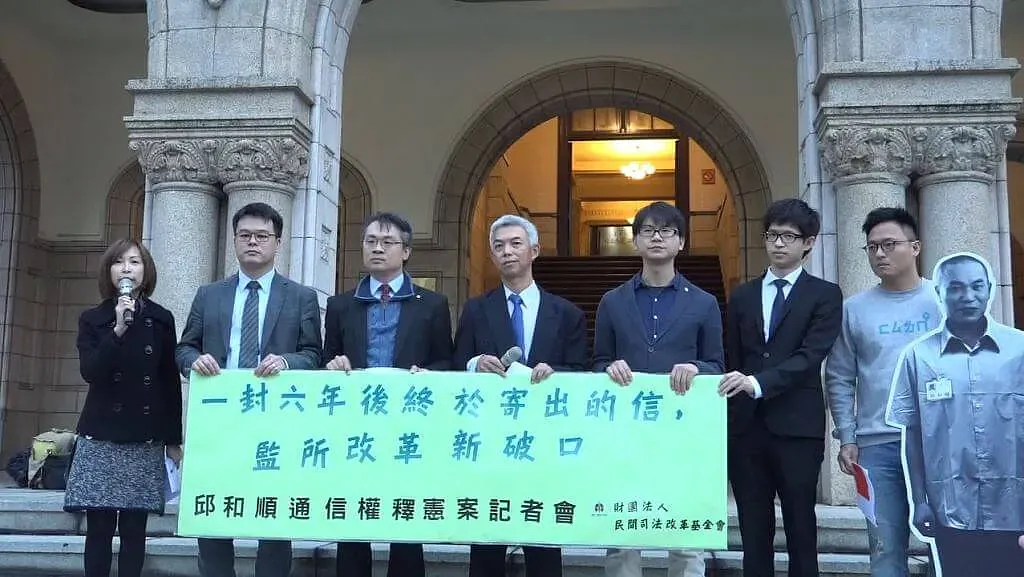
A Letter Finally Sent After Six Years! A New Breakthrough in Prison Reform: Press Conference on Chiou Ho-shun's Right to Prison Correspondence (Constitutional Interpretation Nos. 755 and 756)
Last edited: 2026-08-29
Ever since the authoritarian era, Taiwan's prisons have long been criticized by various sectors for their appalling conditions and disciplinary problems. The key difficulty in reform lies in the fact that the external communications of prisoners and detainees are entirely subject to prison inspection. Consequently, even when subjected to unfair treatment in correctional facilities, prisoners and detainees find it difficult to let the outside world know. Without external awareness of the harsh realities behind the prison walls, prisons naturally have no impetus to reform. A widely known example from the past is how the letters, memoirs, and diaries written in prison by the democracy activist Lei Chen were forcibly confiscated and burned by prison authorities. To prevent prisoners and detainees from exposing dark secrets within the system, prisons have routinely restricted their freedom of communication to block the leakage of human rights violations or illegal acts. As a result, prison conditions have remained unimproved for a long time — overcrowded and with appalling basic living standards. The Kaohsiung Prison hostage-taking incident a few years ago is clear proof that prison conditions are in urgent need of reform. Furthermore, in the extradition case of British businessman Zain Dean, Scotland's High Court of Justiciary ruled that Taiwan's prison conditions do not meet European human rights standards, determining that extraditing Dean to a Taiwanese prison would constitute "torture" or "inhuman or degrading treatment or punishment." This made correctional facilities a major stain on Taiwan's international human rights record. A prison environment that is the laughingstock of the international community proves that prison reform in Taiwan is imperative.

This case originated from a letter sent from inside the detention center by Chiou Ho-shun, a prisoner in a wrongful conviction case. The letter detailed how, during his long years of detention, he had witnessed prison guards selling drugs and inmates engaging in collective drug use inside the detention center. However, the detention center refused to send the letter on the grounds that it might "disrupt prison discipline." Dissatisfied with this decision, Chiou filed an administrative suit and, upon exhausting all avenues of relief, filed a petition for constitutional interpretation. Today (the 1st), the Grand Justices delivered Constitutional Interpretation Nos. 755 and 756. The pro bono legal team for the Chiou Ho-shun case issues the following statement:
The Right to Communication for Prisoners and Detainees Creates a New Breakthrough for Prison Reform
For prisoners and detainees behind bars, one of the primary ways to establish or maintain relationships with the outside world is through "communication." Unless there are reasonable and necessary reasons to maintain prison discipline, correctional facilities must not arbitrarily deprive them of this right, lest it hinder the ultimate goal of reintegrating the vast majority of prisoners and detainees back into society. The Prison Act authorized prison wardens to use the vague pretext of "risk of disrupting prison discipline" to indefinitely open and review letters sent and received by prisoners and detainees, and allowed wardens to alter or delete the contents of correspondence based on their own subjective judgment. If an inmate refused the alterations, the letter could not be mailed. This has already infringed upon the privacy and secret communication rights of prisoners and detainees, and interfered with their freedom of speech and thought.
This Interpretation declares Article 66 of the Prison Act unconstitutional for unrestrictedly allowing prisons to read mail. Aside from returning the right to communication to prisoners and detainees, it holds the crucial value of creating a breakthrough for the advancement of human rights in correctional facilities. Only when the right to communication of prisoners and detainees is protected can abuses — which easily stem from the power-subordinate relationship between administrative staff and inmates — be exposed through letters of appeal, accusation, or even requests for help sent to the outside world. (Constitutional Interpretation No. 756)
Comprehensive Dissolution of Special Power Relations, Re-establishment of the Rule of Law Principle
The right of the people to institute legal proceedings is protected by the Constitution and shall not be treated differently based on one's status or social standing. Although prisoners and detainees are confined in correctional facilities, the doors of the court must still remain open to them. In the past, providing only internal grievance channels for prisoners and detainees meant that even when they suffered unfair treatment or had their rights severely violated, they were sternly rejected by the doors of judicial relief.
This time, the Grand Justices declared Article 6 and Article 5, Paragraph 1, Subparagraph 7 of the Enforcement Rules of the Prison Act unconstitutional, ruling that prisoners must be granted the right to judicial relief when dissatisfied with prison disciplinary measures. This dismantles the special power relations and deserves affirmation for its contribution to implementing the principle of the rule of law. (Constitutional Interpretation No. 755)
Chiou Ho-shun's Wrongful Conviction Case Still Awaits Assistance After 30 Years
"Wrongful convictions" often become important catalysts for judicial progress in Taiwan. Although the Chiou Ho-shun case — shrouded in the shadows of torture and flaws in the investigative process — has traded thirty years of blood, tears, and wrongful imprisonment to petition for constitutional interpretation and bring about progress in prison human rights, he still awaits judicial relief through constitutional interpretation for the unfair trials he suffered due to numerous unconstitutional aspects of the current criminal procedure system. The pro bono legal team will continue to file petitions for constitutional interpretation regarding the unconstitutional litigation system involved in this case, hoping that Chiou's miscarriage of justice will not only promote the advancement of prison human rights, but also drive a comprehensive overhaul of the criminal procedure system. In addition, the legal team will continue to seek a retrial for Chiou, and hereby calls upon the judiciary to grant Chiou an opportunity for vindication, leaving no room for injustice or error, while also urging the public to continue paying attention to this case.
Attendees
Representatives of the Pro Bono Legal Team for the Chiou Ho-shun Case
- Attorney Yu Po-hsiang
- Attorney Lin Chun-hung
- Attorney Cheng Kai-hung
- Attorney Chou Yu-hsiu
- Attorney Lo Shih-hsiang
Representatives of Rescue Organizations
- Attorney Chen Yu-fan, Deputy Executive Director of the Judicial Reform Foundation
Press Contact
Pro Bono Legal Team for the Chiou Ho-shun Case Attorney Yu Po-hsiang 02-23681966
This article is an AI-generated translation of the original Chinese text. In the event of any discrepancy, the Chinese version shall prevail.