
Pilot Both Jury Trial and Lay Assessor Systems to Let Citizens Truly Judge
Last edited: 2026-08-29
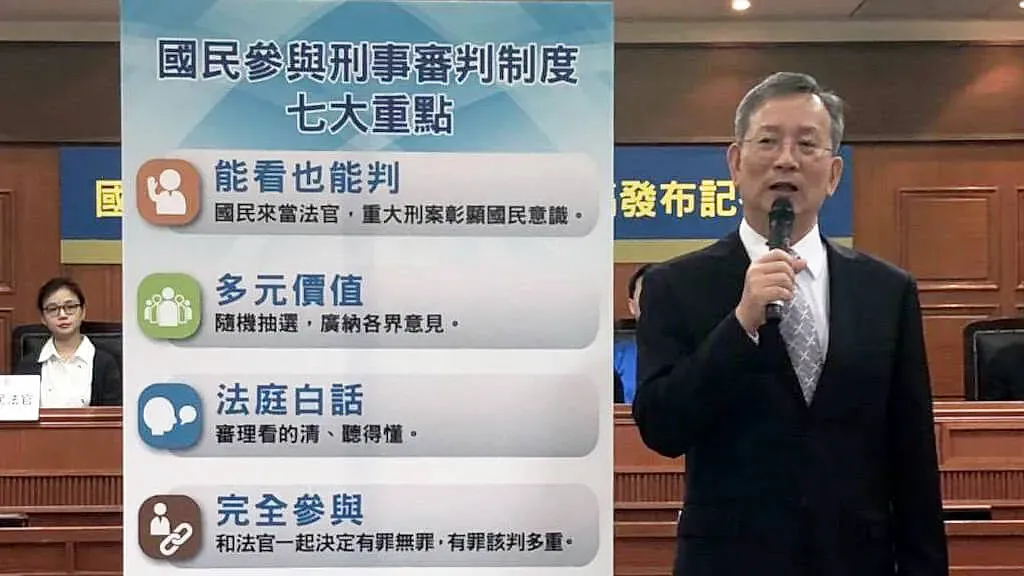
Photo / Retrieved from the Judicial Yuan Press Release
The Judicial Yuan recently released the draft of what would become the Citizen Judges Act (國民法官法, then circulated as the draft Act on Criminal Trials with Citizen Participation), adopting a "lay assessor system" similar to Japan's. Once the draft passes, citizens aged 23 and above will have the opportunity to enter the court and serve as "citizen judges" participating in criminal trials.
Involving "laypersons" without legal expertise in criminal trial procedures is a common trend among advanced nations. The Judicial Yuan began discussing this 30 years ago and even drafted provisional regulations for a trial implementation of the lay assessor system in criminal cases, but legislation was ultimately never completed. In 2011, the Judicial Yuan attempted to promote its uniquely devised "Advisory Jury System" (also known as the "lay observer system"), but the attempt failed, which nevertheless sparked a high-intensity debate on the respective merits and demerits of the "jury system" and the "lay assessor system."
The most crucial difference between the American-style jury system and the Japanese lay assessor system is that in the former, the people discuss among "themselves" and determine whether the defendant committed the crime, and judges cannot participate in the discussion; whereas in the latter, judges and citizens discuss whether the defendant committed the crime "together."
The advantage of a jury lies in its being a collective of diverse individuals, a gathering of diverse experiences. Compared to professional judges who, due to the nature of their work, consciously avoid inappropriate expressions — which also tends to make their social circles relatively narrow and their social experience more limited — juries perform better in overcoming biases, remembering more evidence, and pondering the implications of evidence. However, having citizens discuss amongst themselves also raises concerns about being time-consuming and prone to rambling without focusing. As for the lay assessor system, its biggest problem is that professional judges participate in the discussion; while this can guide citizens to discuss in an orderly fashion, it also leads to the "authority effect" influencing citizens' decisions, thereby weakening the advantages of collective discussion among diverse individuals. The shortcomings of the former happen to be the strengths of the latter, and vice versa.
 Photo / The mock jury trial organized by the JRF—Jury swearing-in
Both systems have their own merits and distinct characteristics. Amid fierce discussions by committee members of Subcommittee Four at the National Congress on Judicial Reform, which concluded just this August, the voting result failed to reach the majority resolution threshold for either proposal, making it impossible to form a resolution. One can thus perceive how difficult the choice is.
To decide which system to adopt, one can return to pondering why we should shift from professional judges to having "citizens" participate in trials. A 2011 research survey by Academia Sinica scholars showed that 67% of Taiwanese citizens supported citizen participation in trials, which is correlated with a significant degree of public distrust in judicial verdicts. If the introduction of a citizen participation system is primarily aimed at resolving the issue of judicial trust, then preventing the trial outcome from ultimately remaining the will of professional judges becomes crucially important here.
Observing the design of the Judicial Yuan's draft of what would become the Citizen Judges Act from this perspective, provisions allowing professional judges to influence citizen judges through interim discussions and final deliberations raise major concerns.
According to the draft, professional judges should explain the basic principles of trial, constituent elements of offenses, and legal interpretations to citizen judges "prior" to the trial. During the pre-trial explanation, both prosecutors and defense counsel are present, and any impropriety can serve as grounds for appeal. However, the draft also stipulates that during court proceedings, professional judges can provide supplementary explanations to citizen judges through "interim discussion" procedures. These interim discussions are conducted behind closed doors without being public, and once mental reservation (conviction) is tainted, prosecutors and defense counsel have no opportunity to examine it.
Most problematic is the draft provision stipulating that professional judges and citizen judges "jointly" conduct final deliberations. If not careful, professional judges will influence citizen judges. For instance, a professional judge's conviction can easily be smuggled to citizen judges when explaining and "summarizing the findings of investigations into various pieces of evidence." Because it is conducted in the form of an explanation, citizen judges, under the authority of professional judges, will accept it without doubt.
Under such institutional design, when there is a high probability that the judgment outcome remains the will of professional judges, it is worrying whether the purpose of enhancing judicial trust can be achieved, or if it will merely reduce citizen judges to rubber-stamping for professional judges.
Faced with various doubts, the Judicial Yuan usually cites empirical research from Japan to indicate that during deliberation procedures, lay assessors did not experience oppression or difficulties in expressing opinions or discussions. However, Japanese criminal justice practice differs vastly from Taiwan's; Japan has long been renowned for its high conviction rate of nearly 99.9%, meaning that cases prosecuted by prosecutors are almost invariably judged guilty by the courts. Yet the reasons behind such a high conviction rate are built upon a very high confession rate, which differs considerably from Taiwan's criminal justice practice, making it difficult to directly equate Japan's empirical experience with Taiwan's domestic empirical results.
Furthermore, the draft stipulates that the citizen judge system applies only to felony cases with a statutory minimum penalty of 7 years or more of imprisonment, and citizens "cannot" refuse citizen judge trials — meaning citizens have no procedural right of choice. The Judicial Yuan may worry that once citizens are granted the right of choice, cases applying citizen judges will be so few that the new system becomes a hollow shell. When public confidence in citizen judges falls short of that in professional judges, citizens should be empowered with procedural rights of choice, allowing them to evaluate and decide whether to have trials conducted exclusively by professional judges or trials "with" citizen judges; this can further strengthen public trust in trial decisions. If there are concerns about case volume being too low, eligibility could be moderately relaxed to offenses with a statutory minimum penalty of 3 years or more of imprisonment, allowing them to choose to be tried under the citizen judge system.
The Judicial Yuan's promotion of citizen participation in trials is commendable, but when introducing legal systems, without domestic empirical research on which system best suits Taiwanese society, culture, and public sentiment, any claims about effectiveness are just empty talk. Although the Judicial Yuan has also planned to establish an "Effectiveness Evaluation Committee" to evaluate whether the joint deliberation method between citizen judges and judges throughout the trial can operate smoothly, in the absence of a control group under a single system, it is difficult to verify the difference between deliberations "with" judge participation and deliberations "without" judge participation.
Rather than continuously facing skepticism, the Judicial Yuan should pilot both the "jury system" and the "lay assessor system" simultaneously. The former involves no professional judges participating in deliberations, while the latter does. By piloting them concurrently, accumulating domestic empirical experience, yielding empirical data, and continuously revising to develop a trial system integrated into Taiwanese society, making the final policy decision on this basis is the truly responsible approach.
※ This article was published in ETtoday News Cloud on Dec. 12, 2017
This article is an AI-generated translation of the original Chinese text. In the event of any discrepancy, the Chinese version shall prevail.