
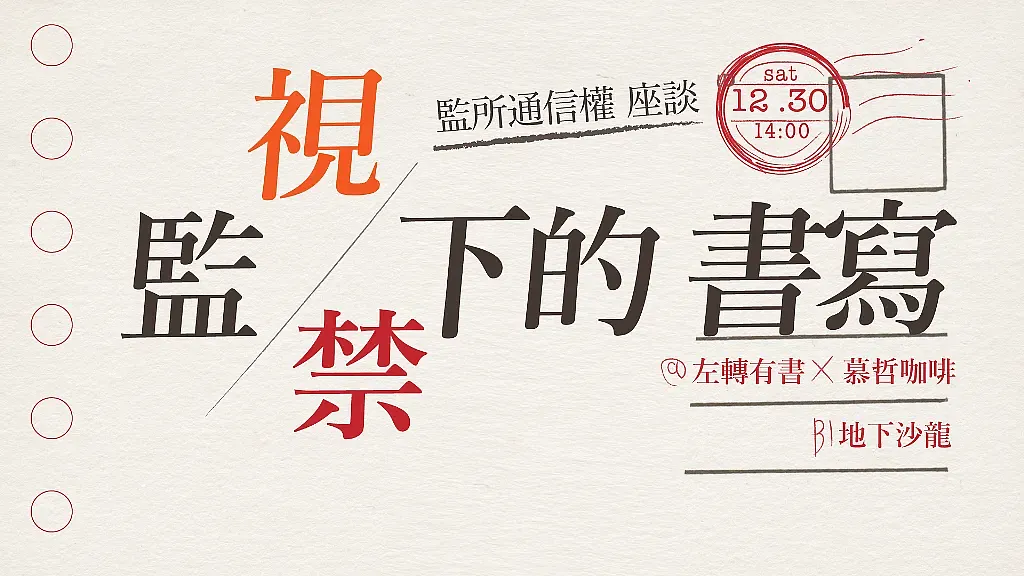
Forum | Writing under Surveillance/Prohibition—Forum on Prisoners' Right to Communication
Last edited: 2026-07-27
In the past, all external correspondence and submissions for publication by prison inmates were inspected and read by correctional facilities. If the content of a letter was deemed to pose a risk of disrupting prison discipline, it could be redacted according to law. If a submission failed to meet the requirement of being "correct in theme and without prejudice to prison discipline and reputation," permission to publish could also be denied under the law. On December 1, 2017, Judicial Yuan Interpretation No. 756 was issued, in which the Grand Justices ruled that all letters cannot be uniformly opened and read, and declared a series of regulations restricting the right to communication in the name of "risk of disrupting prison discipline" to be unconstitutional. This constitutional interpretation came as a bombshell to correctional institutions, and how subsequent legislation should proceed is urgently in need of discussion.
Furthermore, Interpretation No. 756 merely lifts a corner of the veil on restrictions on writing inside correctional facilities. A common scenario where inmates hope their writing will not be inspected by prison supervisors is "filing a grievance." This occurs when they feel they have been treated improperly in prison or have witnessed something wrong and wish to speak out to the outside world. However, in detention facilities, various tangible and intangible forms of surveillance are ubiquitous; in certain circumstances, a letter may not even be written, let alone mailed. This is the daily reality of prison life that constitutional interpretation cases have yet to touch upon.
For this forum, we have invited Attorney Chou Yu-hsiu, one of the primary authors of the petition for Judicial Yuan Interpretation No. 756, to guide us through this constitutional interpretation case from legal and human rights perspectives. We have also invited writer Liu Pei-yuan and prison guard Lin Wen-wei to explain the reality of writing in correctional facilities, as well as share their reflections. Finally, we have invited Legislator Yu Mei-nu to discuss how we can bring more hope through legislation for writing under surveillance/prohibition in the future.
Time
December 30, 2017 (Sat.) 14:00-17:00
Location
A Book <3 Cafe ╳ Cafe Philo Underground Salon
(B1, No. 3, Shaoxing N. St., Zhongzheng Dist., Taipei City 100)
Moderator

Lin Wei-ting
Legal Researcher, Judicial Reform Foundation
Speakers

Chou Yu-hsiu
Attorney, Standing Executive Committee Member of JRF

Liu Pei-yuan
Writer

Lin Wen-wei
Prison Guard

Yu Mei-nu
Legislator
Organizer
judicial Reform Foundation
Taipei Bar Association Constitutional Committee
This article is an AI-generated translation of the original Chinese text. In the event of any discrepancy, the Chinese version shall prevail.