
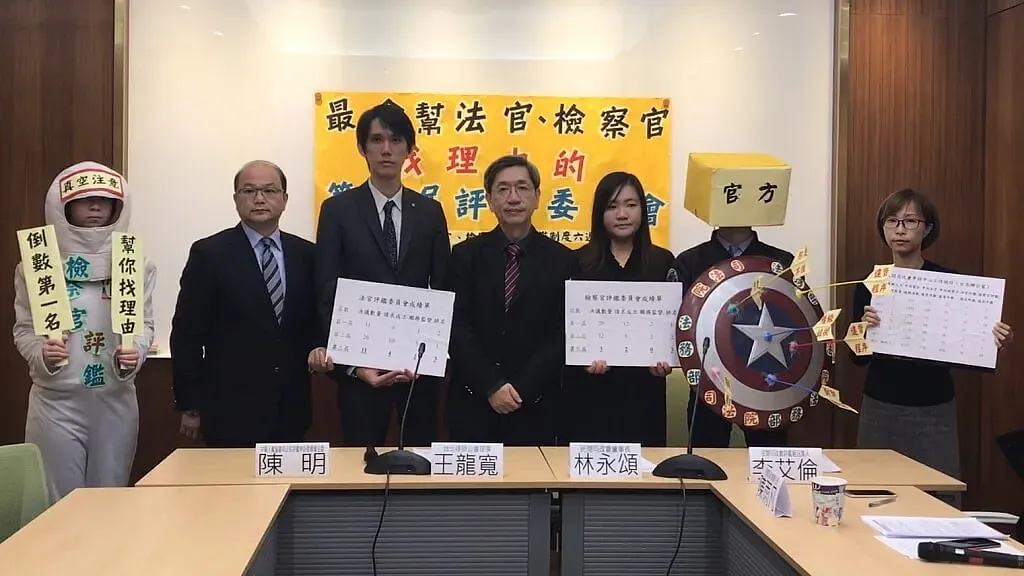
The Third Judges and Prosecutors Evaluation Commission: The Best at "Finding Excuses" for Judges and Prosecutors – Press Conference on the 6th Anniversary of the Individual Judges and Prosecutors Evaluation System
Last edited: 2026-11-03
The individual evaluation system for judges and prosecutors under the Judges Act has been in effect for six years since January 6, 2012, and evaluation members, serving two-year terms, have turned over three times. Today marks the final day of the third term of the Evaluation Commission. As seen in their performance record (shown in the table below), the number of resolutions made, requests for disciplinary action upheld, and official supervisory measures initiated are all lower than those of the first two evaluation commissions, demonstrating a steady decline in evaluation efficacy.
| Judges Evaluation Commission Performance Record | Prosecutors Evaluation Commission Performance Record | |||||||
| Term | Resolutions | Upheld Requests | Supervisory Measures | Ranking | Resolutions | Upheld Requests | Supervisory Measures | Ranking |
| 1st Term | 11 | 6 | 1 | 2 | 20 | 12 | 2 | 1 |
| 2nd Term | 26 | 10 | 5 | 1 | 32 | 5 | 2 | 2 |
| 3rd Term | 11 | 4 | 2 | 3 | 3 | 2 | 0 | 3 |
An analysis of the issues with the Third Evaluation Commission is as follows:
-
The Third Evaluation Commission: Best at "Finding Excuses" for Judges and Prosecutors
Compared to the previous two terms, the Third Evaluation Commission dismissed all evaluation requests concerning "poor demeanor." (See Appendix 1) Regardless of the cynical remarks or discriminatory biases exhibited by judges and prosecutors, the third-term evaluation members always found a way to rationalize their words and actions, completely disregarding the actual experiences of people in the courtroom. They judged courtroom demeanor solely through audio recordings and transcripts without inquiring about the citizens' real courtroom conditions and experiences. They focused entirely on "finding excuses" for every word spoken by judges and prosecutors while ignoring the overall quality of court proceedings.
Taiwanese society's demands for judges and prosecutors can no longer be satisfied by merely being "free of bribery" or "free of malfeasance"; the public is no longer willing to tolerate judges and prosecutors with "poor courtroom demeanor." We have compiled the outrageous evaluation decisions of the Third Evaluation Commission in the table below. Such standards undoubtedly continue to condone a minority of judges and prosecutors treating the public with poor attitudes, doing nothing to enhance the overall public perception of the judiciary.
Overview of the Third Evaluation Commission "Finding Excuses" for Judges and Prosecutors Case No. Requesting Entity Improper Conduct of Judge/Prosecutor Reasons for Dismissing Evaluation (Excerpt) Prosecutors Eval. 106-3 JRF The prosecutor stated in the non-prosecution disposition: "The complainant could have taken the opportunity while performing oral sex on the defendant to bite the defendant's penis, cry out loudly for help, or make a sound to attract the attention of neighbors or the defendant's mother, thereby interrupting the defendant's sexual act." Why would the defendant feel at ease placing their genitalia in Female A's mouth without fear of being injured by sharp teeth? According to common sense, absent a considerable degree of trust in Female A, this would not happen. (The Prosecutors Evaluation Commission held that in forcible sexual assault cases, it is reasonable for a prosecutor to use the victim's failure to bite the defendant's genitalia as a defense counterattack to justify a non-prosecution decision.) Judges Eval. 104-10 JRF The judge stated: "Wait until something happens and then come crying, and then find your mom and dad to help clean up your mess," and "You know it in your heart of hearts; look into your own conscience!" The judge's words were all well-intentioned, earnest admonitions. Judges Eval. 104-9 JRF The judge stated: "Who would like it when you go back and forth like this?" and "Looking at it later makes me kind of angry." Although the judge's subjective feelings and phrasing were prone to misunderstanding, they can be deemed non-malicious. Judges Eval. 105-2 JRF The judge stated: "Today I feel that what you just said is complete bullshit," and "What you are saying right now makes me feel like you're making up a story." The judge urged the plaintiff to fulfill their burden of proof, subsequently uttering colloquial terms such as "bullshit" and "making up a story";
subjectively, it is difficult to find any malice to insult, unreasonably reprimand, or impair the dignity of the plaintiff.Judges Eval. 104-11 JRF The judge stated: "The questions I asked were in plain language," "Don't tell me that, I won't accept it," and "Don't you even know where your service address is?" The judge forcefully led the litigation, and their pitch and tone were indeed relatively elevated, involving interrupting speech, raising volume, and repeated questioning. While this may have made sensory adaptation somewhat difficult, it is still difficult to deem it a clear display of poor courtroom demeanor. -
Public Grievances "Muted" by the Judicial Yuan and the Ministry of Justice
The other half of the responsibility for the poor performance of the Third Evaluation Commission lies with the Judicial Yuan and the Ministry of Justice. According to judicial statistics, the Judicial Yuan received 7,277 public grievance cases in 2016 and 6,489 in 2017. The Ministry of Justice did not even publish its data.
Despite accumulating so many public grievances, the Judicial Yuan only requested the evaluation of 2 judges in 2016 and 0 judges in 2017. The Ministry of Justice only requested the evaluation of 1 prosecutor in 2016 and 0 prosecutors in 2017. (See Appendix 2 for details) What baffles comprehension is whether thousands of public grievances were all "purely misunderstandings," or whether the Judicial Yuan and the Ministry of Justice "muted" genuine public grievances under the pretext of protecting judges and prosecutors, preventing these grievances from ever reaching the Evaluation Commission?
Cases Where Public Grievances Were Muted by the Judicial Yuan and Ministry of Justice, Later Requested for Evaluation by Civil Society Organizations Case No. Requesting Entity Improper Conduct of Judge/Prosecutor Outrageous Circumstances Prosecutors Eval. 106-1 Taiwan Prosecutors Association A prosecutor from the Changhua District Prosecutors Office engaged in sexual transactions with an underage girl. The prosecutor had already confessed, but the Ministry of Justice failed to proactively request an evaluation. Judges Eval. 106-2 JRF A Taiwan High Court judge inquired about the personal data, including the address, of an underage female victim in the presence of her abuser. A social worker first reported this via the judicial mailbox, but the Taiwan High Court claimed the judge acted properly. Taking the decisions of this term's Evaluation Commission as an example, the two most prominent cases (see table above) happened to both involve sexual assault. A prosecutor from the Changhua District Prosecutors Office engaged in sexual transactions with an underage girl, sparking widespread public condemnation known to all; yet, the Ministry of Justice delayed requesting a prosecutor evaluation. Ultimately, it required the Taiwan Prosecutors Association, acting as a civil society organization, to request the evaluation before this clearly unfit prosecutor had a chance to face appropriate disciplinary action. Additionally, a Taiwan High Court judge ignored social workers' dissuasion and unlawfully inquired about personal data such as the address of an underage female victim in the presence of her abuser. The victim's social worker first appealed to the judicial mailbox, but the Taiwan High Court replied that the judge's actions were appropriate. In the end, the social worker had no choice but to request an evaluation through the Judicial Reform Foundation, and the judge was finally subjected to official supervisory disciplinary action.
Despite such serious cases, the Judicial Yuan and the Ministry of Justice could turn a blind eye. Their internal self-discipline mechanisms are tantamount to a failure; only when cases are sent to an evaluation commission with external members do unfit judges and prosecutors have a chance of being exposed.
To this end, civil society organizations call for the public to have the right to directly petition the Evaluation Commission for evaluations without going through the Judicial Yuan or the Ministry of Justice, thereby preventing appeals from being "silenced." Furthermore, only by having the Evaluation Commission come into direct, frontline contact with public complaints can it truly understand the issues the public cares about, thereby reducing the frequency of decisions that "find excuses" for judges and prosecutors.
-
The Public Has the Right to Directly Request Evaluations from the Judges and Prosecutors Evaluation Commissions
The 2017 National Judicial Reform Conference reviewed the operational effectiveness of the individual evaluation system under the Judges Act and resolved: "To safeguard public access to and utilization of the judge and prosecutor evaluation mechanisms, the public shall have the right to directly request evaluations from the Judges and Prosecutors Evaluation Commissions, without needing to go through bar associations, the Judicial Reform Foundation, or other civil society organizations." Although the Judicial Yuan has successively introduced numerous reforms, consulting meetings concerning amendments to the Judges Act have yet to incorporate draft amendments reflecting this resolution.
The Judicial Yuan and the Ministry of Justice have traditionally claimed that granting the public the right to directly request evaluations from the evaluation commissions would flood them with cases. However, based on the experience of civil society organizations over the past six years (see table below), authorities are entirely capable of handling the workload. This claim is likely merely an excuse used by judges and prosecutors to reject oversight and resist the establishment and operation of effective supervisory mechanisms.
Work Statistics of the JRF Complaint Center (Taipei Office) Year Dedicated Staff Allocation Grievance Calls Answered Judicial Grievances Screened Prosecutorial Grievances Screened Judge Evaluation Requests Filed Prosecutor Evaluation Requests Filed 2012 2 629 116 68 2 2 2013 2 1,455 100 88 7 18 2014 2 1,593 112 74 9 18 2015 2 1,022 94 79 11 5 2016 2 1,135 78 50 3 0 2017 2 2,203 78 75 4 2 Total 2 Staff 8,037 578 434 36 45 Civil society organizations have directly handled public complaints against judges and prosecutors since 2012. Over the past six years, evaluation requests initiated by civil society actually accounted for 79% of the total resolutions made by the Judges Evaluation Commission, and an even higher 84% of the total resolutions made by the Prosecutors Evaluation Commission. (See Appendix 2)
Civil society, which should have been a supporting actor in requesting evaluations, has now become the lead protagonist. This is a complete misallocation of resources, shifting the state's responsibility of weeding out unfit judges and prosecutors onto civil society organizations. We cannot help but ask the Judicial Yuan: if civil society organizations are unable to process these cases in the future, wouldn't the evaluation system effectively grind to a halt?
At a time when public trust in the judiciary is at a low ebb, one of the keys to the success or failure of judicial reform lies in the ability to weed out unfit judges and prosecutors. We need a Judges Evaluation Commission and a Prosecutors Evaluation Commission that can truly listen to public grievances. Civil society organizations jointly call upon the Judicial Yuan to cease its stubborn course and immediately implement the reform resolution from the National Judicial Reform Conference, allowing the public to directly request evaluations from the evaluation commissions.
Appendix 1
| Resolution Case No. | Resolution Date | Resolution Outcome | Requesting Entity | Case Type |
| Eval. 9 | 2017/12/01 | Dismissed | JRF | Poor Demeanor |
| Eval. 10 | 2016/10/21 | Dismissed | JRF | Poor Demeanor |
| Eval. 11 | 2016/08/05 | Dismissed | JRF | Poor Demeanor |
| Eval. 13 | 2016/09/08 | Supervisory Measure | JRF | Procedural Violation |
| Eval. 14 | 2016/08/05 | Upheld - Personnel Review Committee | JRF | Procedural Violation |
| 105 Eval. 1 | 2016/09/08 | Upheld - Control Yuan | Taichung District Court | Case Delay |
| 105 Eval. 2 | 2016/09/30 | Dismissed | JRF | Poor Demeanor |
| 105 Eval. 3 | 2017/06/03 | Upheld - Personnel Review Committee | JRF | Procedural Violation |
| 105 Eval. 4 | 2017/09/30 | Upheld - Personnel Review Committee | Taiwan High Court | Case Delay |
| 106 Eval. 1 | 2017/11/03 | Dismissed | JRF | Procedural Violation |
| 106 Eval. 2 | 2017/09/30 | Supervisory Measure | JRF | Procedural Violation |
| Resolution Case No. | Resolution Date | Resolution Outcome | Requesting Entity | Case Type |
| Eval. 1 | 2016/05/26 | Upheld - Control Yuan | Taoyuan District Prosecutors Office | Dereliction of Duty |
| 106 Eval. 1 | 2017/06/29 | Upheld - Control Yuan | Taiwan Prosecutors Association | Underage Sexual Intercourse |
| 106 Eval. 3 | 2017/12/28 | Dismissed | JRF | Discriminatory Bias |
Appendix 2
| Judges Evaluation Commission Received Cases Statistics | Judges Evaluation Commission Resolved Cases Statistics | ||||||||
| Filing Year | Total Resolutions | Official Requests | Civil Society Requests | Civil Society Request Rate | Upheld Requests | Supervisory Measures | Dismissed Requests | Civil Society Upheld/Supervised | Civil Society Success Rate |
| 2012 | 5 | 3 | 2 | 40% | 4 | 0 | 1 | 1 | 50% |
| 2013 | 10 | 3 | 7 | 70% | 3 | 3 | 4 | 5 | 71% |
| 2014 | 14 | 2 | 12 | 86% | 8 | 1 | 5 | 7 | 58% |
| 2015 | 13 | 0 | 13 | 100% | 3 | 2 | 8 | 5 | 38% |
| 2016 | 4 | 2 | 2 | 50% | 2 | 1 | 3 | 1 | 50% |
| 2017 | 2 | 0 | 2 | 100% | 0 | 1 | 1 | 1 | 50% |
| 6 Years | 48 | 10 | 38 | 79% | 20 | 8 | 20 | 20 | 53% |
| Source: Judges Evaluation Commission website. (Civil Society Upheld/Supervised: Civil Society "Requests Upheld" + "Supervisory Measures") Formula: Civil Society Request Rate = Civil Society Requests / Total Resolutions. Civil Society Success Rate = Civil Society Upheld/Supervised / Civil Society Requests. |
|||||||||
| Prosecutors Evaluation Commission Received Cases Statistics | Prosecutors Evaluation Commission Resolved Cases Statistics | ||||||||
| Year | Total Resolutions | Official Requests | Civil Society Requests | Civil Society Request Rate | Upheld Requests | Supervisory Measures | Dismissed Requests | Civil Society Upheld/Supervised | Civil Society Success Rate |
| 2012 | 3 | 1 | 2 | 67% | 3 | 0 | 0 | 2 | 100% |
| 2013 | 21 | 2 | 19 | 90% | 11 | 2 | 8 | 11 | 58% |
| 2014 | 19 | 0 | 19 | 100% | 1 | 2 | 16 | 3 | 16% |
| 2015 | 9 | 2 | 7 | 78% | 2 | 0 | 7 | 1 | 14% |
| 2016 | 1 | 1 | 0 | 0% | 1 | 0 | 0 | 0 | NA |
| 2017 | 2 | 0 | 2 | 100% | 1 | 0 | 1 | 1 | 50% |
| 6 Years | 55 | 9 | 46 | 84% | 19 | 4 | 32 | 17 | 37% |
| Source: Prosecutors Evaluation Commission website. (Civil Society Upheld/Supervised: Civil Society "Requests Upheld" + "Supervisory Measures") Formula: Civil Society Request Rate = Civil Society Requests / Total Resolutions. Civil Society Success Rate = Civil Society Upheld/Supervised / Civil Society Requests. |
|||||||||
Attendees
Lin Yung-sung, Attorney / Chairman, Judicial Reform Foundation
Ellen Lee, Attorney / Convenor, JRF Evaluation Division
Wang Lung-kuan, Attorney / Director, Taipei Bar Association
Ch'en Ming, Attorney / Chairperson, Judicial Officer Evaluation Appeal Committee, Chinese Human Rights Association
Abby Ch'en, Attorney / Executive Director, Judicial Reform Foundation
Press Contact
Judicial Reform Foundation / Executive Director Abby Ch'en (02)2523-1178
This article is an AI-generated translation of the original Chinese text. In the event of any discrepancy, the Chinese version shall prevail.
