
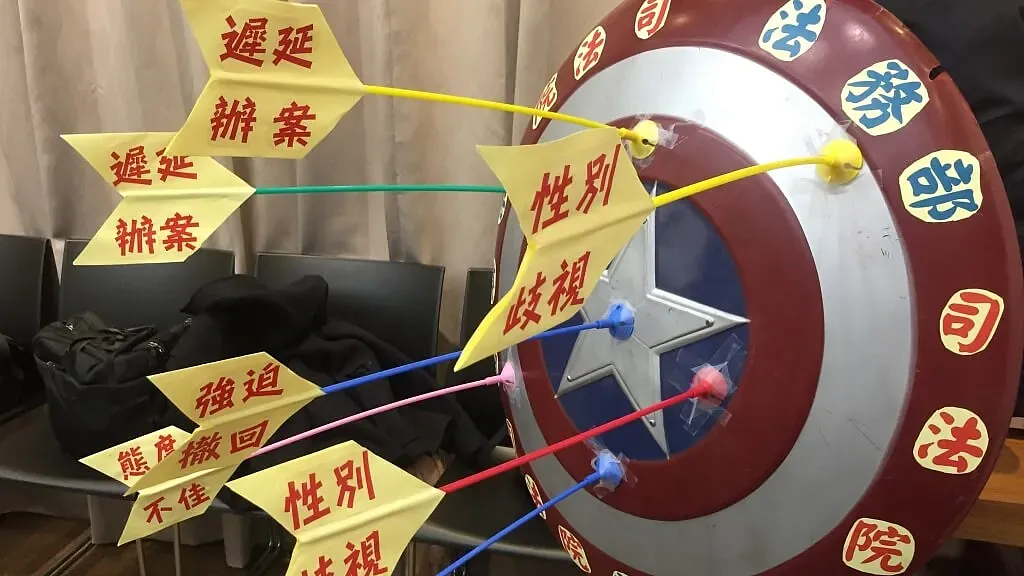
The Evaluation System for Unfit Judges and Prosecutors is Like a Gilded Sham
Last edited: 2026-08-29
According to judicial statistics, the Judicial Yuan received a total of 13,766 public petitions over the past two years, while the Ministry of Justice has failed to even release its data. Despite this massive accumulation of public grievances, the Judicial Yuan has referred only 2 judges for evaluation, and the Ministry of Justice only 1 prosecutor. A colossal gap exists between the volume of public petitions and the number of cases the Judicial Yuan and the Ministry of Justice have actually acted on. This deliberate silencing of public grievances by the authorities has left the evaluation committees sitting idle, creating the false impression that the evaluation system is functioning as effective oversight. In reality, a system that fails to meet public expectations is like a wound that looks scabbed over and dry on the surface but is festering with pus underneath — masking the root cause of the public's distrust in the judiciary.
Looking at the resolutions handed down by the Judges Evaluation Committee and the Prosecutor Evaluation Committee over the past two years, it is not hard to see that allegations of poor attitude and inappropriate conduct are dismissed almost without exception. This happens because the transcripts produced respectively by the evaluation committees and the referring agencies diverge significantly from what people actually experienced. Plain text cannot capture the tone or pitch of a judge's voice during a court session, still less the fear and helplessness felt by the litigants. With no way to reconstruct or verify whether a remark was "cut off," "interrupted mid-sentence," delivered as a "stern rebuke," or simply "natural tonal variation appropriate to the context," these disputes routinely collapse into a matter of one person's word against another's. Without a system that allows people to describe their experiences directly, evaluation committee members cannot grasp the power imbalance between judges and ordinary citizens in the courtroom, nor can they stay alert to how that imbalance shapes — and can be abused through — the exercise of judicial authority. The result is a pattern of decisions that drift further and further from what the public actually experiences.
This state of affairs is a direct reflection of a flaw built into the current system: citizens are barred from describing their courtroom experiences to the evaluation committee directly, which in turn severely suppresses the feedback court users could otherwise offer on the judicial environment. Not only does this keep public sentiment from being properly heard, it also allows genuinely problematic judges and prosecutors to escape supervision and removal — feeding public resentment. Once this contradiction builds past a tipping point, what it produces is outright distrust of the judiciary.
The truth is, the evaluation system could do far more, and far better, to rebuild public trust in the judiciary. Everyone knows the old warning that damming a river only makes it overflow and harm more people downstream. The evaluation system must not retreat into an ostrich-like refusal to look reality in the eye; doing so only reduces the system to an empty shell. The most direct fix is simply this: give citizens the right to petition the committee for an evaluation directly, without having to go through a civil society organization as an intermediary.
This would not only mean court users gain the right to choose a better system for themselves — through face-to-face petitions and a review process conducted directly with complainants, evaluation committee members could also finally escape the long-standing problem of handing down decisions the public simply refuses to accept. Only through this kind of genuine, direct communication can committee members truly grasp the harm people have suffered at the hands of the judiciary, identify the real roots of judicial distrust, and give the system the supervisory power it was always meant to have. That is the real path to restoring trust in the judiciary.
※ This article was published in the Apple Daily Real-Time News on Jan. 8, 2018
This article is an AI-generated translation of the original Chinese text. In the event of any discrepancy, the Chinese version shall prevail.