
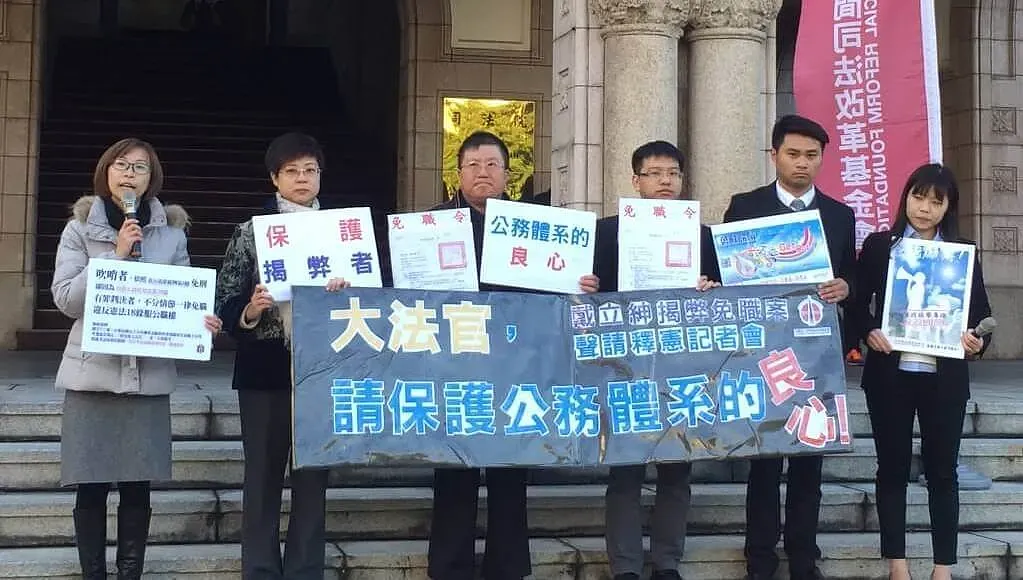
Grand Justices, Please Protect the Conscience of the Civil Service System! Press Conference on the Constitutional Interpretation Petition for Tai Li-shen's Dismissal Case
Last edited: 2026-08-29
Between 2005 and 2016, Tai Li-shen worked at the Hsinchu County Livestock Disease Control Center. Like most civil servants who studied hard to pass the civil service examinations, he thought he could finally lead a stable life. However, when he discovered that his superiors kept demanding he keep false accounts and misappropriate public funds, he could no longer suppress his sense of guilt. Driven by conscience, he turned himself in to the Agency Against Corruption of the Ministry of Justice through his agency's Department of Government Ethics and provided compelling evidence to assist prosecutors and police in their investigation, giving them the opening they needed to expose the corrupt network and bring it to justice.
While the judge presiding over Tai Li-shen's corruption case recognized that he had bravely reported the crime without fear of retaliation and exempted him from criminal punishment, once the judgment became final, the Hsinchu County Government nonetheless "dismissed" him in 2016 and "permanently barred him from public employment" as a result of that very judgment. Having exhausted every avenue of judicial remedy, Tai Li-shen ultimately could not overturn this notice of dismissal that has barred him from public service for life.
Tai Li-shen bravely blew the whistle on corruption only to lose his standing as a civil servant; the judiciary has a responsibility to remedy the harm the state has done to a citizen's fundamental rights. Petitioning the Grand Justices for a constitutional interpretation is Tai Li-shen's sole remaining hope for relief. The "conscience" within the civil service needs protecting. Today (the 10th), the Judicial Reform Foundation held a press conference in front of the Judicial Yuan to file a constitutional interpretation petition on Tai Li-shen's behalf, asking the Grand Justices to declare Article 28, Paragraph 1, Subparagraph 4, and the first half of Paragraph 2 of the Civil Service Employment Act partially unconstitutional, and to suspend their application immediately insofar as they affect the protection owed to civil service whistleblowers.
The Current Civil Service Employment Act Discourages Civil Servants from Reporting Corruption!
To foster the sound development of the state's institutions and build a more honest and efficient government, the state has an obligation to provide the necessary protection to civil servants who bravely report corruption. Only then can whistleblowers within the system expose wrongdoing from the inside, stop illegal conduct from recurring, and weed out those unfit to hold public office.
To encourage insiders to come forward, the Anti-Corruption Act allows judges to "mitigate or exempt from punishment" the sentences of whistleblowers — a well-intentioned design. Yet the current Civil Service Employment Act provides that: "Anyone who has previously served in public office and has committed an act of corruption shall, upon conviction, be dismissed and permanently barred from re-employment."
Legally speaking, an "exemption from punishment" is still a form of "conviction" — it merely exempts the defendant from having the sentence actually carried out. Under the Civil Service Employment Act, then, even a civil servant granted such an exemption is still deemed to have been convicted, and is barred from re-employment categorically, regardless of the circumstances.
A system designed this way offers whistleblowers relief only from criminal punishment while still stripping them of their status as civil servants. This amounts to disguised punishment, and it plainly contradicts the state's own stated intent of encouraging civil servants to come forward and report corruption. Worse, a blanket dismissal rule that applies regardless of the underlying circumstances violates the principle of proportionality, severely undermines the constitutionally guaranteed right of citizens to hold public office, and creates a direct chilling effect: civil servants may simply choose to stay silent about corruption in order to protect their jobs.
Asking the Grand Justices to Protect the "Conscience" of the Civil Service!
Driven by a sense of justice, Tai Li-shen hoped his report would put an end to long-standing malpractice at his workplace. Instead, once his identity as the whistleblower came out, his superiors and colleagues, unable to understand his choice, subjected him to all manner of unwarranted difficulty at work, causing him immense psychological stress. The very exemption from punishment the judge granted him in recognition of his courage in coming forward ended up falling squarely within the Civil Service Employment Act's definition of a "conviction" that bars re-employment — leaving Tai Li-shen permanently barred from public service by operation of law.
Tai Li-shen's ordeal is stark proof that the current legal system betrays the people who report wrongdoing. When would-be whistleblowers see that stepping forward could cost them exactly what it cost Tai Li-shen, how many will still be willing to expose the dark underbelly of government agencies?
We are therefore assisting Mr. Tai Li-shen today in petitioning the Grand Justices for a constitutional interpretation of Article 28, Paragraph 1, Subparagraph 4, and the first half of Paragraph 2 of the Civil Service Employment Act, as applied to civil service whistleblowers. We hope the Grand Justices will protect the conscience within the civil service, declare these provisions unconstitutional, and allow Mr. Tai Li-shen to return to the work he loves. Only then can more conscientious civil servants be encouraged to step forward in the future and expose wrongdoing within government agencies.
Attendees
- Mr. Tai Li-shen / Constitutional Interpretation Petitioner
- Attorney Chou Yu-hsiu / Convener, Constitutional Interpretation Team, JRF
- Professor Lin Chih-chieh / Professor, Institute of Law and Technology, National Chiao Tung University
- Attorney Huang Kuan-wei / Attorney, Constitutional Interpretation Team, JRF
- Attorney Chang Kai-ting / Attorney, Constitutional Interpretation Team, JRF
- Attorney Chen Yu-fan / Executive Director, JRF
Press Contacts
Attorney Chen Yu-fan, Executive Director, Judicial Reform Foundation (02) 2523-1178
Attachments
- Constitutional Interpretation Petition for Tai Li-shen's Dismissal
- Chronology of Tai Li-shen's Dismissal Case
| Date | Content | Case Number |
|---|---|---|
| Jul 2007 – Apr 2011 | Tai Li-shen was asked by his direct superior to keep false accounts and misappropriate public funds | — |
| Late 2012 | Tai Li-shen reported the corruption scandal to the Department of Government Ethics and turned himself in | — |
| Nov 25, 2015 | Hsinchu District Court Judgment — Exempted from Punishment | 103-Su-65 |
| Jan 30, 2016 | Hsinchu County Government approved dismissal | Fu-Jen-Tzu No. 1050019480 |
| Feb 23, 2016 | Tai Li-shen applied for re-examination to the Civil Service Protection and Training Commission | — |
| May 10, 2016 | Civil Service Protection and Training Commission re-examination decision — Dismissed (Denied) | 105-Gong-Shen-Jue-Zi No. 0102 |
| Jul 13, 2016 | Tai Li-shen filed an administrative lawsuit | — |
| Jan 5, 2017 | Taipei High Administrative Court Judgment — Plaintiff's action dismissed | 105-Su-1075 |
| Mar 17, 2017 | Supreme Administrative Court Ruling — Appeal dismissed | 106-Zai-295 |
This article is an AI-generated translation of the original Chinese text. In the event of any discrepancy, the Chinese version shall prevail.