
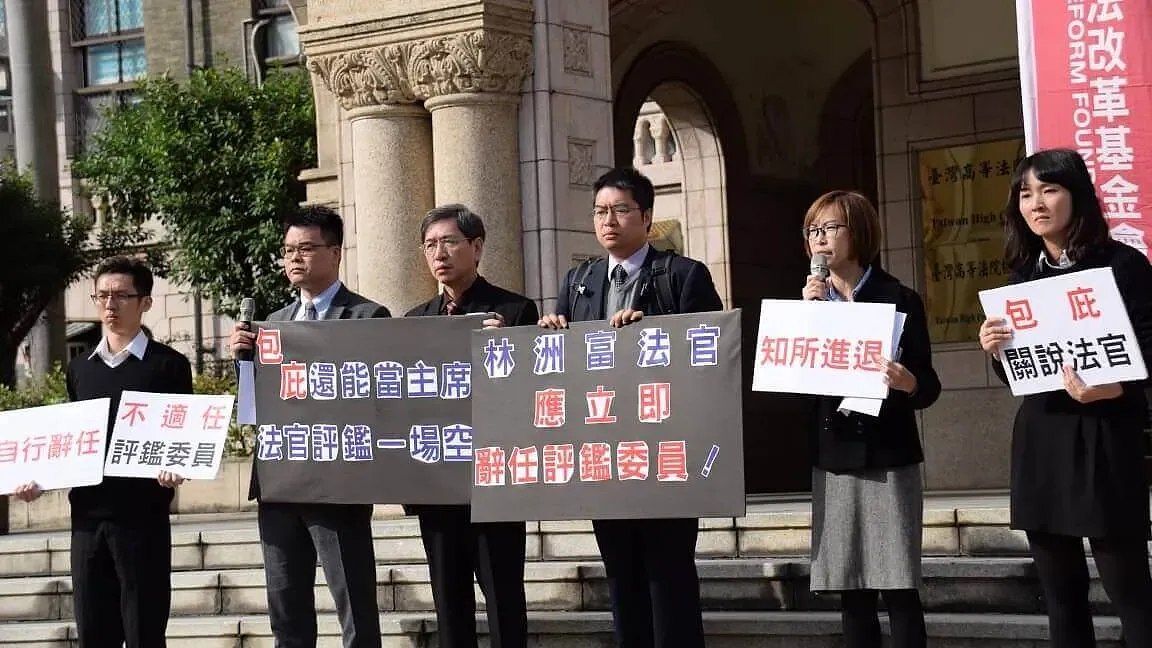
Cover-Up Suspect Elected Chairperson: The Judicial Evaluation Committee Becomes a Farce—Judge Lin Chou-fu Should Immediately Resign as an Evaluation Committee Member!
Last edited: 2026-08-29
Last Friday (Jan 12), the newly appointed members of the 4th Judges Evaluation Committee held their first meeting, during which Judge Lin Chou-fu was elected as the convener and chairperson. He will preside over future meetings, speak on behalf of the committee, and exert decisive influence over its proceedings and deliberation methods. The position of convener is of great significance.
However, Judge Lin Chou-fu is a highly controversial figure. His election as an evaluation committee member had already drawn heavy criticism from both within and outside the judiciary, and his ascension to the chairpersonship will inevitably cast profound doubt on the legitimacy of every resolution the committee makes going forward. We are therefore holding this ad-hoc press conference today to demand, in the strongest terms: "Judge Lin Chou-fu must resign immediately as a member of the Judges Evaluation Committee!"
Judge Lin Chou-fu Implicated in Covering Up Judicial Lobbying
In 2010, then-Supreme Court Judge Hsiao Yang-kuei lobbied on behalf of his son in a hit-and-run case. Reported by his judicial peers, Hsiao was ultimately sanctioned by the Commission on the Disciplinary Sanctions of Functionaries with "suspension from office for 6 months," while Kao Ming-che, the High Court judge who accepted the lobbying, was sanctioned with a "demotion by two grades in official rank, with re-appraisal."
The Commission's decision established that Hsiao Yang-kuei first lobbied the presiding judge of the first-instance court handling his son's case, but the presiding judge remained unmoved and delivered a guilty verdict. After the case was appealed to the High Court, Hsiao lobbied Kao Ming-che, the presiding judge of the second instance, asking him to acquit his son.
After being lobbied, Presiding Judge Kao Ming-che learned during deliberations with two other judges that the assigned judge, Kao Yu-shun, intended to render a "guilty verdict." Kao Ming-che stated on the spot that "what Judge Hsiao wants is an acquittal." With their opinions deadlocked, Kao Ming-che drafted the "acquittal" judgment himself, and the crucial accompanying judge, Lin Chou-fu, signed it, changing the ruling to "acquittal." The case was ultimately finalized on a 2-to-1 vote for acquittal.
The fact that Kao Ming-che mentioned Hsiao Yang-kuei's lobbying to Kao Yu-shun and Lin Chou-fu during deliberations was established by the Commission. Yet when questioned by prosecutors, Lin Chou-fu denied that Kao Ming-che had ever mentioned Hsiao's lobbying during those deliberations — testimony the Commission went on to deem "untenable."
Faced with an act of unlawful lobbying by a fellow judge, Lin Chou-fu not only failed to come forward and expose it, but even denied under questioning that he had heard of it at all. It is telling that a sitting judge's own testimony was found untrustworthy by the disciplinary body. Lin's conduct here has repeatedly drawn scrutiny from his peers, and it demonstrates that his ethical and professional standards as a judge fall well short of what the role demands, mired as he is in a lobbying cover-up controversy.
Judge Lin Chou-fu's Election as Convener Threatens to Render the Evaluation System Meaningless
Despite all this, Judge Lin Chou-fu was elected last year as a member of the Judges Evaluation Committee with the highest number of votes of any candidate — a truly astonishing outcome. Coming right on the heels of the National Congress on Judicial Reform, at a moment when public expectations for judicial reform are running especially high, it is simply unacceptable that a judge embroiled in a lobbying scandal could be elected to the evaluation committee at all. Members of the Judges Evaluation Committee are entrusted with overseeing the professional ethics and discipline of judges nationwide and with weeding out those unfit to serve. They carry the public's hopes for removing bad judges, and when handling evaluation cases, what they need most is the moral courage to call out unlawful conduct among their peers — not a complacent whitewash. Judging by Lin's own conduct in the Hsiao Yang-kuei lobbying affair, it is hard to imagine him summoning the courage to hold fellow judges to account, or reaching decisions free of complacency and mutual back-scratching.
That Judge Lin Chou-fu was elected with the highest vote count of any candidate only further confirms that a mindset persists within the judicial community of evaluating judges by the "lowest possible standard" — hoping for someone on the committee who will "speak up for judges," ideally someone whose own standards aren't too demanding, so as to lower the odds that colleagues will actually face sanction. This is proof that "judicial self-regulation," paralyzed by insular self-interest, has effectively failed.
At the Evaluation Committee's first meeting last Friday (Jan 12), Judge Lin was elected "convener" of the Judges Evaluation Committee. Under Article 6 of the Organic Rules of the Judges Evaluation Committee: "... The first meeting of each term shall be convened by a member designated by the President of the Judicial Yuan." It has been reported that, at that first meeting, Judicial Yuan President Hsu Tzong-li designated Judge Lin as the interim convener — a designation that subsequently allowed Judge Lin to secure the chairpersonship without difficulty. If this is true, we must put a question to President Hsu directly: "Do you genuinely understand the full circumstances of the Hsiao Yang-kuei lobbying case? Were you aware of the Commission's unfavorable findings against Judge Lin Chou-fu, and did you designate him as interim convener regardless — disregarding the consequences and the judiciary's own reputation?"
If so, this is deeply troubling for the nation. The success or failure of the evaluation system is inseparable from the success or failure of judicial reform as a whole. This is a responsibility the President cannot sidestep and must handle with the utmost care. Otherwise, it is entirely foreseeable that Judge Lin's exercise of authority over his two-year term will face intense and ongoing skepticism, undermining the very legitimacy of the committee's decisions and preventing them from ever earning public trust.
Lin Chou-fu Must Resign as an Evaluation Committee Member Immediately!
The judicial evaluation system exists to examine, through an objective and impartial review mechanism, whether individual judges have engaged in illegal or improper conduct, and to give unfit judges the chance to be disciplined and removed. Judge Lin's own record plainly disqualifies him from bearing the heavy responsibility of an evaluation committee member. We therefore solemnly demand that Judge Lin Chou-fu resign immediately from his position on the Judges Evaluation Committee!
Attachments
- Disciplinary Decisions of the Commission on the Disciplinary Measures of Public Functionaries regarding Hsiao Yang-kuei and Kao Ming-che
- ("Controversial Judge Elected, Tainting the Evaluation System") by Ch'en Yü-fan
Attending Representatives
Attorneys Lin Yung-sung / Chairperson, Judicial Reform Foundation
Attorney Shih Hung-ch'eng / Convener of the Evaluation Division, Judicial Reform Foundation
Attorney Lin Chun-hung / Executive Director, Taipei Bar Association
Attorney Ch'en Yü-fan / CEO, Judicial Reform Foundation
Press Contacts
Ch'en Yü-fan, CEO, Judicial Reform Foundation (02)2523-1178
This article is an AI-generated translation of the original Chinese text. In the event of any discrepancy, the Chinese version shall prevail.