
A Self-Disciplined and Self-Respecting Judicial Culture Is the Key to Successful Judicial Reform
Last edited: 2026-07-27
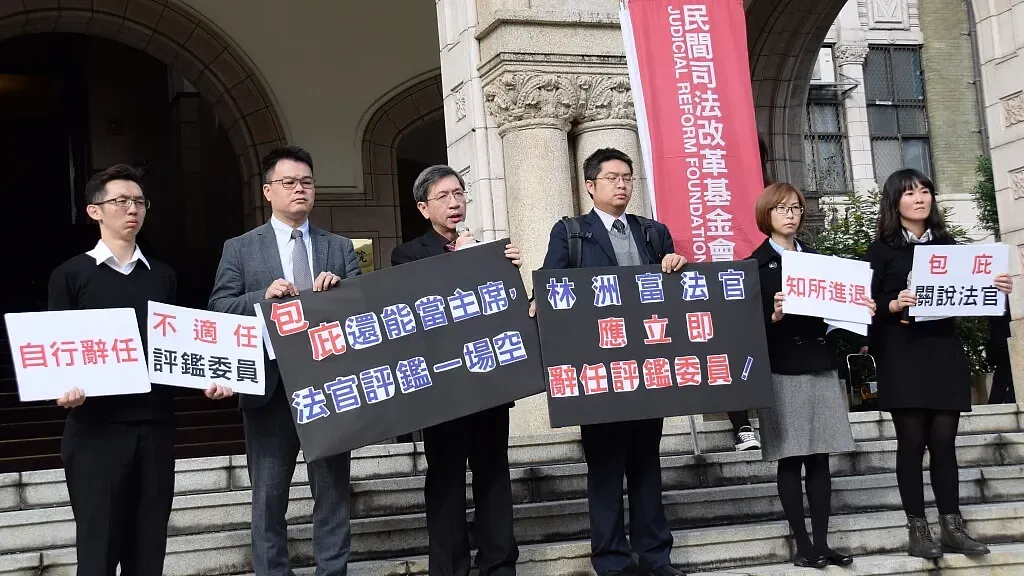
Photo / JRF held a press conference on January 18, 2018: "Shielding Still Allows One to Be Chairperson, Making a Mockery of Judicial Evaluation—Judge Lin Chou-fu Should Immediately Resign as an Evaluation Commissioner"
For more than a decade, the credibility of Taiwan's judiciary has hit an unprecedented low. Apart from controversies stemming from certain verdicts that fail to align with the public's legal sentiment, an even more fundamental cause is the string of judicial corruption, lobbying, and ethical misconduct cases that have erupted since 2010. At the time, the hit-and-run lobbying and acquittal case involving the son of former Supreme Court Justice Hsiao Yang-kuei severely damaged judicial dignity and credibility. According to the facts ascertained by the Commission on the Disciplinary Measures of Public Functionaries, key figure Judge Lin Chou-fu, who was implicated in crimes concerning whether he rendered judgments contrary to the law, can be definitively described as a liar.
This controversy caused a huge uproar, and almost no one in the judicial circle was unaware of it. A person who lies, is suspected of shielding undue lobbying or crimes, or even renders judgments contrary to the law lacks the integrity and probity required of a judge. For the judicial system to allow such a person to continue wielding the power of life and death and deciding right from wrong is a betrayal of the people, let alone placing them in charge of 'deliberating on national judicial ethics and discipline and weeding out incompetent judges.' Why was he elected with the highest number of votes among the judge representatives in the election for the 4th Judges Evaluation Commission (JEC)? Aside from systemic issues such as judges' general apathy toward public affairs, a lack of transparent candidate information, and whether campaigning is permitted, the core problem lies in the judges' group self-perception and a severe lack of a culture of self-discipline!
Following Taiwan's democratic transition, the judicial reform of the past twenty-plus years has seen the judiciary pursue a so-called "space for judicial independence," which overwhelmingly manifested as "judicial autonomy"—the expansion of judges' own rights—as well as matters of compensation and benefits. Meanwhile, "judicial self-discipline," which must naturally accompany judicial independence, has long failed to be genuinely established.
Because autonomy is emphasized while self-discipline is neglected, coupled with the fact that the transfer of judges and the appointment of judicial leaders rely on elections and reputation within the judicial community, which are then deliberated by the Judicial Yuan's Personnel Review Committee (where judges make up the overwhelming majority), a complacent judicial culture naturally forms within the legal community: maintaining superficial harmony while lacking clear values; keeping family skeletons in the closet while only reporting good news; being strict with others but lenient with oneself; and shielding one's colleagues. Meanwhile, to win the support of the judicial community, judicial elites resort to appeasement, pandering, and letting things slide lightly when handling cases of gross dereliction of duty or serious violations of ethical norms. This is the deep-seated reason why the judiciary seeks collective comfort and views itself by the lowest standards.
Take Lin Chou-fu as an example. Two years ago, when he ran for the 3rd JEC, he was already questioned by judges because of his aforementioned "criminal record." Not only did he refuse to back down, remaining on the list of alternate commissioners, but he also ran again in the 4th JEC election, canvassing votes across various courts and seeking support under the guise of enthusiastic service, ultimately winning the highest number of votes. Recently, Lin Chou-fu was even elected as the convener of the commission, responsible for chairing meetings to deliberate on the reprimand and removal of incompetent judges, and serving as the commission's spokesperson to publicly explain the resolution results. Why did such absurd events happen consecutively?
The crux of the matter is that judicial elites were completely desensitized to the rights, wrongs, and values represented by Lin Chou-fu's election. Even after questioning voices emerged on the Judges Forum and civil judicial reform groups published op-eds in the media to criticize the situation, the administrative team of the Judicial Yuan still trivialized the severity of the issue and failed to issue prior warnings. As a result, President Hsu Tsung-li failed to exercise due oversight and designated Lin Chou-fu as the provisional convener for the first meeting of the 4th JEC, making him responsible for chairing the inaugural meeting and election. This allowed "fair-minded individuals"—who were either immersed in the bureaucratic culture of "submitting to the will superiors" or appointed as commissioners by President Hsu without necessarily knowing the full picture—to elect Lin Chou-fu as the convener for this term during that meeting.
Public trust in judges and the judicial system remains at rock bottom to this day, and the public trust crisis in the judiciary has not been resolved. Even though the majority of judges are conscientious and diligent, they still fail to earn the social respect and trust they deserve. In this regard, we must solemnly state that ever since President Hsu took office—perhaps because he came from academia and faced constitutional controversies over his reappointment as a Grand Justice from the very beginning—he has only been seen pandering to and echoing judges' remarks on various occasions, adopting a strategy of "retroactive legalization" and placating minds. We have completely failed to see him contemplate that a judicial system growing up under an authoritarian environment urgently requires the infusion of new value mindsets and a new culture of transitional justice, and thus he has failed to take appropriate proactive measures in personnel appointments and the removal and supervision of incompetent judges. Aside from complaining about frivolous applications for judicial evaluation, can judges ponder: if judges could practice self-discipline and self-respect, strive to elevate themselves, and bravely uphold the integrity proper to a judge, could the hand of external discipline even reach in?
Before the political party rotation, the people strongly demanded judicial reform; after the political party rotation, President Hsu took office nominated by the president representing the new public opinion and consented to by the Legislative Yuan. He logically ought to be accountable to the entirety of public opinion rather than the entirety of judges. This is because the President of the Judicial Yuan should be an agent of the public will rather than a trustee of judicial interests. To cooperate with the resolutions of the National Judicial Reform Conference, although the Judicial Yuan's administrative team has spared no effort in drafting various institutional reform bills such as the "國民參與刑事審判法" (Lay Participation Act), the success of reform hinges upon people. If judges' mindset and group culture fail to reform and remain old wine in new bottles, it will be difficult for reforms to bear fruit. Regrettably, today's Taiwan judiciary may still be severely disconnected from the public opinion that is currently building transitional justice.
Furthermore, judges are also ordinary people with normal human desires. Even if they have previously expressed support for a certain legal view, some will still automatically change course and echo a view once their superiors make it public, all for the "favorable gaze" necessary for promotion. Similarly, some judicial leaders gladly leverage their resources and power to operate, manipulate, and practice "patronage-clientelism" across various elections and resolutions. The root cause of some highly controversial judgments lies precisely here, which is also driven by certain judges' unclear self-awareness of their roles and an insufficient spirit of self-discipline and self-respect.
Current judicial reforms have expanded the use of judge elections to decide all manner of judicial matters. While this may superficially seem like a step toward democratization, if the judicial personnel culture and electoral culture remain unchanged, or if individual leaders are still condoned or even shielded in utilizing their resources and power to operate and influence the results of elections or resolutions, the outcome of judicial reform may be an unimaginable disaster. For judicial reform to succeed and for judges to win back respect, the key lies in establishing a judicial culture of self-discipline and self-respect!
※ This article was published in the Liberty Times on January 22, 2018
This article is an AI-generated translation of the original Chinese text. In the event of any discrepancy, the Chinese version shall prevail.