
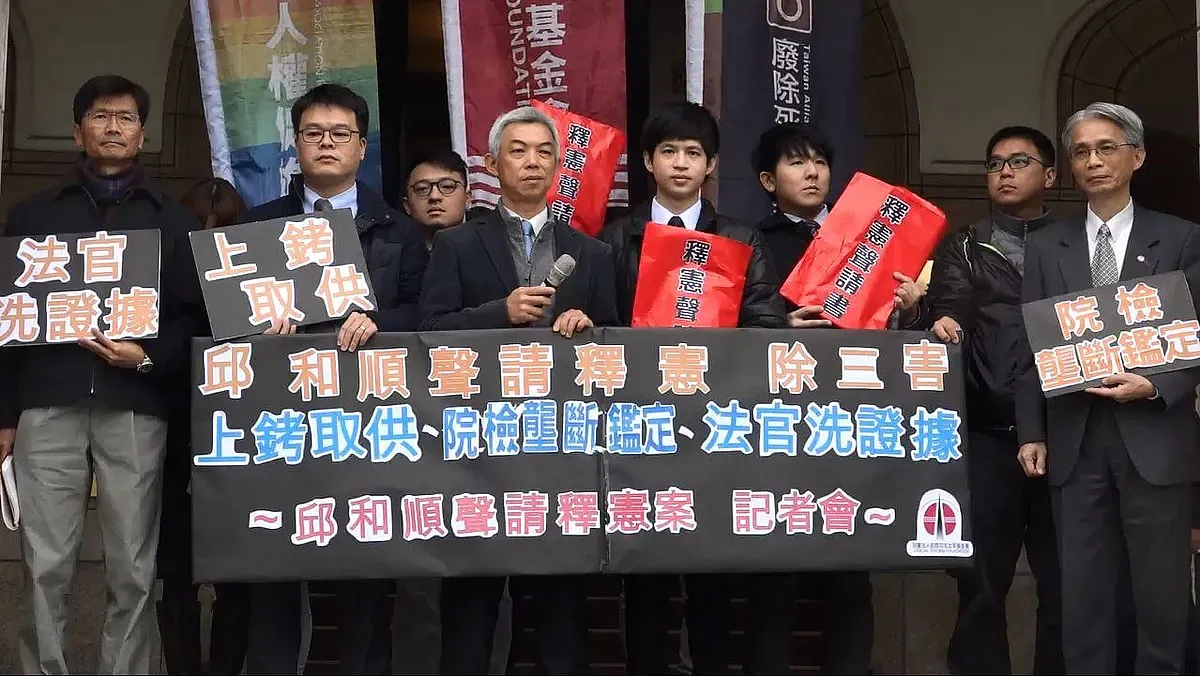
Ch'i Ho-shun Files Constitutional Interpretation Petitions to Eradicate "Three Evils": "Handcuffing for Confessions, Monopolization of Expert Testimony by Courts and Prosecutors, and Laundering of Evidence by Judges" — Press Conference on the Three Constitutional Interpretation Petitions in the Ch'i Ho-shun Case
Last edited: 2026-11-03
Post-Press Conference Press Release
 Photo: Attorney Yu Po-hsiang submitting the three constitutional interpretation petitions to staff at the Secretariat of the Grand Justices
The Judicial Reform Foundation held a press conference this morning (Feb. 9) in front of the Judicial Yuan regarding the three constitutional interpretation petitions for the Ch'i Ho-shun case. The pro bono legal team, experts, scholars, and civil society organizations jointly submitted red envelopes containing the three constitutional interpretation petitions as an early Lunar New Year greeting to the Grand Justices, hoping that the Grand Justices will accept the petitions and render interpretations, ensuring that Ch'i Ho-shun, who has been imprisoned for nearly 30 years, is not imprisoned in vain.
Yu Po-hsiang of the pro bono defense team stated that last year Ch'i Ho-shun submitted a constitutional interpretation petition, upon which the Grand Justices rendered Interpretations No. 755 and 756, pointing out various issues in the criminal procedure system present in the Ch'i Ho-shun case. This round of constitutional interpretation petitions raises three issues: First, unfair expert testimony—prosecutors can choose to commission expert testimony while defendants cannot, violating the principle of equality of arms; furthermore, expert witnesses do not need to appear in court, leaving defendants essentially blindfolded in their defense. The second issue is the laundering of evidence. Testimonial and physical evidence should be directly examined in court, but courts launder them into documentary evidence, requiring only the reading of transcripts, which violates the principle of direct judicial examination and leads to unfavorable preservation of evidence. The third issue is allowing prosecutors and police to handcuff and shackle defendants to extract confessions. Are we still to follow ancient practices in the 21st century?
Hsu Wei-chun, a criminal law scholar at Chung Yuan Christian University, stated that the Ch'i Ho-shun case involves both human and systemic factors. Regarding human factors, judicial personnel possess a very weak understanding of due process, violate the presumption of innocence in the formation of mental conviction, force the case to rely on defendant confessions, and assign the disadvantage of lost evidence to the defendant, blocking all avenues for relief. Systemic factors lead judges to operate under a presumption of guilt, such as the expert testimony system, which skews the defendant's right to defense. The underlying appeal of the three constitutional interpretation petitions is a human rights appeal; vindicating the Ch'i Ho-shun case will further prevent other miscarriages of justice.
Professor Li Chun-yi of the Graduate Institute of Forensic Medicine at National Taiwan University pointed out regarding expert testimony that scientific evidence carries great uncertainty, and expert testimony conducted by courts and prosecutors turns this uncertainty against the defendant. Moreover, because the expert evaluations are proposed by investigative authorities, they are subject to doubts regarding independence and objectivity. In addition, there is a lack of regulations governing the custody of physical evidence; the court's view that the loss of audio tapes does not affect the judgment implies an intent to close the case rather than pursue the truth.
Lin Tzu-wei, legal advocacy officer of the Taiwan Association for the Death Penalty Abolition, stated that Ch'i Ho-shun is Taiwan's longest-imprisoned death row inmate, not as fortunate as Hsu Tzu-chiang or Cheng Hsing-tse. The Grand Justices have made many brilliant decisions on past issues, and it is hoped that Ch'i Ho-shun can reunite with his family during the Lunar New Year next year.
Liu Pei-wei, staff attorney for the Taiwan Association for Innocence, stated that violations of due process and errors in scientific evidence are the two major factors behind wrongful convictions, and both are present in the Ch'i Ho-shun case. The court primarily convicted him based on co-defendant statements and the sole physical evidence of "voiceprint analysis." She hopes the Grand Justices will more rigorously review cases involving death row inmates.
Shih Yi-hsiang, deputy secretary-general of the Taiwan Association for Human Rights, stated that the concluding observations of the 2013 International Human Rights Covenants review pointed out that death penalty judgments must not be based on confessions extracted through torture, and explicitly recommended that the death penalty not be executed against Ch'i Ho-shun. Pursuant to the provisions prohibiting torture under the Covenants and the United Nations Convention against Torture, public officials should receive education and training, accountability should be enforced for personnel who practice torture, and whistleblowers must be protected in order to prevent miscarriages of justice.
Pro bono defense team attorney Yu Po-hsiang concluded by noting that the advancement of Taiwan's rule of law has been built upon miscarriages of justice, including those of Hsu Tzu-chiang, Su Chien-ho, and even earlier, Wang Ying-hsien. He hopes the Grand Justices will accept the three constitutional interpretation petitions and render interpretations, ensuring Ch'i Ho-shun is not imprisoned in vain. Finally, representing the team, Yu Po-hsiang handed over the three constitutional interpretation petitions to the staff of the Secretariat of the Grand Justices.
The Judicial Reform Foundation held a press conference this morning (Feb. 9) in front of the Judicial Yuan. Together with the pro bono defense team including attorney Yu Po-hsiang, Professor Li Chun-yi from the Graduate Institute of Forensic Medicine at National Taiwan University, Professor Hsu Wei-chun of criminal law, and civil society organizations long dedicated to saving Ch'i Ho-shun, they submitted three constitutional interpretation petitions to the Grand Justices of the Judicial Yuan, hoping that the Grand Justices will declare unconstitutional the "three major plagues of criminal procedure" encountered in the Ch'i Ho-shun case.
In 1988, 12 defendants including Ch'i Ho-shun were accused of committing the dismemberment murder of Ko Hung Yu-lan and the kidnapping of Lu Cheng. However, during the trials of this case, three major plagues commonly seen in criminal procedure practice were present: First, the defendants' confession records during investigation were made while they were handcuffed. Second, the Investigation Bureau's voiceprint analysis report lacked scientific professionalism, yet the court accepted it wholesale. Third, the court used the reading of examination transcripts to replace the direct in-court examination of physical evidence.
These "three major plagues" subjected Ch'i Ho-shun to an unfair trial. Consequently, the pro bono defense team for the Ch'i Ho-shun case has filed petitions for constitutional interpretation regarding these persisting "three major plagues" in the Code of Criminal Procedure, thereby moving the criminal procedure system another step forward.
In 1996, in the then-shocking kidnapping and ransom murder case of Huang Chun-shu, defendant Hsu Tzu-chiang was sentenced to death and finalized solely based on the confessions of co-defendants Ch'en I-lung and Huang Chun-ch'i implicating his involvement. Subsequently, the pro bono defense team for the Hsu Tzu-chiang case filed a petition for constitutional interpretation, resulting in the Grand Justices rendering Interpretation No. 582. The Interpretation held that the Supreme Court precedent stating "statements of co-defendants can be mutually corroborative" was unconstitutional and mandated that the defendant's right to cross-examine co-defendants must be ensured. Following this constitutional interpretation, not only was Hsu Tzu-chiang ultimately vindicated and acquitted, but Taiwan's judiciary also broke free from the era of conviction based on co-defendants biting each other, moving toward strict proof and the strict evidence rule.
The Hsu Tzu-chiang case eradicated a major plague from Taiwan's criminal procedure system, marking a great leap forward in enhancing criminal human rights protections. Compared to the Hsu Tzu-chiang case, the Ch'i Ho-shun case simultaneously exhibits these "three major plagues," which urgently need to be eradicated. Constitutional interpretation petitions were already filed for the Ch'i Ho-shun case last year, prompting the Grand Justices to render Interpretations No. 755 and 756, which dismantled the special power relationship within correctional institutions, protected inmates' right to communication, and opened a window for prison reform. Ch'i Ho-shun hopes that through this constitutional interpretation, the three major plagues of Taiwan's criminal procedure practice can be bid farewell, moving Taiwan's criminal procedure practice closer to a fair trial.
The First Major Plague in Taiwan's Criminal Practice: Article 282 of the Code of Criminal Procedure Permits Police and Prosecutors to Interrogate Suspects While Handcuffed
 Photo: Attorney Yu Po-hsiang, Pro Bono Defense Team for the Ch'i Ho-shun Case
First, Ch'i Ho-shun was handcuffed while having his statements recorded during the investigation, which is also a widespread practice in current judicial practice. However, when a defendant is isolated alone in an investigative courtroom or interrogation room, subjected to interrogation by an imposing prosecutor or surrounded by police officers, conducting the interrogation while the defendant is handcuffed further exacerbates psychological fear and obedience toward the police and prosecutors. This makes defendants prone to yielding to pressure and obeying the instructions of police and prosecutors, confessing to crimes they did not commit.
When Ch'i Ho-shun argued before the judge that his confession during the investigation violated Article 282 of the Code of Criminal Procedure—which states: "The physical body of a defendant shall not be restrained while present in court"—and thus constituted a confession obtained by improper means, the judge took the view that since the statutory provision only regulates that the defendant's body shall not be restrained while "present in court" and contains no identical provision for the investigative stage, handcuffs may therefore be used to restrain the defendant during investigation. Such legal provisions and statutory interpretations are hard to convince the public! We must ask: what is the purpose of handcuffing during the investigation? Why on earth must a defendant endure harsher interrogation conditions during the investigation than during the trial? Is there a suspicion that the statutory design utilizes harsh interrogation to extract confessions?
Therefore, the first plague that Ch'i Ho-shun seeks to eradicate through his constitutional interpretation petition is "handcuffing for confessions." He argues that Article 282 of the Code of Criminal Procedure fails to grant defendants during investigations equal protection, thereby violating the constitutional principles of equality, due process of law, human dignity, and the right of access to courts.
The Second Major Plague in Taiwan's Criminal Practice: Articles 198 and 208 of the Code of Criminal Procedure Grant Judges and Prosecutors a Monopoly Over Expert Testimony
 Photo: Professor Li Chun-yi, Graduate Institute of Forensic Medicine, College of Medicine, National Taiwan University
Second, the prosecutor commissioned the Criminal Investigation Bureau to conduct a voiceprint comparison and analysis of the ransom call in the Lu Cheng case. Based solely on the conclusion that the voiceprint was similar to that of co-defendant Yu Chih-hsiang, the expert report concluded that the voices matched. The court relied on this to hold that the expert report proved the confessions of Ch'i Ho-shun and others were true—namely, determining that after Ch'i Ho-shun and other defendants kidnapped Lu Cheng, Yu Chih-hsiang had used the phone to demand a ransom from Lu Cheng's family.
During the trial of this case, Ch'i Ho-shun and other defendants consistently questioned the accuracy of the expert testimony due to the vast discrepancies in the voiceprint spectrums of the expert report, and requested a re-examination as well as the summoning of the expert witness from the Criminal Investigation Bureau for cross-examination. However, Article 198 of the Code of Criminal Procedure restricts defendants from independently appointing expert witnesses, and the ransom tape recordings were lost, dashing their hopes.
Furthermore, Article 208 of the Code of Criminal Procedure stipulates that courts and prosecutors may commission professional agencies to conduct expert evaluations, omitting any provision for defendants to commission expert evaluations. This results in defendants being restricted to applying to the court for expert testimony. Under this systemic design, once a prosecutor commissions an expert evaluation, judges frequently deny a defendant's subsequent application for commissioned expert testimony unless the defendant can point out flaws in the original expert report. This places defendants at a distinct disadvantage in litigation: "Prosecutors can commission expert evaluations at any time they wish, but when defendants wish to commission expert evaluations, they must first point out flaws in the original evaluation and obtain the court's consent."
More gravely, in current practice, institutional expert evaluations under Article 208 of the Code of Criminal Procedure do not need to record the natural person who actually carried out the evaluation, nor do such individuals need to appear in court, take an oath, and submit to cross-examination. This leaves defendants utterly unable to challenge whether the expert was professional or whether the evaluation methods violated scientific standards. Consequently, the various disadvantages imposed on defendants by Articles 198 and 208 clearly violate the constitutional principles of the presumption of innocence, equality of arms, and due process of law. This constitutes the second plague that Ch'i Ho-shun seeks to eradicate in this constitutional interpretation petition: the monopolization of expert testimony by courts and prosecutors.
The Third Major Plague in Taiwan's Criminal Practice: Supreme Court Precedent Permits Judges to Launder Evidence
Finally, Ch'i Ho-shun and other defendants all claimed they were subjected to police torture and requested the court to examine the audiovisual records of the police and prosecutorial interrogations in court. However, although the Retrial 11th Instance Court examined a portion of the audiovisual records of the police and prosecutorial interrogations, it cited a Supreme Court precedent (80-Tai-Shang-4672) holding that because prosecutors and judges in all previous trial instances had already examined a portion of the audiovisual records and made examination transcripts, and because those transcripts recorded no torture, it abruptly dismissed the defendants' defense of torture.
Pursuant to the principle of direct judicial examination, the Retrial 11th Instance Court should have played the audiovisual records of the police and prosecutorial interrogations itself to form its own mental conviction; it should not have inherited the mental convictions of prosecutors and previous trial courts through examination transcripts made by them. Therefore, the judge of the Retrial 11th Instance Court should have examined the audiovisual records of police and prosecutorial interrogations in court himself for the evidence to be usable. However, the precedent (80-Tai-Shang-4672) holds that judges may use previous examination transcripts made by prosecutors and prior trial courts to replace physical evidence such as original audiovisual records. This is tantamount to permitting judges, through "laundering evidence," to launder physical evidence like audiovisual records into examination transcripts, and testimonial evidence into written records like police or interrogation transcripts. This is a major reason why the principle of direct judicial examination has failed to be implemented in practice and often degrades into trial by transcript, violating the principle of direct judicial examination guaranteed by the Constitution. "Judges laundering evidence" is the third criminal procedure practice plague that Ch'i Ho-shun seeks to eradicate through this constitutional interpretation.
Our Demands: Appealing to the Grand Justices to Declare Articles 282, 198, and 208 of the Code of Criminal Procedure and Supreme Court Precedent No. 80-Tai-Shang-4672 Unconstitutional
The three plagues of criminal procedure practice—handcuffing for confessions, monopolization of expert testimony by courts and prosecutors, and laundering of evidence by judges—have not only occurred in the case of Ch'i Ho-shun alone; countless miscarriages of justice have also suffered deeply from them.
Today, although Ch'i Ho-shun himself has suffered nearly 30 years of imprisonment, he earnestly hopes to use his own victimization to eradicate the three plagues of criminal procedure, submitting three constitutional interpretation petitions through lawyers and experts and scholars. We sincerely appeal to the Grand Justices to declare unconstitutional the relevant criminal procedure provisions and precedents involved in the Ch'i Ho-shun case, granting the Ch'i Ho-shun case an opportunity for vindication, driving further progress in criminal human rights, and benefiting countless potential victims of injustice.

Attachments
- Summary of Constitutional Interpretation Petitions
- Petition I: Article 282 of the Code of Criminal Procedure
- Petition II: Articles 198 and 208 of the Code of Criminal Procedure
- Petition III: Supreme Court Precedent No. 80-Tai-Shang-4672
Time
February 9, 2018 (Friday) 10:00–10:30
Location
In front of the Main Gate of the Judicial Yuan (No. 124, Sec. 1, Chongqing S. Rd.)
Attending Representatives
Pro Bono Defense Team for the Ch'i Ho-shun Case
Attorney Yu Po-hsiang
Attorney Lin Chun-hung
Attorney Kuo Hao-jen
Attorney Li Yi-chuan
Representatives of Scholars and Rescue Organizations
Professor Li Chun-yi / Graduate Institute of Forensic Medicine, College of Medicine, National Taiwan University
Associate Professor Hsu Wei-chun / College of Law, Chung Yuan Christian University
Attorney Liu Pei-wei / Staff Attorney, Taiwan Association for Innocence
Shih Yi-hsiang / Deputy Secretary-General, Taiwan Association for Human Rights
Lin Tzu-wei / Legal Advocacy Officer, Taiwan Association for Death Penalty Abolition
Chang Chih / Specialist, Legal and International Affairs Department, Judicial Reform Foundation
Media Contact
Attorney Yu Po-hsiang, Pro Bono Defense Team for the Ch'i Ho-shun Case 02-23681966
This article is an AI-generated translation of the original Chinese text. In the event of any discrepancy, the Chinese version shall prevail.