
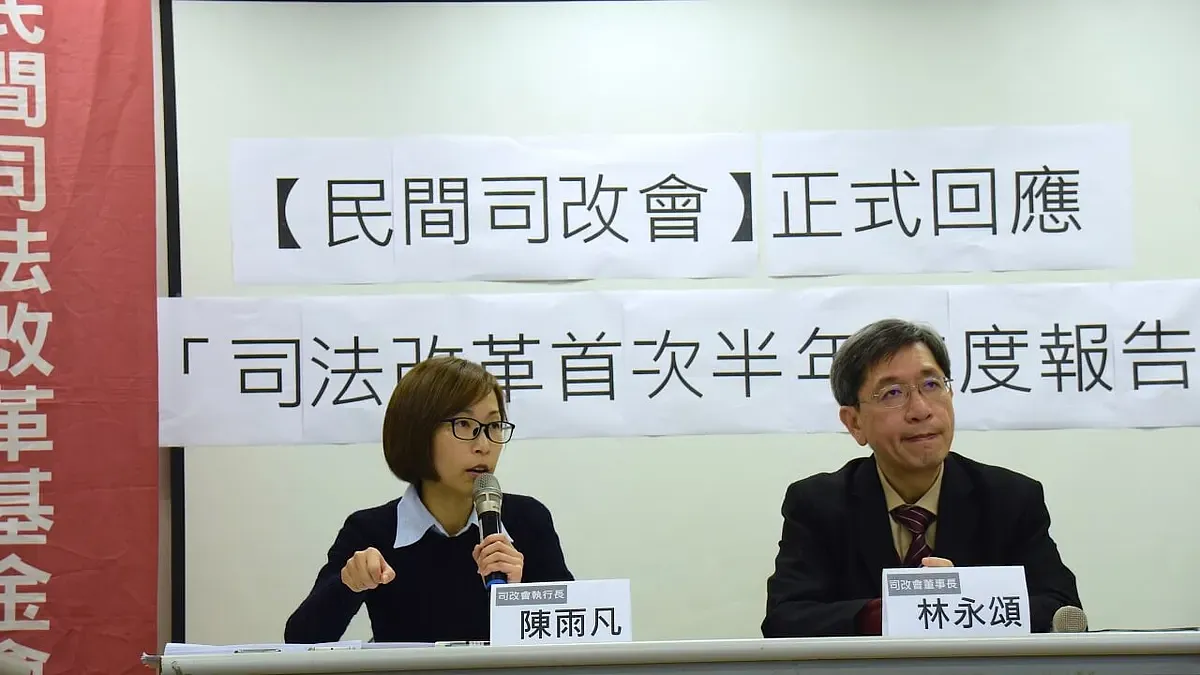
"Imperceptible Judicial Reform" ~ Failing Grade on Midterm, Looking Forward to High Score on Makeup Exam Press Conference
Last edited: 2026-11-03
Post-Meeting Press Release
The Judicial Reform Foundation (JRF) held a press conference this afternoon (02/12) to respond to the "First Half-Year Progress Report on Judicial Reform" jointly released this morning by the Judicial Yuan, Executive Yuan, and Ministry of Justice.
"Imperceptible Judicial Reform, Failing Grade, Looking Forward to High Score on Makeup Exam"
 Photo / Ch'en Yü-fan, CEO of the Judicial Reform Foundation
CEO Attorney Ch'en Yü-fan bluntly stated that the reforms over the past six months have been distant from the public and imperceptible, resulting in a failing grade, and she looks forward to a high score on the upcoming makeup exam.
However, the JRF still affirms President Tsai Ing-wen for fulfilling her promise to proactively report the progress of judicial reform to the public. It also recognizes the "preliminary" responses given regarding the establishment of a dialogue platform between the Judicial Yuan, Executive Yuan, Ministry of Justice, and civil society organizations to collaboratively implement judicial reforms, as well as the creation of a cross-ministerial "single website" to keep the public informed of reform progress and the "responsible units" designated for the 87 resolutions of the National Judicial Reform Conference.
Chairman Attorney Lin Yung-sung stated that the public is "imperceptible" to any "progress" in judicial reform. After the conclusion of the National Judicial Reform Conference summary meeting in mid-August last year, the Office of the President's National Judicial Reform Conference website stopped updating. Only after pressure from civil society will a single website for judicial reform implementation be launched in March this year; how can the public feel any sense of reform? Furthermore, overall, official reports focused on the legislative progress of bulky bills, while reform initiatives that do not require legislation showed no discernible progress. The official authorities only responded to which agencies were the "principal and co-organizing agencies" for the 87 conference resolutions this February. Such efficiency is far too slow and passive; how can the public be satisfied?
"Not Just the Judicial Yuan and Ministry of Justice—Regardless of the Unit, Everyone Must Take Action"
 Photo / Attorney Lin Yung-sung, Chairman of the Judicial Reform Foundation
Attorney Lin Yung-sung also pointed out that the Judicial Yuan and Ministry of Justice have not fully responded on how to implement the resolutions, while some other ministries have not responded at all. He hopes the relevant responsible agencies will step forward to address this. Moreover, for the parts that currently show progress, has the government established "performance evaluation indicators"? Who is evaluating them? None of this is evident.
In addition, Attorney Lin stated that the JRF hoped to establish a pyramidal litigation system. While the Judicial Yuan has a draft proposal, it lacks "complementary measures." As the threshold for judicial remedy is increasingly narrowed, the remedies for wrongful convictions and the quality of judgments are essential complementary systems, yet they are nowhere to be seen. Regarding citizen participation, whether lay participation or mixed-court assessor systems, the conference committee vote was tied at 7:7. Why did the Judicial Yuan choose only the assessor system and remain unwilling to pilot the assessor and lay participation systems side by side? As for the supervision and elimination of incompetent judges and prosecutors, if a factory experiences a high defect rate or receives customer complaints, it is bound to take action. Taiwan's judiciary has problems yet fails to actively address them; businesses would never operate this way.
"Why is there such a gap between the official belief in a perceptible reform and the actual feelings of the public?"
Attorney Ch'en Yü-fan concluded by hoping that official authorities can listen to the voices of civil society, using them as a force to promote the genuine implementation and progress of judicial reform. The Alliance for Civil Monitoring and Implementation of the National Judicial Reform Conference Resolutions, uniting more organizations dedicated to the study of professional issues, will subsequently consolidate its recommendations and responses to the official report. In addition, many responses within the report lack concrete planning and timelines; while these can be awaited, they must not end up empty promises. We look forward to more concrete planning for policies.
During the post-meeting Q&A, reporters asked questions regarding the lawyer elimination mechanism in the draft Attorney Regulation Act announced by the Ministry of Justice, whether the JRF advocates for lay participation or assessor systems, and whether it supports enacting the crime of obstruction of justice to restrict the media. Both Attorney Lin Yung-sung and Attorney Ch'en Yü-fan agreed on establishing a lawyer elimination mechanism, but argued it should not be controlled by the Ministry of Justice through "administrative power"; instead, it should be handled by a national bar association ethics and discipline committee established pursuant to the National Judicial Reform Conference. As for whether to adopt lay participation or assessor systems, the JRF does not currently endorse one over the other; rather, both systems should be piloted concurrently to determine which is best suited for Taiwan, with an evaluation to be made after three to five years. Regarding the enactment of the crime of obstruction of justice, which involves restricting freedom of speech or media reporting freedom, the JRF holds a reserved stance, believing that it would be more appropriate for the media to establish self-regulatory mechanisms.
Today (02/12) is the day President Tsai Ing-wen promised to report on the progress of judicial reform. This morning, Judicial Yuan President Hsu Tsung-li, Minister of Justice Chiu Tai-san, and Executive Yuan Minister without Portfolio Lo Ping-cheng jointly released the "First Half-Year Progress Report on Judicial Reform." Although the government has worked hard over the past six months to implement the resolutions of the National Judicial Reform Conference, overall, we believe this judicial reform remains distant from the people and imperceptible, earning a failing grade. We look forward to more perceptible and resolute judicial reforms moving forward.
-
Affirming the government's efforts in judicial reform:
- We affirm that the President fulfilled her promise to proactively report the progress of judicial reform to the public after half a year.
- We also affirm that the Judicial Yuan, Executive Yuan, Ministry of Justice, and civil society organizations (the Alliance for Civil Monitoring and Implementation of the National Judicial Reform Conference Resolutions) have established a dialogue platform to collaboratively implement judicial reform.
- The official authorities have also promised to build a cross-ministerial "single website" to make implementation progress open and transparent.
- They have provided "preliminary" responses regarding matters such as the "responsible units" for the 87 National Judicial Reform Conference resolutions.
-
Reforms are imperceptible to the public, lacking resolve and determination:
Judicial reform must not distance itself from the public, yet official authorities have prioritized the amendment of bulky legal systems. However, citizens utilize the judiciary every day, and reforms that can be implemented immediately without statutory amendments have instead been neglected. Observing the judicial reform over the past six months, the government remains insufficiently proactive, and the single website has been delayed and is still not online. Furthermore, judicial problems are deeply entrenched and involve cross-branch powers and responsibilities; yet in this half-year report, branches and ministries other than the Judicial Yuan and Ministry of Justice seemed detached, offering no active response. Moreover, in advancing reforms, the authorities failed to broadly incorporate external civil society opinions during the early stages of policy formation. The extensive half-year report lacks "indicators" for evaluating effectiveness and tracking mechanisms, as if reform only requires self-satisfaction.
- Superficial responses: For instance, regarding the implementation of non-disclosure of investigations, conference resolutions demanded that violators be investigated, dealt with, and held strictly accountable, alongside the regular publication of review reports and data concerning related investigations and disciplinary actions. Over the past half-year, no review report has been published; the Ministry of Justice merely reiterated that it would pursue accountability and study plans, lacking concrete actions. Furthermore, no explanation has been provided by the National Police Agency.
- Lack of resolve in reforms: The Judicial Yuan strongly promotes the pyramidal litigation system, but while reducing case volume, it has failed to plan for strengthening wrongful conviction remedy systems, the pyramidal personnel planning, and complementary measures to enhance judgment quality, which is concerning.
- Unfounded, stubborn insistence on pushing policies: The Judicial Yuan insists on promoting the draft "Criminal Trials Act with Citizen Participation," which resembles Japan's Saiban-in (lay assessor) system, while refusing to simultaneously pilot the "assessor system" and "lay participation system" and gather domestic empirical experience and data before formulating policy.
- Refusal to reform: The evaluation system for judges and prosecutors refuses to incorporate the resolution allowing citizens to directly request evaluations.
-
Still looking forward to a closer-to-the-people and more proactive judicial reform:
We expect the government to be close to the people and bring a perceptible judiciary.
- Promptly implement resolutions that can be carried out immediately without legal amendments, such as: resolving the frequent transfer of judges, which leads to delays in complex cases. Resolutions related to interpreters do not require legal amendments; police and prosecutorial authorities should actively implement them to safeguard the rights of vulnerable groups in the judiciary. Actively exercise disciplinary supervision over judges and prosecutors who violate ethical norms.
- We also expect more proactive cross-branch coordination to complete all planning responses.
- Consult opinions from civil society during the early stages of policy formation.
- Hope the government honestly and candidly explain any difficulties in implementation.
- Most importantly, "judicial reform indicators" should be established to transform abstract resolutions into concrete, measurable indicator items in order to effectively evaluate effectiveness. Consideration should also be given to periodically commissioning credible institutions to conduct public opinion polls and research.
Attending Representatives
Attorney Lin Yung-sung / Chairman, Judicial Reform Foundation
Attorney Ch'en Yü-fan / CEO, Judicial Reform Foundation
Press Contact
Attorney Ch'en Yü-fan / CEO, Judicial Reform Foundation (02)2523-1178
This article is an AI-generated translation of the original Chinese text. In the event of any discrepancy, the Chinese version shall prevail.