
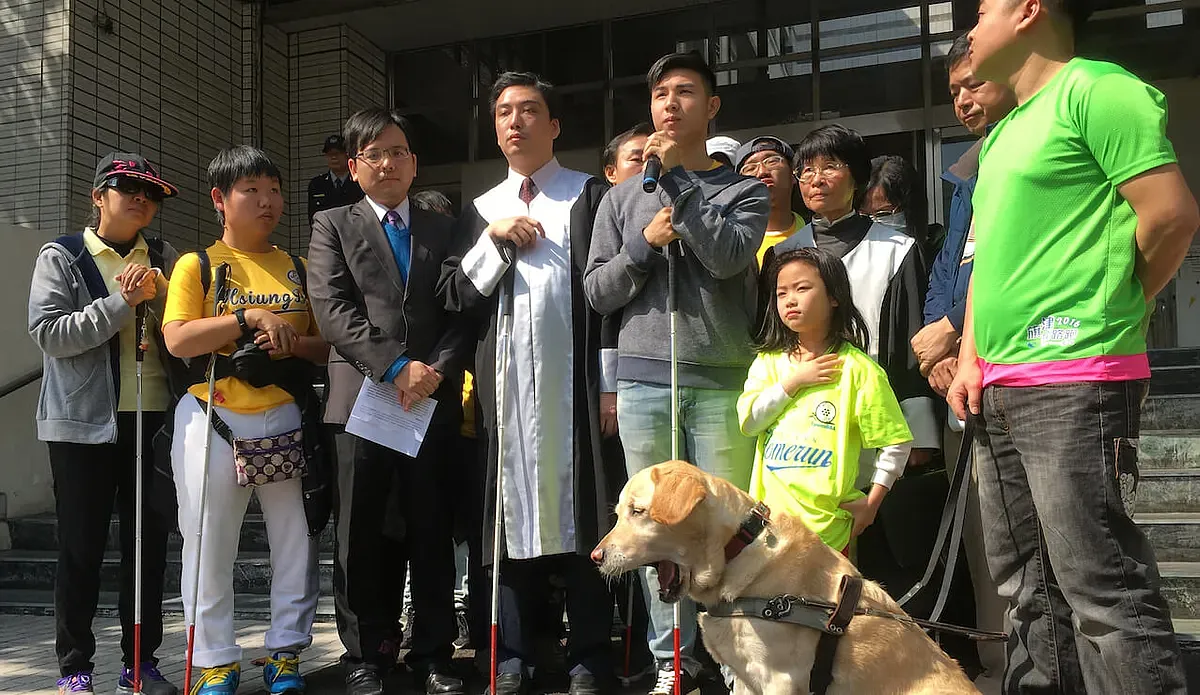
Invisible Justice: Blind Ch'en Ching-k'ai; Narrow-Minded Judiciary ~ Press Conference on the Second-Instance Guilty Verdict against Former Handball National Athlete Ch'en Ching-k'ai for Allegedly Faking Blindness and Insurance Fraud
Last edited: 2026-11-03
Statement from Litigant Ch'en Ching-k'ai
Regarding the guilty verdict and dismissal of the appeal rendered by the Kaohsiung Branch Court under 103-Nien-Shang-Yi-Tzu No. 574, I issue the following statement:
How can you justify ruling against me like this!
I have worked so hard just to survive, yet what I receive in return is the prejudice that visually impaired persons should not act this way, allowing for such discrimination simply because they have never truly seen a visually impaired person exercise and assume that a blind person must stay at home and live as good-for-nothings!
I am not the only one being sentenced; this is a denial of all visually impaired individuals who strive to exist in this society and be treated with the same equality as ordinary people. It tells those of us who work hard to survive that our efforts will not be commended, which is deeply regrettable.
I was truly blinded because of this traffic accident, yet my ability to exercise and write with neat handwriting is being used to judge me as faking blindness.
Using the perspective of you sighted people to decide what I can or cannot do—the current judgment is tantamount to sentencing all visually impaired individuals to death.
On the morning of February 14, 2018 (Wednesday), the Taiwan High Court Kaohsiung Branch Court delivered a guilty verdict on appeal in the case involving former handball national athlete Ch'en Ching-k'ai, who was accused of faking blindness to commit insurance fraud. In response to this outcome, the defense counsel team finds it unacceptable and lodges a solemn protest.
After years of protracted judicial proceedings in this case, multiple pieces of evidence have demonstrated that Ch'en Ching-k'ai is indeed a severely visually impaired person who lost his sight midway through life. However, the prosecutors investigating this case and the judges presiding over it at all levels merely relied on items such as photographs and videos showing Ch'en Ching-k'ai throwing a frisbee, playing table tennis, writing neatly, and dancing, while ignoring scientific evidence and numerous other favorable counter-evidence. Disregarding the principle of the "presumption of innocence," they convicted Ch'en Ching-k'ai of feigning blindness for insurance fraud. There can be no greater damage to judicial credibility and the human rights of visually impaired disadvantaged groups than this!
Visual Science Professional Evaluation Confirms Ch'en Ching-k'ai's Severe Visual Impairment
During the trial, the Kaohsiung Branch Court commissioned National Taiwan University to conduct an evaluation using state-of-the-art technology, specifically employing (1) functional magnetic resonance imaging (fMRI), (2) complex and precise next-generation electroencephalography (EEG) measurement, and (3) behavioral assessment methods specialized in visual science. Through cross-comparison and mutual verification among these three testing methods, Ch'en Ching-k'ai's central visual acuity was measured at only 0.00055, which is more than 24 times lower than the 0.01 threshold for severe visual impairment.
Visual Electrophysiology Professional Evaluation Confirms Abnormal Visual System Function
A visual electrophysiology expert from National Yang-Ming University submitted a professional report and appeared in court to testify at the Kaohsiung Branch Court, evaluating that the pattern visual evoked potentials (PVEP) and pattern electroretinograms (PERG) administered to Ch'en Ching-k'ai by Changhua Christian Hospital and Tri-Service General Hospital were abnormal. Furthermore, the abnormal readings of visual evoked potentials and pattern electroretinograms administered to Ch'en Ching-k'ai by Kaohsiung Veterans General Hospital, Kaohsiung Medical University Hospital, National Taiwan University Hospital, Cheng Hsin General Hospital, and Linkou Chang Gung Memorial Hospital were also verified by the visual electrophysiology expert to be true and factual. In total, test reports from seven hospitals all show that Ch'en Ching-k'ai's visual electrophysiology is abnormal.
Visual Field Reports from Five Hospitals Showed Completely Black Fields in Both Eyes
Following his traffic accident on November 24, 2009, Ch'en Ching-k'ai successively underwent visual field examinations at the ophthalmology departments of five major hospitals—namely, Changhua Christian Hospital on December 25, 2009; Kaohsiung Veterans General Hospital in March 2010 and July 2011; Kaohsiung Medical University Hospital in May 2012; Taipei Veterans General Hospital in May 2016; and Tri-Service General Hospital in November 2016. All of his visual field reports showed that both eyes were completely black.
Professional Personnel Serving the Visually Impaired for Years Assess Him as Severely Visually Impaired
The current president of the Taiwan Blind Association and an orientation and mobility instructor from the association testified in the court of first instance that when Ch'en Ching-k'ai's visual function was evaluated in July 2012, no visual field could be detected in either eye. Moreover, during his rehabilitation process, Ch'en Ching-k'ai bumped into a neighbor's suddenly opened door, collided with a repositioned massage bed and sleep bed, and struck a statue at the rehabilitation center.
Ch'en Ching-k'ai Still Remains Severely Visually Impaired Today
In addition to the aforementioned National Taiwan University evaluation report, a series of abnormal visual field and visual electrophysiology reports from various hospitals, and the visual function evaluation by the Taiwan Blind Association, supplementary footage submitted ad hoc by the prosecutor from the Kaohsiung Branch Court—including customs surveillance footage of Ch'en Ching-k'ai using the automated customs clearance system for entry and exit in November 2017, and covertly recorded video of him signing for a package in January 2017—both demonstrate the reality of Ch'en Ching-k'ai using a white cane while blind. This clearly shows that Ch'en Ching-k'ai has suffered from severe visual function impairment from the very beginning after the traffic accident.
Absurd Arguments in This Case
Whether Ch'en Ching-k'ai faked blindness depends entirely on whether his visual acuity was below 0.02 on the international visual acuity scale at the time he claimed his insurance benefits. Therefore, assessing the state of his visual function is the focal point of this case. Unexpectedly, the court chose to discard the National Taiwan University scientific evaluation showing Ch'en Ching-k'ai's central visual acuity was only 0.00055, as well as the strong counter-evidence consisting of a series of abnormal or completely black visual field and visual electrophysiology reports from various hospitals and the severe visual impairment assessments by professionals serving the visually impaired. Instead, it insisted on using Ch'en Ching-k'ai's active performance in striving to learn and adapt to life after losing his sight as evidence to conclude that he faked blindness and insurance fraud. Preferring to believe the prejudices of sighted people and making the inference that losing sight equals losing ability entirely lacks evidentiary basis and violates the rules of evidence collection! Furthermore, the court failed to abide by the Convention on the Rights of Persons with Disabilities' provision that "discrimination shall not be based on any grounds" and its explicit definition of disability as "impairment of functions"; nor did it follow the principle of the presumption of innocence under the Code of Criminal Procedure, which dictates that "in case of doubt regarding the evidence, the benefit shall lie with the defendant." This is heartbreaking!
Regarding the case in which Ch'en Ching-k'ai was convicted of feigning blindness and insurance fraud, the pro bono defense counsel team issues the following statements:
- Ch'en Ching-k'ai's case is a judicial miscarriage of justice. We earnestly urge all sectors of society to pay active attention to this matter, and we also request the Prosecutor-General to file an extraordinary appeal.
- Judicial personnel, due to a lack of accessibility awareness, have severely harmed the rights of persons with disabilities. There is an urgent need for vigorous reform to improve the quality of justice.
- This case bears witness to the failure of justice and public reason in Taiwan, where the presumption of innocence has become dead letters and credibility has completely vanished!
Appendix
| Time | Event |
| 2009.11.24 | Ch'en Ching-k'ai was injured in a motorcycle collision caused by another driver and was admitted to Changhua Christian Hospital. |
| 2009.12.15 | While hospitalized at Changhua Christian Hospital, Ch'en Ching-k'ai was referred to the Department of Neurology due to blurred vision. |
| 2009.12.25 | Ch'en Ching-k'ai's visual field chart at Changhua Christian Hospital showed both eyes completely black. |
| 2010.01.12 | Ch'en Ching-k'ai's pattern visual evoked potential (PVEP) at Changhua Christian Hospital was abnormal, diagnosed as "possible right pre-chiasmal lesion." |
| 2010.01.28 | Ch'en Ching-k'ai's cerebral blood perfusion test at Changhua Christian Hospital diagnosed that "reduced cerebral blood perfusion or cerebral cortical parenchymal damage should be considered, particularly prominent in bilateral occipital lobes." |
| 2010.02.02 | Ch'en Ching-k'ai's visual evoked potential (PVEP) at Kaohsiung Veterans General Hospital was abnormal, noting delayed responses and small waveforms in both eyes. |
| 2010.03.15 | Ch'en Ching-k'ai's visual field chart at Kaohsiung Veterans General Hospital showed both eyes completely black. (Note: After February 2010) |
| 2010.03.18 | Diagnosis certificate from Kaohsiung Veterans General Hospital diagnosed Ch'en Ching-k'ai with "head trauma resulting in concussion complicated by bilateral visual impairment; post-concussion syndrome." |
| 2010.03.26 | Diagnosis certificate from Changhua Christian Hospital diagnosed "suspected traumatic cerebral cortical visual lesion"; certifying that Ch'en Ching-k'ai's "binocular visual acuity is below 0.01 on the international visual acuity scale due to the aforementioned reasons." |
| April 2010 | Ch'en Ching-k'ai obtained the physical and mental disability handbook for severe visual impairment issued by the Social Welfare Bureau. |
| 2010.06.11 | Ch'en Ching-k'ai's visual evoked potential (PVEP) at Kaohsiung Veterans General Hospital was abnormal, noting delayed responses in both eyes. |
| 2010.09.10 | Diagnosis certificate from Changhua Christian Hospital diagnosed "suspected traumatic cerebral cortical visual lesion," certifying that Ch'en Ching-k'ai's "binocular visual acuity is below 0.01 on the international visual acuity scale due to the aforementioned reasons." |
| 2011.02.21, 2011.03.07 | Ch'en Ching-k'ai's visual evoked potential (PVEP) at Changhua Christian Hospital presented as abnormal. |
| 2011.07.08 | Ch'en Ching-k'ai's visual field chart at Kaohsiung Veterans General Hospital showed both eyes completely black. Visual field indices for both left and right eyes were recorded as 0%. |
| 2011.08.05 | Ch'en Ching-k'ai's flash visual evoked potential (flash VEP) at Kaohsiung Veterans General Hospital was abnormal, noting delayed responses in both eyes. |
| 2011.08.08 (After claiming insurance benefits) | Diagnosis certificate from Changhua Christian Hospital diagnosed "suspected traumatic cerebral cortical visual lesion," certifying that "corrected uncorrected visual acuity of both eyes showing hand movement at 30 centimeters is below 0.01 on the international visual acuity scale." |
| 2012.01.17 | Ch'en Ching-k'ai's visual evoked potential (PVEP) chart at Changhua Christian Hospital was evaluated as abnormal by expert Professor Chang Yin. |
| 2012.05.07 | Ch'en Ching-k'ai's visual field chart at Kaohsiung Medical University Hospital showed both eyes completely black. |
| 2012.05.08 | Ch'en Ching-k'ai's flash visual evoked potential (flash VEP) at Kaohsiung Medical University Hospital was abnormal, noting delayed responses and low waveforms in both eyes. |
| 2012.06.22 | Medical records of National Taiwan University Hospital recorded abnormal visual evoked potentials (PVEP) with flat waveforms in both eyes. |
| 2014.06.20 | Ch'en Ching-k'ai's pattern electroretinogram (Pattern ERG) and pattern visual evoked potential (Pattern VEP) at Cheng Hsin General Hospital showed flat waveforms and low amplitudes in both eyes, with response periods unrecognizable. Cheng Hsin General Hospital diagnosed Ch'en Ching-k'ai with cortical blindness. |
| June 2015 | Visual system function evaluation report from the Department of Psychology at National Taiwan University recorded that Ch'en Ching-k'ai's central visual acuity was left with only 0.00055, and only peripheral vision remained in the lower left visual field. |
| 2016.05.23 | Ch'en Ching-k'ai's visual field chart at Taipei Veterans General Hospital showed both eyes completely black. Visual field indices for both left and right eyes were recorded as 0%. |
| 2016.11.29 | Ch'en Ching-k'ai's pattern electroretinogram (Pattern ERG), pattern visual evoked potential (Pattern VEP), and flash VEP charts at Tri-Service General Hospital were evaluated as generally abnormal by expert Professor Chang Yin. |
| 2017.04.21 | Linkou Chang Gung Memorial Hospital diagnosed Ch'en Ching-k'ai with abnormal PERG conduction (N95) and abnormal PVEP conduction (P100 delay). Ch'en Ching-k'ai was also diagnosed with "nystagmus and abnormal vision." |
| January 2017 and November 2017 | The prosecutor submitted ad hoc covertly recorded footage of Ch'en Ching-k'ai signing for a package and customs surveillance footage of him using a white cane and relying on assistance to clear customs, both demonstrating the reality of his blindness. |
Attending Representatives
Party to the Case
Ch'en Ching-k'ai
Pro Bono Defense Counsel Team
Attorney Yang Cheng-hua
Attorney Li Ping-hung
Attorney Hu Feng-pin
Supporting Organizations
Taiwan Blind Baseball Team
Taiwan Blind Association
Legal Aid Foundation
Judicial Reform Foundation
Taiwan Association for Criminal Jury Trial
Press Contacts
Attorney Yang Cheng-hua, Director Liang Hong-ru
This article is an AI-generated translation of the original Chinese text. In the event of any discrepancy, the Chinese version shall prevail.