
An Arbitrary and Unconstitutional Decision: The "Bundling" of Single-Copy Indictments with Discovery—A Brief Review of the Judicial Yuan's Draft "Act on Credential Participation in Criminal Trials" Regarding Discovery (Part 1)
Last edited: 2026-07-27
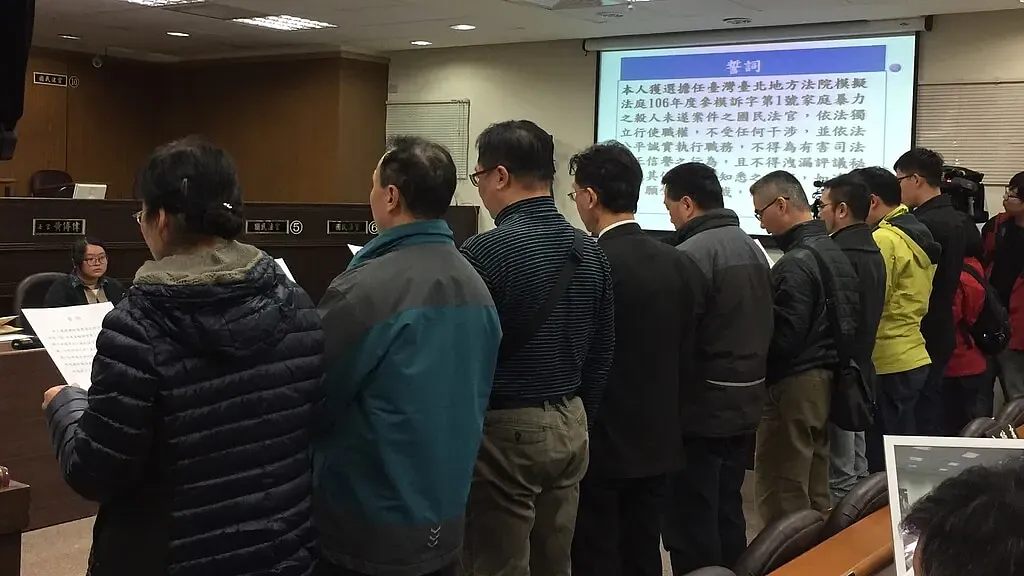
Photo / Oath-taking of citizen judges in the Taipei District Court mock trial
The mock trial held by the Taipei District Court based on the Judicial Yuan's draft "Act on Credential Participation in Criminal Trials," bolstered by President Hsieh Tsung-li personally "appearing in court" to deliver a speech on January 29, 2018, received widespread media coverage and high public attention. After two consecutive days of exhausting drills for participants, the event concluded to much fanfare at around 9 p.m. on January 30.
Entrusted by the Taipei District Court, the Taipei Bar Association appointed its members to serve as defense counsel for this mock trial. Although the author does not support the lay participation system (specifically the lay assessor model adopted from Japan in the Judicial Yuan's draft) due to my support for the lay judge (jury) system, out of the attorney's mission to promote democracy and the rule of law—and in order to achieve the goal of using the mock trial to examine the feasibility of the draft for future reference in the legislative deliberation process—I accepted the association's appointment and formed a defense team with two other lawyers to participate in this simulation. Once the simulation concluded, without presuming my views to be profound, I have penned my personal insights from the participation, hoping to serve as a modest spur to induce others to come forward with valuable contributions, and to prompt all sectors to face the problems of the draft squarely.
The most noteworthy and top-priority aspect of the draft to be reviewed is its introduction of the single-copy indictment and discovery systems to Taiwan for the first time.
To avoid the undue burden and even pre-judgment caused by pre-reading case files and evidence for citizen judges lacking professional legal training—differing from the current practice under the Code of Criminal Procedure where case files and evidence are sent along with the indictment (dosier-forwarding system) to facilitate judges' ex officio investigations—the draft introduces the principle of single-copy indictment for the first time in domestic history. It explicitly stipulates that when prosecuting, a prosecutor shall submit only the written indictment to the court and shall not simultaneously transmit case files and physical evidence to the court. This ensures that professional and citizen judges form their mental impressions only after the case enters the trial stage through the presentation of evidence by the prosecution and defense in court.
Compared to previous drafts of the consultative participation system which cut corners and made do with the current Code of Criminal Procedure's dossier-forwarding system—resulting in a severe information asymmetry between lay assessors and professional judges—this draft's use of the single-copy indictment as a necessary corollary for citizen participation in trials can be described as significant progress. However, while introducing the single-copy indictment, it abolishes defense counsel's right to access case files and introduces a discovery system in its place. Through the operation of this mock trial, it is evident that such an approach is open to question, and the provisions concerning discovery in the draft are overly rudimentary, giving rise to obvious constitutional doubts.
To clarify this point, it is necessary to briefly introduce why and how the United States developed the discovery system.
Under the adversarial system adopted in the United States (where "adversary" originally means opponent or rival, translated domestically as the party-prosecution system), prior to the development of the discovery system, both parties traditionally gathered evidence independently, presented it at trial, and engaged in mutual attack and defense. To explain further, when a defendant received the prosecutor's indictment, apart from the facts and legal arguments recorded therein, they knew nothing further until the case entered trial. Only after the prosecution finished presenting its evidence in court could the defense learn the full picture of the prosecution's evidence and subsequently mount a defense. Trials conducted in this manner seemingly resemble a fair duel on paper, but in reality, after the prosecution finishes presenting its evidence, the defense is often caught off guard and lacks sufficient time to gather rebuttal evidence against the prosecution's evidence for impeachment. On the other hand, allowing the defense to specifically plead and present evidence only after the prosecution has completed its presentation also exposes the prosecution to surprise attacks. Once a trial degenerates into a jungle prone to mutual ambushes, the accuracy of the trial outcome is naturally questionable. Therefore, the United States initially developed discovery procedures in civil litigation, requiring both parties to mutually disclose evidence prior to trial (disclosure of evidence), so that the adversarial system could better examine evidence at trial, promote trial fairness, improve litigation efficiency, and avoid unnecessary trials.
Following the development of discovery procedures in civil litigation, the U.S. Supreme Court through a series of rulings in the 20th century established the prosecution's disclosure obligations in criminal procedures. In the 1935 case of Mooney v. Holohan, the Supreme Court held that if a prosecutor knows or should know that prosecution witnesses have presented false testimony or evidence, the principle of due process requires the prosecutor to disclose this to the defense and the court. Subsequently, in the 1957 case of Jencks v. United States, the Supreme Court ordered the federal government to disclose prior statements of prosecution witnesses. In the 1963 case of Brady v. Maryland, the Supreme Court pointed out that to avoid an unfair trial for the defendant, whether concerning evidence of guilt or sentencing, as long as it is materially favorable to the defendant, the prosecutor has a due process obligation to disclose it to the defendant. In the 1972 case of Giglio v. United States, the Supreme Court expanded the scope of information prosecutors must disclose to include information usable to impeach prosecution witnesses, such as witnesses testifying for the prosecution in exchange for leniency. In the 1976 case of United States v. Agurs, the Supreme Court noted that because prosecutors are servants of the law and must comply with due process principles to protect the defendant's right to a fair trial and to avoid miscarriages of justice, prosecutors cannot blindly pursue convictions; thus, even if the defense does not request disclosure, prosecutors must proactively disclose favorable evidence to the defendant. The 1995 case of Kyles v. Whitley further expanded the prosecutor's disclosure obligation to evidence in the possession of the police that was not presented by the prosecution.
As the U.S. Supreme Court established prosecutors' discovery obligations through judicial rulings, the Federal Rules of Criminal Procedure were correspondingly amended to explicitly stipulate the prosecution's discovery obligations. Regarding professional disciplinary standards, the American Bar Association (ABA) formulated the Standards Relating to Discovery and Procedure Before Trial in 1970, imposing broader disclosure obligations on prosecutors than Supreme Court rulings. The scope of required disclosure is not limited to evidence the prosecutor intends to use at trial, and evidence related to innocence and mitigation must also be proactively disclosed. Because American prosecutors are practicing attorneys bound by professional ethics of bar associations, the aforementioned ABA standards, after being referenced and adopted by various states, have exerted an undeniable influence on the practical operation of discovery.
Looking at the developmental process of the discovery system in American criminal procedure, it is clear that although the U.S. Constitution does not explicitly mention a criminal defendant's right to request the prosecutor to disclose evidence, the U.S. Supreme Court maintains that because the due process principle protects a defendant's right to a fair trial, enabling the defendant to mount an effective defense against the prosecution's attacks necessitates granting the defendant the right to request prosecution discovery. On the other hand, considering the vast disparity in power between the prosecution and defense, and that the prosecution represents the public interest and should not blindly pursue convictions but must pay equal attention to matters favorable and unfavorable to the defendant, the scope of disclosure is not limited to evidence the prosecution intends to use at trial; prosecutors must proactively disclose any evidence that substantially impacts the defendant's defense.
Since the jurisprudential basis of discovery lies in enabling the defendant to fully acquire information necessary for defense through the prosecution's disclosure so as to effectively exercise the right to defense, it is evident that the rationale and function of discovery are no different from Taiwan's dossier-review system: both are means to realize the defendant's right to information access to ensure a fair trial. While the purpose of the single-copy indictment principle is to prevent pre-judgment, and discovery is intended to realize the defendant's right to information access, both undoubtedly serve respective functions in promoting the fairness, accuracy, and efficiency of the adversarial system, but they are not mutually exclusive complements. Looking back at the historical development of the discovery system in the United States toward an increasingly broad scope of prosecutorial disclosure obligations, it is evident that even when adopting the single-copy indictment principle, the dossier-review system can still be retained to maximize the realization of the defendant's right to information access (which can be modified to copying and reviewing case files at the prosecutors' office), and there is no jurisprudential contradiction whatsoever.
The underlying mindset behind abolishing the dossier-review system in order to adopt the single-copy indictment in citizen participation trials is perhaps the belief that without the shelter of the "pre-judgment" effect caused by dossier forwarding, the difficulty for prosecutors to prove a defendant's guilt beyond a reasonable doubt in court increases; therefore, prosecutors must be allowed to withhold certain evidence from the defense to maintain an informational advantage in litigation. Such thinking not only erroneously transforms prosecutors into blindly conviction-driven "plaintiffs" who no longer represent the public interest and need not heed matters favorable to the defendant, but it also places defendants in citizen participation trials at a distinct disadvantage in mastering case facts compared to defendants in non-citizen participation trials, creating an unjustified differential treatment that violates the principle of equality.
Furthermore, considering that unlike the United States, defendants in Taiwan lack compulsory process to obtain evidence, and attorneys lack investigative powers, the defense is not only incomparable to the prosecution in terms of evidence-gathering capabilities, but if the prosecution wishes to play cat-and-mouse with the defense by withholding defense-related evidence, the defense will nine times out of ten lack the ability to discover it. Therefore, introducing the discovery system will inevitably severely weaken the defendant's defense capabilities, forcing them to stand trial under conditions of unequal arms.
Introducing the single-copy indictment principle was originally intended to ensure defendants receive a fair trial, yet the draft "bundles" it with a discovery system that will inevitably undermine the right to a fair trial. Such a decision can be described as arbitrary and self-contradictory, and the harm inflicted upon the defendant's right to defense and right to a fair trial lacks justification and necessity, clearly violating the proportionality principle (to be continued).
Series Articles
Alas, the Defendant: A Brief Review of the Judicial Yuan's Draft "Act on Credential Participation in Criminal Trials" Regarding Discovery
- An Arbitrary and Unconstitutional Decision: The "Bundling" of Single-Copy Indictments with Discovery
- Prosecutorial Disclosure Rules Where Prosecutors Hold All the Advantages
- Defense Disclosure Rules That Mistake Feng Jing for Ma Liang
- Constitutional Boundaries of Defense Disclosure Rules
※ This article was originally published in ETtoday News Cloud
This article is an AI-generated translation of the original Chinese text. In the event of any discrepancy, the Chinese version shall prevail.