
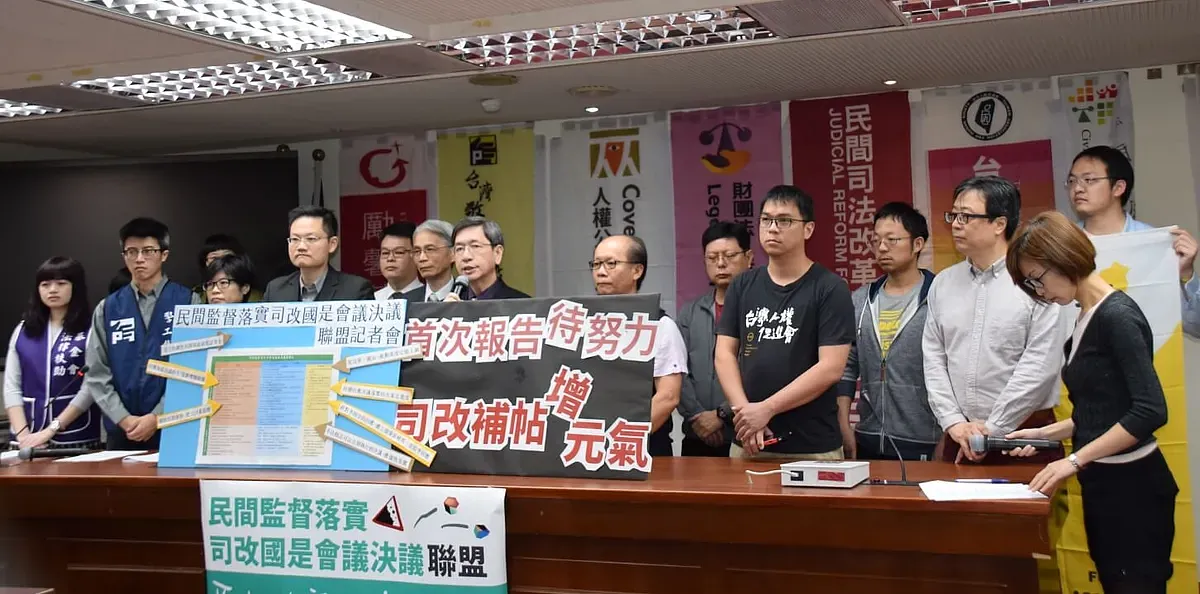
"First Report Needs Improvement, Judicial Reform Booster Shot Revives Energy" ~ Alliance for Civilian Monitoring the Implementation of Judicial Reform National Consultative Conference Resolutions Press Conference
Last edited: 2026-11-03
Post-Meeting Press Release
The "Alliance for Civilian Monitoring the Implementation of Judicial Reform National Consultative Conference Resolutions" held a press conference today (March 2) at Room 801, Qunxian Building, Legislative Yuan, proposing three points of affirmation and four recommendations regarding the "First Semi-Annual Progress Report on Judicial Reform" released by the Tsai Ing-wen administration on February 12 this year.
Ch'en Yü-fan, CEO of the Judicial Reform Foundation and moderator of the press conference, stated that the Democratic Progressive Party (DPP) Legislative Caucus has recently listed three priority legislative bills: judicial reform, military pension reform, and organizational restructuring. As judicial reform is a crucial priority bill for this legislative session, the Alliance calls on the government to implement reforms and urges legislators to step up their efforts in advancing judicial reform-related legislation.
Alliance Convener, Attorney Lin Yung-sung, further stated that the Alliance affirms the government's regular publication of the judicial reform progress report, but noted that there is still room for improvement in the report's content and approach. Aspects affirmed by the Alliance include: 1. Establishing a continuous dialogue platform between the public and the government; 2. Setting up a single website to regularly publish progress online; 3. Designating primary and coordinating agencies for all resolutions. As for areas requiring improvement, the Alliance proposed four recommendations: 1. Opening up to public participation and establishing evaluation indicators; 2. Continuing to respond to plans and progress for resolution implementation; 3. Immediately re-examining and responding to inadequate responses; 4. Promptly implementing resolutions that can be executed immediately without waiting for legal amendments.
Father Peter阮文雄 (Fr. Nguyen Van Hung), member of Group 1 of the National Consultative Conference on Judicial Reform and representative of the Vietnamese Migrant Brides Office of the Catholic Diocese of Hsinchu, stated that regarding the improvement of migrant worker interpretation issues, although official actions have been taken, public participation was not invited. Furthermore, regarding the human rights issues of foreign inmates, including legal and language barriers, the Ministry of Justice also failed to invite public participation and assistance. He hopes the official sector will invite public participation to enable suggestions and supervision from society.
Huang Yi-pi, member of Group 2 of the National Consultative Conference on Judicial Reform and CEO of the Covenants Watch, stated that a fair, just, and transparent judicial system is the last line of defense for human rights protection. Regarding the process of implementing the resolutions of the National Consultative Conference on Judicial Reform, CEO Huang raised three recommendations: 1. Enabling genuine public participation—after six months of the National Consultative Conference on Judicial Reform, the process was open to the public; the implementation of resolutions should not exclude the people, and the government should invite civic groups with specialized knowledge or long-term engagement to participate; 2. Establishing a reform schedule—concrete plans require timelines to verify practical implementation; 3. Setting indicators as a concrete basis for measurement—every resolution should take stock of the relevant laws or policies and establish concrete indicators for reform schedules, outcomes, and resource investment for public review.
Professor Li Chün-yi, member of Group 1 of the National Consultative Conference on Judicial Reform, mentioned that "Improving Judicial Science and Rules of Evidence" is the only blank item in the semi-annual progress report. Judicial science is the foundational work for consolidating criminal evidence; if the government does not value it, resources will ultimately be wasted back and forth in litigation. This part can be directly promoted without legislation, such as establishing laboratory accreditation standards, appraisal guidelines, standard operating procedures for appraisals, personnel training, and evidence custody regulations. In the rescue process of many wrongful convictions, it is discovered that evidence was lost, depriving the defendant of the right to re-examine evidence. Without reviewing wrongful convictions, the same appraisal methods, personnel, and appraisal processes may be replicated in other cases; for example, wrongful convictions caused by lie detectors. The Control Yuan's investigation report has already pointed out flaws in lie detection, and even one lie detector operator has conducted hundreds of appraisal cases. Whether these appraisals had flaws or caused wrongful convictions remains unknown if not reviewed. The government may not have noticed these issues yet, and it is hoped that the second-half report will not leave this blank.
Environmental Jurists Association Chairman, Attorney Chang Yü-yin, stated that the Environmental Jurists Association pays special attention to environmental criminal law and environmental governance, particularly the ASE Kaohsiung plant wastewater case before the National Consultative Conference and the case after the conference where the Mailiao plant marked a large amount of data exceeding emission standards as invalid. These two incidents reveal major loopholes in the mutual integration of environmental criminal law and environmental administrative law. Although suggestions were made during the National Consultative Conference, the implementation has been partly remedied while other responses remain inadequate. For example, regarding remedied parts such as increased administrative fines, a mechanism running parallel to recover unjust enrichment alongside criminal fines and administrative fines has been incorporated into the draft amendments to the Air Pollution Control Act proposed by the Environmental Protection Administration (EPA) during this revision period; it is hoped this will pass in the next legislative session. As for the inadequate part—the foundational facts of environmental governance, namely the completeness of emission data, such as increasing the monitoring ratio and including monitoring substances not yet covered—the current response does not make clear whether the monitoring ratio has been increased, and whether pollutants previously omitted have been included. It is hoped that the government can provide a complete response regarding factual governance.
Lian-Hsin Social Welfare Foundation Advocacy Specialist Liao Ya-chün stated that during the National Consultative Conference last year, four members of Group 5 held a press conference to protest the marginalization of children, youth, and gender issues. After the release of the six-month progress report of the National Consultative Conference, children, youth, and gender issues still received minimal attention. Because the government provided little response, it is difficult to make comments. It is hoped that the government can respond to children, youth, and gender issues as soon as possible so that suggestions can be provided and the public can truly feel the impact.
Shih I-hsiang, Deputy Secretary-General of the Taiwan Association for Human Rights, stated that the TAHR pays close attention to the human rights issues of inmates in Group 5, including prisons and correctional institutions. Compared to other issues, the six-month progress report on prisons and correctional institutions received relatively more attention, which must be affirmed, including Minister Chiu Tai-san's previous prison visits and the proposal of the "one bed per person" policy. However, government reforms have stopped at hardware upgrades while ignoring the delicate structural issues within prison human rights. The Alliance proposes five key recommendations here, hoping the Ministry of Justice and the Ministry of Health and Welfare will pay closer attention: 1. The problem of severe prison overcrowding—how to improve the working conditions of frontline prison staff; 2. Restoring the right to vote for prison inmates; 3. The Ministry of Health and Welfare should take primary charge of inmate medical affairs and amend the Prison Act; 4. The allocation of prison inmate earnings should be rethought; 5. A comprehensive correctional education system should be tailored, with resource investment and the cultivation of professional correctional education teachers to fulfill the functions of juvenile reformatory schools or correctional schools.
Sun Yu-lien, member of Group 2 of the National Consultative Conference on Judicial Reform and Secretary-General of the Taiwan Labor Front, stated in his summary that every judicial reform resolution is related to human rights and serves as an important indicator for practicing human rights protection. The government is a single entity and should not disintegrate in the process of handling reforms. In the future, the Alliance will supervise the government more diligently to implement all reform resolutions, and will continue to communicate with the Judicial Yuan, related units, and the Office of the President, hoping to make all reforms more transparent and efficient.
Moderator Ch'en Yü-fan added in conclusion that the convening of the National Consultative Conference on Judicial Reform gathered problems from people across the country, transformed these problems into issues, and formulated 87 resolutions. However, resolutions are abstract texts; how to respond to the earnest expectations of the people is what concerns the Alliance the most. The Alliance hopes to supervise and cooperatively assist the government in implementing the resolutions of the National Consultative Conference on Judicial Reform. The government should understand whether the people can feel judicial reform and should not use the excuse that reform takes time to procrastinate.
Summary of Press Conference Statements
Moderator: The DPP Caucus has listed three priority bills, including judicial reform, military pension reform, and organizational restructuring; judicial reform is a very important priority bill for this session. In addition to calling on the government, the Alliance will also urge legislators to step up their efforts in advancing judicial reform legislation.
*Invited seven partners to post the judicial reform booster shots on the semi-annual report
Three Affirmations
- Establish a continuous dialogue platform between the public and the government
- Set up a single website to regularly publish progress online
- Designate primary and coordinating agencies for all resolutions
Four Recommendations
- Open up public participation and establish evaluation indicators
- Continue to respond to plans and progress for resolution implementation
- Immediately re-examine and respond to inadequate responses
- Promptly implement resolutions that can be executed immediately without waiting for legal amendments
Lin Yung-sung, Chairman of the Judicial Reform Foundation:
Regarding the judicial reform progress released on 2/12, the Alliance affirms the regular responses, but content and methods still need improvement. Worthy of affirmation: the communication platform established by Professor Lin Tzu-ih after August 12 can deepen public awareness of resolution implementation; the Presidential Office's National Consultative Conference on Judicial Reform official website had not been updated since August 12, and under the Alliance's suggestion, officials agreed to set up a dedicated webpage; officials confirmed the responsible agencies for the 87 resolution items. Areas for improvement: the implementation process should open up public participation (resolutions are sometimes abstract; committee members at the time and the public should be allowed to participate), and evaluation indicators should be established; for unaddressed parts, it is hoped officials can respond in the near future; inadequate responses should be immediately re-examined and addressed; reforms that do not require legal amendments should be implemented as soon as possible.
Father Peter阮文雄 (Fr. Nguyen Van Hung), Vietnamese Migrant Brides Office of the Catholic Diocese of Hsinchu:
Regarding the migrant worker interpretation issue, although officials have taken action, the public was unable to participate; participation would allow for better supervision. Regarding the human rights issues of foreign inmates and the barriers of law and language, the Ministry of Justice has not wanted to let the public participate and assist.
Huang Yi-pi, CEO of the Covenants Watch, member of Group 2 of the National Consultative Conference on Judicial Reform:
A fair, just, and transparent judicial system is the last line of defense for human rights protection. After six months of the National Consultative Conference on Judicial Reform, the process was open to the public, yet officials did not allow public participation in implementing the resolutions. The public should be allowed to genuinely participate (Point 1). Reform without a timeline is reform without determination. Concrete plans require timelines to verify practical implementation (Point 2). Indicators should be set as a concrete basis for measurement (Point 3)—indicators related to the rule of law or structure. Every resolution should concretely take stock of whether resolutions or action plans involve substantive legal or policy reforms. The government should inform the public how much time it is prepared to take to complete these legal reforms, rather than merely presenting action plans without timelines. The government should clearly inform the public of the results of the concrete action plans (this part serves as an outcome indicator). The government should clearly inform the public how, in addition to amending laws, other investments such as human rights education and training for judges and prosecutors will be made to achieve these results; this is currently invisible in the action plans. What is needed is not an essay contest, but a truly concrete and feasible document capable of achieving the resolution's effects, and the government should invite civic groups with specialized knowledge or long-term engagement to participate.
Professor Li Chün-yi, member of Group 1 of the National Consultative Conference on Judicial Reform:
"Improving Judicial Science and Rules of Evidence" is the only blank item in the report. Judicial science is the foundational work for consolidating criminal evidence; if the government does not value it, resources will ultimately be wasted back and forth in litigation. This part can be directly promoted without legislation, such as establishing laboratory accreditation standards, appraisal guidelines, standard operating procedures for appraisals, personnel training, and evidence custody regulations. In the rescue process of many wrongful convictions, it is discovered that evidence was lost, depriving defendants of the right to re-examine evidence. Wrongful convictions have not been reviewed. Without reviewing wrongful convictions, the same appraisal methods, personnel, and appraisal processes may be replicated in other cases. Regarding wrongful convictions caused by lie detectors, investigation reports from the Control Yuan have already pointed out flaws in lie detection, and even one lie detector operator has conducted hundreds of appraisal cases. Whether these appraisals had flaws or caused wrongful convictions remains unknown. The government may not have noticed these issues yet, and it is hoped that the second-half report will not leave this blank.
Chang Yü-yin, Chairman of the Environmental Jurists Association:
The Environmental Jurists Association pays special attention to environmental criminal law and environmental governance, particularly the ASE Kaohsiung plant wastewater case before the National Consultative Conference and the case after the conference where the Mailiao plant marked a large amount of data exceeding emission standards as invalid. These two incidents reveal major loopholes in the mutual integration of environmental criminal law and environmental administrative law. Suggestions were made during the National Consultative Conference, and implementation has been partly remedied while other responses remain inadequate. For example: remedied parts, such as increased administrative fines; for criminal fines and administrative fines, a parallel mechanism to recover unjust enrichment and fines should be established. The EPA has incorporated the mechanism to recover illicit gains and increase fines into the draft amendments to the Air Pollution Control Act proposed during this revision period, and it is hoped this will pass in the next legislative session. Inadequate parts: foundational facts of environmental governance—namely the completeness of emission data. It is hoped that the monitoring ratio will be increased and monitoring substances not yet included will be added; the current response does not make clear whether the monitoring ratio has been increased, and whether pollutants previously omitted have been included. The response remains inadequate, and complete responses regarding factual governance are needed.
Liao Ya-chün, Specialist at the Lian-Hsin Social Welfare Foundation:
During the National Consultative Conference last year, four members of Group 5 held a press conference to protest the marginalization of children, youth, and gender issues. After the release of the six-month progress report of the National Consultative Conference, children, youth, and gender issues still received minimal attention. Because the government has provided little response, the Alliance finds it difficult to make comments. It is hoped that the government can respond to children, youth, and gender issues as soon as possible so that suggestions can be provided and judicial reform can truly be felt by the people.
Shih I-hsiang, Deputy Secretary-General of the Taiwan Association for Human Rights:
The TAHR pays close attention to the human rights of inmates in Group 5, including prisons and correctional institutions. Compared to other issues, the six-month progress report on prisons and correctional institutions received relatively more attention, which must be affirmed, including Minister Chiu Tai-san's previous prison visits and the proposal of the "one bed per person" policy. However, the government has stopped at hardware upgrades while ignoring delicate structural issues within prison human rights. Five key points are proposed, hoping the Ministry of Justice and the Ministry of Health and Welfare will pay closer attention: the problem of severe prison overcrowding—although 400 management personnel have been added, are their numbers and professionalism sufficient (improving working conditions for frontline prison staff)? What the National Consultative Conference and the general public have overlooked is that the right to vote of prison inmates has been stripped for a long time; restoring inmate voting rights is the only way to make public representatives care about prison human rights. The initial review of the two covenants raised the protection of inmates' right to medical care; prison custody ideology dominates inmate medical care needs, and the Ministry of Health and Welfare should take primary charge of inmate medical affairs and amend the Prison Act. The allocation of prison inmate earnings should be rethought; most inmates have a monthly income of only several hundred, which is insufficient to maintain basic human dignity and should be improved. Regarding juvenile reformatory schools or correctional schools, the government should tailor a comprehensive correctional education system, invest resources to design lesson plans, and cultivate professional correctional education teachers to fulfill correctional functions.
Sun Yu-lien, Secretary-General of the Taiwan Labor Front and member of Group 2 of the National Consultative Conference on Judicial Reform:
Resolutions demonstrate the government's determination to implement them. Regarding labor judicial reform, since the Judicial Yuan announced the draft of the Labor Incident Act on January 22, regional forums have been launched in full swing. Every judicial reform resolution is related to human rights and is an important indicator for practicing human rights protection. The government is a single entity and should not disintegrate in the process of handling reforms. In the future, we will supervise the government more diligently to implement all reform resolutions, and will continue to communicate with the Judicial Yuan, related units, and the Office of the President, hoping to make all reforms more transparent and efficient.
Ch'en Yü-fan, CEO of the Judicial Reform Foundation:
The convening of the National Consultative Conference on Judicial Reform gathered problems from people across the country, transformed problems into issues, and now formulated 87 resolutions. However, resolutions are abstract texts; how to respond to the earnest expectations of the people is what concerns the Alliance the most. The government should understand whether the people can feel judicial reform. We hope to supervise and cooperatively assist the government in implementing the resolutions of the National Consultative Conference on Judicial Reform, and not use the excuse that reform takes time to procrastinate.
Six months after the conclusion of the National Consultative Conference on Judicial Reform on February 12 this year, the Tsai Ing-wen administration published the "First Semi-Annual Progress Report on Judicial Reform." After concretely reviewing the report, the "Alliance for Civilian Monitoring the Implementation of Judicial Reform National Consultative Conference Resolutions" held a press conference today (March 2) and proposed judicial reform booster shots as a reference for government review and improvement:
Affirming the government's actions in implementing the resolutions of the National Consultative Conference on Judicial Reform include:
-
Establishing a continuous dialogue platform between the public and the government
Group 4 of the National Consultative Conference on Judicial Reform passed a resolution suggesting the President design "a consultative platform providing continued dialogue for society and relevant government departments." President Tsai Ing-wen also announced at the concluding meeting that she would ask Professor Lin Tzu-ih to convene a consultative group to collect public opinions and report regularly to the President. Since its establishment in October 2017, the Alliance has held two meetings with Professor Lin Tzu-ih, representatives from the Judicial Yuan, Executive Yuan, and Ministry of Justice, exchanging views on implementing resolutions. The Alliance affirms the government's sincerity in valuing public voices.
-
Setting up a single website to regularly publish progress online
Following the National Consultative Conference on Judicial Reform, the original Presidential Office National Consultative Conference on Judicial Reform website stopped updating. The Judicial Yuan and Ministry of Justice each built content and progress information on their respective official websites, making searches difficult and information disorganized, obstructing the public from understanding and caring about the progress of judicial reform and easily causing public misunderstandings regarding the progress of judicial reform. Under civilian promotion, officials promised to build a single website, the "Judicial Reform Progress Tracking Information Platform," in March, presenting the implementation progress of various units in a consistent format to make information open and transparent, which is worthy of affirmation.
-
Designating primary and coordinating agencies for all resolutions
Officials have organized the resolutions of the National Consultative Conference on Judicial Reform into 87 major items and 303 sub-items, and the primary and coordinating agencies for each item have been coordinated. For example: regarding item 002-1 concerning the protection of crime victims, the National Consultative Conference resolution states: "The central government shall build a national intelligent platform for crime victim protection." Officials responded that it is hosted by the Ministry of Justice, with the Ministry of Health and Welfare, National Police Agency of the Ministry of the Interior, Legal Aid Foundation, and the Crime Victims Protection Association acting as co-organizers. Another example is item 008-1, concerning reducing the occurrence of wrongful convictions and reforming eyewitness identification procedures; officials responded that it should be led by the National Police Agency of the Ministry of the Interior (inviting judicial police agencies in the name of the Ministry of the Interior, including the Coast Guard Administration of the Executive Yuan, Investigation Bureau of the Ministry of Justice, Agency Against Corruption of the Ministry of Justice, National Police Agency of the Ministry of the Interior, National Immigration Agency of the Ministry of the Interior, and the Ministry of National Defense to discuss together). In the future, paired with the completion of the aforementioned single website and the publication of implementation progress online, the public will be able to know whether responsible authorities have faithfully practiced them.
The Alliance's Recommendations:
-
Open up public participation and establish evaluation indicators
It is recommended that when formulating policies or drafting bills to implement resolutions, officials should invite civic groups concerned with reform issues to participate in discussions, providing channels for groups to express opinions and making policies or bills more thorough. In addition, officials should construct "indicators" to evaluate the degree and effectiveness of resolution implementation. The process of indicator establishment and evaluation should be open for civic groups to participate and provide opinions.
-
Continue to respond to plans and progress for resolution implementation
Taking stock of the official semi-annual progress report reveals that the Judicial Yuan and Ministry of Justice proposed implementation plans for some resolutions, while the Ministry of the Interior, Ministry of Health and Welfare, Ministry of Education, and Environmental Protection Administration only responded briefly to a few resolutions. As for the Examination Yuan, it made no response at all. In response, officials should continue planning responses, and the Alliance will continue to monitor this progress. (Regarding resolutions left unanswered by officials, please refer to Appendix Table 1)
-
Immediately re-examine and respond to inadequate responses
Reviewing the official semi-annual progress report reveals that some response contents are overly crude, empty, or lacking comprehensive consideration, and even lack schedule planning. It is recommended that these be immediately re-examined before providing a response. (Please refer to Appendix Table 2)
-
Promptly implement resolutions that can be executed immediately without waiting for legal amendments
Judicial reform should not focus solely on massive legal amendments; many matters that can be executed immediately without waiting for legal amendments, if completed one by one as soon as possible, can also meet public expectations for advancing judicial reform. (Please refer to Appendix Table 3)
Synthesizing this semi-annual progress report, the Alliance is pleased to see the government taking the first step in implementing judicial reform. However, judicial reform carries the earnest expectations of all citizens and cannot tolerate a moment of procrastination or perfunctory carelessness. The Alliance will continue to monitor official progress, hoping the government displays determination to put the National Consultative Conference resolutions into practice and gradually complete judicial reform.

【Attending Representatives of the Alliance for Civilian Monitoring the Implementation of Judicial Reform National Consultative Conference Resolutions】 (Ordered by stroke count)
Huang Yi-pi, CEO of Covenants Watch
Li Yi-ying, Head of the Heart-Accepting (Inmate) Family Service Group, Red Cross Society of the Republic of China
Father Peter阮文雄 (Fr. Nguyen Van Hung), Vietnamese Migrant Brides Office of the Catholic Diocese of Hsinchu
Lin Chün-hung, Standing Director of the Taipei Bar Association
Shih I-hsiang, Deputy Secretary-General of the Taiwan Association for Human Rights
Hung Chung-yen, Deputy Secretary-General of Taiwan Association for Advancement of Social Sciences
Sun Yu-lien, Secretary-General of Taiwan Labor Front
Kuo Li-hsüan, Standing Supervisor of Taiwan Police Working Rights Advocacy Association
Tseng Shou-yi, Director of Association for Democratic and Legal Education
Chen Chia-ping, Specialist at Association for Democratic and Legal Education
Lin Yung-sung, Chairman of the Judicial Reform Foundation
Ch'en Yü-fan, CEO of the Judicial Reform Foundation
Professor Li Chün-yi (Member of the National Consultative Conference)
Attorney Chang Ching-pei of the Legal Aid Foundation
Attorney Chen Yi-cheng of the Taichung Bar Association
Wang Hao-han of the Taiwan Alliance to End the Death Penalty
Liao Ya-chün, Advocacy Specialist at Lian-Hsin Social Welfare Foundation
Yang Pin-wen, Regulatory Specialist at the Environmental Jurists Association
Chang Yü-yin, Chairman of the Environmental Jurists Association
Tu Yu-wen, CEO of the Environmental Rights Foundation
Press Contacts
Judicial Reform Foundation / CEO Ch'en Yü-fan (02)2523-1178
Appendix Table 1: Examples of Items and Opinions Yet Unanswered by Officials
| Item No. | Content | Suggesting Member |
| 004, 011, 043 | Judicial reform resolutions related to indigenous peoples are mentioned in items 004, 011, and 043. However, currently only the Ministry of Justice mentions in item "Enhancing the Professional Competence of Incumbent Prosecutors (43-2)" that a professional seminar titled "Seminar on Investigating Indigenous Cases" is scheduled to be held in 2018. | Legal Aid Foundation (See Attachment 1) |
| 5, 8, 12, 13 | Regarding reducing the occurrence of wrongful convictions and strengthening relief mechanisms, judicial science, appraisal mechanisms, and expert witnesses. | Professor Li Chün-yi |
| 04-6, 04-7 | Regarding restorative justice for campus and medical disputes. | Attorney Chen Yi-cheng |
| 010 | 1. Since foreign inmates are not fluent in the national language, prison units should set up translators for respective native languages to facilitate foreign inmates inquiring about legal rights and provide translation communication channels for foreign inmates. 2. To help foreign inmates gain positive thoughts and correct deviant concepts, the power of faith is an indispensable link. Recently, the Vietnamese Migrant Brides Office officially wrote to the Taipei Prison requesting the provision of space and time, with the office's priest willing to volunteer to provide psychological counseling and Vietnamese-language pastoral activities in prison, but this was rejected by the Taipei Prison on the grounds that "the prison regularly holds Catholic Mass activities, hence there is currently no demand for such activities." The Office believes that the language used in the Catholic Mass activities provided by the Taipei Prison is "Chinese," which is inconvenient for inmates of other nationalities to listen to; the Judicial Yuan is requested to assist prisons in regularly holding foreign-language Mass activities to fulfill religious rights. In addition, psychological counseling is the specialty of our office's priest; to help foreign inmates gain peace of mind in prison and ponder future life directions, the Judicial Yuan is requested to incorporate psychological counseling into items regularly held in prisons. | Vietnamese Migrant Brides Office (See Attachment 2) |
| 057, 058 | Prison inmates are divided into four tiers. Depending on the category of status, visiting objects and frequency limits also differ. Serious offenders have meeting times with their family members only once a week. Considered from a human rights perspective, this class disparity appears somewhat unfair; to implement legal equality, the Judicial Yuan is requested to reform visiting restrictions. | Vietnamese Migrant Brides Office (See Attachment 2) |
| 79 | Amendments to Article 239 of the Criminal Code (Adultery) and Article 227 (Romeo and Juliet provisions) | Lian-Hsin Social Welfare Foundation (See Attachment 3) |
| 87 | Amendment to Article 9 of the Genetic Health Act | Lian-Hsin Social Welfare Foundation (See Attachment 3) |
| 77 | The government should prioritize a generous budget allocation for the child and youth care fund | Lian-Hsin Social Welfare Foundation (See Attachment 3) |
| 78 | comprehensively review child abuse prevention policies | Lian-Hsin Social Welfare Foundation (See Attachment 3) |
| 81 | Institutions housing juveniles, executing juvenile fixed-term imprisonment, and reformatory education should belong to the Agency of Corrections of the Ministry of Justice or the Ministry of Education | Lian-Hsin Social Welfare Foundation (See Attachment 3) |
| 82 | Evaluate the comprehensive restructuring of juvenile reformatory schools into juvenile correctional schools | Lian-Hsin Social Welfare Foundation (See Attachment 3) |
| 84 | Feasibility of improving judicial disposition for drug-using children and youths | Lian-Hsin Social Welfare Foundation (See Attachment 3) |
| 85 | Deliberate on the particularity of children and youths in judicial procedures and provide necessary protection and assistance | Lian-Hsin Social Welfare Foundation (See Attachment 3) |
| 86-1 | The government should bear the responsibility of placement for law-breaking and hard-to-place children and youths | Lian-Hsin Social Welfare Foundation (See Attachment 3) |
| 86-2 | Uphold the right of law-breaking children and youths in placement institutions to receive national education | Lian-Hsin Social Welfare Foundation (See Attachment 3) |
Appendix Table 2: Examples of Inadequate Responses
| Item No. | Content | Suggesting Member |
| 8-2 | Although the Ministry of the Interior proposed in the semi-annual progress report that it has revised and passed the "Operating Procedures for Police Authorities to Notify Legal Aid Institutions to Assign Lawyers to Appear for Defense" and "Matters Requiring Attention for Police Authorities to Notify Legal Aid Institutions to Assign Lawyers to Appear for Defense," according to statistics from the Legal Aid Foundation's "Special Project on Lawyer-Accompanied Appearances for Indigenous Police Interrogations," the proportion of indigenous people waiving lawyer accompaniment exceeded 90% by 2016. Therefore, it is recommended that the Ministry of the Interior and related departments ensure through legal amendments and publicity that frontline law enforcement personnel inform indigenous people of related legal aid rights during police interrogation procedures, and explain to indigenous people the importance of applying for lawyer-accompanied interrogation, so as to truly strengthen the protection of criminal defense rights of indigenous people in police interrogation procedures and implement legal aid regulations. | Legal Aid Foundation (See Attachment 1) |
| 10 | Regarding the improvement of the interpretation system, the following opinions are proposed: 1. Regarding interpreter training, the Judicial Yuan should cooperate with the Executive Yuan and Ministry of Education to establish a complete training model. The Ministry of Education can promote the establishment of Southeast Asian language departments in grassroots colleges and universities and provide interpreter employment counseling mechanisms; the Judicial Yuan should strengthen interpreters' legal knowledge and concepts to foster their professional attitude; the Executive Yuan should develop employment opportunities for interpreter talent in accordance with the New Southbound Policy to attract more Southeast Asians to Taiwan. 2. The Judicial Yuan should provide civil interpreters for courts in various counties and cities, and incorporate relevant regulations into the Directions for Court Interpreters to facilitate applications by civic groups. | Vietnamese Migrant Brides Office (See Attachment 2) |
| 19 | Establish a litigation pyramid, but supporting systems including wrongful conviction relief and judgment quality should be planned and published together. | Judicial Reform Foundation |
| 40-1-5 | 1. The EPA proposed raising the upper limits of fine amounts in Articles 58 to 69 of the Air Pollution Control Act, which is worthy of affirmation. 2. The EPA proposed parallel mechanisms for recovering proceeds of crime and fines in Articles 86 and 87 of the Air Pollution Control Act and Article 64 of the Toxic Chemical Substances Control Act, which is worthy of affirmation. However, according to the intent of the judicial reform conference conclusions, thoroughly cutting off the economic incentives for actors to pollute the environment also includes "ordering actors to bear the compensation or expenses required to restore the environment" and "criminal fines." It is requested that a meticulous regulatory system consistent from administrative control to criminal prosecution be constructed together to avoid huge disparities caused by administrative and criminal punishment for the same case (referencing items 4-1-2, 40-1-3, and 40-1-4). | Environmental Jurists Association (See Attachment 5) |
| 40-3-2 | 1. Before the National Consultative Conference on Judicial Reform, the proportion of existing factories' air, water, waste, and toxins included in monitoring was not high. Did the EPA amend laws or legislate to require factories and operators to install monitoring (testing) equipment and provide CEMS monitoring data online as much as possible? Or did it increase the proportion of factories and operators included in monitoring as much as possible? The response in the first semi-annual progress report was unclear. 2. The "Management Regulations for Continuous Automatic Monitoring Facilities of Stationary Source Air Pollutants" seems not to have been amended to date. Analyzing raw emission data of monitored stacks at Mailiao collected by the Environmental Protection Bureau of Yunlin County Government through the Green Citizens' Action Alliance's Transparent Footprint project, it was found that Mailiao exploited regulatory loopholes, marking tens of thousands of data items exceeding standards as "measurement values of monitoring facilities during temporary shutdowns of stationary sources," "measurement values during maintenance and upkeep of monitoring facilities," and "other invalid measurement values" as invalid data to evade punishment. Have the loopholes in the above regulations been improved and remedied? (For example, whether the requirement for valid data in Article 15 of the regulations, which is only up to 85%, needs to be raised.) In addition, not all stacks currently publish emitted polluting substances and data, and some are not even tested. Have the omissions in this part been improved? The response in the semi-annual progress report was unclear. 3. Have air, water, waste, and toxic polluting substances under continuous monitoring been added after the Judicial Reform Conference? (For example, have VOCs been added to air pollutants? Have heavy metals been added?) Have control standards been tightened? (For example, the current benzene control standard is 500 ppb.) Are polluting substances of special manufacturing processes required to be made public? The response in the semi-annual progress report was unclear. 4. Has the number of monitoring stations increased after the Judicial Reform Conference? The response in the semi-annual progress report was unclear. 5. Draft Article 20 of the Air Pollution Control Act proposed by the EPA explicitly stipulates in the parent law that "emission standards" should include "hazardous air pollutant items," which is worthy of affirmation. 6. Draft Articles 20 and 28 of the Air Pollution Control Act proposed by the EPA strengthen "end-of-pipe control" of air pollutants into "source control" + "end-of-pipe control," which is worthy of affirmation. 7. Draft Articles 13 and 15 of the Air Pollution Control Act proposed by the EPA explicitly stipulate that the central competent authority shall establish and regularly publish raw data of air monitoring in townships, cities, and special industrial zones where petrochemical industrial zones are located, which is worthy of affirmation. | Environmental Jurists Association (See Attachment 5) |
| 076 | The Judicial Yuan has established the "Human Rights, Children and Youth Protection, and Gender Friendliness Committee." Judging from its establishment guidelines, the tasks of this committee are to provide consultative opinions or suggestions on the following matters: (1) Policies, regulations, and administrative measures propagating and promoting human rights, children's and youths' rights, and gender equality concepts. (2) Implementation of human rights, children's and youths' rights, and gender equality promotion work and training matters in this court and subordinate organs. (3) Other matters promoting human rights, children's and youths' rights, and gender equality. It is recommended to clarify the authority of this committee and whether it truly has a-influential impact on the policy promotion of the Judicial Yuan. It is also expected that this committee will soon discuss the issue of "gender-friendly judiciary" and make future meeting agendas, times, and minutes public. In addition, the gender equality training mentioned in Article 2 of the aforementioned regulations should simultaneously consider the cultivation, selection, professional training, and legal education of legal professionals; this involves serial numbers 41, 42, and 43. To engrain gender awareness into the minds of judicial personnel, besides designing indicators to evaluate the effectiveness of gender education, gender concepts should also be incorporated into judicial officer evaluations, which involves serial number 36 of judicial officer evaluations. Therefore, it is recommended to use the "Human Rights, Children and Youth Protection, and Gender Friendliness Committee" established pursuant to serial number 76 as the core of promoting gender equality work, advancing resolutions including serial numbers 36, 41, 42, and 43. | Lian-Hsin Social Welfare Foundation (See Attachment 3) |
| 80 | Right to litigation participation for sexual assault victims. Recommendation: The Judicial Yuan has proposed the "Draft Regulations on Litigation Participation and Protection Systems for Crime Victims," but participation during the investigative stage is not included in the draft. The Ministry of Justice should promptly propose a victim litigation participation system for the investigative stage. | Lian-Hsin Social Welfare Foundation (See Attachment 3) |
| 83-1 | Regarding equal treatment of female juveniles receiving institutionalized treatment. Recommendation: The planning of female courses should break gender myths and respect the wishes of juveniles. | Lian-Hsin Social Welfare Foundation (See Attachment 3) |
| 86-1 | Implementing the appraisal function of juvenile detention homes, the Agency of Corrections of the Ministry of Justice should increase professional manpower such as medical, psychological, and social work personnel. Recommendation: The Ministry of Justice is requested to propose a timeline for supplementing manpower. | Red Cross Society (See Attachment 4) |
Appendix Table 3: Items That Can Be Executed Immediately Without Waiting for Legal Amendments
| Item No. | Content | Suggesting Member |
| Please refer to content description | 002-2-2 (Crime Victims Protection Association has limited budget; seed training can be adopted, making it easier after training is completed) 004-3 to 7 below can all be executed without legal amendments (except for organization) 006 can be executed without legal amendments; budget and resources should be fought for to reallocate budget in place 010-3 to 010-7 judicial document translation can be executed without legal amendments 026-20 Judges Academy adding course parts can be executed without legal amendments 035-5-3 Simplifying written documents can be executed without legal amendments 029-2 Second half, regarding being dispatched to administrative agencies unrelated to prosecutorial business, should be implemented 054 can be executed without legal amendments; the implementation of this part can also echo the lay assessor system 058-4 can be executed without legal amendments 076 (Child and Youth Committee members should be published) 083-1 can be executed without legal amendments |
Alliance Meeting Resolution |
| 5-3, 8-1, 8-2, 12, 13-1, 13-2, 13-3, 13-4 | 1. Plan education and training and licensing systems for appraisers, promote laboratory accreditation, establish judicial science appraisal guidelines and standard procedures, and review wrongful convictions. 2. Promote judicial science education to reduce judicial misjudgments. 3. Formulate evidence custody regulations. 4. Use advanced testing technology to strengthen forensic and investigative efficacy. 5. For detailed contents, please refer to: (1) Supplementary explanation "Methods to Enhance Scientific Evidence Quality and Avoid Wrongful Convictions" by Professor Li Chün-yi, First Division of the National Consultative Conference on Judicial Reform. (2) Control Yuan Investigation Report, January 17, 2017, Yuan-Tai-Szu-Tzu No. 1062630027 (Lie detector appraisal flaws). (3) Control Yuan Investigation Report, November 11, 2016, Yuan-Tai-Szu-Tzu No. 1052630281 (Investigation opinions on scientific forensic errors in five major wrongful convictions). |
Professor Li Chün-yi |
| 40-3-3, 40-2-1, 40-2-2, 40-2-3 | 1. Public participation level: Continue current environmental (forestry) inspection, police, and civilian alliance mechanisms, contact window platforms, establish communication groups and name lists, and invite academia to join. 2. Organizational level: (1) Increase inspection and investigation manpower (including administrative, prosecutorial, and police) (2) Establish a reasonable working environment, establishment, and funding for investigating environmental crimes (3) Raise score points for police handling environmental crimes (Note: However, please pay attention to related supporting measures; contact the Taiwan Police Working Rights Advocacy Association, one of the Alliance members) (4) Strengthen the connection between the EPA and the judiciary, establish reporting windows and contact mechanisms (5) Establish an environmental expert database and real-time consultation window (6) Uniformly assign cases related to environmental crimes and other connected cases to specialized prosecutors for investigation |
Environmental Jurists Association (See Attachment 5) |
| 69-1, 69-2 | Regarding police training, professionalism, and performance management (1) Government division of labor 1. Currently, the authority and responsibility for establishing the police performance committee and police education committee are divided under the Ministry of the Interior. However, during the resolution process of this case, the Ministry of Justice also put forward opinions on the waste of judicial resources caused by defective performance systems; therefore, the Ministry of Justice should jointly participate in this reform. 2. The Ministry of Education should participate in the police education and training committee part. (2) Reform process 1. The planning and implementation of these two judicial reform national consultative conference resolution cases should be negotiated with and supervised by the Taiwan Police Working Rights Advocacy Association. 2. The establishment of committees should form decisions from the grassroots (such as public hearings and forums) (3) Establishment of committees 1. Committee regulations (1) Drafting of committee bylaws should begin immediately (2) The planning process of committee bylaws should be public 2. Committee authority (1) Should have investigative power (2) Should have punitive power over conditions of abusing performance systems (3) Substantive review authority over investigative power and the formulation of performance systems 3. Grassroots representation (1) Proportion of frontline police personnel (2) The selection method for frontline police representatives should be reasonable and democratic (3) Empower frontline representatives with veto power 4. Expert members (1) What kind of professional members to select (2) How expert members are selected (3) A certain proportion of members should be non-police positions or personnel outside the police system (4) According to the explanation of the resolutions, the purpose of these two committees also includes protecting the labor rights of frontline police personnel, the right to education of police school students/cadets, and various basic rights. When there are doubts of rights infringement during performance systems and education and training processes (such as leave deductions due to performance, unfair labor practices, improper discipline), the committee should have system designs to assist in individual case relief. |
Taiwan Police Working Rights Advocacy Association |
| 78-2 | modeled after the existing high-crisis case network of the "Domestic Violence Safety Protection Network," construct a "Major Child Abuse Case Prevention Network" led by the prosecutorial system to strengthen current child protection mechanisms. | Lian-Hsin Social Welfare Foundation (See Attachment 3) |
| 78-3 | The Ministry of Justice is requested to deliberate on constructing a "Child Death Review" mechanism and amend relevant regulations to report cases involving the death of children under 6 years old to prosecutors for cause-of-death investigation feasibility. | Lian-Hsin Social Welfare Foundation (See Attachment 3) |
| 83-5 | Regarding the protection of law-breaking children: It is recommended that the government quickly establish placement facilities for law-breaking children. Before such facilities are established, the Judicial Yuan and administrative competent authorities (such as the Ministry of Health and Welfare, Ministry of Education) are requested to consult on adjusting the handling methods for law-breaking children, changing to handling them through welfare services and educational guidance methods. | Lian-Hsin Social Welfare Foundation (See Attachment 3) |
| 85-1 | Deliberate on strengthening the rights of children and youths in judicial procedures (including questioning methods and a friendly judicial environment suited to the plight of children and youths), expand the feasibility of mandatory assistants and mandatory defense regarding the Juvenile Law, put forward powerful diverse treatments with juveniles as the subject, and strengthen the feasibility of applying restorative justice during the execution period of juvenile courts and correctional institutions. | Lian-Hsin Social Welfare Foundation (See Attachment 3) |
| 85-2 | Juvenile assistants and defense counsel should receive professional training in juvenile protection, and it is recommended that professional lawyers add juvenile protection items. | Lian-Hsin Social Welfare Foundation (See Attachment 3) |
| 79-2 | Although Article 227 of the Criminal Code has not yet been amended, judicial and administrative authorities should currently be able to review the handling methods for Romeo and Juliet cases, prioritizing education and guidance. | Lian-Hsin Social Welfare Foundation (See Attachment 3) |
【Attachment Downloads】
Attachment 1: Legal Aid Foundation Data
Attachment 2: Vietnamese Migrant Brides Office of the Catholic Diocese of Hsinchu Data
Attachment 3: Lian-Hsin Social Welfare Foundation Data
Attachment 4: Red Cross Society Data
Attachment 5: Environmental Jurists Association Data
This article is an AI-generated translation of the original Chinese text. In the event of any discrepancy, the Chinese version shall prevail.