
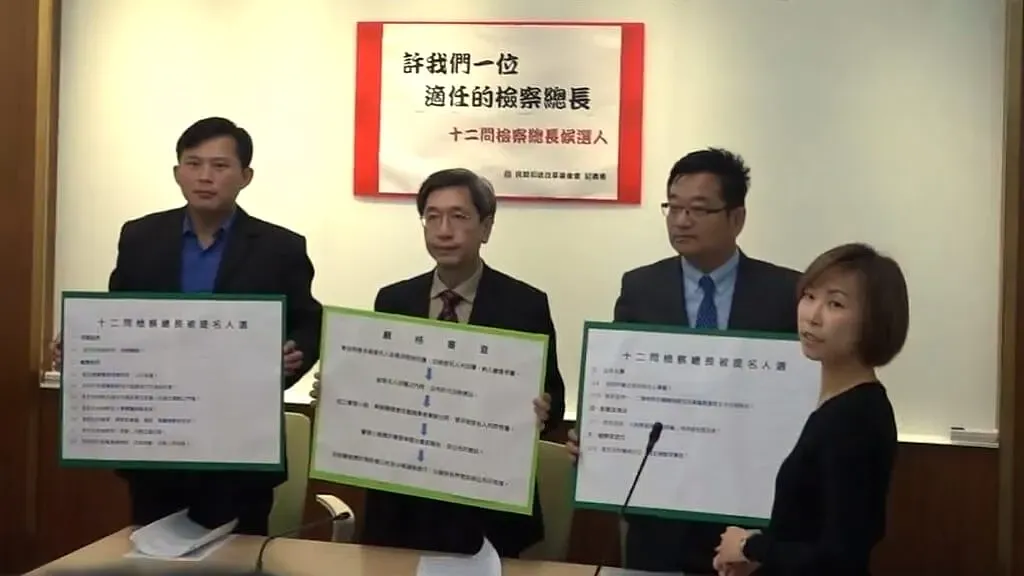
In Search of a Competent Prosecutor-General: Twelve Questions for Prosecutor-General Candidates Press Conference
Last edited: 2026-11-03
Post-Conference Press Release
Prosecutor-General Yen Ta-ho's term will expire this May, and President Tsai Ing-wen has already initiated consultation procedures for the new candidate. Therefore, the Judicial Reform Foundation held a press conference today (March 7), inviting Taipei Bar Association Chairman Hsueh Ch'in-feng and New Power Party Legislator Huang Kuo-chang to present demands regarding the nomination and review process of the Prosecutor-General, and announced "Twelve Questions" requiring responses from Prosecutor-General candidates.
The press conference moderator, JRF Executive Director Attorney Ch'en Yü-fan, stated that the Prosecutor-General is the highest authority in individual case investigations and holds the highest position within the prosecutorial system. The problems that occurred under previous prosecutors-general are intolerable to the general public. In the new era following the National Congress on Judicial Reform, we expect the President to nominate a truly remarkable candidate.
JRF Chairperson Attorney Lin Yung-sung then stated that the Prosecutor-General holds a leading role during investigation processes. Such a candidate cannot be accepted if their integrity is questioned; even if their integrity is not questioned, their ability to lead reforms and strictly adhere to boundaries is crucial. We hope the President will follow procedures and carefully nominate candidates during the nomination process, and that the Legislative Yuan will conduct substantive reviews.
Taipei Bar Association Chairman Hsueh Ch'in-feng expressed hope that this Prosecutor-General nomination could trend toward generational renewal. Many prosecutors have reflected that the current prosecutorial organization is aging and lacking vitality; many proactive prosecutors want to work hard, but due to regulatory constraints, personnel matters remain conservative and outdated. Regarding the Prosecutor-General position, consideration should be given to appointing someone who has a greater understanding of the new generation in terms of mindset, capability, and physical energy. Since organizational aging is a major problem, if this is considered from the perspective of the Prosecutor-General appointment, we believe the organization and personnel of local prosecutors' offices can be fully revitalized, further encouraging grassroots prosecutors to throw themselves into prosecutorial affairs.
Regarding the Legislative Yuan's review process, Legislator Huang Kuo-chang responded that among the 2016 parliamentary reform demands was the hope to establish a parliamentary hearing system, which could be combined with the review of parliamentary personnel consent rights. Unfortunately, regarding personnel reform, legislation has not yet been completed. The New Power Party caucus's consistent stance has been strict review. Whether concerning Grand Justices of the Judicial Yuan or this appointment of the Prosecutor-General of the Supreme Prosecutors Office, they will fulfill their gatekeeping responsibilities. We hope parliamentary reform bills can be passed in three readings at an early date; before that, the New Power Party caucus will fulfill its duties of self-requirement and self-gatekeeping. Although the general public can appreciate the hard work of grassroots prosecutors, when the people of Taiwan continually witness poor prosecution quality—which not only causes delays in trial proceedings but may also subject innocent people to the wicked consequences of state punishment; when ordinary citizens suffer because of the judiciary while the rich and powerful bear no corresponding criminal responsibility—this deals a grave blow to fairness and justice. What the most important and effective reform measures of the new Prosecutor-General are in response to these issues should be concretely addressed, so as not to allow Taiwan's criminal justice system to continue in a state where the powerless must weep in the dark while the rich and powerful remain at large outside the law.
Attorney Ch'en Yü-fan concluded by stating that the JRF, together with more than twenty organizations, has formed a coalition to monitor and review the Tsai administration's judicial reform scorecard. The nominated candidate for Prosecutor-General is precisely an important indicator for testing the determination of judicial reform. We will continue to monitor the Legislative Yuan's review process and report back to the general public.
Prosecutor-General Yen Ta-ho's term concludes this May, and President Tsai Ing-wen has begun consultations for the new appointment. The Judicial Reform Foundation held a press conference today (March 7) to announce our demands regarding the nomination and review of the Prosecutor-General, putting forward "Twelve Questions." We hope the new Prosecutor-General will build a prosecutorial system that strictly upholds procedural justice, balances power with responsibility, breaks the traditional career-advancement ladder for prosecutors, remains free from external interference, and has the courage to weed out incompetent prosecutors, allowing the prosecutorial system to truly earn the respect and trust of the people.
The President Should Make Public Information Such as Nomination Criteria
- Make nomination criteria public to broadly incorporate opinions from all sectors.
- Prior to official nomination, moderately publicize the list of candidates for all sectors to express opinions.
- Candidates should proactively provide information demonstrating their suitability, such as responses to questions from civil society.
- When announcing the nominated candidate for Prosecutor-General, the reasons for nomination should be explained, and relevant information about the nominee should be published on the Office of the President website for public inspection.
The Legislative Yuan Should Conduct Rigorous Reviews
The aforementioned review process is also a matter of congressional reform, and we call on the Legislative Yuan to amend the Law Governing the Exercise of Powers of the Legislative Yuan to make the exercise of personnel consent rights more rigorous.
- Upon receiving official correspondence from the Office of the President, the Legislative Yuan should immediately send questionnaire materials to the nominee and require the nominee to respond within a time limit; those who fail to respond should be factored into review considerations.
- The content of the nominee's responses should be published on the Legislative Yuan website for public inspection.
- A review committee should be established to hold hearings and invite scholars and experts to attend, while simultaneously requiring the nominee to be present to answer questions from scholars and experts.
- The review committee should submit a written report after the review and publish it on the website for public inspection.
- The plenary review should be scheduled at least two weeks after the publication of the report to ensure that opinions from all sectors are fully expressed.
Twelve Questions for Prosecutor-General Candidates
The new Prosecutor-General must implement the reform items resolved by the National Congress on Judicial Reform. Regarding whether the new candidate is appropriate, the JRF has listed twelve questions across five major dimensions: "Objective Detachment," "Balance of Power and Responsibility," "Fair Personnel Management," "Supervision and Elimination," and "Prosecutor Positioning," demanding that nominees provide concrete responses:
Under the Dimension of "Objective Detachment"
-
Do you promise: to strictly observe the boundaries of your duties and never disclose cases under investigation to the President? Contact with the President and political figures shall be limited to public occasions for official business? If you receive any "lobbying and intercession," you will log it according to law and proactively make it public. If this promise is violated, you will immediately and voluntarily step down?
The Prosecutor-General is the head of all prosecutors, must faithfully obey the law, strictly observe boundaries, and shall not disclose the details of individual cases. If any lobbying is received, it should also be logged and proactively disclosed in accordance with the "Executive Yuan and its Subordinate Agencies and Institutions Lobbying and Intercession Logging and Investigation Operational Guidelines." Any violations should result in immediate resignation to take responsibility.
Under the Dimension of "Balance of Power and Responsibility"
-
Will you comply with the Judges Act regarding concrete instructions on individual cases by strictly observing the "written command" system, and do you agree to amend the Judges Act so that prosecutors should request the Prosecutor Review Commission to conduct individual case evaluations against heads who violate this?
The National Congress on Judicial Reform resolved that failure by a chief prosecutor to issue written instructions in accordance with regulations shall constitute grounds for individual case evaluation. The Ministry of Justice's self-reform proposal further requires prosecutors to have the obligation to refer violating heads for individual case evaluation.
-
How will you implement the resolutions of the National Congress on Judicial Reform concerning "eradicating abuse of power in prosecutions or non-prosecutions" and "holding prosecutors who abuse power in prosecutions or non-prosecutions accountable"? What kind of responsibility should the Prosecutor-General and relevant chief prosecutors (chief prosecutors, senior prosecutors) bear when the handling prosecutor has problems of abusive prosecution or non-prosecution?
The National Congress on Judicial Reform resolved that a complete accountability mechanism should be established and team-based case-handling models strengthened to prevent abusive prosecution by prosecutors. Chief prosecutors bear the responsibility of directing and supervising prosecutors in handling cases, and bear unshirkable responsibility for the institutional construction of abuse prevention and accountability.
-
If a prosecutor commits illegalities or dereliction of duty (such as violating the non-disclosure of investigations), what kind of supervisory responsibility should the chief prosecutor bear? Do you support abolishing Article 13 of the State Compensation Act to enable people to claim state compensation due to infringements by prosecutors?
The National Congress on Judicial Reform resolved to conduct investigations and accountability regarding violations of the non-disclosure of investigations, and the people have the right to claim state compensation against prosecutors who commit illegalities and dereliction of duty. However, Article 13 of the current State Compensation Act, "upon a final judgment of conviction," overly restricts the people's right to claim state compensation and is in urgent need of reform.
-
Do you support the resolutions of the National Congress on Judicial Reform regarding the "reform of the prosecutor personnel review system" (including: internal democracy, with prosecutors voting to recommend candidates; external democracy, adding external members to the Prosecutor Review Committee)?
The National Congress on Judicial Reform resolved that the Prosecutor Personnel Review Committee should incorporate more external members and that candidates should be recommended through voting by prosecutors, so as to avoid influencing case handling through personnel control.
-
What are your concrete thoughts on how to implement prosecutorial autonomy? Do you support the resolution of the National Congress on Judicial Reform to expand the authority of resolutions made by the "prosecutors' meeting"? Regarding the controversy last year in 2017 when the Kaohsiung District Prosecutors' Office passed a resolution in the prosecutors' meeting concerning the chief prosecutor's handling of cases, what do you consider to be the most appropriate solution?
According to law, a chief prosecutor can directly alter the resolution of a prosecutors' meeting. To strengthen prosecutorial autonomy and prevent improper interference, the authority of prosecutors' meetings should be expanded to restrict the chief prosecutor's methods of altering prosecutors' meeting resolutions.
-
Do you support prosecutors personally handling cases from investigation all the way through "successive instances" in order to enhance investigation quality and be responsible for the cases?
To achieve the goal of aligning prosecutorial power with responsibility, prosecutors should participate throughout the entire process of investigation, indictment, and even the conclusion of the case for the same matter, thereby demonstrating accountability.
-
How will the prosecutorial system implement the resolution of the National Congress on Judicial Reform to "reduce the occurrence of miscarriages of justice and strengthen relief mechanisms"? Do you think the "review mechanism for cases with final convictions established by prosecutorial agencies" has achieved results? Do you support reforms to retrials and extraordinary appeals?
The Chief Prosecutor of the Taiwan High Prosecutors Office convened and established the "Review Committee for Cases with Final Convictions" in 2017. As of January 2018, it had only accepted 2 cases; whether it can achieve results remains to be observed. The requirements for retrials and extraordinary appeals are extremely strict, and the Prosecutor-General monopolizes the great power of extraordinary appeals, which merely increases barriers for victims of miscarriages of justice in seeking relief.
Under the Dimension of "Fair Personnel Management"
-
Does the Prosecutor-General enjoy certain personnel authority over chief prosecutors in order to balance with the Minister of Justice? How should matters be handled when there are differing opinions with the Minister of Justice regarding prosecutorial personnel deployment? If criminal policies promulgated by the Ministry of Justice conflict with investigation practice, how should communication be conducted with the Minister of Justice (for example, the special expenses case)?
Under the current system, the Prosecutor-General may submit recommendations regarding prosecutorial personnel, but the power of personnel appointment is the exclusive authority of the Minister of Justice. Although the Prosecutor-General can direct and supervise the investigations of all prosecutors, they lack the personnel deployment authority over chief prosecutors. Is such a design appropriate? If the Prosecutor-General and the Minister of Justice hold different opinions regarding personnel deployment, how should it be handled? Furthermore, constrained by prosecutorial manpower limitations, if criminal policies promulgated by the Ministry of Justice cause burdens that are difficult to bear in practice or conflict with investigation practice, how should the Prosecutor-General communicate with the Minister to improve the conduct of investigation practice?
-
Do you support the principle that first-instance senior prosecutors should be generated based on recommendations through voting by prosecutors, as well as a rotation system for first- and second-instance prosecutors?
Prosecutorial personnel management should implement internal democracy and reduce the possibility of controlling individual cases through personnel control. Therefore, the selection of first-instance senior prosecutors should be based on recommendations through voting by prosecutors, while moderately consulting the opinions of judges and defense attorneys. Moreover, through a rotation system, the traditional career-advancement ladder can be broken and opportunities for prosecutors to gain experience across different trial instances enhanced.
Under the Dimension of "Supervision and Elimination"
-
Do you think the current elimination mechanism is already sufficient to weed out incompetent prosecutors? Do you support implementing the reforms of the National Congress on Judicial Reform concerning the Prosecutor Review Commission, including allowing the public to directly request evaluations?
The evaluation system for judges and prosecutors has been implemented for six years, yet the public still generally distrusts the judiciary. The fact that the public cannot directly initiate evaluations under the current Judges Act also prevents the functions of the review committee from being fully realized, and the elimination mechanism is in need of re-examination and reform.
Under the Dimension of "Prosecutor Positioning"
-
Do you support the principle of "separation of the judiciary and prosecution" and enacting separate Organic Act of the Prosecutors Offices and Prosecutors Act?
Under the current system, the organic law and status law of prosecutors are both subordinate within the Court Organization Act and the Judges Act. This not only blurs the proper positioning of prosecutors and easily confuses the public, but is also detrimental to the independence of prosecutorial power and the goal of "separation of the judiciary and prosecution." Fundamentally speaking, we should enact separate Organic Act of the Prosecutors Offices and Prosecutors Act to clarify the positioning of prosecutors and design corresponding powers to safeguard the rights rightfully bestowed upon our citizens by the Constitution.
Attendee List
Huang Kuo-chang / Legislator
Hsueh Ch'in-feng, Attorney / Chairman of the Taipei Bar Association
Lin Yung-sung, Attorney / Chairperson of the Judicial Reform Foundation
Ch'en Yü-fan, Attorney / Executive Director of the Judicial Reform Foundation
Press Contact
Ch'en Yü-fan, Attorney / Executive Director of the Judicial Reform Foundation 02-2523-1178
This article is an AI-generated translation of the original Chinese text. In the event of any discrepancy, the Chinese version shall prevail.