
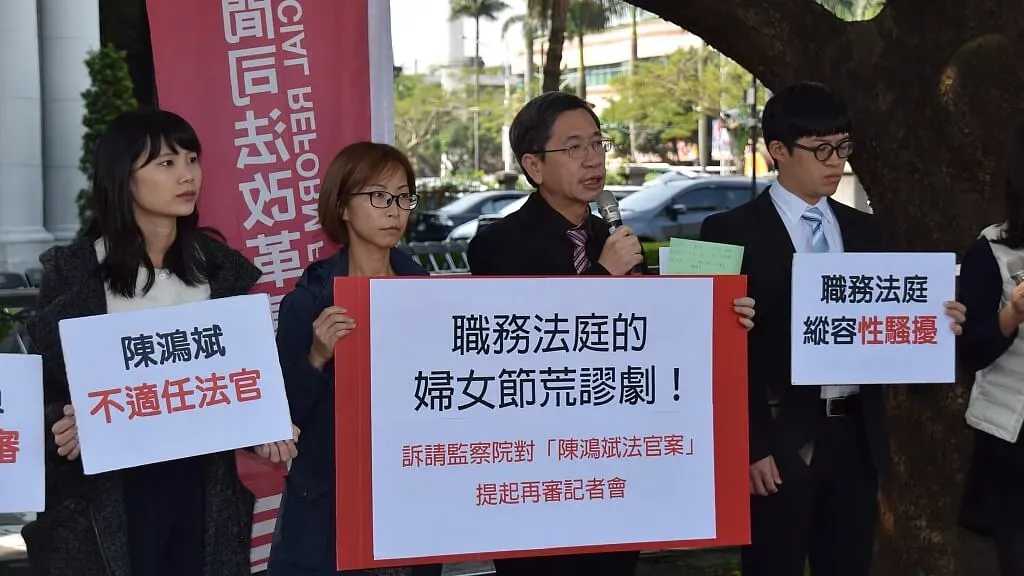
The Judicial Court's Women's Day Absurdity! Press Conference Urging the Control Yuan to File for a Retrial in the Case of "Judge Ch'en Hung-pin's Harassment of a Female Assistant Without Dismissal"
Last edited: 2026-07-27
Post-Conference Press Release
The Judicial Reform Foundation (JRF) held a press conference at the Control Yuan this morning (March 12) to submit a petition regarding the disciplinary case of Judge Ch'en Hung-pin for harassing a female assistant, urging the Control Yuan to file for a retrial with the Judicial Court of the Judicial Yuan. The JRF also called upon the Legislative Yuan to amend the law to allow lay judges to participate in the adjudication of judicial disciplinary cases.
The Judicial Court Let Off Judicial Misconduct Lightly
JRF Chairperson Lin Yung-sung stated that while Judge Ch'en Hung-pin's sanction was changed from dismissal to a fine, the married Judge Ch'en engaged in inappropriate behaviors with a female assistant who was under his supervisory authority, such as kissing, hugging, and preventing her from leaving the office. His integrity and conduct have already fallen short of the standards set by the Code of Judicial Ethics. Since 2012, there have been a total of 19 disciplinary cases, with only 2 resulting in dismissal from office—one of which was Judge Ch'en Hung-pin. However, following Judge Ch'en's resentencing to a fine, the only judge dismissed was one who colluded with organized crime. Does the Judicial Court believe a judge's conduct must be so severe as to involve colluding with organized crime to warrant dismissal? Are judges never to be dismissed for improper words and deeds?
JRF CEO Ch'en Yü-fan stated that at 8:00 this morning, Judge Ch'en Chih-xiang, who adjudicated this case, accepted a radio interview and expressed the view that Judge Ch'en Hung-pin's actions did not constitute sexual harassment, thus the original judgment was too heavy and was modified. Ch'en Yü-fan expressed regret over such a perspective, and women's groups as well as Democratic Progressive Party legislators held a press conference on the same day expressing the same view. The threshold for whether a judge of questionable conduct can still perform adjudication duties should be extremely high, yet the Judicial Court persists in its own stubborn opinion.
JRF Full-time Attorney Ch'en Yü-ting stated: The Judicial Court excused Judge Ch'en on the grounds of his excellent performance evaluations, while ignoring the vulnerable position of the victim who, afraid of exposing the incident, did not cause it to be reflected in the judge's performance evaluations. By relying on past performance evaluations to deem Judge Ch'en's past conduct as favorable, the Judicial Court ignored workplace inequality and oppression. Furthermore, the Judicial Court cited Judge Ch'en's introduction of prospective partners to the victim as a sign of deep remorse; however, whether a judge is fit for office has nothing to do with whether they show remorse afterward.
Urging the Control Yuan to File a Retrial Against the Unlawful Judgment
Lin Yung-sung stated that according to the Judges Act, the presiding judge of the Judicial Court should be Shih Mu-ch'in, the President of the Commission on the Disciplinary Measures of Public Functionaries, yet this case was presided over by Lin Wen-chou, which is evidently illegal and constitutes grounds for a retrial. Ch'en Yü-fan also noted that filing for a retrial against a retrial judgment by the Judicial Court is unprecedented, and expressed hope that the Control Yuan would file for a retrial to restore greater trust in the judiciary.
Lay Judges Should Participate in Judicial Disciplinary Adjudication
Lin Yung-sung called on the Legislative Yuan to promptly amend the Judges Act to require the Judicial Court to utilize lay judges, with 3 professional judges and 6 lay judges jointly adjudicating disciplinary cases involving judges and prosecutors, thereby preventing judicial corporatism.

Former Taipei High Administrative Court Judge Ch'en Hung-pin was disciplined by the Judicial Court in 2016 for forcibly kissing and sexual harassing a judicial assistant, with a judgment of "dismissal from the judicial office." However, after Ch'en Hung-pin petitioned the Judicial Court for a retrial, the Judicial Court surprisingly ruled that Ch'en Hung-pin's conduct was "relatively minor" and that he "showed deep remorse," altering the judgment to eliminate dismissal and instead imposing only a one-year salary fine. This judgment, handed down on Women's Day, caused an uproar across all sectors of society!
Because this case originally stemmed from a "judicial evaluation" submitted against Ch'en Hung-pin by the JRF, which led to impeachment by the Control Yuan and subsequent referral to the Judicial Court, the JRF held a press conference in front of the Control Yuan today. The conference explained the procedural and substantive illegality and impropriety of the Judicial Court's retrial judgment as well as the pitfalls of judicial corporatism within the Judicial Court, petitioned the Control Yuan to file a "retrial" in this case, and called upon the Legislative Yuan to immediately amend relevant provisions of the "Judges Act" to prevent similar situations from recurring!
JRF Chairperson Lin Yung-sung stated that the "composition" of the Judicial Court that rendered the retrial judgment was flawed. According to the provisions of the Judges Act, the "presiding judge" of the Judicial Court should be held by the "President of the Commission on the Disciplinary Measures of Public Functionaries." However, the presiding judge of the retrial judgment, "Lin Wen-chou," was not the President of the Commission on the Disciplinary Measures of Public Functionaries. Although Lin Wen-chou stated in an interview that current Commission President Shih Mu-ch'in took office after the grounds for retrial were established, and that Lin Wen-chou chose not to replace the judge out of consideration for the parties' wishes, why was the Commission President "Shih Mu-ch'in" not added to the panel when retrial panel judge "Lin Chi-yuan" resigned due to illness, but rather Judge "Hsieh Ching-hui" was added instead? This clearly shows that the retrial panel deliberately excluded the President of the Commission on the Disciplinary Measures from joining. The composition of the panel fundamentally failed to comply with the provisions of the Judges Act, hence the petition requesting the Control Commission members to file for a retrial in this case.
JRF CEO Ch'en Yü-fan stated that the original resolution of the Judicial Evaluation Commission was to submit a report to the Control Yuan for review and "recommend dismissal from the judicial office, transferring to other non-judicial offices." However, following the Control Yuan's impeachment, the Judicial Court's judgment proclaimed to the public that "a judge using power and influence to harass an assistant is a minor matter, and a fine is sufficient." Such open connivance by the judicial system regarding sexual harassment also establishes a double standard that judicial sexual harassment does not require severe punishment. No wonder that as soon as the Judicial Court judgment was released, public condemnation poured in. Releasing such an outrageous judgment on Women's Day is an even greater irony! Ch'en Yü-fan stated that a judge who exploits their power and influence to harass subordinates has low moral and ethical concepts, and is very likely to abuse power and influence during adjudication as well; they can no longer be expected to fairly perform judicial adjudication duties. If Ch'en Hung-pin retains his judicial status to retire as a result, the hefty pension might have to be footed by the general public. We demand that the Control Yuan members who originally proposed the impeachment, given that they are one of the parties to the retrial judgment, file for a retrial of this judgment and must never allow the Judicial Court to condone sexual harassment.
JRF Full-time Attorney Ch'en Yü-ting stated that Judge Ch'en Hung-pin invited the assistant out on the day before the assistant's contract renewal meeting, and even kissed the assistant's mouth without consent. This can be described as ironclad evidence of harassment utilizing the assistant's need for employment. Yet, the Judicial Court presented past performance evaluation records in an attempt to excuse Judge Ch'en Hung-pin, while ignoring that such harassment is often concealed due to unequal power dynamics and would never be reflected in performance evaluations. The Judicial Court judgment absurdly used "having introduced prospective partners to the victim" as a symbol of Judge Ch'en Hung-pin's "deep remorse" and as one of the grounds for a lenient sentence, completely disregarding whether a judge is fit for office, which has absolutely nothing to do with whether he "shows deep remorse." If showing deep remorse allows one to return to a judicial position, why has the public office prosecuting crimes in our country ever been so "merciful" to criminals? Ch'en Yü-ting stated that from this case, it can be discovered that a Judicial Court composed entirely of judges cannot be expected to fairly adjudicate disciplinary cases for unfit judges and prosecutors. External members must be included in the Judicial Court in order to break away from judicial parochialism and make decisions worthy of the public's trust, and she called on the Legislative Yuan to swiftly amend the Judges Act, referencing the lay judge system to allow the public to participate in Judicial Court adjudications.
JRF Legal Affairs Director Huang Ying-chia then stated that current provisions of the Judges Act stipulate that judicial disciplinary measures generally include dismissal, removal from office, fines, and reprimand. In Ch'en Hung-pin's retrial judgment, it was mentioned that "under the principle that there is no necessity to deprive Judge Ch'en Hung-pin of his judicial status, a heavier disciplinary category of a fine was chosen." Furthermore, because the Judges Act stipulates that the maximum amount of a fine is one year's salary, the Judicial Court deemed that fining him a year's salary "cannot be considered a light punishment" and was sufficient. However, Ch'en Hung-pin's conduct has already compromised the judicial image and he is clearly unfit to be a judge. Aside from expressing that the Judicial Court's standards are dismally low, Huang Ying-chia also called upon the Legislative Yuan to amend the Judges Act to expand the categories of disciplinary sanctions for the Judicial Court. For instance, if the severity of certain judges' misconduct does not reach the level of depriving them of judicial status, alongside a fine, they should at least be mandatorily subjected to "re-education," such as "gender education," to prevent the same situation from recurring in the future.
At the conclusion of the press conference, the JRF submitted a petition to the Control Yuan, requesting that the Control Members immediately file for a retrial in this case.
Attendees
Attorney Lin Yung-sung / Chairperson, Judicial Reform Foundation
Attorney Huang Ying-chia / Legal Affairs Director, Judicial Reform Foundation
Attorney Ch'en Yü-ting / Full-time Attorney, Judicial Reform Foundation
Attorney Ch'en Yü-fan / CEO, Judicial Reform Foundation
Press Contact
Attorney Ch'en Yü-fan / CEO, Judicial Reform Foundation (02)2523-1178
This article is an AI-generated translation of the original Chinese text. In the event of any discrepancy, the Chinese version shall prevail.