
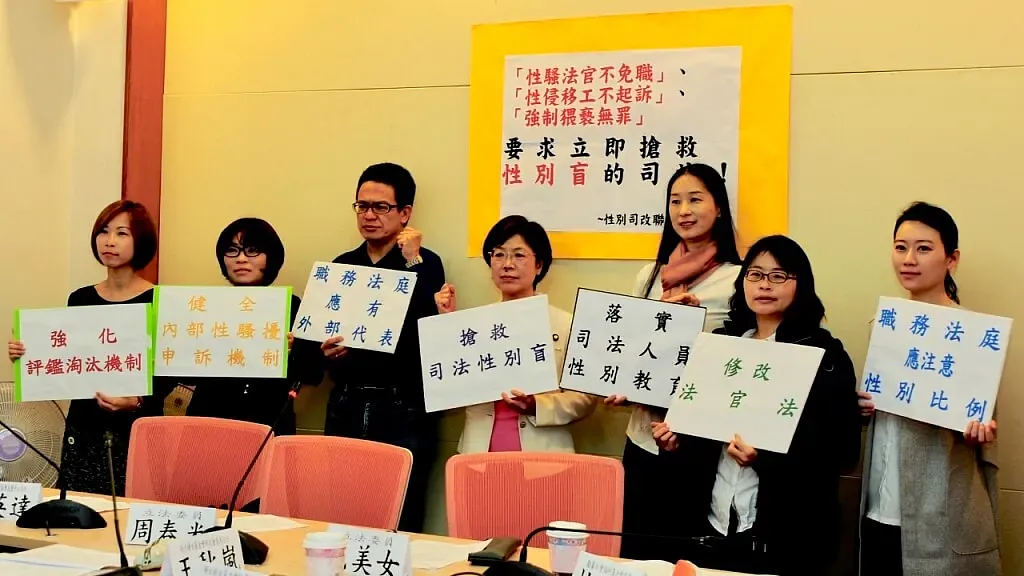
"Judge Who Sexually Harassed Not Dismissed", "Migrant Worker Rape Case Not Prosecuted", "Forcibly Molested Found Not Guilty": Demands for Immediate Rescue of a Gender-Blind Judiciary! Gender Judicial Reform Alliance Press Conference
Last edited: 2026-07-27
Recently, the case in which Judge Ch'en Hung-pin was not dismissed for sexual harassment has drawn universal public condemnation, bringing the judiciary's long-standing lack of gender awareness back into the spotlight. The "Gender Judicial Reform Alliance," composed of multiple women's and judicial reform groups, highlighted three outrageous cases handled by its member organizations: "judge who sexually harassed not dismissed," "migrant worker rape case not prosecuted," and "forcibly molested found not guilty." These cases reveal that whenever gender-related matters arise, the judicial system—from judges and prosecutors to the Evaluation Committees tasked with supervising incompetent judges and prosecutors, and ultimately to the Disciplinary Court which holds the power of removal—easily malfunctions!
 Chou Chun-mi / Legislator
The "Gender Judicial Reform Alliance" held a press conference at the Legislative Yuan today to explain the three outrageous cases and put forward four demands, urging the Judicial Yuan and the Ministry of Justice to: (1) strengthen the evaluation and removal mechanisms for judges and prosecutors, (2) establish sound internal sexual harassment grievance, investigation, and disciplinary mechanisms within the judicial system, (3) truly implement gender education for judicial personnel, and (4) have the Legislative Yuan amend the Judges Act to include external opinions in the Disciplinary Court and increase the proportion of female members. They demanded an immediate rescue of the precarious, gender-blind judiciary!
Legislator Chou Chun-mi stated that judging from the retrial judgment in the judge sexual harassment case, if judges who are supposed to uphold social justice commit predatory acts themselves, the credibility of the judiciary will suffer a severe blow. The public will reasonably suspect the deeply ingrained practice of officials protecting one another and be astonished at how limited the Disciplinary Court's understanding of sexual harassment is. Therefore, at Monday's Judiciary and Organic Laws and Statutes Committee, she already submitted an interpellation demanding that the Judicial Yuan explain, within its authority, the procedural grounds for granting a retrial and whether the composition of the Disciplinary Court panel was lawful. She also demanded that the Disciplinary Court include external members to make the monitoring mechanism for judges more open and transparent!
 Yu Mei-nu / Legislator
Legislator Yu Mei-nu stated next that according to the Sexual Harassment Prevention Act, local-level sexual harassment prevention committees with the authority to investigate sexual harassment dispute cases must have female representatives account for no less than one-half of their members. The Gender Equity Education Act also stipulates that female members on a school's gender equity education committee must account for more than half of the total, and further requires that when the education committee forms a team to investigate sexual harassment and sexual assault incidents, it should hire professional experts and scholars. In contrast, the Judicial Yuan's Disciplinary Court completely lacks even the most basic gender proportion requirements among its members when adjudicating gender-related cases. Given the stark disparity in gender ratios, it is little wonder that the sole female judge on the retrial bench felt compelled to blame herself for being unable to persuade her peers and expressed her position by resigning. She called upon the Judicial Yuan to reference the Sexual Harassment Prevention Act and the Gender Equity Education Act when amending the Judges Act in the future, and to incorporate relevant provisions regarding gender ratios into the composition of the Prosecutor and Judge Evaluation Committees and the Disciplinary Court when they hear gender cases.
 Ch'en Yü-fan / Executive Director, Judicial Reform Foundation
Judicial Reform Foundation Executive Director Ch'en Yü-fan stated that Judge Ch'en Hung-pin, who was originally "dismissed from his position as a judge" by the Disciplinary Court for harassing a female assistant, had his sentence commuted to a one-year salary fine after filing for a retrial. This is an indulgence by the judicial system toward sexual harassment and the abuse of workplace power relations. Ch'en Yü-fan noted that recently, the judge-rapporteur of this case went on radio and television programs to "defend" his outrageous judgment, even publicly stating that Judge Ch'en Hung-pin "was merely unsuccessful in having an extramarital affair, not committing sexual harassment." This action instead exposed the Disciplinary Court's lack of gender awareness starkly to the citizens of the country, which is deeply regrettable. Ch'en Yü-fan called for external members to be included in the Disciplinary Court so that diverse perspectives can be incorporated, breaking free from judicial parochialism and enabling judgments worthy of public trust. She urged the Legislative Yuan to amend the Judges Act as soon as possible, drawing inspiration from the "lay participation" (国民法官) system to allow the public to participate in Disciplinary Court trials.
 Wang Ying-ta / Director of the Shelter Center, Taoyuan Association of Services for Foreign Workers
Wang Ying-ta, Director of the Taoyuan Association of Services for Foreign Workers, stated that the case he assisted involved a domestic caregiver migrant worker. During the investigation of the migrant worker's sexual assault by her employer, the prosecutor ignored the victim's vulnerable situation as a foreign migrant worker and objective facts such as the defendant's robust build. The prosecutor concluded that the victim engaged in consensual sexual behavior because she did not "bite the perpetrator's (defendant's) penis" while being forced to perform oral sex, failing to consider that if the victim had bitten the defendant's penis, she might have faced immediate retaliation and potential beatings. Wang Ying-ta stated that after this case was reported to the Prosecutor Evaluation Committee, the committee not only endorsed the prosecutor's conclusion, but further opined that the defendant "had a considerable sense of trust in the victim, which is why he felt safe placing his genitals in the victim's mouth without fear of being injured by her teeth." The Evaluation Committee's determination completely runs counter to common social sense, demonstrating that the lack of gender awareness is not limited to judges and prosecutors, but also infects the "Evaluation Committee" that evaluates them. This lack of gender awareness has become a structural problem throughout the entire judicial system, and he called for an immediate strengthening of gender education for judicial personnel to prevent similar cases from recurring!
 Tu Ying-chiu / Supervisor, Garden of Hope Foundation
Garden of Hope Foundation Supervisor Tu Ying-chiu stated that the case she assisted involved the victim being forcibly kissed and molested by the defendant. The judge concluded that the victim did not resist the defendant's forced tongue-kissing simply because she "did not bite the perpetrator's (defendant's) tongue," and dismissed the injury report submitted by the victim on the grounds that the "injuries were minor," thereby determining that the victim did not try her best to resist and ultimately acquitting the defendant. This judgment reveals a severe "sexual assault myth" held by the judge, who scrutinized and blamed the victim, demanding that she put up a desperate fight and suffer severe injuries, otherwise failing to qualify as an "ideal victim" in the judge's mind, thereby inflicting secondary trauma on the victim through the judiciary. Tu Ying-chiu stated that the judicial system must take the problem of lacking gender awareness seriously and actively propose improvement plans.
 Ch'in Chi-fang / Secretary-General, Awakening Foundation
Ch'in Chi-fang, Secretary-General of the Awakening Foundation, stated that judges, whose duty is to evaluate the conduct of others, engaged in words and actions constituting sexual harassment against subordinates. In contrast to many teachers who sexually harass others on campuses and face dismissal, the judge-rapporteur of the Disciplinary Court publicly stated that Judge Ch'en did not use his official authority, nor was it sexual harassment: "Judges are human and make mistakes; minor mistakes receive light punishments, and grave crimes receive heavy punishments." This shows that the majority of judges in the Disciplinary Court not only have a limited understanding of the nature of workplace sexual harassment and lack power and gender sensitivity, but also hold expectations of professional judicial ethics and moral standards lower than those expected of anyone else? We condemn the Judicial Yuan's Disciplinary Court decision in the retrial of Ch'en Hung-pin's case, and further discover through numerous litigation cases the systemic flaw of judges' insufficient gender awareness. Therefore, we solemnly demand that the judicial system confront the systematic problem of gender blindness, radically improve ongoing judicial training courses, and actively build gender awareness among judges. Given the vast power hierarchy within courts—especially in subordinate power relationships involving work instructions, evaluations, and supervision where subordinates are vulnerable to pressure from superiors—once sexual harassment occurs, victims worry about the impact on their employment opportunities, preventing them from refusing, compelling them to submit to inappropriate demands, or forcing them to feign compliance. If this is subsequently deemed a consensual relationship or a source of benefit and therefore not sexual harassment, it not only violates the criteria for identifying workplace sexual harassment, but also fails to protect personal dignity and autonomy. Therefore, we call upon the court not to remain an extraterritorial zone exempt from a gender-friendly workplace; the judicial system must establish robust sexual harassment grievance, investigation, and disciplinary mechanisms to ensure that complaints are no longer handled by those lacking gender awareness, and to prevent the recurrence of judicial officials protecting one another and lightly condoning abuses of power and harassment of others.
 Wang Chiu-lan / Director of Research and Development Department, Modern Women's Foundation
Wang Chiu-lan, Director of the Research and Development Department at the Modern Women's Foundation, stated that when the Evaluation Committees and the Disciplinary Court adjudicate gender-related cases, they should consult external expert opinions to increase diversity across different professions and perspectives. For instance, regarding labor sexual assault cases, experts and scholars with gender awareness and labor backgrounds should be invited to participate to avoid potential blind spots in thinking. Furthermore, because judge and prosecutor evaluation cases may involve many different types of matters, she also called upon the Judicial Yuan and the Ministry of Justice to compile statistics on the types of cases submitted for judge and prosecutor evaluations over the years, identify the types of cases most frequently referred for evaluation, and adjust the composition of the evaluation committees accordingly so that individuals with specialized fields in those areas can join the committees.

Attending Representatives
Yu Mei-nu / Legislator
Chou Chun-mi / Legislator
Wang Ying-ta / Director of the Shelter Center, Taoyuan Association of Services for Foreign Workers
Tu Ying-chiu / Supervisor, Garden of Hope Foundation
Ch'in Chi-fang / Secretary-General, Awakening Foundation
Wang Chiu-lan / Director of Research and Development Department, Modern Women's Foundation
Ch'en Yü-hsien / Deputy Section Chief, Taipei Women's Rescue Foundation
Ch'en Yü-fan / Executive Director, Judicial Reform Foundation
Huang Ying-chia / Legal Affairs Director, Judicial Reform Foundation
Press Contact
Ch'en Yü-fan / Executive Director, Judicial Reform Foundation (02)2523-1178
This article is an AI-generated translation of the original Chinese text. In the event of any discrepancy, the Chinese version shall prevail.
