
Prosecutor-Dominant Disclosure Rules: A Brief Review of Evidence Disclosure in the Judicial Yuan's Draft Act on国民参与刑事审判法 (Part 2)
Last edited: 2026-07-27
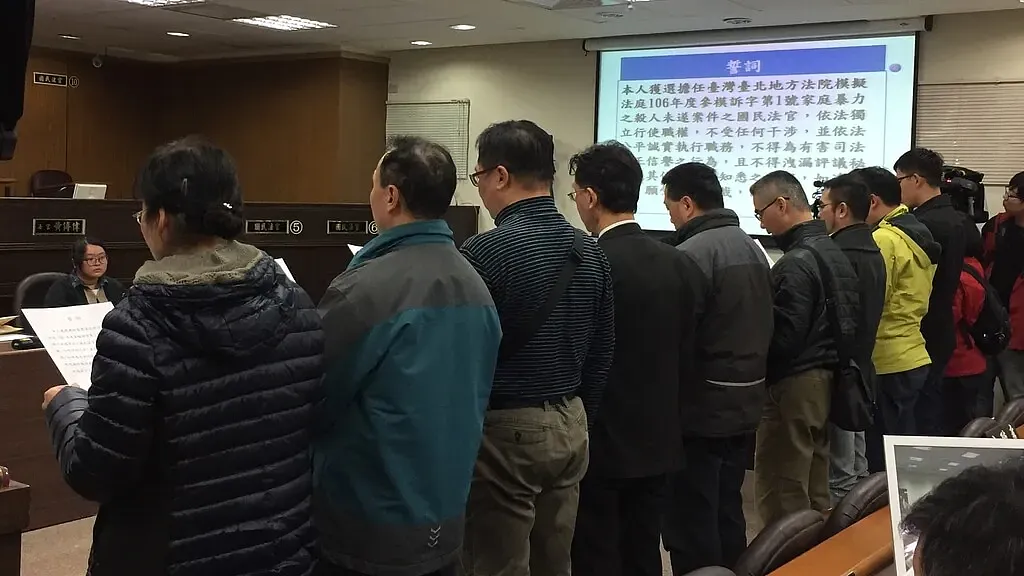
Photo/The National Lay Judge Mock Trial Oath Ceremony at the Taipei District Court
The previous article discussed the problematic policy decision in the draft regarding the single-copy indictment tied with evidence disclosure. This article reviews the evidence disclosure procedures set forth in the draft.
According to the materials provided to the author by the Taipei District Court during the preparation of the mock trial, the evidence disclosure procedure in the draft is largely modeled after Japan's system and is divided into three stages. Each stage is analyzed below in sequence.
The first stage is voluntary (non-compulsory) disclosure prior to the preparatory proceedings. Paragraph 1 of Article 51 of the draft stipulates that prosecutors and defense counsel should contact each other prior to the preparatory proceedings to confirm: 1. the criminal facts, statutory provisions violated, and the defendant's statements and defenses as stated in the indictment; 2. the disputed issues of the case; 3. the items, facts to be proven, scope, order, and methods of evidence investigation scheduled to be requested by both parties; 4. both parties' opinions on the requested evidence investigation.
In short, this provision hopes that the prosecution and defense will proactively contact each other and organize the disputed issues on their own before the court's first preparatory hearing, even reaching a "gentlemen's agreement" on what evidence to investigate. However, for the defense to cooperate in organizing disputed issues, it must first grasp the facts of the case. Therefore, this provision actually expects the prosecution to proactively disclose the evidence necessary for organizing the disputed issues to the defense; it further expects that, after the prosecution discloses the evidence, the defense can also submit the gist of its defense and corresponding evidence investigation methods, thereby disclosing its own evidence to the prosecution. I must say that such a vision is infinitely beautiful and infinitely naive.
Let us first discuss the problems the defense will face. Do not forget that before the prosecution and defense meet for voluntary disclosure, the prosecutor naturally has not disclosed a single piece of evidence to defense counsel. Therefore, other than the thin indictment, defense counsel only has the defendant's account heard during meetings with the defendant, with no evidence to cross-reference and verify, let alone a grasp of the full picture of the case. Given the reality that Taiwanese lawyers lack investigative powers, relying solely on the defendant's statements to determine factual relations and organize disputed issues is an entirely unprofessional practice (if the defendant cannot clearly explain their defense due to intellectual disability or other factors, defense counsel will find it even harder to confirm the defendant's claims regarding the facts of the case through interviews). Therefore, although Paragraph 2 of Article 51 of the draft requires defense counsel to determine factual relations and organize disputed issues in advance with the defendant before the first preparatory proceeding, this is actually difficult to implement without the prosecutor proactively disclosing evidence when the full picture of the evidence and the case remains unknown.
To go into more depth, for matters not contested by the defense, the prosecutor does not need to request the investigation of evidence in the preparatory proceedings pursuant to Article 52 of the draft in order to prove their existence. Since there is no need to request evidence investigation in the preparatory proceedings, the prosecutor is not required by the provisions of Article 53 of the draft to disclose evidence related uncontested matters to defense counsel. In other words, the more matters the defense does not contest, the less information the prosecutor must prove and correspondingly disclose, and thus the less information the defense can obtain from the prosecutor during the disclosure process. Therefore, if the defense agrees not to contest certain matters in the voluntary disclosure stage without waiting for the prosecutor to disclose evidence, it will likely be very difficult thereafter to obtain evidence related to these uncontested matters from the prosecutor.
In most cases, the most reasonable approach for the defense at the very beginning of the voluntary disclosure stage should be to contest everything in the indictment except the defendant's name, in order to force the prosecutor to disclose as much evidence as possible (this is precisely what the defense team, consisting of the author and two other lawyers, did in this Taipei District Court mock trial). However, doing so makes it impossible to achieve the voluntary disclosure goal of expecting the prosecution and defense to independently complete the organization of disputed issues. As can be seen from the above analysis, for voluntary disclosure to accomplish the mission assigned by the drafters, the key is whether the prosecutor will fully and autonomously disclose evidence to the defense during this stage.
However, Article 51 of the draft only "expects" prosecutors to voluntarily disclose based on good faith, and does not dare to explicitly require prosecutors to proactively disclose the evidence they intend to use at trial and evidence favorable to the defense based on their responsibilities as representatives of the public interest. To put it bluntly, the draft is simply not equipped with a driving engine sufficient to make the voluntary disclosure mechanism operate.
Taking this Taipei District Court mock trial as an example, since the Taipei District Court had long announced the schedule for the mock trial's preparatory and trial dates, the evidence disclosure simulation had to comply with the established schedule and be completed before the preparatory hearing date to avoid scheduling additional preparatory hearings to resolve disputes arising from evidence disclosure. Therefore, in order to perform this grand show perfectly before judicial leaders, department heads, and the media, the prosecution had no choice but to cooperate with the court's schedule with 120% good faith, granting every request for disclosure made by the defense. However, a simulation is ultimately a simulation; the real world, lacking the spotlight of supervisors and the media, cannot be this wonderful. Both the prosecution and the defense have the instinct to win, and the pressure of not being able to afford to lose, especially in front of lay judges, will likely be even greater. Pumping the evidence out of one's pockets for the other side to see violates the instinct to win, yet the draft does not impose a mandatory proactive disclosure obligation on prosecutors, completely deviating from human nature. In the future, voluntary disclosure will likely become mostly a dead letter.
In reality, most prosecutors will likely wait until the second stage—that is, when requesting evidence investigation on the preparatory hearing date—to disclose the following to defense counsel pursuant to Article 53 of the draft: 1. the evidence requested for investigation; 2. statements or other written records made by the requested witnesses, expert witnesses, or interpreters prior to the trial date. The evidence disclosed by prosecutors pursuant to this provision will naturally all be unfavorable evidence used to prove the defendant's crime.
Because Taiwanese lawyers lack investigative powers and their ability to gather evidence and investigate facts is generally poor, after the prosecutor discloses unfavorable evidence pursuant to Article 53 of the draft, defense counsel will not know what other evidentiary materials the prosecutor still holds that have not been disclosed. If the prosecutor conceals evidence favorable to the defendant, defense counsel will hardly discover it nine times out of ten. Although Article 54 of the draft stipulates that after the prosecutor discloses unfavorable evidence pursuant to Article 53, defense counsel may request the prosecutor to deliver an inventory of the evidence held or kept by the prosecutor, and subsequently request the prosecutor to disclose impeachment evidence in the inventory pursuant to Article 55 (i.e., evidence referred to in Paragraph 1 of that article as "important for judging the probative value of the specific evidence requested for investigation by the prosecutor, and necessary for preparing a defense"), or request the prosecutor to disclose evidence in the inventory related to the defendant's defense pursuant to Article 59 (i.e., evidence referred to in that article as "relevant to the factual or legal assertions made by defense counsel or the defendant pursuant to Article 56, and necessary for preparing a defense"); however, pursuant to Paragraphs 2 and 3 of Article 55 of the draft, defense counsel must state the reasons for requesting disclosure (the relevance and importance to impeaching the prosecution's evidence, and the necessity for preparing a defense), and only if the prosecutor deems the defense counsel's request appropriate will it be disclosed.
However, because the evidence inventory only lists the names and quantities of physical evidence (e.g., one seized kitchen knife), the names of the makers of statements and the dates they were made (e.g., the interrogation record of witness Chang San on a certain month and day of a certain year), and the makers and titles of other documentary evidence (e.g., the record of the video recording of the inspection made by prosecutor Li Szu on a certain month and day of a certain year), just by looking at such a "roster" or "menu," it is extremely difficult for defense counsel to glimpse the contents of the evidence listed in the roster. Naturally, it is also difficult to judge which of them are impeachment evidence as stipulated in Article 55 or favorable evidence as stipulated in Article 59. There is even less need to talk about stating reasons to request disclosure from the prosecutor in accordance with these two articles. Needless to say, if there are omissions in the evidence inventory delivered by the prosecutor (e.g., omitting the police interrogation record of witness Wang Wu on a certain month and day of a certain year), defense counsel will certainly find it very hard to discover this, and thus will not request the disclosure of evidence "omitted" outside the inventory by the prosecutor pursuant to Article 55 or Article 59.
To take it a step further, if defense counsel wants to try their luck and insist on requesting the prosecutor to disclose certain evidence pursuant to these two articles, and after being rebuffed by the prosecutor, even if they subsequently apply to the court pursuant to Article 60 to order the prosecutor to disclose, it is expected that the application will be dismissed by the court when they cannot clearly articulate the reasons for requesting disclosure.
In a word, in Taiwan's reality where lawyers lack investigative powers and their evidence-gathering and investigative capabilities are generally poor, the possibility of Articles 55 and 59 of the draft becoming a dead letter is very high.
When all is said and done, defense counsel will likely only be able to obtain the unfavorable evidence that the prosecutor is willing to disclose pursuant to Article 53 due to requesting evidence investigation in most cases. If this is truly the case, the prosecutor clearly holds an overwhelming informational advantage over the defendant, the weapons of both parties are manifestly unequal, and the defendant has already lost more than half the battle before it even begins. Such disclosure rules violate the principle of equality of arms, are practically entirely unfair, and thus run afoul of the principle of due process of law, infringing upon the defendant's right to litigation.
In contrast, in the United States, after the U.S. Supreme Court established the prosecutor's duty to disclose evidence to the defendant through a series of judgments based on the requirement of guaranteeing the defendant a fair trial under the constitutional due process principle and the recognition that the prosecutor is a public interest representative who should pay attention to matters favorable to the defendant, the prosecutor's proactive disclosure to the defendant of evidence the prosecution intends to use at trial and evidence having a substantial impact on the defendant's defense has long been a mandatory requirement at the constitutional level.
Taking the Federal Rules of Criminal Procedure, which are considered relatively conservative even in the U.S., as an example, Rule 16(a) "Government's Disclosure", Item (1) "Information Subject to Disclosure", explicitly stipulates that the government (prosecutor) shall, upon the defendant's request, disclose the defendant's prior oral and written statements, and prior criminal record; permit the defendant to inspect, copy, or photograph books, papers, documents, data, photographs, tangible objects, buildings or places, or copies or portions thereof, which are within the possession, custody, or control of the government and which are material to the preparation of the defendant's defense or are intended for use by the government as evidence in chief at the trial; permit the defendant to inspect, copy, or photograph any results or reports of physical or mental examinations, and of scientific tests or experiments, which are within the possession, custody, or control of the government, and which are material to the preparation of the defense or are intended for use by the government as evidence in chief at the trial; and upon the defendant's request, provide a written summary of any expert testimony the government intends to use at trial on the issue of the defendant's mental state, which summary must describe the witness's opinions, the bases and reasons for those opinions, and the witness's qualifications. The disclosure obligations imposed on prosecutors by the above provisions are not only clear, but the scope of disclosure is not limited to what the prosecutor intends to use at trial; matters material to the defense must also be disclosed or permitted for inspection, copying, or photographing by the defendant. These provisions, coupled with the requirements of U.S. Supreme Court judgments, clearly provide superior protection for the defendant's right of access to information compared to Articles 53, 55, and 59 of the Draft Act on National Participation in Criminal Trials. By comparison, the concern that the draft infringes upon the defendant's right to litigation by violating the principle of equality of arms is even more obvious.
It is not to say that the moon is always rounder abroad, but shouldn't one first provide a reasonable explanation before stubbornly forcing defendants in cases involving citizen participation in trials to play a game of cat and mouse with prosecutors with their eyes covered under conditions of severe informational asymmetry, while referencing the practices of the birthplace of evidence disclosure? (To be continued)
Series Articles
Alas, the Defendant: A Brief Review of Evidence Disclosure in the Judicial Yuan's Draft Act on National Participation in Criminal Trials
- Arbitrary and Unconstitutional Decision-Making: The Single-Copy Indictment "Tied with" Evidence Disclosure
- Prosecutor-Dominant Disclosure Rules
- Defense Disclosure Rules That Mistake Feng Jing for Ma Liang
- The Constitutional Boundaries of Defense Disclosure Rules
※ This article was originally published in ETtoday News Cloud
This article is an AI-generated translation of the original Chinese text. In the event of any discrepancy, the Chinese version shall prevail.