
The Defense Disclosure Rules That Mistook Feng Ching for Ma Liang: A Brief Review of the Judicial Yuan's Draft "Lay Participation in Criminal Trials Act" Regarding Evidence Disclosure (Part 3)
Last edited: 2026-07-27
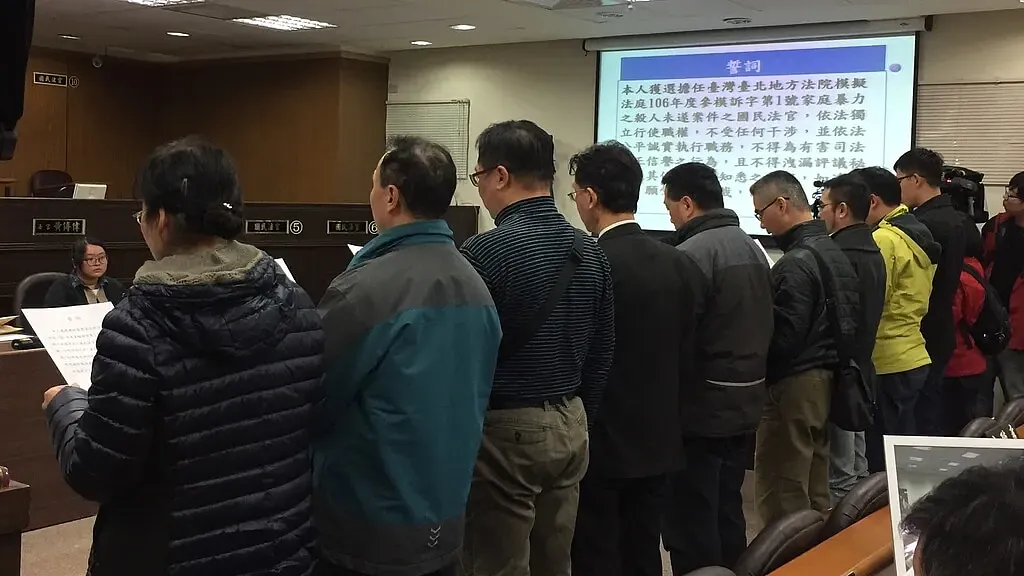
Photo/Citizens participating in the mock trial at the Taipei District Court take their oaths as citizen judges.
While the previous article pointed out that the prosecution evidence disclosure prescribed in the draft raises significant unconstitutionality concerns, this article continues to examine the defense evidence disclosure procedure under the draft.
Article 57 of the draft stipulates that when the defense applies to the court for evidence investigation pursuant to Article 56, it shall immediately disclose to the prosecutor the evidence it applies to investigate, as well as the interrogation records or other written records prepared prior to the trial date by the witnesses, expert witnesses, or interpreters whom it applies to summon. Comparing this with the prosecution disclosure prescribed in Article 53 of the draft, it can be found that the wording used in Article 57 and Article 53 is identical and completely symmetrical. This shows that the drafters understood evidence disclosure under the premise of equal status and strength between the prosecution and the defense, and consequently required the defense to disclose to the prosecutor within the scope of disclosure provided by the prosecution to the defense, based on the principle of equality and reciprocity.
The problem is that the jurisprudential basis of the evidence disclosure system has two pillars: first, to ensure the defendant's right to a fair trial through evidence disclosure so that the defendant can mount a defense under conditions of information symmetry with the prosecutor; second, as the representative of the public interest, the prosecutor has an obligation to ensure the due process of the prosecution proceedings and to pay heed to matters favorable to the defendant, and therefore should proactively disclose evidence to the defendant. From these two jurisprudential foundations of the evidence disclosure system, it cannot be deduced that the defendant should disclose evidence to the prosecutor, nor can it be deduced that the defendant should take the evidence in their pocket and share it with the prosecutor on an equal and reciprocal basis. Furthermore, the equal status and strength of the prosecution and defense are not a presupposition of the evidence disclosure system.
On the contrary, this system recognizes that the prosecutor represents the state in prosecuting the defendant, wields immense public authority, and is backed by a massive governmental apparatus to assist in investigation and evidence collection. Compared to the defendant, who lacks public authority, the prosecutor enjoys a significantly superior position in both strength and information. Therefore, it is necessary to compel the prosecutor to disclose evidence to the defendant in order to narrow the gap in strength and status between the two sides, so that the trial may move closer to fairness.
This rationale is well-articulated in Judgment No. 39 (Administrative Litigation Summary Appeal, 2015) of the Kaohsiung High Administrative Court: "In a modern state, administrative agencies remain the primary monopolists of information. Administrative litigation is basically litigation brought by individuals against official agencies, and in terms of information mastery, individuals are inherently in an unequal position. To achieve the purpose of equality of arms, in addition to the parties' right to inspect various litigation documents, administrative agencies bear the obligation to produce documents related to the litigation." Although this judgment does not specifically address prosecutors, prosecutors are part of the government apparatus, and the rationale remains the same.
Article 57 of the draft goes in the opposite direction by analogizing the defense to having equal strength as the prosecution, which precisely demonstrates that the drafters actually mistook Feng Ching for Ma Liang—mistakenly planning evidence disclosure in criminal proceedings as if it were civil proceedings, thereby imposing upon the defense disclosure obligations identical to those of the prosecution.
Because Article 57 imposes disclosure obligations on the defense equal to those of the prosecution, fierce contention broke out between the prosecution and the defense over the interpretation and application of this provision during the Taipei District Court's mock trial. As discussed in Part 2 of this series, during the voluntary disclosure stage, the prosecution, acting in complete good faith, disclosed all evidence requested by the defense. Not returning a courtesy is impolite; thus, the defense, also acting in 120% good faith, informed the prosecution during the voluntary disclosure stage that the defense would apply to summon two witnesses to corroborate the defendant's lack of motive for murder. Thereupon, the prosecution asked the defense whether it had interviewed these two witnesses beforehand and prepared interview records. The defense, still acting in good faith, answered in the affirmative. Subsequently, the prosecution relied on Article 57 to argue that the interview records constituted the written records referred to in that article, and demanded that the defense disclose them. The defense argued at the time that interview records constitute a lawyer's work product, which by nature are records prepared by the lawyer investigating the facts of the case in preparation for the defense. Like case analysis reports, legal research memos, draft pleadings, or other preparatory work documents prepared by a lawyer for trial preparation, they belong to the working papers within the defense counsel's file and should not be disclosed; otherwise, not only would the defense's litigation strategy be exposed, but it might also provide the prosecution with information to attack the defendant.
If defense counsel must disclose work products in such files or dossiers as interview records, it will force defense counsel into a trilemma: either neglect interviewing witnesses; or interview witnesses but refrain from making records; or lie to the prosecutor that no interview records were made. The first two options would impair the quality of defense and violate the defendant's right to rely on defense counsel, while the third option would cause defense counsel to violate legal ethics. Therefore, the defense argued that the written records referred to in Article 57 should be given a constitutional interpretation, limited to statement records whose nature is similar to interrogation records and which are prepared through statutory procedures, such as statements or confessions written by witnesses or expert witnesses in other judicial or administrative proceedings, or administrative investigation or interview records. Defense counsel are not public officials and possess no public authority; nor are their records of interviewing witnesses or expert witnesses statutory hearsay exceptions, lacking evidentiary capacity, and are not other written records under Article 59 of the draft.
Unmoved, the prosecution further applied to the court pursuant to Article 60 of the draft to order the defense to disclose the interview records (this is also an inevitable outcome of operating the principle of equality and reciprocity in good faith, because at some point, one party will always feel that its sincerity was met with ruthlessness and will thus turn hostile. This also shows that ignoring human nature when designing a system is simply foolish). Because the second point of the legislative reasoning for Article 57 states that "Other written records (including statements recorded on recording media of images and sounds). Such written statements bear an important relationship to the preparation of attacks and defenses by the parties, and should also fall within the scope of evidence that defense counsel must disclose," which explanation regarding what constitutes "other written records" did not distinguish whether they are work products within defense counsel's files, the Taipei District Court unsurprisingly ruled to grant the prosecution's application and ordered the defense to disclose the interview records. Consequently, the defense had no choice but to conjure up two interview records out of nowhere. These two interview records only recorded the time, place, and persons present at the interview. As for the content of the interview, in order to protect the defendant and prevent the prosecution from using the interview content against the defendant, it simply recorded "interviewed the facts of the case" (the defense originally wanted to just draw a turtle and submit it to finish the job, but feared that submitting such a thing to the prosecution might lead to being arrested in the courtroom for the crime of insulting an official authority, so that idea was abandoned).
As expected, the prosecution was highly dissatisfied with such simple recording and once again requested the court to order the defense to further disclose the content of the interview. The defense argued that the Code of Criminal Procedure contains no provisions requiring defense counsel to prepare interview records, and naturally contains no regulations on how interview records should be prepared to satisfy the prosecutor; therefore, the defense had no obligation to re-prepare more detailed interview records and disclose them to the prosecution. The court once again agreed with the prosecution's argument and ordered the defense to submit more detailed interview records. The defense refused, and the court consequently ruled to dismiss the defense's application to summon the two witnesses pursuant to Article 61 of the draft. At this point, this dispute ended in a total defeat for the defense.
Since this was a mock trial, no real defendant would be wrongfully imprisoned because of the inability to summon these two witnesses to testify on their own behalf, allowing the author to smile at the total defeat in the aforementioned evidence disclosure dispute. But if the defense disclosure under Article 57 were to pass and enter into force just like this, what should defendants and defense counsel in real cases do? If such interview records truly must be disclosed, to what extent must defense counsel record them for the prosecution to be satisfied? When the prosecution and defense dispute whether the recorded content is sufficiently specific and consequently request a court ruling, by what standard should the court judge? More importantly, in the future, should defense counsel choose to sacrifice the quality and efficiency of defense and refrain from interviewing witnesses, or is it better to interview witnesses but not make records?
In summary, the drafters formulated Article 57 based on a mistaken understanding of defense disclosure, resulting in a provision that is overly simplistic. If left uncorrected, its implementation will likely cause catastrophic impacts on the defendant's right to rely on defense counsel and the fairness and efficiency of lay participation in criminal trials.
The purpose of mock trials is to test the feasibility of a draft. In this regard, the Taipei District Court's mock trial successfully exposed major flaws in Article 57 of the draft, thereby fully accomplishing its mission and validating the efforts and dedication of all participants. However, to improve future legislation and prevent unconstitutional infringements on the litigation rights of defendants, it is imperative to thoroughly clarify the concept of defense disclosure. (To be continued)
Series Articles
Alas, the Defendant: A Brief Review of the Judicial Yuan's Draft "Lay Participation in Criminal Trials Act" Regarding Evidence Disclosure
- Arbitrary and Unconstitutional Decision-Making: Tying the "Single Copy of Indictment" to Evidence Disclosure
- Prosecution Disclosure Rules Where the Prosecutor Holds All the Advantages
- Defense Disclosure Rules That Mistook Feng Ching for Ma Liang
- The Constitutional Boundaries of Defense Disclosure Rules
※ This article was originally published in ETtoday News Cloud
This article is an AI-generated translation of the original Chinese text. In the event of any discrepancy, the Chinese version shall prevail.