
Constitutional Boundaries of Defense Disclosure: A Brief Critique of the Judicial Yuan's Draft "國民參與刑事審判法" (Lay Participation in Criminal Trials Act) Regarding Evidence Disclosure (Part 4)
Last edited: 2026-07-27
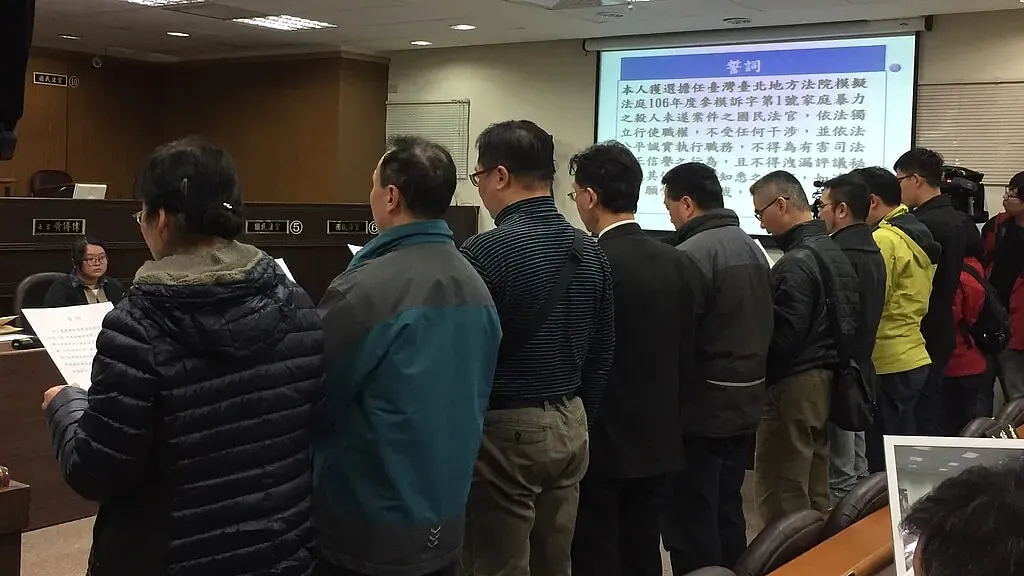
Photo/Oath-taking ceremony of lay judges in the Taipei District Court simulation trial
As mentioned previously, the drafters formulated Article 57 of the Draft Act based on a flawed understanding of defense disclosure, which risks severely impairing the defendant's right to the assistance of counsel as well as the fairness and efficiency of the trial. Therefore, looking to American law on defense disclosure, this article attempts to clarify the scope and limitations of defense disclosure in the hope of improving future legislative deliberation and preventing unconstitutional infringements upon the defendant's right of action.
As part of the discovery system, while the U.S. Supreme Court was establishing and progressively expanding the prosecution's disclosure obligations, criminal procedure borrowed from civil procedure to introduce defense disclosure. However, in the view of the U.S. Supreme Court, defense disclosure is not only not a constitutional requirement, but rather a matter for legislative formation (meaning that whether to impose a disclosure obligation on the defense is left entirely to the discretion of the legislature, which is fundamentally different from the prosecutor's disclosure obligation, which stems from the Constitution), and it is subject to strict constitutional limitations.
In the 1970 case of *Williams v. Florida*, the U.S. Supreme Court permitted the legislature to impose a certain degree of mandatory disclosure obligations on the defense (with non-compliance potentially resulting in the preclusion of evidence). First is the privilege against self-incrimination, which protects defendants in criminal cases from being compelled to incriminate themselves, thereby granting defendants the right to refuse to comply with government requests to provide evidence adverse to themselves. After the introduction of defense disclosure into criminal procedure, if the prosecution were permitted to obtain evidence adverse to the defendant through defense disclosure, there would be concerns of violating the privilege against self-incrimination. Therefore, the defense should not be forced by disclosure obligations to produce evidence adverse to itself, nor should the prosecution use materials disclosed by the defense, or information further derived from such disclosed materials, to prove the defendant's guilt.
In the 1973 case of *Wardius v. Oregon*, the U.S. Supreme Court emphasized the principle of a fair trial under the Due Process Clause, demanding parity of arms between the prosecution and the defense, and prohibiting the compulsion of the defense to disclose more information than the prosecution. Consequently, it is unfair to require a defendant to unilaterally disclose their own evidence without requiring the prosecution to make reciprocal disclosures. Therefore, after the defense discloses its witness list, the prosecution must also disclose evidence it intends to use to impeach the defense's witnesses.
In accordance with the intent of U.S. Supreme Court jurisprudence, the federal government and various states establish the specific content of defense disclosure systems through legislation. Taking the relatively conservative Federal Rules of Criminal Procedure as an example, the rules first prescribe in Rules 12.1 through 12.3 three types of disclosures that the defense must make upon the prosecution's request, and then provide in Rule 16(b)(1) the types of disclosures that the defense may voluntarily decide whether to make to the prosecution. Because these provisions are very long and extremely specific and detailed (thus offering high operational feasibility; the author has always believed that this legislative approach is an advantage of foreign legislative examples and is worth our country learning from), to save space, only their main outlines are introduced below. Interested readers may search and read the details online themselves.
Rule 12.1, "Notice of an Alibi Defense," provides that an attorney for the government may request in writing that the defense notify it of any intent to offer an alibi defense at trial. Upon receiving the request, the defense must disclose to the prosecution the specific details of the alibi and the names, addresses, and telephone numbers of the witnesses. Upon receipt, the prosecution must correspondingly disclose the names, addresses, and telephone numbers of the government's witnesses (other than the victim) whom it intends to use to establish the defendant's presence at the scene. Rule 12.2, "Notice of an Insanity Defense; Mental Examination," provides that if the defense intends to introduce an insanity defense at trial, or expert evidence relating to a mental disease or defect or any other mental condition of the defendant, it must do so pretrial and provide written notice to the prosecution. Rule 12.3, "Notice of a Public-Authority Defense" (similar to official acts under Article 21 of our Criminal Code), provides that if a defendant intends to assert this defense at trial, they must raise it pretrial and notify the prosecution in writing of the specific details of the defense. Upon receiving the notice, the prosecution must reply to the defense within 14 days stating whether it contests the defense, and may request in writing that the defense disclose the names, addresses, and telephone numbers of the witnesses it relies upon to prove the defense. Upon receiving the defense's disclosure, the prosecution must in turn disclose the names, addresses, and telephone numbers of the government's witnesses (other than the victim) it will use to rebut the defense.
In addition to the three types of disclosures that the defense must make upon the prosecution's request, Rule 16, "Discovery and Inspection (b) Defendant’s Disclosure (1) Information Subject to Disclosure," specifies the categories that the defense may voluntarily decide whether to disclose to the prosecution. Under this provision, if the defense requests discovery from the prosecution under subsection (a) ("Government’s Disclosure") and the prosecution complies, the prosecution is entitled to inspect, copy, or photograph books, papers, documents, data, photographs, tangible objects, buildings or places, or copies or portions of any of these items, as well as reports of physical or mental examinations and of scientific tests or experiments, or a written summary of expert witness testimony, which are within the possession, custody, or control of the defense and which the defense intends to use at trial.
Looking broadly at the defense disclosure provisions in the Federal Rules of Criminal Procedure, it can be seen that, aside from raising the three specific types of defenses stipulated in Rules 12.1 through 12.3, the defense is only required to make disclosures upon the prosecution's request after it has requested and received disclosures from the prosecution. Once the defense discloses, the prosecution must also correspondingly disclose evidence it will use to impeach the defense's evidence or rebut the defense's arguments.
Paragraph 1 of Article 57 of the Draft *Lay Participation in Criminal Trials Act* provides that once the defense applies to the court for the investigation of evidence, it shall disclose to the prosecutor: 1. the evidence for which it applies for investigation; and 2. the examination transcripts or other written records prepared prior to the trial date by witnesses, expert witnesses, or interpreters whom it applies to summon (according to the explanation of the legislative reasoning, this includes statements recorded on video or audio recording media). The aforementioned draft provision uses the defense's application for the investigation of evidence as the triggering condition for defense disclosure, which formally mirrors the language governing prosecution disclosure under Article 53 of the Draft, seemingly creating equality between the prosecution and defense. However, because there is actually a distinct gap in the investigative and evidence-gathering capabilities of the two sides, and given the premise that a defendant's fate is decided at the first instance (Article 90 of the Draft stipulates that in lay participation trials, no new evidence may be investigated in the second instance except for extremely strict exceptions prescribed in that article), the defendant must put forth all available weapons at the first instance, and consequently disclose them fully to the prosecution under Article 57. Meanwhile, the prosecution may benefit from the defense's weaker investigative capacity while concealing evidence favorable to the defendant. In other words, when pocket sizes differ vastly between the parties, the prosecution can see the bottom of the defense's pockets, but it is very difficult for the defense to see deep into the prosecution's pockets, which is naturally extremely disadvantageous to the defense.
Furthermore, using the application for the investigation of evidence as the trigger for defense disclosure without restricting the prosecution from using data disclosed by the defense—or information derived therefrom—to prove the defendant's guilt, runs a clear risk of conflicting with the defendant's privilege against self-incrimination, in light of the aforementioned U.S. Supreme Court ruling in *Williams v. Florida*. This creates a chilling effect whereby the defense hesitates to apply for the investigation of evidence, thereby infringing upon the defendant's right of defense.
rUnlike the Federal Rules of Criminal Procedure, Article 57 of the Draft does not explicitly mandate that upon obtaining information disclosed by the defense, the prosecution must proactively disclose to the defense the evidence it intends to use to impeach the defense's evidence or rebut the defense's arguments. Although theoretically, if the prosecution wishes to introduce such impeachment or rebuttal evidence at trial, it should still apply to the court for the investigation of evidence and make reciprocal disclosure to the defense in accordance with Article 53 of the Draft, operating the statutory provisions in this manner will inevitably make it difficult to conclude the preparatory proceedings (if the preparatory proceedings have already been concluded, they must be reopened, and if the defense has further evidence to present in response to the prosecution's impeachment or rebuttal evidence, the preparatory proceedings will naturally have to continue). This leads us further and further away from the ideal of the drafters, who hoped that the prosecution and defense would independently complete disclosure and maximize the efficiency of preparatory proceedings.
Aside from the aforementioned shortcomings, another major omission in the Draft is the failure to stipulate that information falling within the scope of the attorney-client privilege and attorney work product immunity is exempt from disclosure. This led to fierce clashes between the prosecution and defense in this simulation trial.
The U.S. Supreme Court first established the rule in the 1947 case of *Hickman v. Taylor* that materials prepared and gathered by an attorney in anticipation of litigation do not need to be disclosed to the opposing party in civil discovery proceedings. The reason for establishing this rule is that while information obtained by an attorney through communication and interaction with their client is naturally protected by the attorney-client privilege and need not be disclosed, an attorney's work product in preparing for litigation—including interview records, statements, memoranda, correspondence, and case summaries—may not necessarily be protected by the attorney-client privilege (for example, the statements obtained by the attorney from witnesses at issue in *Hickman* could not be protected by the privilege).
If an attorney's work product in preparing for litigation had to be disclosed to the opposing party, lawyers would be forced to avoid creating written records while preparing for litigation to prevent confidential information such as their litigation strategy from being known in advance by the opposing party through disclosure, or even hindered as a result. Under such circumstances, lawyers would inevitably find it difficult to prepare for litigation efficiently, which not only harms the client's right of action but also undermines the adversary system's ability to discover the truth through both sides doing their utmost to gather evidence, present proof, and contend. Therefore, the U.S. Supreme Court established the work product doctrine in *Hickman*, allowing an attorney's work product prepared in anticipation of litigation to be exempt from disclosure to the opposing party, even if it is not protected by the attorney-client privilege.
Following the *Hickman* decision, the U.S. Congress amended the Federal Rules of Civil Procedure, codifying the work product doctrine in Rule 26(b)(3). As criminal procedure subsequently adopted discovery, the work product doctrine also became a part of criminal discovery.
Taking Rule 16 of the Federal Rules of Criminal Procedure as an example, it sets forth the scope of information that the prosecution and defense are exempt from disclosing to each other based on the work product doctrine and attorney-client privilege, respectively under (a) "Government’s Disclosure (2) Information Not Subject to Disclosure" and (b) "Defendant’s Disclosure (2) Information Not Subject to Disclosure." The former, based on the work product doctrine, provides that—except as provided in Rule 16(a)(1)(A)-(D), (F), and (G)—reports, memoranda, or other internal government documents made by the attorney for the government or other government agents in connection with the investigation or prosecution of the case are not subject to disclosure or inspection. Except as provided in 18 U.S.C. §3500, statements made by prospective government witnesses are also not subject to disclosure or inspection. The latter, based on the work product doctrine and attorney-client privilege, provides that reports, memoranda, or other documents made by the defendant or the defendant's attorney during the investigation or defense of the case, statements made by the defendant to the defendant's attorney, and statements made by witnesses to the defendant or the defendant's attorney (including prosecution or defense witnesses, regardless of whether they are on the witness list) are all excluded from disclosure.
According to the above provisions, defense counsel's records of interviewing witnesses and the contents of witnesses' statements to the defendant or defense counsel do not need to be disclosed to the prosecutor. Precisely because defense counsel's interview records and witnesses' statements fall within the protective scope of the work product doctrine and attorney-client privilege, the defense disclosures stipulated in Rules 12.1 through 12.3 and 16(b) require only the disclosure of names, addresses, and telephone numbers for witnesses other than expert witnesses.
As demonstrated by the introduction of U.S. Supreme Court jurisprudence and the Federal Rules of Criminal Procedure above, the fact that information protected by attorney-client privilege and attorney work product is exempt from disclosure is an indispensable part of the defense disclosure system. Without these two exemption rules, defense disclosure will not only give rise to endless disputes in actual practice, but will also impair the defendant's right to the assistance of counsel and trial fairness, thereby hindering the criminal trial's efficacy in discovering the truth and preventing miscarriages of justice, which naturally harms the public interest as well. Article 53 of the Draft completely fails to mention these two exemptions, which is indeed overly crude.
From this we can see more clearly that the Draft structures criminal procedure discovery using the mindset of civil procedure discovery design. However, even though they both adopt the adversarial system (party-prosecution principle), the essence of civil and criminal procedures remains vastly different. Civil plaintiffs bear no public interest obligation and typically do not have a significant power imbalance with defendants. In contrast, the prosecuting party in criminal procedure—the prosecutor—is a representative of the public interest, who not only bears the duty to avoid causing miscarriages of justice while prosecuting the defendant, but also possesses a disparity of power with the defendant that is as vast as heaven and earth. Therefore, the Constitution attempts to ensure the fairness of trial procedures through principles such as the presumption of innocence, the privilege against self-incrimination, and the right to the assistance of counsel, in order to protect defendants whose power is vastly disparate from that of the prosecutor.
These distinctions are completely obliterated once the drafters of the Draft plan criminal procedure discovery as if it were civil procedure. If the Draft goes live as it stands, lay participation trials in the future will likely truly degenerate into a slaughterhouse where giants massacre pygmies—after all, David only defeated Goliath in biblical stories! When one further considers that the Draft *Lay Participation in Criminal Trials Act* does not grant defendants the right to refuse lay participation trials, defendants cannot refuse to play this manifestly unfair game. Alas, poor defendants!
Series Articles
Alas, Poor Defendants: A Brief Critique of the Judicial Yuan's Draft "Lay Participation in Criminal Trials Act" Regarding Evidence Disclosure
- Arbitrary and Unconstitutional Decision-Making: "Indictment-Only" Bundled with Evidence Disclosure
- Prosecution Disclosure Rules Where Prosecutors Hold Every Advantage
- Defense Disclosure Rules That Mistake Mist for Smoke
- Constitutional Boundaries of Defense Disclosure
※ This article was originally published on ETtoday News Cloud
This article is an AI-generated translation of the original Chinese text. In the event of any discrepancy, the Chinese version shall prevail.