
The 318 Occupation is Justified, Speech is Not a Crime
Last edited: 2026-07-27
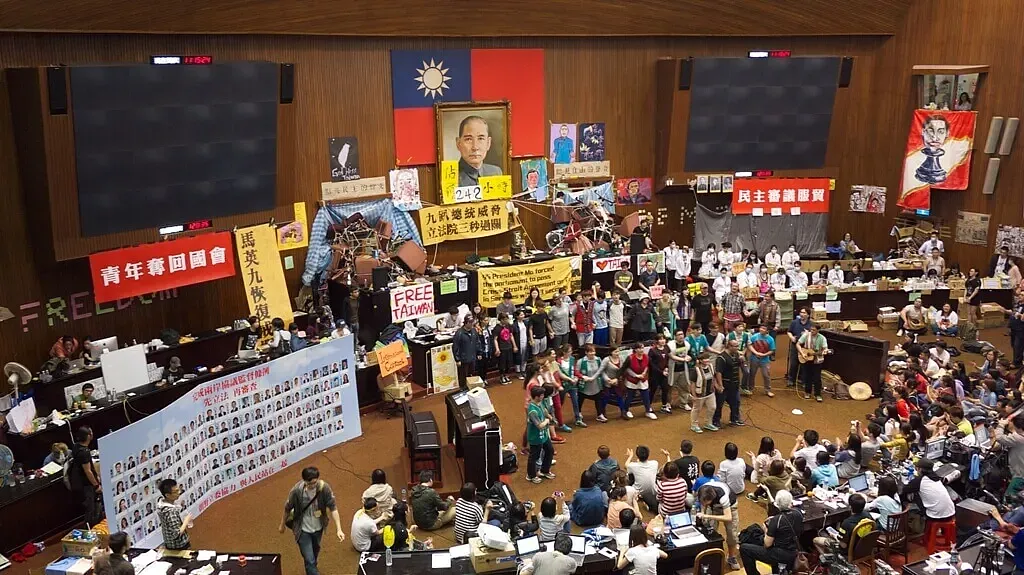
The second-instance judgment of the March 18 Legislative Yuan occupation case was handed down on the 13th, upholding the first-instance acquittal. Although the appellate court and the district court reached the same conclusion, their reasoning differed. The appellate court closely examined the legislative branch's dysfunction in reviewing the Cross-Strait Service Trade Agreement in 2014, using this as an entry point to discuss the peaceful and non-violent actions of the crowd participating in the occupation of the Legislative Yuan. The district court, on the other hand, adopted the perspective of civil disobedience advocated by the volunteer legal team, affirming the legitimacy of the crowd's peaceful occupation action in accordance with the legal requirements of social adequacy. Regardless of these differences, if we were to ask what inspiration the verdict of the 318 case brings to society, the most important aspect is that it manifests the judiciary's starting point of the "protection" spirit of freedom of speech and freedom of assembly, thereby conferring legality to assembly and demonstration activities.
Both the first- and second-instance courts in this case devoted considerable length to discussing whether the legislative process during the controversy over the Service Trade Agreement complied with relevant parliamentary rules, thereby interpreting the March 18 occupation of the Legislative Yuan as the public holding different opinions on the ruling authorities' related actions and conveying different political demands through assemblies and other means. Therefore, regardless of whether such speech aligns with the state's preferences, people exercising their constitutional guarantees of freedom of speech and freedom of assembly should be tolerated to the maximum extent, and the state must not arbitrarily restrict them. In addition, the appellate court also held that the state's frequent prosecution of citizens under the Criminal Code, which stifles opportunities to express opinions, is incompatible with the protection of freedom of speech. This view is extremely important in light of the currently worsening judicial prosecution of social movement participants.
In recent years of social movements, one consistently sees prosecutors and police pursuing the legal responsibilities of participants retrospectively, draining the energy and time of numerous participants through lengthy litigation procedures. The state's purpose in doing so is none other than litigation-based exclusion, sending batches of participants to court so that they can no longer continue to speak out on the issue. Furthermore, differences among judges in how they understand the legitimacy of social movements affect whether they are willing to actively protect freedom of speech in their judgments, leading to guilty verdicts in related cases. All of these factors may silence social movement participants.
The two acquittals in the 318 case, whether based on civil disobedience or the necessity to protect political speech, have legally carved out possibilities for an increasingly shrinking space for social movements. In addition, the courts did not support administrative agencies in abusing the Criminal Code and the Assembly and Parade Act to intimidate people from participating; the state should exercise restraint over its own power. Last and most importantly, it is hoped that the acquittal in the 318 case will enable frontline law enforcement officers to realize that they are also a link in state power, and that they should value the rights to freedom of speech and freedom of assembly guaranteed by the Constitution.
※ This article was published in the Liberty Times on 2018.03.16
This article is an AI-generated translation of the original Chinese text. In the event of any discrepancy, the Chinese version shall prevail.