
The Conflict Between the Discovery System and the Protection of the Right to Review Case Files in the Draft Lay Judge Criminal Trial Act
Last edited: 2026-07-27
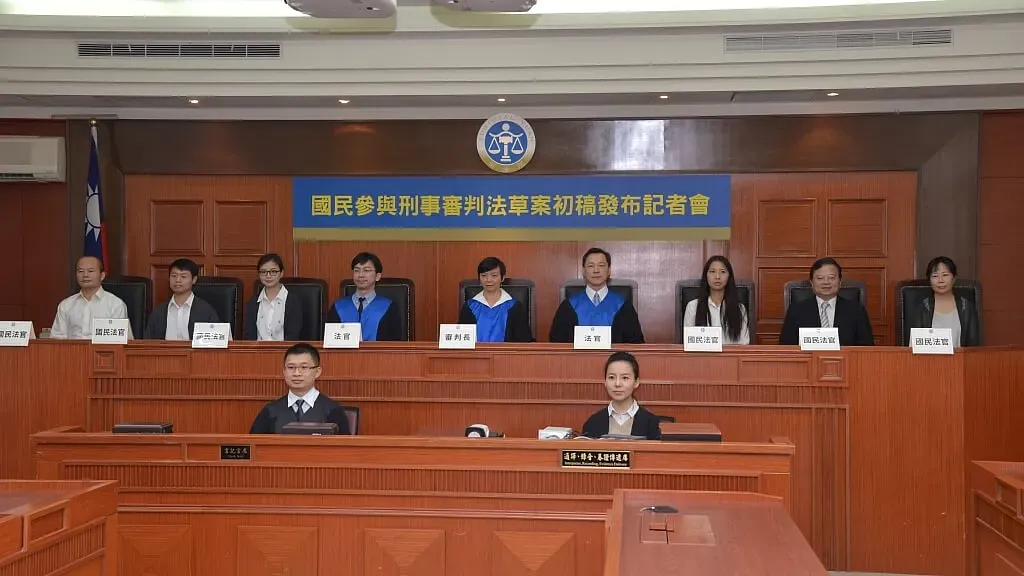
Photo credit: Adapted from the Judicial Yuan Lay Judge Trial website
At the end of 2017, the Judicial Yuan drafted the initial version of the Draft Lay Judge Criminal Trial Act (hereinafter the "Draft Lay Judge Criminal Trial Act"). Targeting serious offenses carrying a minimum sentence of seven years or intentional homicide resulting in death, the draft proposes that a collegiate panel composed of six lay judges and three professional judges jointly determine whether the criminal facts exist and assess sentencing upon conviction. The indictment procedure for cases subject to lay participation in criminal trials will depart from the current general trial system of simultaneous dossier submission, adopting instead "separate submission of dossiers and indictments" paired with a "discovery system" designed to complement it.
The system of separate submission of dossiers and indictments—namely, the Japanese principle of single-charge submission—is a form of prosecution rooted in the adversary system. In Taiwan, in order to place judges in the position of fair and neutral third-party arbiters, there have long been calls to adopt this separate-submission system. One indicative example was the inclusion of a reform item to adopt the principle of single-charge submission during the 1999 National Judicial Reform Conference. However, prosecutors, led by the Ministry of Justice, strongly opposed this system, arguing that adopting single-charge submission would drastically and unmanageably increase prosecutors' workloads. Ultimately, the Minister of Justice exercised a veto vote to reject the reform item. Perhaps because the single-charge submission principle was rejected at the time, Taiwan has never engaged in discussions regarding how evidence should be reviewed following the adoption of such a system.
The Discovery System in the Draft Lay Judge Criminal Trial Act
Under Article 43 of the current Draft Lay Judge Criminal Trial Act, the separate-submission system is established, while drawing upon Japanese law to introduce a three-stage discovery system nearly identical to it, summarized as follows:
First, the initial stage is the "prosecutor's motion for evidence investigation, disclosure, and delivery of an evidence inventory." Beginning with Article 52 of the draft, the prosecutor must first state in the preparatory brief the evidence requested for investigation and its relationship to the facts to be proved, information on witnesses requested for summons, and the required cross-examination time. Pursuant to Article 53, the prosecutor must disclose the requested evidence to the defense counsel. Upon receiving the aforementioned evidence, the defense counsel may request that the prosecutor deliver an inventory of all evidence in their custody. However, under Article 54, Paragraph 2, the prosecutor may exceptionally omit items from the inventory. The grounds for this exception are that "there are factual grounds to believe that recording specific evidence in the inventory presents a risk of destroying, forging, or altering evidence, colluding with accomplices or witnesses, thereby endangering the purpose of the investigation or endangering the life and physical safety of others."
Next is the second stage: "requesting the prosecutor to disclose evidence other than that requested for investigation by the prosecutor." Upon receiving the aforementioned evidence inventory and conducting a comprehensive review, the defense counsel may, pursuant to Article 55, Paragraph 1, request the prosecutor to disclose evidence related to the probative value of the evidence requested by the prosecutor for investigation, known in Japan as the disclosure of category evidence. However, Paragraph 1 of the same article prescribes that such evidence must be "important for determining the probative value of the specific evidence requested by the prosecutor for investigation, and necessary for preparing a defense." Furthermore, pursuant to Paragraph 2 of the same article, the defense counsel "shall specify facts sufficient to identify such evidence." If the prosecutor deems it appropriate pursuant to Paragraph 3 of the same article, the evidence shall be disclosed, but "when necessary, the prosecutor may instruct the date, method of disclosure, or attach conditions." Pursuant to Paragraph 4 of the same article, the prosecutor may refuse disclosure or limit the scope of disclosure for "case dossiers and evidence for which there are factual grounds to believe that they present a risk of destroying, forging, or altering evidence, colluding with accomplices or witnesses, thereby endangering the purpose of the investigation or endangering the life and physical safety of others."
The third stage is "requesting the prosecutor to disclose evidence related to the facts intended to be asserted by the defendant and defense counsel." After receiving the asserted evidence and category evidence disclosed by the prosecutor mentioned above and conducting a comprehensive review, the defense counsel must, pursuant to the subparagraphs of Article 56, Paragraph 1, state whether the defendant pleads guilty, express opinions on the admissibility and necessity of investigating the evidence requested by the prosecutor, move for evidence investigation, and summon witnesses. Pursuant to Article 57, Paragraph 1, the defense counsel shall disclose to the prosecutor the statements made before the trial date by the evidence requested for investigation, summoned witnesses, expert witnesses, and interpreters. At this juncture, pursuant to Article 59, Paragraph 1, "...where it is related to the factual or legal assertions made by the defense counsel or the defendant pursuant to Article 56 and is necessary for preparing a defense, the defense counsel may also request the prosecutor to disclose [evidence]." Nevertheless, because Article 59, Paragraph 2 applies mutatis mutandis to Article 55, Paragraph 2, the defense counsel, as stated above, "shall specify facts sufficient to identify such evidence." In addition, Article 59, Paragraph 3 applies mutatis mutandis to Article 55, Paragraphs 3 to 5; hence, the prosecutor may, when necessary, designate the date and method of disclosure or attach conditions, and may also refuse disclosure or restrict the scope of disclosure.
From the aforementioned discovery process, the following four points can be observed:
- The evidence inventory disclosed by the prosecutor may exclude evidence with a potential for destruction, and does not constitute the entire case dossier.
- When requesting the prosecutor to disclose category evidence during the second stage, the defense counsel must satisfy the requirements of being "important for determining the probative value of the specific evidence requested by the prosecutor for investigation, and necessary for preparing a defense."
- When requesting the prosecutor to disclose evidence during the second and third stages, the defense counsel "shall specify facts sufficient to identify such evidence."
- When making disclosures upon accepting requests for evidence disclosure in the second and third stages, the prosecutor "may, when necessary, instruct the date, method of disclosure, or attach conditions," and may refuse disclosure or restrict the scope of review on the grounds of evidence destruction or witness collusion.
Overall, under this discovery system, the prosecutor has no obligation to produce all evidence. Conversely, when the defense counsel requests the prosecutor to disclose required evidence, they must clearly record and identify the specific evidence—particularly during the second stage of category evidence disclosure, where the requirements of materiality and necessity for defense must be met. Not only does the prosecutor judge whether the defense counsel's request meets these conditions, but they may also attach conditions to the method of disclosure or even restrict or refuse inspection. Whether this legislative approach aligns with the rationale governing how defendants and defense counsel obtain dossier information under Taiwan's current Code of Criminal Procedure, and whether it can achieve the objectives of discovering the truth and protecting human rights in criminal proceedings, remains, in the author's view, open to debate.
The Status of Obtaining Dossier Information in Taiwan and Japan
What position does obtaining dossier information occupy within Taiwan's Code of Criminal Procedure? First, statutory provisions are set forth in Article 33 of the Code of Criminal Procedure. Paragraph 1 of Article 33 governs the review of case dossiers by defense counsel, while Paragraph 2 governs the review of case dossiers by the defendant in person. Although the scope of review for defendants themselves is heavily restricted, at least pursuant to Paragraph 1 regarding the review of dossiers by the defendant's defense counsel, current Taiwanese practice dictates that—barring exceptions such as the Witness Protection Act where review is withheld—defense counsel may, in principle, review at the court all dossiers and evidence submitted by the prosecutor to the court pursuant to Article 264, Paragraph 3 of the Code of Criminal Procedure at the time of indictment. Theoretically speaking, the review of dossiers in Taiwan is grounded in the "right to review case files" (閱卷權). Whether this right to review is an inherent right of defense counsel or a right "whose subject of right is the defendant, while the subject of exercise is the defense counsel," academic theories vary; however, referring to it as the "right to review case files" leaves no dispute that it constitutes a right.
As for the origin of the right to review case files, academic interpretation traces it to the right to request information under the principle of being heard. Such an interpretation originates from German law and is frequently adopted in judicial practice. For instance, rulings such as Taiwan High Court Ruling 106-Sheng-Zhi-2844, Taiwan High Court Taichung Branch Court Ruling 107-Sheng-Zhi-214, and Ruling 106-Sheng-Zhi-1970 all state that: "Defense counsel may inspect dossiers and evidence during trial. This right to review case files constitutes one of the defendant's most crucial rights of defense, and its legal basis derives from the defendant's right to request information under the principle of being heard." Since Taiwan's Code of Criminal Procedure historically inherited German law and pre-war Japanese law—both of which were inquisitorial criminal procedure systems—such interpretation and application were entirely natural. In 2002, general trials were reformed to adopt a modified adversarial system; however, because the concept of a right to review case files does not exist under the adversarial system, and given that Taiwan's method of simultaneous dossier submission remained unchanged, the concept of the "right to review case files" was preserved.
The discovery system in the Draft Lay Judge Criminal Trial Act originates from Japan. As noted above, the concept of a "right to review case files" does not exist under an adversarial criminal procedure system; hence, in Japan, reviewing case dossiers is not a right. How, then, is dossier information obtained? A brief historical overview is provided here. Following the post-war adoption of the adversarial system and the principle of single-charge submission in Japan, prosecutors submitted only a single indictment document to the court upon prosecution so as to avoid instilling preconceived notions in judges.
Regarding dossiers, pursuant to Article 299, Paragraph 1 of the Japanese Code of Criminal Procedure, the prosecutor must afford the defendant and defense counsel an opportunity to know the names and addresses of witnesses intended to be requested for investigation, as well as an opportunity to review documentary evidence and articles of evidence. Please note: this does not involve proactively granting inspection, but rather providing an opportunity for inspection; consequently, the defendant and defense counsel must make proactive requests.
As for other evidence not intended for investigation by the prosecutor, the prosecutor has no obligation to disclose it to the defendant and defense counsel. When lawyers request prosecutors to disclose evidence for inspection, prosecutors decide whether to make a "discretionary disclosure" based on their own discretion. It must be noted, however, that this rests entirely on prosecutorial discretion, leaving no room for court intervention. Consequently, as one can imagine, the exercise of the defendant's and defense counsel's rights of defense is severely constrained. Evidence absent from these ordinary three-instance trials has given rise to numerous wrongful convictions and miscarriages of justice in Japan. In recent years, wrongful conviction cases finalized through retrial and resulting in acquittals—such as the Ashikaga incident, the TEPCO female employee murder case, the Fukawa incident, and the Higashisumiyoshi incident—were all connected to the failure to disclose evidence favorable to the defendant prior to the final judgment. Although exoneration was ultimately achieved, such failures wasted the defendants' lives and judicial resources, while leaving true perpetrators at large to this day.
Although this practice has faced relentless criticism since the post-war period, the legislature has taken no action, leaving the matter dependent on judicial judgments and precedents. This ultimately culminated in the Supreme Court ruling of April 25, 1969 (Supreme Court Grand Bench Decision, April 25, 1969, Keishu Vol. 23, No. 4, p. 248). The ruling held that once entering the trial stage, if defense counsel demonstrates specific necessity and requests the court to order the prosecutor to disclose evidence, the court may—based on a comprehensive consideration of the nature of the case, trial conditions, the type and content of the evidence requested for inspection, the timing and method of inspection, and other matters—order the prosecutor to disclose such evidence in their possession to defense counsel pursuant to its power to direct litigation, provided that the inspection is of special importance to the defendant's defense and presents no danger of destroying evidence or intimidating witnesses. Although defense counsel has finally been able to obtain certain evidence pursuant to this precedent, judges have exercised their power to direct litigation relatively passively, and the timing and scope of disclosure remain heavily restricted.
As to why the post-war Japanese Code of Criminal Procedure was enacted without accompanying mechanisms matching the principle of single-charge submission, it may be related to the hurried legislative process of that era. Japanese scholars have conducted relevant research; for instance, Professor Saitō Tsukasa (斎藤司) of Ryukoku University provides a detailed introduction in chapters 5 and 6 of his monograph, *Fair Criminal Proceedings and the Right to Request Evidence Disclosure* (公正な刑事手続と証拠開示請求権), which will not be elaborated upon here. Simply put, pre-war Japan adopted an inquisitorial system, wherein dossiers and indictments were submitted simultaneously upon prosecution, mirroring current Taiwanese law. During parliamentary deliberations on the enactment of the new post-war Code of Criminal Procedure, committee members with legal backgrounds also raised questions regarding how transcripts should be reviewed after transitioning to single-charge submission under the adversarial system. However, government committee members took the view that prosecutors, apart from being a party to the proceedings, also represent public interest and justice, and would likewise consider evidence favorable to the defendant. Under the principle of ensuring swift trial proceedings, prosecutors were expected—pursuant to Article 299 of the Japanese Code of Criminal Procedure—to disclose evidence needed by the defense, just as they did before the war. Little did they know that Japan would subsequently move toward a mindset of independent offensive and defensive preparation, thereby plunging into such a desperate predicament of defensive difficulty.
The introduction of the evidence discovery system in Japan in 2005 was motivated by the adoption of the lay assessor system (Saiban’in system). At the time, trial proceedings spanned several months without pre-trial scheduling, creating the risk that prosecutors might move for evidence investigation during court hearings, requiring defendants and defense counsel to request adjournments for several days to prepare their defense, followed by further delays between the conclusion of evidence investigation and court judgment. Such discontinuous and protracted trial methods threatened to undermine public willingness to participate in criminal trials; consequently, upon deciding to introduce the lay assessor system, the pre-trial arrangement procedure was established, incorporating a discovery system intended to enable both parties to settle disputes, trial schedules, and planning prior to entering the trial proceedings. Because preparation time was required after the enactment of the lay assessor system and prior to its implementation, the discovery system took effect ahead of time in 2005.
In practice, once operational, the discovery system not only facilitated the smooth functioning of the lay assessor system but also genuinely enhanced the possibility of defense for defendants and defense counsel. Nevertheless, because the three-stage discovery system initially implemented failed to afford defendants and defense counsel the opportunity to obtain an inventory of evidence in the prosecutor's custody, it generated problems regarding how to request evidence when its title was unknown—a source of particular distress for lawyers lacking accumulated experience. Inability to specifically request evidence risked eliciting a prosecutor's response that "no such evidence exists." Such prosecutorial-defense back-and-forth over discovery in practice also served as a factor prolonging the duration of pre-trial arrangement procedures.
Consequently, the Code of Criminal Procedure was amended in 2016 to introduce Article 316-14, Paragraph 2, allowing defense counsel to request the prosecutor to disclose the evidence inventory. Although Paragraph 3 of the same article provides recording methods for the evidence inventory that lack sufficient specificity, and permits prosecutors to omit entries on grounds such as damage to third-party bodies or property—leaving room for thorough improvement—it nonetheless provides greater protection for the defense rights of defendants and defense counsel compared to the 2005 discovery system.
However, regardless of whether under the 2005 legislation or the 2016 amendments, such a system can never guarantee that defendants and defense counsel will be able to inspect all evidence gathered by the prosecution and find therein the materials necessary for their defense.
Building upon the foregoing overview of conditions in Taiwan and Japan, the following analysis examines Japan's approach and whether theoretical integration is feasible when transplanted into Taiwan's legal system.
Comparative Analysis of Dossier Information Acquisition in Taiwan and Japan
First, Japan's discovery system was established not primarily to protect the right of defense counsel to obtain dossier information, but rather to meet the preparatory defense needs arising for cases subject to the lay assessor system. This is manifested in the legislative amendment that introduced the pre-trial arrangement procedure alongside the lay assessor system. Because the reform accompanied the lay assessor system, Article 49 of the Act on Criminal Trials in which Lay Assessors Participate (裁判員の参加する刑事裁判に関する法律) mandated that all lay assessor trial cases must be submitted to the pre-trial arrangement procedure, whereas Article 316-2 of the Code of Criminal Procedure restricted the referral of cases to the pre-trial arrangement procedure solely to the judge's official discretion. Furthermore, the discovery system operates as an integral part of the pre-trial arrangement procedure and cannot be exercised independently.
In other words, the discovery system may, in principle, be utilized only in cases subject to lay assessor trials, while for other cases, courts decide at their discretion whether to submit them based on case complexity, and only cases submitted to the pre-trial arrangement procedure may utilize the discovery system. Such a system serves purely criminal policy needs of the lay assessor system, rather than strengthening the defendant's right of defense.
According to the Japanese courts' judicial statistical annual report for Heisei 28 (fiscal year 2016), the total number of defendants whose first-instance trials were concluded was 59,103, among whom the number of defendants whose cases were submitted to pre-trial arrangement procedures was 1,327, while the number of defendants whose first-instance lay assessor trials were concluded was 1,104. From these figures, it can be calculated that there were 57,999 defendants in non-lay-assessor trials, of whom 223 defendants had their cases submitted to pre-trial arrangement procedures. The proportion of non-lay-assessor trial defendants protected by the discovery system was merely 0.38%. Consequently, excluding defendants in lay assessor trials, the vast majority of criminal defendants remain unprotected by a discovery system.
Regarding this historical development in Japan, some commentators might argue that because the adversarial system inherently lacks a right to review case files, Japan's adoption of this system—modifying the original adversarial approach where party status is equal from the outset and offensive/defensive materials are prepared independently—already represents a progressive example of enhancing the defendant's right of defense. However, as demonstrated by the legislative process of the post-war Japanese new Code of Criminal Procedure, committee members drafting the law under the practical environment of an inquisitorial system featuring simultaneous dossier submission and full dossier inspection failed to foresee that prosecutors would adopt such a passive stance toward evidence discovery after transitioning to the adversarial system.
Additionally, referring to U.S. precedents and legislation, we can see that the original adversarial concept of independently preparing materials for offense and defense began to shift with the enactment of the Federal Rules of Civil Procedure in the 1930s. This was subsequently codified in Rule 16 upon the enactment of the Federal Rules of Criminal Procedure in 1946, followed by the 1957 Jencks ruling, the 1963 Brady ruling, and related legislative amendments that expanded the scope of discovery to facilitate the defendant's acquisition of favorable evidence.
Beyond the federal level, individual states have developed their own approaches; notably, North Carolina enacted legislation in 2004 adopting a comprehensive discovery system, and further expanded the entities bound by discovery in 2011. Under this framework, statutory discovery obligations are imposed not only on prosecutorial agencies but also on police agencies or public and private bodies gathering information on behalf of prosecutors, striving to enable the defense to obtain favorable evidence. Although the United States—an adherent to the adversarial system—lacks the concept of a right to review case files, it has progressively expanded the scope of case dossiers open to inspection by defendants and defense counsel in the pursuit of substantive equality of arms and the constitutional requirements of due process.
Furthermore, as an aside, evidence custody—the prerequisite of discovery—constitutes an indispensable element of discovery. Without accurate preservation and custody records and articles of evidence, how can evidence discovery take place? Japanese prosecutors' administrative documents have been excluded from the governance of their Act on the Management of Public Documents (公文書等の管理に関する法律, similar to Taiwan's Archives Act) from the outset. Consequently, aside from documents submitted to trials as investigated evidence, which are preserved under the Act for Custody of Finalized Criminal Trial Records and subject to applications for inspection thereunder, evidence not submitted to trial chambers lacks any application procedure for inspection. The procedures governing the custody and disposal of documentary evidence remain an enigma, posing a formidable hurdle when asserting new facts and new evidence during retrial applications.
In summary, Japan's dossier review procedure has both discarded the concept of the right to review case files under the pre-war inquisitorial system and failed to evolve alongside the adversarial mother country of the United States, which through discovery progressively operationalized due process and substantive equality of arms. The foundational basis for exercising the rights of defense and counsel—obtaining case dossiers—has shockingly been reduced to a mere byproduct of the lay assessor system.
Conversely, Taiwan has historically recognized the right to review case files. Whether grounded in defense counsel's inherent right or as a proxy exercise of the defendant's right, once the prosecutor files an indictment, a lawyer acting as defense counsel may—barring exceptions under the Witness Protection Act—go to court to inspect and copy all dossiers and evidence. Although this inspection procedure stems from the inquisitorial system, when Taiwan adopted a modified adversarial system, it did not introduce the principle of single-charge submission; consequently, no issues regarding evidence discovery arose, and the procedure for reviewing case dossiers remained unchanged in Taiwan.
From another perspective, although Taiwan adopted a modified adversarial system at the time—seeking to place judges in the position of fair third-party arbiters, introducing the hearsay rule and cross-examination, enabling mutual offense and defense between prosecution and defense, and strengthening oral advocacy rooted in the principle of immediacy—we did not attempt to adopt the original adversarial philosophy in which parties enjoy equal status from the outset and independently prepare offensive and defensive materials. While challenges regarding how to resolve judicial pre-judgment remain, prosecution and defense engage in offense and defense on the basis of the same set of dossier materials—namely, the dossier materials submitted simultaneously to the court upon indictment, in principle. In the author's view, Taiwan's approach simultaneously safeguards the right of defense derived from the inquisitorial system, the right to request information stemming from the principle of being heard, and the right to review case files, while aligning with due process and the principle of equality of arms under the adversarial system, thus achieving two goals at once.
Having recently perused commentary submitted by several senior practitioners, I have gained insight into practical operations, absorbed diverse perspectives, and benefited immensely. Some argue that under current law, prosecutors do not necessarily attach all evidence gathered during investigation to the case file, and defense counsel visiting the court to review files cannot inspect materials omitted by the prosecution; hence, utilizing discovery as an accompanying measure under separate dossier submission can accomplish trial planning focused on contested issues. If such a phenomenon indeed occurs—where the prosecution has failed to submit all dossiers to the court under current law—then from the perspective that wrongful convictions may lurk within unproduced evidence, this issue should instead be addressed by tackling flaws in the chain of evidence custody, as well as more thoroughly defining what constitutes "dossiers and evidence" under Article 264, Paragraph 3 of the Code of Criminal Procedure. Treating this as a distinct issue from adopting a discovery system under separate dossier submission is essential.
Separate Consideration for Separate Dossier Submission and Discovery
Japan adopted a discovery system for the sake of the lay assessor system. Beyond enabling the defense in lay assessor trial cases to conduct smooth defenses, it further enhanced the willingness of prosecutors to disclose evidence in other non-lay-assessor trial cases, representing remarkable progress in that country.
However, under Taiwan's current Code of Criminal Procedure, the right to review case files is beyond question. In addition to the general rule allowing defense counsel to inspect all dossiers submitted by the prosecution to the court at the time of indictment, the 2007 amendment adding Article 33, Paragraph 2 of the Code of Criminal Procedure further enabled defendants appearing without counsel to inspect portions of the case dossiers, thereby perfecting the protection of the right to review case files.
Yet today, the Draft Lay Judge Criminal Trial Act—targeting serious offenses in particular—introduces a discovery system wherein the prosecution unilaterally decides whether to disclose evidence needed by defendants and defense counsel to prepare their defense. This transforms dossier review from an "active right of inspection" into "passive waiting for disclosure," failing to fully protect the right of defendants and defense counsel to obtain dossier information, let alone realizing the principle of equality of arms. Furthermore, it risks generating problems regarding whether unproduced evidence will be made available for inspection during subsequent requests for retrial after a final judgment, or even how new facts and new evidence are evaluated.
The author believes that introducing the principle of single-charge submission and adopting separate dossier submission to ensure judges or lay adjudicators stand as fair, neutral third parties is well-intentioned; however, the target of measures preventing judicial pre-judgment is the adjudicator, not the defendant and defense counsel exercising their right of defense. Therefore, whether under the Draft Lay Judge Criminal Trial Act or future amendments to the Code of Criminal Procedure introducing single-charge submission, the right of defendants or defense counsel to obtain all case dossiers related to the prosecuted matter and held by the prosecution should not be blocked in principle—barring extremely rare exceptions where inspection is withheld pursuant to the Witness Protection Act—in order to safeguard the right of defense of defendants and defense counsel, thereby realizing the principle of equality of arms and achieving the criminal procedure objectives of discovering the truth and protecting human rights.
※ This article was originally published in the PTS News Issues Center
This article is an AI-generated translation of the original Chinese text. In the event of any discrepancy, the Chinese version shall prevail.
