
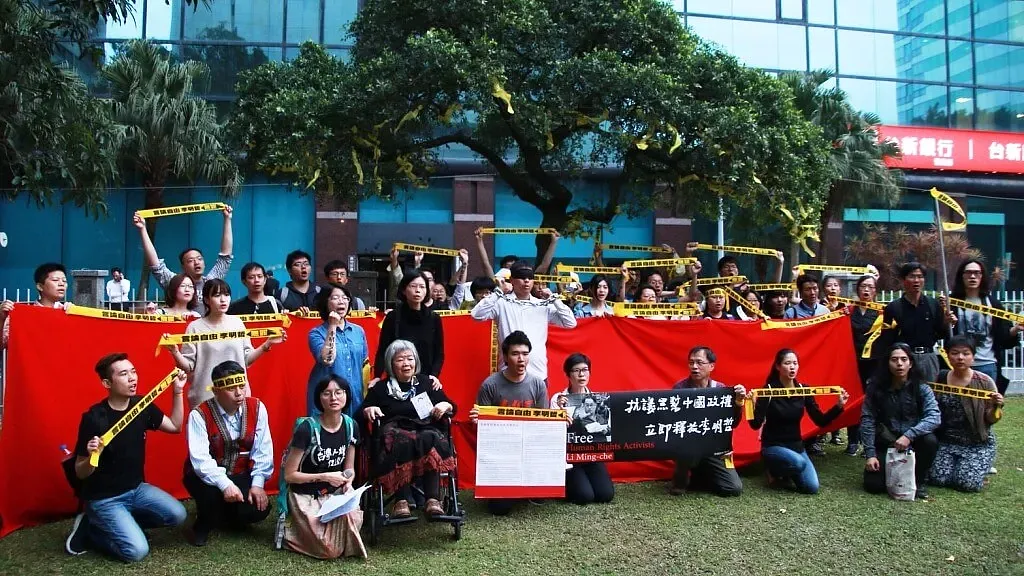
One-Year Anniversary of Li Ming-che's Arrest: Rescue Team Ties Yellow Ribbons in Front of Presidential Office
Last edited: 2026-07-27
Today, March 19, marks the one-year anniversary of Li Ming-che's (李明哲) arrest. The Li Ming-che Rescue Team gathered in front of the Presidential Office, demanding that the President continue to follow the case, cooperate with the international community to pressure China, and establish effective relief channels for future individual cases.
Following Li Ming-che's disappearance on March 19 of last year, international networking by civil society organizations sparked widespread international concern. Subsequent actions—including the acceptance of an appeal submitted to the United Nations, a report delivered to the U.S. Congress, and visits to the European Parliament—once again highlighted the stark differences in rule of law and human rights values upheld by Taiwan and China.
The Li Ming-che Rescue Team gathered in front of the Presidential Office, displaying a long red banner encasing a figure with a black blindfold over their eyes and handcuffs on their wrists. This symbolized Li Ming-che's detention by China, where his freedom is restricted and he is unable to communicate with the outside world, while also symbolizing how Taiwan's overall democracy and human rights are likewise infringed upon and impacted.
The press conference was hosted by Taiwan Association for Human Rights (TAHR) Secretary-General Ch'iu I-ling (邱伊翎), with remarks delivered by representatives including Wenshan Community College President Cheng Hsiu-chüan (鄭秀娟), Economic Democracy Union attorney Lai Chung-chiang (賴中強), Amnesty International Taiwan Chairperson Lin Shu-ya (林淑雅), Taiwan Professors Association President Lin Hsiu-hsing (林秀幸), Taiwan Forever Association Deputy Secretary-General Hung Chung-yen (洪崇晏), Judicial Reform Foundation Board Director Ch'en Yao-hua (陳瑤華), and Covenants Watch Executive Committee Member Hsu Wei-kuang (徐偉群). Finally, participants collectively tied yellow ribbons in front of the Presidential Office.
Ch'iu I-ling of the Taiwan Association for Human Rights stated that China had just amended its constitution to abolish term limits for the state presidency, and on March 17, Xi Jinping was re-elected as state president at the National People's Congress, further entrenching China's one-party dictatorship. Meanwhile, the Taiwan High Court upheld an acquittal in the second instance for the March 18 Sunflower Student Movement from four years ago, demonstrating the concrete gap in democracy and the rule of law between the two countries. However, regarding the Li Ming-che case, the Taiwanese government's low-profile approach and its tolerance of negotiations between family members and unauthorized third parties delegated by entities other than our government revealed a governance crisis.
Lin Hsiu-hsing, President of the Taiwan Professors Association, stated that when Taiwanese people strive for transitional justice, everything seems to be a reflection on past unjust regimes. When we do this, it is as if such anti-democratic human rights violations belong to the last century, and we are standing on a solid rock of democracy, looking back at the past. However, the Li Ming-che case shatters this illusion; it is not history, it is the present continuous tense. Taiwan's "transitional justice," aside from holding authoritarian regimes accountable for human rights abuses, has a difficult-to-handle gap, and this gap is also the Achilles' heel of Taiwan's situation. That is: was the government of the past that engaged in large-scale persecution of the people a government of China, or of Taiwan? Although there is no shortage of local collaborators in the joint persecution, is Taiwan a country after all, and is the government governing Taiwan truly the Taiwanese government? A "latent empire" is using various methods to exercise its unique imperialist view over the entire world. Taiwan is the softest and most accessible morsel in its eyes. What is the meaning of pursuing transitional justice in Taiwan? Beyond pursuing injustices, must we not also question the "governing authority of democracy" and the importance of the "sovereignty" of a democratic nation?
Ch'en Yao-hua, Board Director of the Judicial Reform Foundation, stated that Li Ming-che's arrest, enforced disappearance, prosecution, and five-year prison sentence by the Chinese government in 2017 showed little fundamental difference from the July 9 crackdown of 2015, which targeted over 300 human rights lawyers and rights defenders. Therefore, to understand what kind of treatment he was subjected to after his arrest that led him to rapidly confess in a September 2017 court trial to involvement in "subversion of state power," one only needs to read the testimonies of the human rights lawyers from the 709 crackdown to deeply understand why a defendant would publicly read out their own charges in court. Furthermore, some Taiwanese people traveling or lecturing in China have published statements before departure promising not to commit suicide or engage in certain activities. Such illegal arrest procedures already involve enforced disappearances, torture, and a major international human rights crime since World War II: crimes against humanity. When Taiwan began the work of uncovering the truth through transitional justice, it could not help but be astonished that the terrifying system of the past party-state apparatus could spread into present-day China and Hong Kong. However, this paradoxically highlights the urgency of Taiwan's pursuit of transitional justice. Taiwan must shoulder the responsibility of assisting China and certain Asian countries in democratization. Although it appears superficially to be helping others, if progress can be made, this will truly be the opportunity for enduring peace in Asia.
Hung Chung-yen, Deputy Executive Director of the Taiwan Forever Association, stated that China's current leadership group is continuously expanding its power across political, economic, media, and other fields through various means. This is an obviously malicious authoritarian government that even extends its dirty hands into other countries and infringes upon the rights of other nations' citizens. As one of the most severely affected victims, Taiwan must do everything in its power to resist it. Such resistance cannot be merely a twenty-some-day occupation movement, nor can it be mutual destruction through weapons. The method capable of truly resisting this thin-skinned authoritarian government of China has already been revealed to us by China itself: everything that Li Ming-che has done—free speech, advocating democracy, resisting human rights violations, and organizing human rights defenders and democratic advocates. Why was Li Ming-che arrested by the Chinese government? Because the Chinese government is afraid; it fears that Li Ming-che will shake its authoritarian rule. Although Li Ming-che is temporarily unable to continue his work, what we hope to do for him is to tell the Chinese government: you arrested one Li Ming-che, but there are thousands more like him. Freedom of speech, democracy, and human rights are already the air Taiwanese breathe and the water we drink. For all of China's threats and inducements against us, as long as the price is freedom, democracy, and human rights, it will ultimately only invite greater and fiercer resistance from us.
Hsu Wei-kuang, Executive Committee Member of Covenants Watch, also stated that we must remind the Taiwanese government that when facing China's human rights violations against our own citizens, we must never embrace defeatism, nor simply tell the people to be careful when speaking about China and to rely on their own good fortune. We must never merely talk about "democratic and human rights values" in speeches while perfunctorily going through the motions in practice, continuing to scheme for comfort, votes, and short-term gains. The Tsai Ing-wen administration must solidly recognize that only by connecting Taiwan with the global network of democratic and human rights values can national security be truly consolidated.
Following the press conference, the Rescue Team began a march with large red banners passing through Taipei Main Station and Zhongshan MRT Station, holding short speeches along the route and distributing postcards to invite the public to write letters to Chishan Prison to express their concern.
Finally, at the destination of the march—the Tsai Jui-yueh Dance Research Institute—dancers, accompanied by murmuring cello music and Li Ching-yü's (李凈瑜) voice, performed imagery depicting China's continuous intimidation of its people, Ming-che's personal freedom being controlled, and Li Ching-yü raising her tattooed hands in resistance. At the end of the dance, all attendees present were invited to apply stickers to their arms reading "Freedom of Speech: Li Ming-che is Innocent," joining the action to resist China's red authoritarianism.
Following the dance, exiled Chinese human rights lawyer Teng Piao (滕彪) and *In the Name of Confucius* documentary director Li Hui-jen (李惠仁) engaged in a dialogue regarding the Li Ming-che case and the limitless expansion of China's human rights violations. The public was also invited on-site to join in tying yellow ribbons and writing letters.
Letter from the Li Ming-che Rescue Team to President Tsai
Respected President Tsai Ing-wen:
One full year has passed since our nation's social movement worker Mr. Li Ming-che was arrested by the government of the People's Republic of China. We are angered by the Chinese government's abuse of the judiciary to infringe upon freedom of speech, deeply concerned for Mr. Li Ming-che's safety and well-being, and hopeful that the government will redouble its efforts to safeguard the fundamental rights of our citizens.
As you know, Mr. Li Ming-che not only participated in Taiwan's social movements for a long time, but also spared no effort as an individual in supporting China's human rights movement via the internet. However, his exercise of freedom of speech within Taiwan unexpectedly made him a national security threat in the eyes of the Chinese government. Consequently, on March 19 of last year, when he passed through Chinese customs with valid documents, he was detained by Chinese national security authorities and his whereabouts remained unknown for months. Through the diligent efforts of his family and Taiwanese human rights organizations, the Li case ultimately garnered widespread attention from United Nations human rights bodies and international human rights organizations. Nonetheless, following a grossly unfair trial, the Chinese government sentenced Mr. Li Ming-che to five years in prison on November 28 of last year under the charge of "subversion of state power," alongside a two-year deprivation of political rights. Currently, Mr. Li Ming-che has been transferred to Chishan Prison in Hunan Province, China, to serve his sentence.
We maintain that Mr. Li Ming-che's actions constituted purely the exercise of freedom of speech and should not be treated as a crime. The Chinese government's investigation and trial process for this case failed to meet domestic Chinese legal standards or international human rights standards, both in substance and in procedure. Therefore, Li Ming-che is innocent, and we will continue to pressure the Chinese government to demand the immediate and unconditional release of Mr. Li Ming-che.
Until Mr. Li Ming-che regains his freedom, we are deeply concerned about his treatment in Chinese prisons. In recent years, multiple cases have occurred in China where prisoners of conscience suffered torture, abuse, and the forced administration of unknown drugs during detention, resulting in severe physical and psychological trauma or even suspected loss of life. Under Chinese law, inmates have the right to correspond with family members and receive family visits at least once a month. However, several months since Mr. Li began serving his sentence, his family has not been permitted correspondence or entry to visit him, leaving them unable to understand Mr. Li's treatment in prison or his health condition. Consequently, we cannot help but feel grave concern regarding Mr. Li Ming-che's situation. We believe the Chinese government has an obligation to abide by domestic and international legal guarantees regarding the basic treatment of prisoners, and must promptly permit family correspondence and visits.
Over the past year, numerous Taiwanese civil organizations and individuals have formed the Li Ming-che Rescue Team, working hard to support Mr. Li's family in conducting rescue efforts through various channels. Relevant government departments have also maintained attention and occasionally provided assistance. However, protecting the rights of citizens is a fundamental obligation of the state, and the repeated arbitrary arrest and detention of our citizens by a foreign power is an issue that directly concerns national security. We believe the government should adopt a much more proactive and positive stance, seriously engaging with China on the sovereignty and human rights issues involved in the Li case, lobbying the international community through all diplomatic and civil society channels to maintain pressure, and establishing relief procedures and response mechanisms for similar cases in the future.
In recent years, through channels such as acquiring media outlets or releasing fake news, China has continuously exported "sharp power" outwardly, attempting to manipulate public opinion globally regarding China through financial inducements or threats of closing markets. Just as China also attempts to compel Taiwanese people to self-censor—fearing to criticize China—through the enticements of the "31 preferential policies for Taiwan" and the export of fear demonstrated by the Li Ming-che case. These threats to the democracy and human rights of people worldwide stem from the Chinese leadership's fear of losing power. Yet we must emphasize: freedom of speech is the best preservative for a government, and only a thin-skinned dictator wishes to eradicate it swiftly.
Faced with continuous oppression by China, as Taiwan's head of state, we expect you to continue and timely express adequate concern regarding Mr. Li Ming-che's predicament. We also ask that you instruct the Mainland Affairs Council, the Ministry of Foreign Affairs, the Ministry of Justice, and other related ministries and institutions to assist the family and the civil rescue team with all their might in rescue efforts, so that Mr. Li Ming-che may return home safely at an early date and continue his human rights vocation. We further call upon the government to squarely face China's malicious acts of using threats and enticements to export fear, and through the deepening of democratic systems and actions, allow the Taiwanese people to witness the values of human rights and democracy, as well as to see and resist the absurdity of authoritarian regimes.
Thank you for your attention, and we hope for an opportunity to further exchange views with you regarding the rescue efforts for Mr. Li Ming-che.
CC: Premier of the Executive Yuan, President of the Legislative Yuan, President of the Control Yuan, Minister of the Mainland Affairs Council, Minister of Foreign Affairs, Minister of Justice
Li Ming-che Rescue Team
Covenants Watch
Wenshan Community College
Citizens' Constitutional Promotion Alliance
Taiwan Association for Human Rights
Taiwan Professors Association
Taiwan Labour Front
Judicial Reform Foundation
Taiwan Forever Association
Good People Movement Association
Taiwan Tibet Human Rights Network
National Association for the Promotion of Community Universities
Green Citizens' Action Alliance / New Frontier Foundation
Congress Watch
Cheng Nan-jung Foundation
Dr. Chen Wen-chen Memorial Foundation
Tsai Jui-yueh Cultural Foundation
China Democracy College
Taiwan Association for the Abolition of the Death Penalty
Press Contact
Taiwan Association for Human Rights Ch'iu I-ling
This article is an AI-generated translation of the original Chinese text. In the event of any discrepancy, the Chinese version shall prevail.