
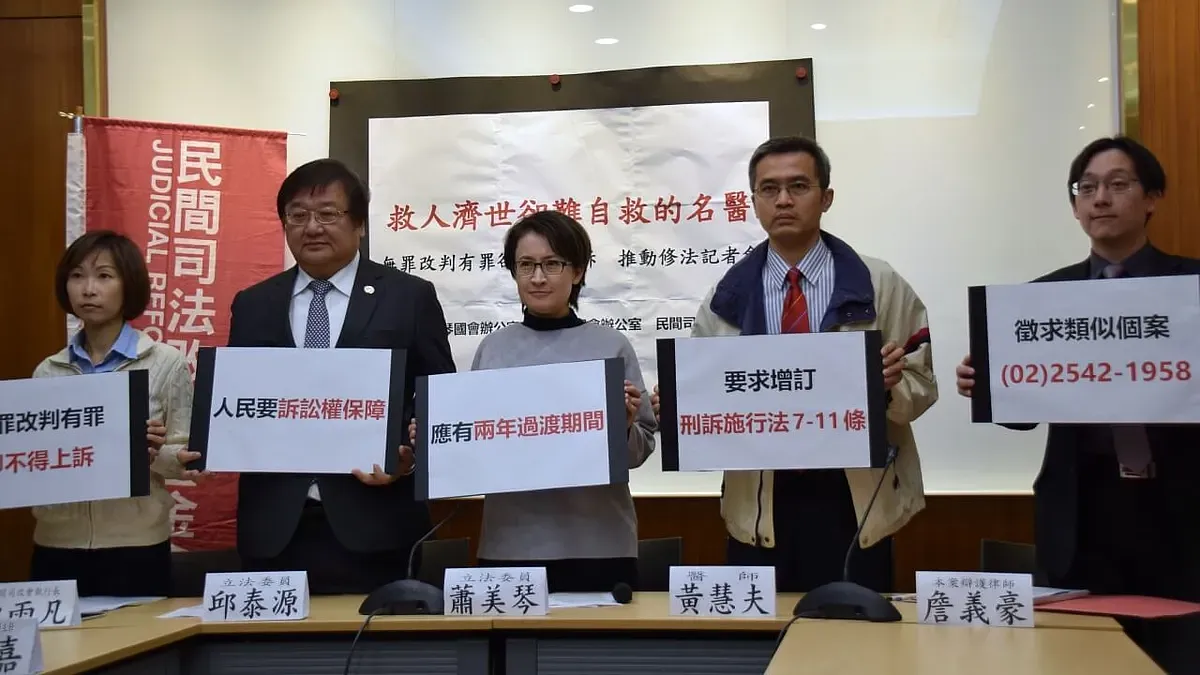
Renowned Physician Who Saved Lives But Cannot Save Himself: Press Conference on Promoting Legal Amendments for 'Acquittals Overturned to Convictions Without the Right to Appeal'
Last edited: 2026-11-03
Dr. Huang Hui-fu, a renowned attending physician at National Taiwan University Hospital who performed surgery on 20 emergency patients from the Formosa Fun Coast dust explosion, performed a right leg fasciotomy on a patient in 2008. Five days after the surgery, the patient transferred to another hospital on their own accord, after which their right leg developed a knee dislocation causing popliteal artery compression, forcing an amputation. The prosecutor indicted Dr. Huang Hui-fu for the offense of professional negligence causing grievous bodily harm. The court of first instance found Dr. Huang Hui-fu not guilty, determining he was free of negligence, but the court of second instance found him negligent and overturned the ruling to convict him.
Constrained by the provisions of Article 376 of the Code of Criminal Procedure at the time, minor offenses carrying a maximum principal sentence of imprisonment for three years or less could not be appealed to the third-instance court, and thus the judgment became final. Although the Grand Justices subsequently issued Interpretation No. 752, declaring that restricting appeals to the third-instance court in cases where the first instance is an acquittal and the second instance is a conviction is unconstitutional and should immediately cease to apply, and while the Legislative Yuan amended the law accordingly, only cases finalized after the amendment could be appealed to the third instance. Cases like Dr. Huang Hui-fu's, which became final before the amendment, still could not obtain relief.

Dr. Huang Hui-fu, Legislator Hsiao Bi-khim, Legislator Chiu Tai-yuan, and the Judicial Reform Foundation jointly held a press conference at the Legislative Yuan today (March 22), demanding the addition of Article 7-11 of the Enforcement Act of the Code of Criminal Procedure to establish a two-year "transitional period." This would allow past cases where the first instance was an acquittal and the second instance a conviction to have an opportunity to seek relief again within two years. They also publicly solicited similar cases, hoping to gather momentum through numerous cases to promote legislative amendments and allow past victimized citizens to petition the Supreme Court for a retrial.
NTU Hospital attending physician Dr. Huang Hui-fu stated that the second-instance court, without any new evidence or new expert evaluation reports and after holding only two court sessions, overturned the acquittal to convict him. Following the second-instance judgment, he had no further opportunity to appeal, and his right to litigation was completely stripped away. Dr. Huang stated that an unfair trial has saddled him with an undeserved criminal record; his qualifications for hospital promotions and advanced studies applications have faced heavy obstacles, and his ongoing research on burns and limb reconstruction has been shelved. The unfair judgment destroyed his future, and he hopes to use his own case to promote legislation, giving cases previously unable to be appealed due to a bad law the opportunity to be retried. He asks the judiciary to restore a fair trial opportunity to people like him.
Legislator Hsiao Bi-khim stated that the former provision of Article 376, Paragraph 1 of the Code of Criminal Procedure stipulated that "specific cases, once finalized in the second instance, may not be appealed further to the third-instance court." Last year, this bad law was declared unconstitutional by the Grand Justices, and following the legislative amendment at the end of last year, cases where the first instance resulted in an acquittal but the second instance overturned it to a conviction can henceforth be appealed to the third instance for relief. However, cases like Dr. Huang Hui-fu's—where an acquittal was overturned to a conviction—have never had the opportunity to appeal since. Legislator Hsiao stated that besides Dr. Huang's case, citizens may have petitioned her regarding similar situations in the past, which led her to propose the addition of Article 7-11 of the Enforcement Act of the Code of Criminal Procedure to establish a two-year "transitional period." This allows past first-instance acquittal and second-instance conviction cases to have an opportunity to seek relief again within two years, and she hopes this press conference will transmit the message of legal reform to gather more cases and gain the support of cross-party legislators.
Legislator Chiu Tai-yuan stated that in the past, countless doctors, like Dr. Huang Hui-fu, received acquittals in the first instance only to have them overturned to final convictions in the second instance. Confronting unreasonable criminal liability determinations while constrained by flawed procedural regulations, doctors have had grievances they could not voice and injustices they could not redress, ultimately leading to the proliferation of defensive medicine and the flight of talent from high-risk medical departments. As a doctor himself, seeing this is supremely distressing and heartbreaking. Legislator Chiu stated that doctors in clinical settings must consider all conditions to make professional judgments, and should not merely follow medical norms by rote. His proposed amendment to Article 82 of the Medical Care Act was passed in its third reading at the end of last year, requiring courts to respect doctors' clinical professional judgment and prohibiting the sole determination of doctor negligence merely because "medical norms were violated." Substantive law has been amended, and procedural law should catch up accordingly. He hopes that through the addition of Article 7-11 of the Enforcement Act of the Code of Criminal Procedure, similar cases will be given a "retrial" opportunity. Dr. Huang Hui-fu's case can serve as a benchmark case for Taiwan's judicial and medical reforms, and he hopes it will help doctors with similar experiences rediscover their passion and courage for practicing medicine, allowing them to save lives with peace of mind and without worry.
 Photo / Dr. Huang Hui-fu and Attorney Chan I-hao
Attorney Chan I-hao, retained counsel for this case, stated that the case involves many medical professional matters. The second-instance court lacked medical expertise, resulting in a misjudgment. Only by granting an opportunity to appeal and allowing the third-instance court to re-examine the case is a reversal possible. The Grand Justices rendered Interpretation No. 752 last year, declaring the bad law unconstitutional, an interpretation that briefly reignited hope for Dr. Huang Hui-fu. However, regretfully, although the Legislative Yuan amended the law after the interpretation was rendered—allowing first-instance acquittals overturned to convictions in the second instance to be appealed to the third instance—it was limited to future cases and cases not yet finalized. Past cases had no transitional provisions whatsoever, leaving him still unable to assist Dr. Huang Hui-fu in filing an appeal. Attorney Chan stated that the former Code of Criminal Procedure restricted the right to appeal because the Supreme Court argued that the case load was too excessive, thus legislatively restricting specific minor offenses from being appealed to the third instance. The problem is that if guilty judgments are finalized without a third-instance court examining whether the second-instance guilty verdict contained "misjudgments," the protection of the defendant's rights is manifestly inadequate. Furthermore, for guilty verdicts, there should be at least one opportunity for relief to allow the court to re-examine the case and prevent erroneous miscarriages of justice.
JRF Executive Director and Attorney Ch'en Yü-fan then stated that during the Legislative Yuan's legal amendments last year, the Judicial Yuan shut citizens out on the grounds that past cases of acquittals overturned to convictions were too numerous and the Supreme Court might not be able to handle the load. According to judicial statistics, there are about 300-odd cases per year of acquittals overturned to convictions, and not all citizens intend to dispute them through further appeals once finalized. In addition, supporting measures such as mandatory legal representation could be designed to cope with the workload, and the Supreme Court should have the capacity to handle them. Every single case impacts a person's life, and hoping for a chance to wash away a wrongful accusation is actually the most humble request. Ch'en Yü-fan called upon the Legislative Yuan to enact Article 7-11 of the Enforcement Act of the Code of Criminal Procedure, granting parties whose acquittals were overturned to final convictions the opportunity to initiate trial proceedings within two years, provided they meet specific conditions.
JRF Legal Department Director and Attorney Huang Ying-chia lastly emphasized that to the court, these cases—which were acquittals overturned to convictions under the old law and could not be appealed—might simply be "minor offenses." However, what has been seen and heard among the public are the blood, tears, and agony of citizens whose right to appeal was stripped away. These cases might not carry heavy criminal sentences, but every single case represents a "person" and a "family." In the event of a misjudgment, the impact falls upon this person's reputation, employment, and even a lifetime. Attorney Huang stated that the judiciary should exist for the people, and citizens' right to litigation is explicitly guaranteed by the Constitution. Even for minor offenses, it should not be arbitrarily sacrificed by the government on the grounds of caseload burdens. She called for immediate legal amendments to give cases where acquittals were overturned to convictions an opportunity for retrial.
Following last year's legal amendments, many citizens whose right to appeal was stripped away have successively protested against the judicial system for ignoring their rights, bitterly recounting the blood, tears, and agony of being wrongfully accused. Huang Hui-fu is one of them. However, Huang Hui-fu has chosen not to remain silent. He stepped forward hoping to draw society's attention through this press conference, publicly soliciting individual cases so that similarly victimized people can stand up and speak out together, and—through another legislative amendment establishing a two-year transitional period—restore the people's right to have guilty verdicts re-examined.
Attachments
- Chronology of the Huang Hui-fu Case
- Comparison Table for the Addition of Article 7-11 of the Enforcement Act of the Code of Criminal Procedure
| Time | Event |
| August 7, 2008 | Dr. Huang Hui-fu performed a right leg fasciotomy on a patient injured in a traffic accident suffering from "simple compartment syndrome." Five days post-surgery, the patient transferred hospitals on their own accord, only to discover that their right lower leg had undergone necrosis due to vascular occlusion and was forced to be amputated. The patient's family filed a criminal complaint against Dr. Huang. |
| First-Instance Judgment on January 27, 2014 | The first-instance judge considered that X-ray examinations showed no dislocation, and there was no evidence proving that the patient's right knee dislocation and displacement compressing the popliteal artery existed at the time of transfer; according to nursing records, the patient's blood circulation showed no abnormalities during hospitalization. Dr. Huang's failure to perform an angiogram did not constitute negligence, and the medical team indeed cared for and observed the patient's blood circulation status post-surgery. Therefore, it was determined that Dr. Huang had no medical malpractice and was acquitted. |
| Second-Instance Final Judgment on October 7, 2014 | Although expert opinions deemed Dr. Huang's diagnosis and surgery free of negligence, the second-instance judge engaged in personal speculation, asserting that because the patient underwent amputation due to tissue necrosis, it could be deduced that dislocation and popliteal artery compression symptoms had already occurred prior to the hospital transfer. Furthermore, the judge held that Dr. Huang visited the patient's room only the day after surgery and failed to record the patient's blood circulation status in the medical records, violating medical norms. Consequently, the court overturned the ruling to convict him of the offense of professional negligence causing grievous bodily harm, sentencing him to four months of imprisonment. |
| July 28, 2017 | The Grand Justices rendered Judicial Yuan Interpretation No. 752, declaring that Article 376 of the Code of Criminal Procedure is unconstitutional in prohibiting appeals to the third instance for cases where the first instance resulted in an acquittal but the second instance overturned it to a conviction. |
| November 7, 2017 | The Legislative Yuan amended Article 376 of the Code of Criminal Procedure, but the new law took effect from the date of promulgation without establishing a transitional period. |
| Amended Article | Explanation |
|
Article 7-11 Where a judgment of acquittal, dismissal of prosecution, non-受理 judgment, or jurisdictional error rendered by a first-instance court was revoked by a second-instance court which instead pronounced a judgment of conviction prior to the enforcement of the amended Article 376 of the Code of Criminal Procedure passed on November 7, 2017, the defendant or a person entitled to appeal for the benefit of the defendant who meets the circumstances of Articles 377 to 380 of the Code of Criminal Procedure may, within two years from the date of enforcement of this Article, petition the Supreme Court for a retrial. The provisions of Articles 423, 427, 429, 430, 431, 432, 433, 434, 435, 436, 439, and 440 of the Code of Criminal Procedure shall apply mutatis mutandis to the retrial proceedings. In the retrial proceedings of Paragraph 1, the petitioner shall retain an attorney as their agent. |
|
Attending Representatives
Huang Hui-fu / Physician
Hsiao Bi-khim / Legislator
Chiu Tai-yuan / Legislator
Chan I-hao / Defense Attorney for this Case
Ch'en Yü-fan / Executive Director, Judicial Reform Foundation
Huang Ying-chia / Legal Department Director, Judicial Reform Foundation
Press Contact
Attorney Ch'en Yü-fan, Executive Director, Judicial Reform Foundation (02)2523-1178
This article is an AI-generated translation of the original Chinese text. In the event of any discrepancy, the Chinese version shall prevail.