
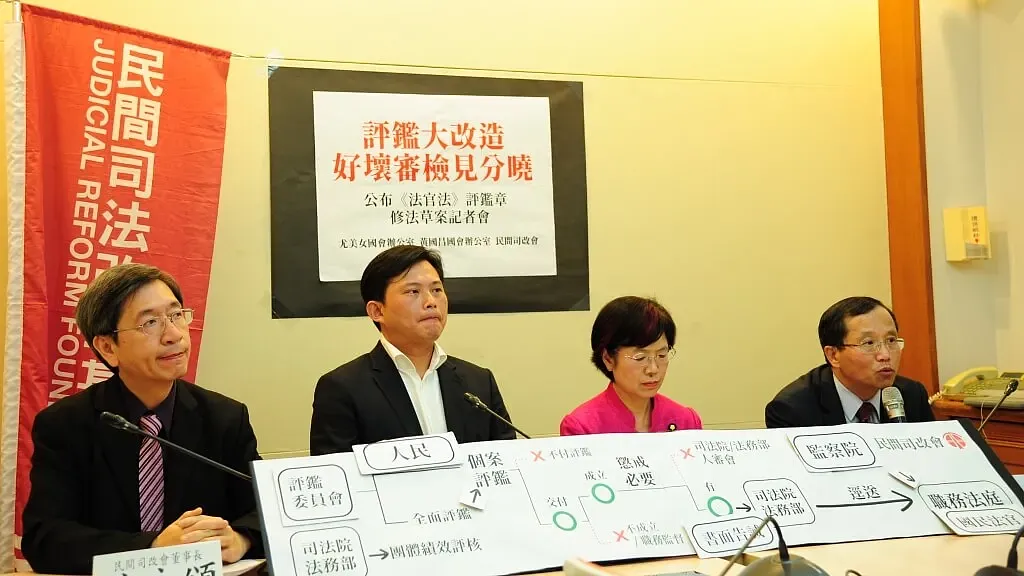
Overhauling the Evaluation System to Tell the Good from the Bad: Press Conference on the Release of the Draft Amendments to the Judges Act Evaluation Chapters
Last edited: 2026-07-27
The recent sexual harassment case involving a judge has once again severely undermined public trust in the judiciary. More than six years since its implementation in 2012, the Judges Act has reached a critical juncture for a comprehensive review and amendment. In accordance with the resolutions of the National Judicial Reform Conference, JRF has completed a draft amendment to the evaluation and other chapters of the Judges Act and held a press conference today (March 26) to release the contents of the draft. Legislators Yu Mei-yu and Huang Kuo-chang, who have long advocated for the Judges Act, were also invited to attend the press conference to jointly strengthen the evaluation mechanism and restore public trust in the judiciary.
Key highlights of the draft amendments are summarized below:
-
Evaluation Committee to Handle Both Individual and Comprehensive Evaluations
Under the current Judges Act, comprehensive reviews of judges and prosecutors are handled by the Judicial Yuan and the Ministry of Justice, with results kept confidential. If problematic conducts are found, they should be referred for individual evaluations. However, among the two comprehensive reviews conducted thus far, "not a single" judge or prosecutor has been referred for individual evaluation and investigation. Furthermore, because the results are not made public, the outside world has no way to examine them; thus, comprehensive reviews lack any discriminatory power and exist in name only.
The draft amendment stipulates that comprehensive evaluations shall be conducted by the "Evaluation Committee," and the results shall be made public. Those found problematic shall be directly subjected to individual evaluations by the Evaluation Committee. The Evaluation Committee may also proactively initiate individual evaluations to truly fulfill the function of supervising judges and prosecutors.
-
Direct Request for Evaluation by Citizens
Under the current Judges Act, citizens cannot directly request an evaluation; requests can only be filed by courts, prosecutors' offices, or civil organizations. However, according to statistics from the Judicial Yuan, it accepted 7,277 citizen petitions in 2016 and 6,489 in 2017. Yet, in 2016, requests were made to evaluate only 2 judges, and 0 in 2017. The Ministry of Justice did not even publish the number of petitions, but in 2016, a request was made to evaluate only 1 prosecutor, and 0 in 2017. The number of resolutions made by the 3rd Judges and Prosecutors Evaluation Committees hit an all-time low since the implementation of the individual evaluation system. Over the past 6 years, only one judge has been dismissed from office and transferred to a non-judicial position, and only one prosecutor has been dismissed and disqualified from holding public office. Public grievances regarding the judiciary have been severely silenced. Therefore, the draft is amended to allow case parties to directly request evaluations.
-
Non-Legal Background Majority in the Evaluation Committee and Dedicated Personnel to Handle Evaluation Affairs
The ineffectiveness of evaluations, as evident from the preceding statistics, is partly due to inappropriate standards set by the Evaluation Committee. Taking cases handled by JRF as an example, a prosecutor surnamed Ch'en opined that because the victim did not bite off the assailant's penis, it was consensual rather than forced oral sex—a textbook example of the "ideal victim myth." The Prosecutors Evaluation Committee even deduced on its own that the defendant "must have felt secure enough to place his genitals in the victim's mouth without fear of being injured by sharp teeth" because he trusted the victim, demonstrating a severe lack of gender awareness.
The draft is amended to establish a selection committee to ensure that impartial members of society without a legal background constitute a majority on the Evaluation Committee, and to establish a gender ratio where members of either gender shall not be less than one-third. This avoids legal chauvinism and allows for diverse perspectives. Additionally, full-time evaluation commissioners and dedicated personnel will be appointed to handle evaluation affairs, establishing a case-filtering mechanism to prevent frivolous requests.
-
Extension of the Evaluation Statute of Limitations and Participation in Investigation Procedures
According to the current Judges Act, the statute of limitations for prosecutor evaluations is two years. Citizens are often exhausted by trials and lack the time to report unfitness in prosecutors; by the time trial proceedings conclude, the statute of limitations has often expired, making it impossible to request an evaluation. This overly short limitation period is the primary reason for the low volume of prosecutor evaluation cases. The draft amends the statute of limitations for prosecutor evaluations to three years from the date the judgment becomes final.
In addition, the current Evaluation Committee repeatedly ignores the feelings of parties, relying solely on courtroom recordings and transcripts to judge courtroom demeanor, without inquiring into the parties' actual experiences and feelings in court. It fails to empathize with the improper treatment people encounter in the judicial system from the perspective of the parties. The draft strengthens the parties' right to participate in evaluation procedures. Except for justified reasons, the Evaluation Committee shall investigate facts and evidence requested by the parties and grant them the right to express opinions and inspect documents during the proceedings, allowing the Committee to more comprehensively listen to public dissatisfaction with the judiciary.
-
Evaluation Committee Directly Refer Cases to the Disciplinary Court to Avoid Redundancy
Under the current system, when the Evaluation Committee deems disciplinary action necessary, it must first refer the case to the Control Yuan for review and cannot directly submit it to the Disciplinary Court for trial. However, the Control Yuan and the Evaluation Committee exercise their respective powers independently and are not subordinate to each other. The current process is redundant; therefore, the draft is amended so that when the Evaluation Committee deems disciplinary action necessary, it can directly refer the case to the Disciplinary Court without prior review by the Control Yuan.
-
Inclusion of Lay Judges in the Disciplinary Court and Addition of Disciplinary Types
The case of Judge Ch'en Hung-pin highlighted the importance of external perspectives in judicial reform. If the Evaluation Committee and the Disciplinary Court fail to abandon departmentalism and attempt to think from different angles, more judgments lacking gender awareness may occur, or unfit judges and prosecutors may be treated with undue leniency. Therefore, the draft introduces the lay judge system into the Disciplinary Court, enabling the Court to more comprehensively exercise its supervisory function. Furthermore, in addition to dismissal, removal from office, removal from judicial duties with transfer to other positions, fines, and reprimands, the disciplinary types now include suspension with mandatory education or "other dispositions," diversifying punishments to be applied timely and achieving disciplinary effects.
-
Mutatis Mutandis Application of the Prosecutor Evaluation System
In the absence of dedicated legislation for prosecutors at present, the prosecutor evaluation system must mutatis mutandis apply the provisions governing judges. Therefore, except for special provisions regarding the statute of limitations, the draft applies the aforementioned amendment directions mutatis mutandis to the prosecutor evaluation system.
The evaluation system for judges and prosecutors is a touchstone for whether the judicial system can confront its errors, correct them, subsequently weed out unfit judges and prosecutors, and set an example of a fair judiciary for all citizens. We hope that through this amendment to the evaluation chapters of the Judges Act, an evaluation mechanism capable of rewarding the competent and eliminating the incompetent can be established to reverse the negative image of the judiciary and respond to the public's urgent expectations for judicial reform.
Attachments
| Key Amendment Focus | Current Issues | Amendment Content |
| 1. Evaluation Committee to Handle Individual and Comprehensive Evaluations |
|
|
| 2. Direct Request for Evaluation by Citizens |
|
|
| 3. Non-Legal Background Majority in the Evaluation Committee and Dedicated Personnel to Handle Evaluation Affairs |
|
|
| 4. Extension of the Evaluation Statute of Limitations and Participation in Investigation Procedures |
|
|
| 5. Evaluation Committee Directly Refer Cases to the Disciplinary Court to Avoid Redundancy |
|
|
| 6. Inclusion of Lay Judges in the Disciplinary Court and Addition of Disciplinary Types |
|
|
Attendees
Yu Mei-yu / Legislator
Huang Kuo-chang / Legislator
Lin Yung-sung / Chairperson, Judicial Reform Foundation
Huang Hsu-t'ien / Convenor, Judges Act Amendment Committee, Judicial Reform Foundation
Ch'en Yü-fan / CEO, Judicial Reform Foundation
Press Contact
Judicial Reform Foundation / CEO Ch'en Yü-fan
This article is an AI-generated translation of the original Chinese text. In the event of any discrepancy, the Chinese version shall prevail.