
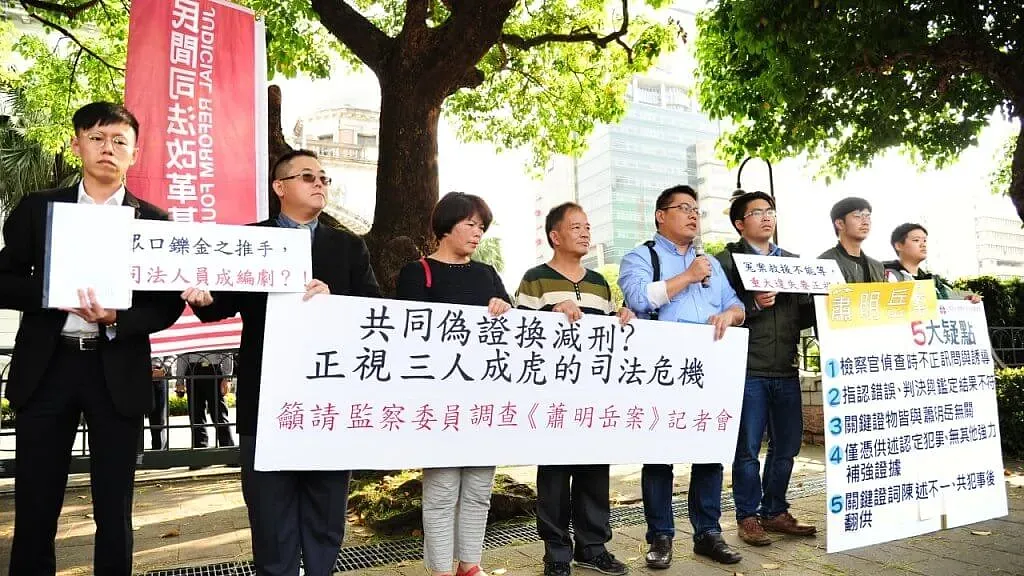
False Testimony in Exchange for Reduced Sentences? Confronting the Judicial Crisis of "Three Men Make a Tiger"—Press Conference Urging Control Yuan Members to Investigate the Hsiao Ming-yueh Case
Last edited: 2026-07-27
 Photo / Defendant Hsiao's Father and Mother
Wrongful conviction defendant Hsiao Ming-yueh was framed and falsely determined by the court to have played a leading role in an international drug-trafficking syndicate, resulting in a finalized life imprisonment sentence. Today (March 26), Hsiao's elderly parents went to the Control Yuan to petition the Control Members in order to clear their son's name, hoping the Control Members will investigate this case, hold the personnel responsible for professional negligence accountable, reopen the trial, and restore their son's innocence.
The pro bono legal team has analyzed the flaws in the trial of this case as follows:
-
The prosecutor engaged in improper interrogation and induced confessions
The interrogation video recording from June 8, 2011, shows that before recording officially began, the prosecutor repeatedly told drug syndicate member Kuo Chê-wei, "Regarding Article 17 of the Narcotics Hazard Prevention Act, if you confess the source, you can get a sentence reduction." "You were always together with Hsiao Ming-yueh, you should know best. Right!" "Well, think it over carefully, alright?" "I'm telling you, Liang Chia-lin has already confessed, and whatever you say about Liang Chia-lin is useless now. Do you understand what I mean?" This strongly implied that identifying Hsiao Ming-yueh as the mastermind would present an opportunity to obtain a sentence reduction.
-
Key testimonies were inconsistent; accomplices retracted their statements afterwards
- Drug syndicate member Sung Yün-hua stated during the prosecutor's interrogation that she had previously made reckless accusations falsely claiming Hsiao Ming-yueh was the mastermind of the drug-trafficking syndicate merely in order to seek a sentence reduction for herself.
- Drug syndicate member Sung Yün-hsiang confessed that after previously making false statements to frame Hsiao Ming-yueh and send him to prison, out of a guilty conscience, she mailed a letter from prison to Hsiao Ming-yueh's defense attorney Chiu Hsien-chih. In the letter, Sung Yün-hsiang repeatedly stated that Hsiao Ming-yueh did not participate in the crime, and that she had falsely pointed the finger at Hsiao Ming-yueh initially in order to get a sentence reduction.
- After Hsiao Ming-yueh was sentenced to life imprisonment in the first instance, drug syndicate member Kuo Chê-wei submitted a confession to the second-instance court detailing the ins and outs of how the drug syndicate members jointly framed Hsiao Ming-yueh. The confession stated: "Your Honor, actually Hsiao Ming-yueh did not participate in the smuggling at all. It was Liang Chia-lin... who told me to pin it on Hsiao Ming-yueh, and they told me that way I could get my sentence reduced (they also promised to let me get a sentence reduction, which is why I joined everyone in framing Hsiao Ming-yueh). Your Honor, I really had no choice; I was just running errands for Liang Chia-lin, but A-lin pushed all the blame onto me because he was caught first, causing me to be sentenced to life... I had no choice but to listen to them and frame A-yueh (Hsiao Ming-yueh) together to strive for a sentence reduction. I hope Your Honor can understand my situation and forgive my selfishness."
-
Erroneous identification; the judgment contradicted the appraisal results
- The judge determined that the drug syndicate members discussed how to destroy evidence at Hsiao Ming-yueh's "residence," but during the interrogation, the house identified by drug syndicate member Lü Chang-chun was by no means Hsiao Ming-yueh's residence. Furthermore, syndicate member Sung Yün-hsiang even testified during the prosecutor's interrogation that she "had never been to Hsiao Ming-yueh's residence." The judge unexpectedly convicted Hsiao Ming-yueh based on this erroneous identification.
- According to a report from the Investigation Bureau of the Ministry of Justice, there were no crime-related records whatsoever in Hsiao Ming-yueh's computer files.
-
Key physical evidence was entirely unrelated to Hsiao Ming-yueh
The physical evidence relied upon by the judge—including heroin, mobile phones, books on drug trafficking, fingerprint comparisons, voiceprint comparisons, remittance data, and seized computers—could only prove the criminal acts of the other drug syndicate members.
-
Conviction based solely on statements without other strong corroborating evidence
Grand Justices' Interpretation No. 582 states that "a defendant's confession cannot serve as the sole evidence for a guilty verdict; other necessary evidence must still be investigated." In this case, the judge convicted Hsiao Ming-yueh based solely on the statements of the drug syndicate members. The other physical evidence, including heroin, mobile phones, books on drug trafficking, fingerprint comparisons, voiceprint comparisons, remittance data, and seized computers, was used to prove the criminal acts of the other drug syndicate members, yet failed to prove Hsiao Ming-yueh's involvement. The court judgment violated the Grand Justices' Interpretation.
The prosecutor handling this case unlawfully obtained the syndicate members' statements, which, combined with the fact that the testimonies of other syndicate members did not match the actual truth, led ultimately through numerous doubts to an innocent young man suffering the severe penalty of life imprisonment. Hsiao Ming-yueh is already serving his 7th year in prison, and his lifelong prospects and family happiness have been ruined. We hope the Control Yuan understands the suffering of the wrongfully accused, intervenes in the investigation, and hopes to reopen the trial to restore Hsiao Ming-yueh's innocence!
 Photo / Hsiao's Father, Hsiao's Mother, and the Pro Bono Lawyers Petitioning the Duty Commissioner
Subsequent Relief Directions
-
Constitutional Interpretation
- Address whether paragraph 1 of Article 17 of the Narcotics Hazard Prevention Act—regarding confessing upstream sources—violates the presumption of innocence, and apply for a supplementary interpretation of Interpretation No. 582 to clarify the boundary between testimonial evidence and discretionary evaluation of free conviction.
- Address whether paragraph 1 of Article 4 of the Narcotics Hazard Prevention Act imposes a disproportionately heavy penalty that violates the principle of proportionality.
- Petition the Control Yuan, urging Control Members to intervene in the investigation to restore the truth, and ascertain the professional negligence to penalize the relevant negligent personnel.
- Intend to file an extraordinary appeal regarding the portions of the judgment that violate the law.
- Intend to apply for a retrial based on the retracted confessions, letters, and erroneous location identifications of co-defendants Kuo Chê-wei and Sung Yün-hsiang.
Chronology
| Date | Fact Occurred |
| November/December 2009 | The court determined that Sung Yün-hsiang flew to Cambodia to understand local international mail delivery conditions in order to test the safety of subsequently concealing and smuggling heroin into Taiwan. |
| 2009/12/05 | The court determined that Sung Yün-hsiang and Kuo Chê-wei mailed an international package from Cambodia to a convenience store in Taiwan for local pickup to test the safety of subsequently concealing and smuggling heroin into Taiwan. |
| July/August 2010 | The court determined that Sung Yün-hsiang portioned heroin into 9 parcels and mailed them back to Taiwan, with Liang Chia-lin instructing Sung Yün-hua to collect the parcels at the designated convenience store. Sung Yün-hua and Lü Chang-chun arrived at the aforementioned convenience store, collected the drug-concealing parcels, and brought the drug-concealing parcels back to a warehouse to carry out heroin pressing and packaging matters. |
| 2010/08/25 | The court determined that when Sung Yün-hua and Lü Chang-chun arrived at the convenience store intending to retrieve the parcels, they were caught on the spot by personnel of the Taichung Maritime Patrol Station lying in wait outside, who seized heroin and other evidence, while Lü Chang-chun seized an opportunity to escape. Lü Chang-chun used a public payphone to inform Hsiao Ming-yueh that Sung Yün-hua was in trouble, and Hsiao Ming-yueh told others to come to his residence to discuss matters of destroying physical evidence. |
| 2010/10/12 | Liang Chia-lin, Sung Yün-hsiang, and Lü Chang-chun were arrested and brought in. |
| 2010/12/13 | Kuo Chê-wei was arrested and brought in. |
| 2011/03/25 | First-instance judgment rendered in the separate trial of Liang Chia-lin and others. |
| 2011/05/03 | Hsiao Ming-yueh was arrested and brought in. |
| 2011/06/21 | Hsiao Ming-yueh was indicted by the prosecutor. |
| 2011/07/20 | Second-instance judgment rendered in the separate trial of Liang Chia-lin and others. |
| 2011/11/02 | The Supreme Court remanded the separate trial of Liang Chia-lin and others for retrial. |
| 2011/12/29 | First-instance judgment rendered in the Hsiao Ming-yueh case. |
| 2012/02/02 | First-remand judgment rendered in the separate trial of Liang Chia-lin and others. |
| 2012/05/03 | The Supreme Court remanded the separate trial of Liang Chia-lin and others for retrial. |
| 2012/09/12 | Second-remand judgment rendered in the separate trial of Liang Chia-lin and others. |
| 2012/09/27 | Second-instance judgment rendered in the Hsiao Ming-yueh case. |
| 2012/12/20 | Final-instance judgment rendered in the separate trial of Liang Chia-lin and others. |
| 2013/01/17 | Third-instance judgment rendered in the Hsiao Ming-yueh case. |
Attendees
Chiu Hsien-chih / Pro Bono Lawyer
Hsiao's Father, Hsiao's Mother / Defendants' Family Members
Huang Wei-ting / Director of the Taichung Office, Judicial Reform Foundation
This article is an AI-generated translation of the original Chinese text. In the event of any discrepancy, the Chinese version shall prevail.