
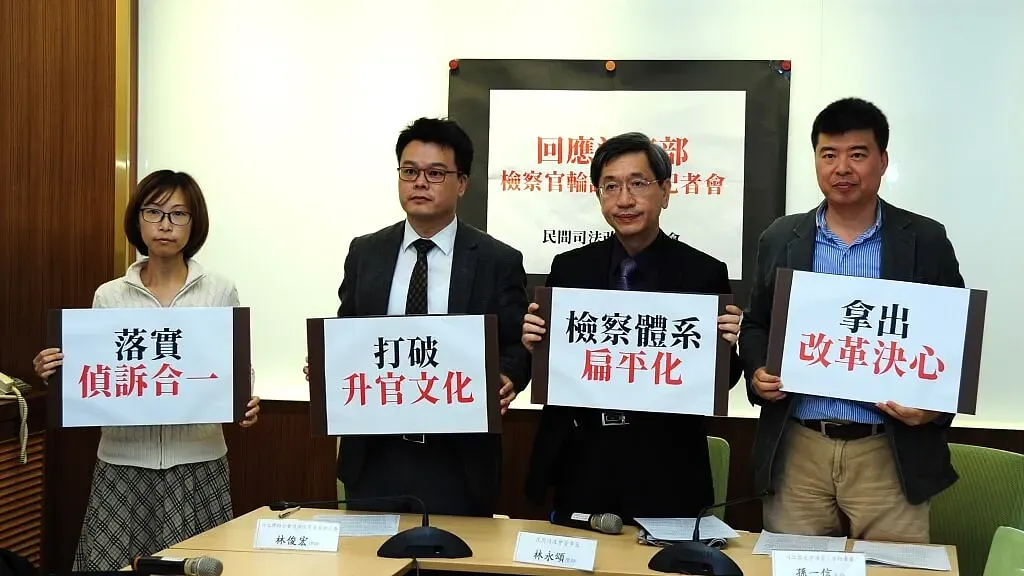
Press Conference in Response to the Ministry of Justice's "Prosecutorial Rotation System"
Last edited: 2026-07-27
Post-Meeting Press Release
Attorney Lin Yung-sung stated that judicial reform is divided into litigation systems and personnel systems. While reforming personnel systems is typically more difficult, it also reveals whether leadership possesses the determination to reform. However, from the newly announced "Directions for the Rotation System," it is evident that Minister of Justice Chiu Tai-san completely lacks the determination to reform. The plan announced by the Ministry of Justice divides second-instance prosecutors into new and incumbent ones, with incumbent second-instance prosecutors completely exempt from rotation, requiring only prosecutors promoted to the second instance after the announcement to participate in rotation. This is utterly unreasonable. If Minister Chiu does not amend the rotation plan within a month, it will represent a disregard for the opinions of grassroots prosecutors, a betrayal of promises, a dismissal of the National Judicial Reform Conference convened by the President, and a profound lack of determination to reform.
Attorney Lin Chun-hung stated that in current judicial litigation practice, after criminal cases are appealed from the district courts to the high courts, it is often heard that high court prosecutors attending court hearings fail to bring case files with them, and some even borrow case files from judges on the spot. This demonstrates that the issue of unequal distribution of workload within the prosecution system has become quite severe. Yet, rather than actively pursuing reform, the Minister of Justice has proposed a "Directions for the Rotation System" that completely fails to solve the problem, showing a total lack of determination to reform.
Director Sun Yi-hsin stated that the rotation system was incorporated last year during the discussions of Group 3 of the National Judicial Reform Conference on reducing the workload of judges and prosecutors. At that time, it gained the unanimous approval of all attending members and led to the resolution to: "Review the staffing allocation issues of the Taiwan High Prosecutors Office and the Taiwan High Court, and design a mechanism that allows the personnel of the High Prosecutors Office and the High Court to flow back to the district prosecutors offices and district courts." Minister Chiu Tai-san also expressed support for this at the time. However, the directions announced by the Ministry of Justice clearly violate the spirit of the aforementioned resolution. Not only do they fail to alleviate the pressure on grassroots prosecutors, but such "non-retrospective" reforms actually create chaos within the prosecution system and generate new problems.
In the current prosecutorial system, improper planning of the promotion system, the disproportionate workload between district prosecutors offices and high prosecutors offices, opaque supervisory mechanisms under the principle of prosecutorial unity, and the failure of the prosecutor evaluation mechanism prevent prosecutors from matching their internal and external powers with responsibilities, while also providing room for political intervention. The directions announced by the Ministry of Justice highlight the Ministry's lack of determination to reform prosecutorial personnel. Without fair personnel administration, prosecutorial power can never be fair. If resolutions with such a high degree of consensus from the National Judicial Reform Conference are executed in this manner, is there still any hope for judicial reform in our country?
Recently, the Ministry of Justice announced the "Directions for Implementing the Rotation of Prosecutors in Courts and Branch Courts at and below the High Court Level," stipulating that starting from 2018, prosecutors transferred from the first instance to the second instance must rotate back to the first instance after completing a three-year term. Meanwhile, incumbent second-instance prosecutors may choose to return to the first instance voluntarily, without mandatory enforcement. These directions have been severely criticized by grassroots prosecutors as "solidifying permanent second-instance positions." The Judicial Reform Foundation held a press conference today (April 16) to express its regret over the Ministry of Justice's lack of determination to reform, while also offering recommendations for reform.
Proponents of the rotation system primarily aim to break the "promotion ladder," eliminate lobbying or political intervention in the exercise of prosecutorial powers, eradicate the possibility of influencing individual cases through the manipulation of personnel, and prevent abuses such as prosecutors rushing to handle high-profile cases under a promotion-driven culture, violating the principle of non-publicity of investigations, and abusing prosecution powers. However, while the "first- and second-instance rotation mechanism" may slightly reduce the impact of promotions, it cannot fundamentally solve the problem. As long as the mechanism for "promoting to supervising prosecutors and advancing to the second instance" remains unchanged, the "promotion ladder" cannot truly be broken, yielding no benefit to the reform of the prosecutorial system.
To this end, the Judicial Reform Foundation proposed the Draft "Organic Act of the Prosecutors Offices" in 2016. Only the following advocacy points can fundamentally resolve the promotion culture of "advancing to supervising prosecutor and second instance" and align power with responsibility:
-
Realize organizational streamlining by reducing the prosecutor offices from three tiers to two tiers
The draft explicitly stipulates that the Supreme Prosecutors Office shall be the highest authority in the prosecutorial system, divided into only two tiers: the Supreme Prosecutors Office and regional prosecutors offices, thereby phasing out the currently underperforming high prosecutors offices (such as the criticism that prosecutors from these offices attending second-instance hearings to execute public prosecution do so without complete case files and evidence, leading to the mockery of "attending court without case files"; and when high-profile social cases are appealed by parties, the public prosecution prosecutors from the district prosecutors offices still need to attend court to assist). Version:
-
Integrate investigation and public prosecution to achieve alignment between power and responsibility
The current prosecutorial system adopts a separate system for investigation and public prosecution. After an investigating prosecutor files an indictment, the case is handed over to a public prosecution prosecutor to argue in court and prove the criminal facts. Requiring public prosecution prosecutors to repeatedly review case files to understand the case is a waste of human resources. Moreover, once an investigating prosecutor files an indictment, they bear no responsibility for the case outcome, and may even engage in abusive appeals for performance appraisal metrics, which violates the concepts of aligning power with responsibility and protecting criminal human rights. Therefore, the draft explicitly stipulates the integration of investigation and public prosecution into a single vested authority in order to effectively utilize human resources and achieve alignment between power and responsibility.
-
Abolish supervising prosecutors and adopt a "senior prosecutor system"
Excessive official ranks easily lead prosecutors to pursue high-profile cases and become overly obsessed with competing for power and status when exercising their duties. Current supervising prosecutors enjoy institutional incentives such as prestigious titles and lighter caseloads, yet hold power without accountability, leading to persistent concerns about interference in case handling. To shatter the myth of promotions and implement an accountability mechanism, the draft abolishes the position of supervising prosecutors and adopts a "senior prosecutor" system. Any fully qualified prosecutor whose base salary reaches the thirteenth grade and whose performance evaluations for the past five years are all rated as good shall be a senior prosecutor, responsible for passing down experience and presiding over collaborative case handling. Furthermore, prosecutors will be organized into working groups supervised by a senior prosecutor who serves as the group leader to oversee the affairs of each respective group. To ensure the principle of putting the right person in the right job and to establish accountability, the draft also stipulates that the selection of group leaders and the allocation of group members shall be determined through discussions in prosecutor meetings.
-
Properly balance the personnel authority of the Minister of Justice to implement responsible politics
Although the Minister of Justice is prohibited from directing or supervising individual cases, appropriate authority should be vested in the appointment of chief prosecutors to implement responsible politics. However, to prevent a recurrence of unfortunate incidents where political forces manipulate personnel authority through the Minister to influence and interfere with prosecutors handling cases impartially and neutrally, a balancing mechanism for the Minister's personnel authority must be established. This includes granting the Prosecutor-General participation rights in decision-making, while also establishing a mechanism for all prosecutors to express their opinions. Regarding prosecutorial personnel matters, newly appointed chief prosecutors should be selected from a pool of candidates three times the number of available vacancies voted on by prosecutors nationwide, narrowed down to twice the number of vacancies by the Prosecutor-General, submitted to the Minister of Justice for final selection, and subsequently sent to the Prosecutorial Personnel Review Committee for approval.
After Group 3 of last year's National Judicial Reform Conference passed a resolution to promote "an experiential-based seniority rotation system" within the prosecutorial system, grassroots prosecutors actively consolidated their opinions and proposed five concrete plans regarding rotation term limits, the scope of participating prosecutors, sequence, headcount, reinstatement standards, and incentive packages, and held a vote. Among the more than 1,100 prosecutors nationwide, 461 participated in the vote, and as many as 456 voted in favor of implementing the "rotation system" (see Attachment 1).
Although Minister of Justice Chiu Tai-san personally promised to take the voting results into reference, the newly announced rotation directions chose a plan that received only 11 votes out of the 456 votes supporting reform. This plan adopts a "voluntary rotation" system for incumbent second-instance prosecutors, allowing experienced incumbent second-instance prosecutors to completely bypass participation in rotation, reducing the passing down of experience to mere empty talk, let alone breaking the existing promotion ladder. The Minister of Justice lacks the intent to reform and has instead proposed an ineffective plan for the personnel system that the public anticipates the most, attempting to simply sweep the matter aside.
This Foundation calls on the Ministry of Justice to withdraw the recently announced "Rotation Directions" and propose effective reform plans directed toward flattening the prosecutorial system, implementing the integration of investigation and prosecution, and breaking the "promotion ladder." At the same time, we look forward to the Legislative Yuan enacting the "Organic Act of the Prosecutors Offices" to build an exemplary prosecutorial system. Only then can we truly respond to the expectations of the public and grassroots prosecutors for judicial reform.
Attachments
- First- and Second-Instance Prosecutor Rotation System
- Remarks by Secretary-General Sun Yi-hsin, Member of Group 3 of the Judicial Reform Conference (Taiwan Council of Social Welfare)
- Draft Civil Version of the "Organic Act of the Prosecutors Offices"
Attending Representatives
Attorney Lin Yung-sung / Chairperson, Judicial Reform Foundation
Attorney Lin Chun-hung / Chairperson, Judicial Reform Committee, Taipei Bar Association
Director Sun Yi-hsin / Member, Group 3 of the National Judicial Reform Conference
Attorney Ch'en Yü-fan / Executive Director, Judicial Reform Foundation
Press Contact
Judicial Reform Foundation / Executive Director Ch'en Yü-fan 02-25231178
Remarks by Secretary-General Sun Yi-hsin, Member of Group 3 of the Judicial Reform Conference (Taiwan Council of Social Welfare)
- The directions for implementing the rotation of prosecutors announced by the Ministry of Justice have sparked much discussion.
- The rotation system was incorporated during the discussion on reducing the workload of judges and prosecutors under the agenda item of diverse recruitment and supervision of judges and prosecutors during the third meeting of Group 3 on March 22 of last year. That discussion also included topics such as increasing auxiliary personnel and necessary hardware facilities for judges and prosecutors; reducing the workload of judges and prosecutors; and simplifying case documentation.
- The resolution reads as follows: "Review the staffing allocation issues of the Taiwan High Prosecutors Office and the Taiwan High Court, and design a mechanism that allows the personnel of the High Prosecutors Office and the High Court to flow back to the district prosecutors offices and district courts." At the time, this proposal received 17 votes in favor (including Minister Chiu Tai-san and Prosecutor Ch'en Jui-jen).
- Regarding the controversy surrounding the newly announced directions—which distinguish between mandatory rotation for newly appointed prosecutors and voluntary return to the first instance based on personal will for incumbent ones—I must point out that such a reform clearly violates the spirit of the conclusions adopted on March 22, 2017 (1060322) by Group 3 of the National Judicial Reform Conference. Not only do these directions fail to alleviate the pressure on grassroots prosecutors, but such "non-retrospective" reforms further provoke backlash from grassroots prosecutors and chaos within the prosecutorial system, creating new problems. The sentiment of grassroots prosecutors is as follows: "The original separation of oil and water was already bad enough; are we now going to let the oil sublime from a liquid into a solid?"
- I want to state very seriously: "Without fair personnel administration, prosecutorial power can never be fair."
- The greatest controversy in Group 3 of last year's National Judicial Reform Conference was the issue of the identity and positioning of prosecutors. If the insistence that prosecutors are judicial officers is intended to guarantee prosecutorial independence, Taiwan's current prosecutorial system unfortunately provides a counterexample.
- What the current system reveals is that due to improper planning of the prosecutorial personnel promotion system, a disproportionate workload between district prosecutors offices and high prosecutors offices, opaque supervisory mechanisms under the principle of prosecutorial unity, and ineffective prosecutor evaluation and supervision mechanisms, prosecutors cannot align their internal and external powers with responsibilities. Political forces can still march right in, regardless of what prosecutors call themselves or what mainstream academic theories advocate. Because of improper or ineffective systems in personnel and supervision, the structure for political intervention has long been in place.
- Today's directions for implementing rotation thoroughly highlight the Ministry of Justice's determination to resist reform, which is deeply disappointing.
- Although the bills for the Prosecutor Act and the Organic Act of the Prosecutors Offices did not reach a consensus in Group 3, members still made many contributions toward the direction of reforming the prosecutorial system. However, if even resolutions with consensus are executed in this manner, is there still any hope for judicial reform in our country?
This article is an AI-generated translation of the original Chinese text. In the event of any discrepancy, the Chinese version shall prevail.