
Seeing the Unseen Barriers and Discrimination in the Judiciary
Last edited: 2026-07-27
"Ch'en Ching-k'ai, you've deceived everyone! You still refuse to admit you can see. Just how much longer are you going to keep up this act?" Faced with the reprimand of the judge of the first instance[1], Ch'en Ching-k'ai, if it were possible, would have loved to admit he could see—except that he had truly lost his sight. In the end, the court still sentenced him to 1 year and 2 months in prison with finality for faking blindness to commit insurance fraud[2]. The judgment emphasized that a person with a visual acuity below 0.01 is incapable of reading and writing test papers or throwing and catching a frisbee, and further explicitly stated that this case absolutely involved no discrimination against the blind!
The UPIAS Manifesto (1976), which marks the modern disability rights movement, states: "It is society which disables physically impaired people. Disability is something imposed on top of our impairments, by the way we are unnecessarily isolated and excluded from full participation in society." The Ch'en Ching-k'ai case highlights that Taiwan's judiciary is blind to its own discriminatory barriers against disabilities, excluding Ch'en Ching-k'ai and also denying persons with disabilities their right to participate in society.
To see the barriers and discrimination within the judiciary, we must begin by seeing the real Ch'en Ching-k'ai.
The Person Who Least Wanted to Go Blind
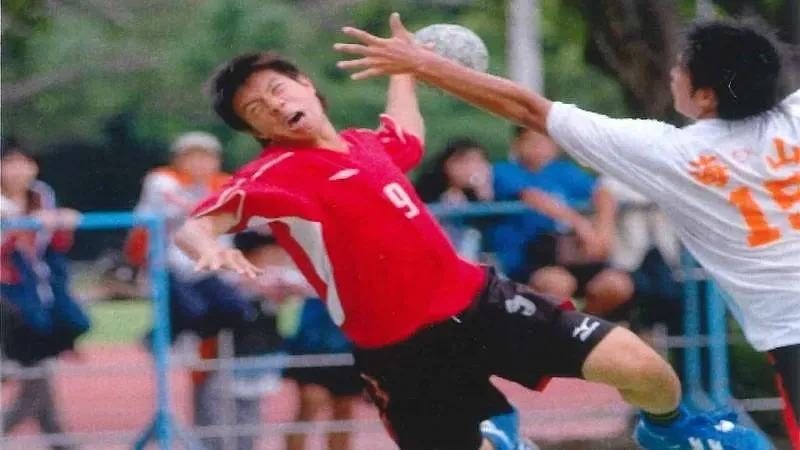
 Photo / Ch'en Ching-k'ai participating in the Hsinchu National High School Athletic Games team handball competition in 2006
In 2007, as an elite player in the high school division of the national handball tournament, Ch'en Ching-k'ai was admitted to the Department of Physical Education at National Taiwan University and National Changhua University of Education. Having wanted to be a P.E. teacher since childhood, Ch'en Ching-k'ai without hesitation chose to study at the National Changhua University of Education.
To make his dream a reality, the person he is most grateful to is Coach Wang Chien-wen of the Wenshan Senior High School handball team in Kaohsiung. Ch'en Ching-k'ai recalled:
"When I participated in dodgeball tournaments in elementary school, the coach saw that I played well and asked if I wanted to attend their junior high school division and join the handball team. I said yes, and I stayed there all the way until I graduated from high school. I trained with the coach for six years, spending more time together than I did with my own father. Later, the best high school handball team in the country tried to poach me, but I didn't consider it because I couldn't let down my coach.
The coach was especially strict, insisting that if we trained, we had to train to the best of our ability. That's how we went from an unknown local school all the way to winning the national championship. The coach cared even more about our future, giving us pop quizzes on academic subjects during training and punishing us with physical exercise if we answered incorrectly, all to ensure we could get into university. I still remember the coach personally taking me to report to the National Changhua University of Education handball team, begging the new coach to continue honing my skills, hoping that one day I could make a name for myself internationally!"
Ch'en Ching-k'ai did not let down expectations; he truly became a national handball team member, representing Taiwan in international competitions. Little did he expect that a car accident during his junior year of college would rob him of his sight, forever preventing him from shooting a ball into the hoop. From then on, he lost his status as a national athlete and could no longer become a P.E. teacher. After losing his sight, he felt he had failed his coach's cultivation, and for eight years he did not dare return to his alma mater to see his coach.
On February 14 this year, when news broke that the court had handed down a guilty verdict, Coach Wang Chien-wen took the initiative to call and express his concern. Hearing that familiar voice, Ch'en Ching-k'ai's tears burst forth. He knew that even if the judge did not believe him, his coach would, because the coach knew he was the person who least wanted to go blind.
The Insurance Payout He Least Wanted to Receive
Ch'en Ching-k'ai's family had been vegetarian since he was little because after Father Ch'en fathered five daughters in a row, he made a vow that if he had a son, he would eat vegetarian food in gratitude. Ch'en Ching-k'ai had always been a good boy who never gave his parents cause for worry—until November 24, 2009, when he was in a motorcycle accident. Mother Ch'en said:
"He was injured very seriously; his lumbar spine, cervical spine, and cheekbones were all fractured, and his concussion triggered numbness in his limbs, hearing impairment, and mild dementia. Later on, he lost his sight. Dealing with doctors and rehabilitation all day long, I had no choice but to quit my job to care for him full-time. NCUE was also very helpful, clearing out a first-floor dorm room so I could stay and live on campus with him. I had to handle getting him dressed, eating, and going to class. A few months later, he was able to walk a bit better, and once his classmates knew how to help out, I finally went home.
Six months after the accident, his severe visual impairment handbook was issued. My heart ached terribly; the Ch'en family only had this one son—how was he supposed to build a family and a career when he couldn't see? I cried every day and asked everywhere about renowned doctors, hoping to cure him! A few months later, a friend who came to collect insurance premiums advised me that since he had a disability handbook, we could apply for disability benefits. Since seeing doctors also cost money, she offered to help process it. I don't understand why the judge said we committed insurance fraud; this is an insurance payout that any parent would least want to receive!"
When Ch'en Ching-k'ai was in high school, Mother Ch'en worried that her son was playing sports and competing all day and wondered what would happen if he got hurt. Pinching pennies from their living expenses, she bought 300,000 NTD in health insurance from Nanshan Life, with attached injury and medical riders as well as 2.2 million NTD in accident insurance. Combined with NCUE's student group insurance and the government's compulsory automobile liability insurance, Ch'en Ching-k'ai claimed a total of 5.22 million NTD in insurance payouts for this accident.
Criminal cases involving insurance fraud are not uncommon; fraudsters typically purchase multiple high-value insurance policies beforehand, then manufacture severe disabilities to claim a large lump sum, or frequently fake illness to claim smaller amounts numerous times. The physically robust Ch'en Ching-k'ai had never claimed insurance benefits before, the insurance was bought many years ago, and the insured amount was very low—completely inconsistent with the criminal pattern of insurance fraud! Furthermore, by faking blindness, Ch'en Ching-k'ai had to give up competing internationally and could no longer be a P.E. teacher. Compared to the lucrative prize money from international competitions and the long-term salary and retirement pension of a P.E. teacher, the insurance payout he obtained by faking blindness was pitifully small. Who would make such an irrational choice?
The Bravest Suitor
 Photo / Ch'en Ching-k'ai's wedding photos in 2015
After graduating from NCUE, Ch'en Ching-k'ai went to the Taiwan Foundation for the Blind to receive rehabilitation training, and was subsequently referred to work at a massage parlor in Taipei to become self-reliant. One day, he went to eat at a vegetarian restaurant he frequented, and the enthusiastic proprietress recommended to customers that this young man's massage skills were very good. A customer decided to try a foot massage. To her surprise, a single trial turned her into a regular, and it blossomed into a romantic romance. On December 30, 2015, the two registered their marriage. Mrs. Ch'en said:
"Ching-k'ai was the first blind person I had ever met, so I curiously asked how he managed to live when he couldn't see. He said he used Line and could add me as a friend—I was startled! He also said he went to exercise on weekends and asked if I wanted to go together. I thought going to see how blind people exercise sounded neat, so I often went along. What attracted me to him was his bravery; for example, he dared to go abroad to participate in blind baseball tournaments, and even dared to take me along. Of course, the bravest thing he did was dare to pursue me. Because I wasn't sure if it was pity or love, I handed him plenty of 'nice guy cards.' When I finally agreed to marry him, it completely blew everyone's minds.
In the beginning, I too doubted whether he could actually see because he looked truly normal. Moreover, I knew about his fake-blindness lawsuit and even tried to persuade him to just plead guilty! He then took me to meet the teachers at the Foundation for the Blind, allowing the teacher to explain to me what Cortical Visual Impairment (CVI) is, explaining that his blindness was caused by brain damage, which is very different from blindness caused by eye damage. His brain could still vaguely perceive light, shadow, and color, so he would indeed gaze directly, trying to figure out what that dark shadow or patch of color was. Later, after we started living together, I understood even more. If I left the wardrobe door open, he would smash his head and bleed! If I didn't put the kitchen knife away properly, he would cut himself. Having truly lived together and seeing him spend countless hours behind the scenes trying to make himself live normally, I realized he was far, far braver than I had imagined."
The Most Dangerous Discrimination Stems from Ignorance
In addition to common eyeball function disorders, blindness can also be caused by brain damage, known as Cortical Visual Impairment (CVI). Before this type of visual impairment was widely understood, patients were often deemed to be faking illness or suffering from mental illness! Such instances of persecuting persons with disabilities out of ignorance are common throughout history. Up to now, medical research, diagnosis, and treatment for CVI are still in their infancy. In Taiwan, even among professional ophthalmologists, understanding of CVI remains uncommon, leading patients to miss golden opportunities for rehabilitation and even be mistakenly accused of faking blindness.
In fact, the court also acknowledged that Ch'en Ching-k'ai is a CVI patient, because according to examination results from the Changhua Christian Hospital and Kaohsiung Veterans General Hospital, both confirmed that he suffered from reduced cerebral blood flow and cortical brain damage. The problem lies in the fact that no matter how scholars and experts—such as Dr. Chao Hsiao-ming from Hsin Sheng Hospital, Professor Ch'en Chien-chung from the Department of Psychology at National Taiwan University, and Teacher Yeh Chao-min from the Foundation for the Blind—testified in court to explain that most CVI patients still possess residual vision, and that with the assistance of residual light perception and color perception Ch'en Ching-k'ai could accomplish many actions, including reading/writing test papers and throwing/catching a frisbee—the judges still believed these experts were all deceived by Ch'en Ching-k'ai, insisting that a severely visually impaired person could never do such things!
American civil rights leader Dr. Martin Luther King Jr. once said: "Nothing in the world is more dangerous than sincere ignorance and conscientious stupidity." After reading the judgment in Ch'en Ching-k'ai's case, I believe you will feel the same lament: the judges tried extremely hard to prove Ch'en Ching-k'ai was a liar, yet only succeeded in highlighting their own utter ignorance of CVI. When judges are blinded by their own stereotypes about the visually impaired, they can no longer see the individuality of every visually impaired person. This is the most dangerous form of discrimination.
Vindicate Ch'en Ching-k'ai, Eradicate Disability Discrimination
Like many people who acquire blindness halfway through life, for a very long time Ch'en Ching-k'ai could not accept the reality of his blindness. Yet he drew upon the sportsman's spirit of challenging oneself to complete his university education, receive vocational training in massage, pursue love and marriage, and strive to integrate normally into society. Yet the judiciary treated Ch'en Ching-k'ai as a criminal simply because he appeared too normal—how cruel is that to him? If a person with a disability does not look like what society thinks a disabled person should look like, it's fraud! It's a crime! How severe is the judiciary's discrimination against persons with disabilities!
The United Nations Convention on the Rights of Persons with Disabilities (CRPD) has been implemented in Taiwan for four years now, yet the judicial system clearly has yet to fulfill the Convention's requirements. The Ch'en Ching-k'ai case is merely the tip of the iceberg. The most urgent priority is for the judiciary to swiftly reopen the trial and vindicate this miscarriages of justice. Judge training and continuing education courses should also incorporate education on the CRPD to eradicate discrimination starting from concepts. We look forward to the judiciary beginning to see the disadvantaged status of persons with disabilities in society and assuming the responsibility of assisting persons with disabilities in integrating into society.
※ This article was published in ETtoday News Cloud on April 19, 2018
Notes
- Judge Liu Hsi-sheng of the Kaohsiung District Court, presiding judge of the first-instance collegiate panel.
- Criminal Judgment of the Kaohsiung Branch of the Taiwan High Court, 103年度上易字第574號
This article is an AI-generated translation of the original Chinese text. In the event of any discrepancy, the Chinese version shall prevail.