
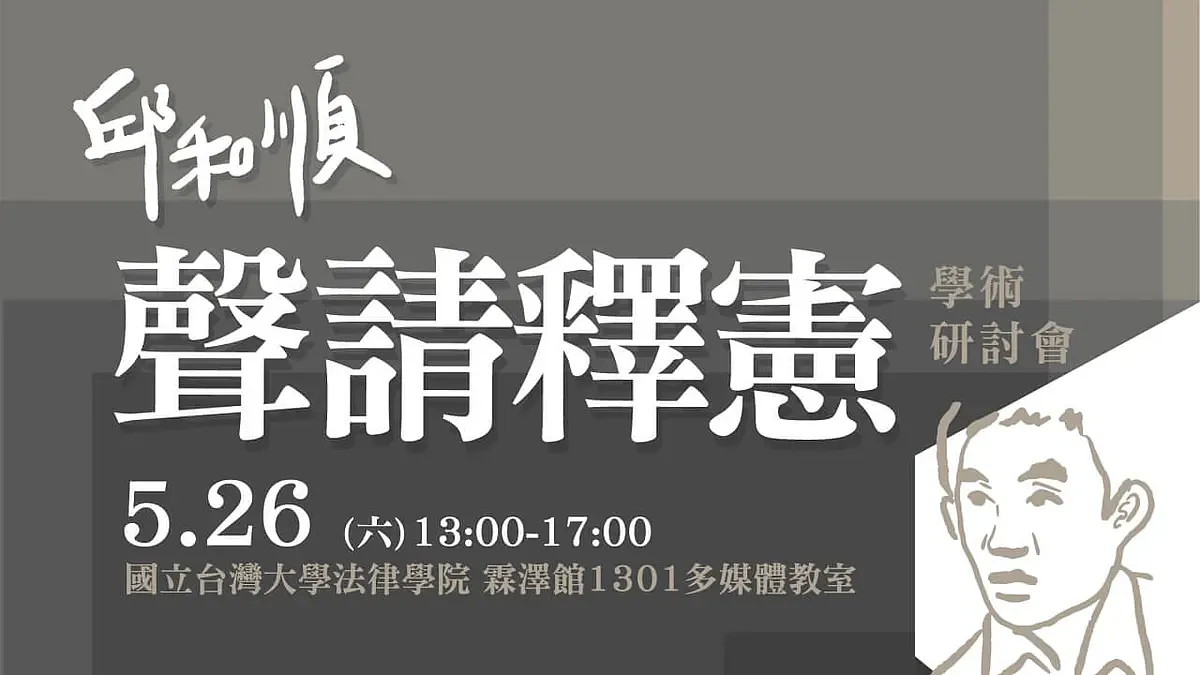
Seminar | Academic Seminar on the Constitutional Interpretation Petition for Chiou Ho-shun
Last edited: 2026-11-03
In 1988, Chiou Ho-shun and 11 other defendants were accused of committing the dismemberment of K'o Hung-yü-lan and the kidnapping of Lu Cheng. However, the trial of this case was plagued by three major evils commonly found in criminal litigation practice: First, the defendants' confession records during investigation were produced while the defendants were handcuffed. Second, the Bureau of Investigation's voiceprint identification report failed to meet scientific standards, yet the court accepted it wholesale. Third, the courts substituted the reading of verification records for the on-site examination of physical evidence. The Hsu Tzu-chiang case eliminated a major evil from Taiwan's criminal litigation system, representing a major leap forward in the enhancement of criminal human rights protections. In contrast to the Hsu Tzu-chiang case, the Chiou Ho-shun case simultaneously exhibits these "three major evils," which urgently need to be eradicated.
On the morning of February 9 this year, the Judicial Reform Foundation held a press conference at the Judicial Yuan regarding three petitions for constitutional interpretation filed in the Chiou Ho-shun case. The volunteer legal team, experts, scholars, and civil society organizations jointly submitted three constitutional interpretation petitions, hoping that the Grand Justices will accept and issue an interpretation addressing the aforementioned harms in criminal litigation practice, ensuring that Chiou Ho-shun, who has been imprisoned for nearly 30 years, has not been imprisoned in vain.
This seminar will invite lawyers from the JRF's Chiou Ho-shun volunteer legal team and scholars to participate, engaging in in-depth and extensive discussions to pool wisdom and foster a more thorough exploration of constitutionality.
Topics
- ("Can Verification Records Hollow Out the Principle of Direct Examination?—On the Constitutionality of the Supreme Court's 1991 Tai-Shang No. 4672 Criminal Precedent")
- ("Handcuffing for Confessions During Investigations and the Defendant's Procedural Subject Status—An Exploration of the Constitutionality of Article 282 of the Code of Criminal Procedure")
- ("Judicial and Prosecutorial Monopoly on Expert Testimony and Fair Trial—On the Constitutionality of Articles 198 and 208 of the Code of Criminal Procedure")
Time
Saturday, May 26, 2018, 13:00-17:00
Location
Multimedia Classroom 1301,霖澤 Hall, College of Law, National Taiwan University
Target Audience
Lawyers, current or former judges and prosecutors, university law department faculty and students, etc.
Agenda
| Time | Content | Moderator / Speaker / Discussant |
| 1300-1320 | Registration | |
| 1320-1330 | Opening Remarks |
Guest Speaker Li Mao-sheng / Professor, Department of Law, National Taiwan University Distinguished Guest from Taipei Bar Association |
| 1330-1420 |
Session 1 Can Verification Records Hollow Out the Principle of Direct Examination? —On the Constitutionality of the Supreme Court's 1991 Tai-Shang No. 4672 Criminal Precedent |
Moderator Hsu Wei-ch'un / Associate Professor, Department of Financial and Economic Law, Chung Yuan Christian University |
|
Speaker Li I-chuan / Lead Attorney for the Constitutional Interpretation Petition |
||
|
Discussant Su Kai-p'ing / Assistant Professor, Graduate Institute of Law and Government, National Central University |
||
| 1420-1510 |
Session 2 Handcuffing for Confessions During Investigations and the Defendant's Procedural Subject Status —An Exploration of the Constitutionality of Article 282 of the Code of Criminal Procedure |
Moderator Li Chia-wen / Professor, Department of Law, National Cheng Kung University |
|
Speaker Kuo Hao-jen / Lead Attorney for the Constitutional Interpretation Petition |
||
|
Discussant Hsu Chia-yuan / Assistant Professor, Department of Law, Providence University |
||
| 1510-1520 | Break | |
| 1520-1610 |
Session 3 Judicial and Prosecutorial Monopoly on Expert Testimony and Fair Trial —On the Constitutionality of Articles 198 and 208 of the Code of Criminal Procedure |
Moderator Yu Po-hsiang / Convener of the Chiou Ho-shun Case Volunteer Legal Team |
|
Speaker Lin Chun-hung / Lead Attorney for the Constitutional Interpretation Petition |
||
|
Discussant Li Chun-yi / Professor, Graduate Institute of Forensic Medicine, National Taiwan University |
||
| 1610-1700 |
Session 4 General Discussion |
Moderator Hsu Yu-hsiu / Former Grand Justice of the Judicial Yuan |
|
Discussants Professor Li Chun-yi, Assistant Professor Hsu Chia-yuan, Assistant Professor Su Kai-p'ing, Attorney Lin Chun-hung, Attorney Kuo Hao-jen, Attorney Li I-chuan |
||
Organizer / Co-organizers
Organizer
Taipei Bar Association
Judicial Reform Foundation
Co-organizers
Center for Criminal Law, College of Law, National Taiwan University
Judicial Science Promotion Alliance
Constitutional Committee, Taipei Bar Association
Judicial Reform Committee, Taipei Bar Association
Criminal Law Committee, Taipei Bar Association
Taiwan Association for Human Rights
Taiwan Innocence Project
Taiwan Alliance to End the Death Penalty
Covenant Watch
This article is an AI-generated translation of the original Chinese text. In the event of any discrepancy, the Chinese version shall prevail.
