
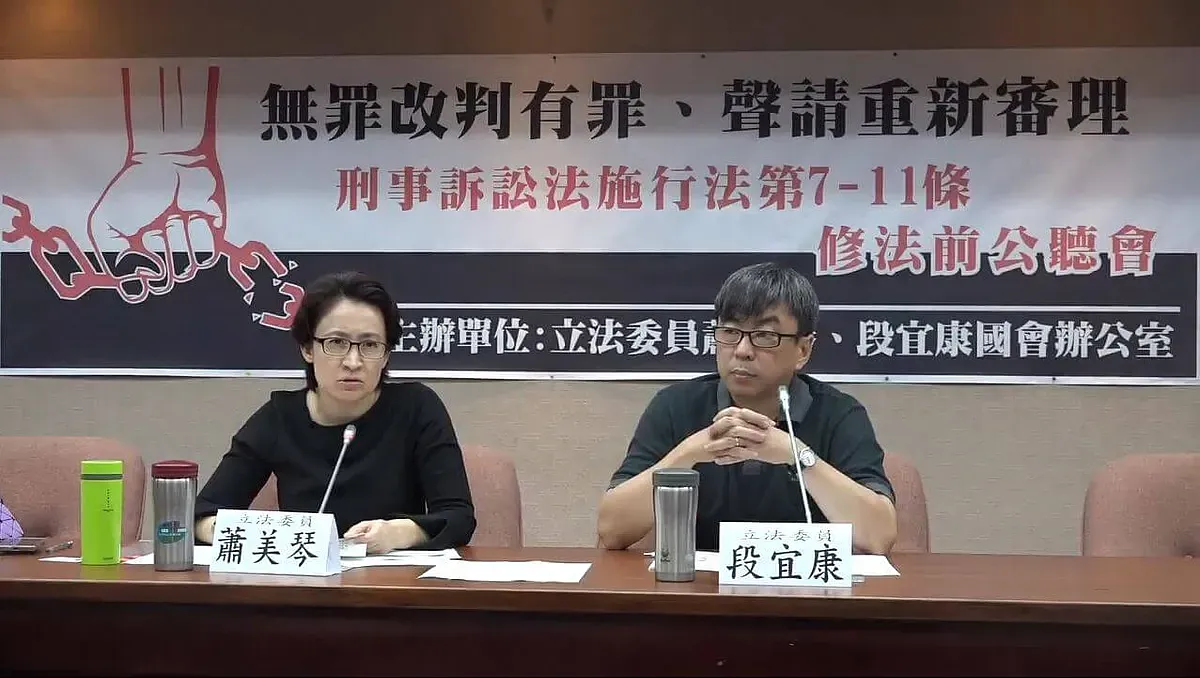
Public Hearing Prior to Amendments to Articles 7-11 of the Enforcement Act of the Code of Criminal Procedure Concerning Convictions Following Acquittals and Petitions for Retrial
Last edited: 2026-07-27
Table of Contents
00:00:00 Moderator's Introduction
Phase I
Statements by Government Officials
- 00:02:22 Representative of the Judicial Yuan / Judge Li Ming-i, Department of Criminaliciary, Judicial Yuan
- 00:06:22 Representative of the Ministry of Justice / Prosecutor Kuo Chün-hao, Department of Prosecutorial Affairs, Ministry of Justice
- 00:08:52 Moderator's Remarks
Statements by Experts, Scholars, and Litigants
- 00:11:11 Standing Executive Committee Member of the JRF / Attorney Lin Chün-hung
- 00:15:59 Taiwan High Court / Judge Ch'ien Chien-jung
- 00:39:10 Soochow University School of Law / Associate Professor Hu Po-yen
- 00:45:10 Aletheia University Department of Law / Associate Professor Wu Ching-chin
- 00:54:57 Litigant / Huang Hui-fu
- 01:03:50 Litigant / Ho Ch'ing-liang
Phase II Extended Discussion
- 01:13:37 Representative of the Judicial Yuan / Judge Li Ming-i, Department of Criminaliciary, Judicial Yuan
- 01:26:36 Representative of the Ministry of Justice / Prosecutor Kuo Chün-hao, Department of Prosecutorial Affairs, Ministry of Justice
- 01:31:09 Representative of the Judicial Yuan / Judge Li Ming-i, Department of Criminaliciary, Judicial Yuan
- 01:33:06 Legislator Tuan Yi-kang's Inquiry: Compensation Issues Post-Amendment?
- 01:36:10 Representative of the Judicial Yuan / Judge Li Ming-i, Department of Criminaliciary, Judicial Yuan
- 01:36:33 Legislator Hsiao Bi-khim's Inquiry: Case Volume and Adjudication Capacity?
- 01:37:00 Representative of the Judicial Yuan / Judge Li Ming-i, Department of Criminaliciary, Judicial Yuan
- 01:37:44 Aletheia University Department of Law / Associate Professor Wu Ching-chin
- 01:38:25 JRF Volunteer / Hsiao I-min
- 01:45:49 Soochow University School of Law / Associate Professor Hu Po-yen
- 01:48:27 Standing Executive Committee Member of the JRF / Attorney Lin Chün-hung
- 01:50:56 Legislator Hsiao Bi-khim's Inquiry: Purpose of Mandatory Legal Representation?
- 01:51:28 Standing Executive Committee Member of the JRF / Attorney Lin Chün-hung
- 01:51:58 Aletheia University Department of Law / Associate Professor Wu Ching-chin
- 01:53:45 Attorney Chan Yi-hao
- 01:57:29 Moderator's Conclusion
◎Minutes compiled by Attorney Huang Ying-chia
At the end of last year, Article 376 of the Code of Criminal Procedure was amended to allow future "cases involving a conviction following an acquittal" to be appealed to the third instance for relief. However, it failed to stipulate how finalized second-instance convictions prior to the implementation of the new law should apply, leaving citizens whose right of appeal was previously stripped unable to seek relief accordingly.
In view of this, to introduce a two-year "transition period" via the addition of Articles 7-11 to the Enforcement Act of the Code of Criminal Procedure—granting finalized cases that were acquitted in the first instance but convicted in the second instance an opportunity to seek relief within two years—Legislator Hsiao Bi-khim and Legislator Tuan Yi-kang convened a pre-amendment public hearing at Meeting Room 201 of the Legislative Yuan's Red Building. They invited official representatives, legal scholars and experts, and Dr. Huang Hui-fu and Mr. Ho Ch'ing-liang, litigants whose rights of appeal were previously infringed upon, to fulfill the constitutional protection of the right to litigation.
 Photo / Judge Li Ming-i, Department of Criminaliciary, Judicial Yuan (Representative of the Judicial Yuan)
Judge Li Ming-i of the Department of Criminaliciary of the Judicial Yuan (representative of the Judicial Yuan) explained that the Judicial Yuan had considered whether to treat Paragraphs 3-7 of Article 376 of the Code of Criminal Procedure as equivalent to the retroactive application of a Grand Justices' Interpretation. However, because practitioners (such as Judge Ch'ien) would directly apply the two Covenants to handle such matters, it was ultimately decided to respect practical operations and let the Supreme Court independently decide whether to accept jurisdiction. Furthermore, given that our country currently features two levels of fact-finding, and considering the expenditure of so many judicial resources, second-instance judgments are not so unbearable. What litigants seek to remedy is the judgment itself, not a flawed law. Legal stability is a core principle of the rule of law state; one must ponder whether being favorable to the people is everything, or if all constitutional interpretation cases could otherwise come to the courts for relief in the future. Moreover, Articles 7-11 do not limit the scope of retroactive application, meaning the volume of cases might trace back to 1967. He cited data showing that since the passage of Article 376 of the Code of Criminal Procedure, a total of 104 cases eligible for third-instance appeal have emerged, demonstrating a very high proportion. Claiming that very few people would appeal amounts to mere speculation.
 Photo / Prosecutor Kuo Chün-hao, Department of Prosecutorial Affairs, Ministry of Justice (Representative of the Ministry of Justice)
Prosecutor Kuo Chün-hao of the Department of Prosecutorial Affairs of the Ministry of Justice (representative of the Ministry of Justice) stated that the Ministry of Justice had originally suggested studying whether the Enforcement Act should apply retroactively. However, the experts and representatives in attendance at the time believed that leaving it to practical operation would suffice, deeming the enactment of the Enforcement Act unnecessary. Furthermore, Interpretation No. 752 provided a 10-day retroactive period permitting appeals within a narrow scope, meaning the Grand Justices had already made their choice regarding legal stability. Broad retroactive application would entail problems of execution and retroactive enforcement, and lawmakers should consider in tandem whether criminal compensation would apply. Additionally, whether special relief pathways should be placed within the Code of Criminal Procedure is more appropriate, though our country already possesses systems for retrial and extraordinary appeals, which are fully sufficient.
 Photo / Attorney Lin Chün-hung, Standing Executive Committee Member of the Judicial Reform Foundation
Attorney Lin Chün-hung, Standing Executive Committee Member of the JRF, stated that legal stability is not such a paramount concept; when citizens' rights are affected, adjustments should be made. One of his clients, a security guard, was convicted after an acquittal; because of his prior criminal record, he was unable to obtain a police criminal record certificate, thereby impacting his right to work and his right to reputation. Many citizens have had their lives affected by Article 376 of the Code of Criminal Procedure. The judicial system should afford them an opportunity for relief—not treating these as miscarriage of justice cases, but simply returning a chance for relief to them. He hopes to correct this through the present amendment. Attorney Lin believes the authorities' primary concern is case load, but looking at statistical data, there are roughly over 300 cases of convictions following acquittals per year. With our country's appeal rate at approximately 44%—which even includes appeals by prosecutors—not everyone will appeal. The actual number of people wanting to appeal might be even lower, and only those genuinely impacted by a case would seek to appeal. Furthermore, mandatory legal representation, while a burden to the public, might serve to screen cases.
 Photo / Judge Ch'ien Chien-jung (Presentation Slides)
Judge Ch'ien Chien-jung argued that the true essence of the principle against non-retroactivity is "no retroactivity for disadvantages," whereas retroactivity is permitted for benefits. The narrow retroactivity of Interpretation No. 752 falls short of completing the task. For provisions that had long violated the Enforcement Act of the Two Covenants and the Constitution, countless defendants suffered infringements. Yet, solely to conserve judicial resources, defendants in finalized cases were barred from re-filing appeals for relief. Among these cases, the vast majority are likely offenses punishable by fines convertible to custodial sentences. If defendants still vociferously proclaim their innocence, who should be held accountable for irremediable miscarriages of justice arising from the lack of a second court review? Due process is expensive and demands a price. Judge Ch'ien noted that criminal cases emphasize individualized justice. German legislation directly prescribes that unconstitutional regulations applied in criminal cases uniformly permit all finalized cases to petition for retrial, unlike our Grand Justices who arbitrarily decide who may apply. Ultimately, whether an individual case is correct is decided by the court. Precisely for this reason, granting defendants at least one opportunity for relief against a guilty verdict is the judicial system's commitment to facing appellate supervision and review. It gives defendants who repeatedly proclaim their innocence the chance to prove whether their claims have merit, rather than prohibiting them from crying out and denying them even the opportunity to prove it. This is the lofty stature the judicial power ought to display. In conclusion, Judge Ch'ien summarized that implementing transitional justice is selective legislation. We must bid farewell to past judicial relief mindsets and legislative conventions. Based on legislative freedom of formation, lawmakers possess the freedom to choose; as long as they do not violate the principles of equality and proportionality, they may decide whether to apply laws retroactively. He also argued that legislation addressing over 300 individuals multiplied by N years can never be characterized as ad hoc legislation.
 Photo / Professor Hu Po-yen, Department of Law, Soochow University
Professor Hu Po-yen of the Department of Law at Soochow University expressed that Grand Justices' interpretations are abstract explanations that do not state whether they take effect prospectively or retrospectively. However, many resolve previously occurring issues, such as Interpretation No. 400, which addressed past problems. While non-retroactivity safeguards "legal stability," the "rule of law state principle" is the superior principle. For instance, promoting transitional justice is a matter for the rule of law state to handle; if retroactive application cannot be addressed, then transitional justice is unconstitutional. Handling transitional justice directly responds to the demands of the rule of law state. German law makes different arrangements for civil and criminal matters: civil laws involve the weighing of interests between two parties and the protection of reliance, whereas criminal matters rely on the state to deliver a fair outcome. Yet in the present interpretation, the litigant obtained the interpretive ruling but failed to secure true justice. This is something future amendments must change through lawmakers, because the democratic legitimacy of the judiciary is weak, meaning it cannot dictate how the law ought to be, whereas action taken by lawmakers is appropriate. Professor Hu also believes that setting provisions in the Enforcement Act is more rigorous than in the Code of Criminal Procedure, as it deals with how to handle past finalized cases following the enactment of Article 376, rather than how to arrange the criminal procedure system as a whole.
 Photo / Associate Professor Wu Ching-chin, Department of Law, Aletheia University
Associate Professor Wu Ching-chin of the Department of Law at Aletheia University noted that finalized criminal judgments possess res judicata, ensuring high legal stability, which is why extraordinary appeal remedies exist. However, in cases of convictions following acquittals, defendants are denied the right to relief and due process is unprotected; hence, legal stability should not be prioritized so heavily, and defendants' rights should take precedence. Furthermore, the enforcement issues raised by the Ministry of Justice and the problem of evidence destruction raised by the Judicial Yuan are manageable details, and citizens' right to relief must not be obstructed by case volume. Relevant statistical data for this amendment was not held by the JRF, and he suggested that the Judicial Yuan and the Ministry of Justice should submit counter-proposals. Professor Wu further argued that lawmakers must bear the primary responsibility; judges should not individually determine on a case-by-case basis whether retroactivity is permissible. Favorable retroactivity poses absolutely no constitutional violation issue. Nonetheless, he believes retroactivity should be housed within the Code of Criminal Procedure because petitioning the Supreme Court for a "retrial" is a novel system that belongs in the main text of the Code of Criminal Procedure rather than the Enforcement Act, and the phrase "retrial" should be redefined first. Associate Professor Wu opposed pairing this with mandatory legal representation because the Supreme Court currently does not require mandatory representation. Finally, he mentioned that why individuals convicted upon retrial/appeal cannot appeal to the third instance warrants thought; perhaps such conviction-upon-conviction cases could adopt discretionary third-instance appeals in the future.
 Photo / Litigant Dr. Huang Hui-fu
Litigant Dr. Huang Hui-fu stated that his case was a medical dispute. Because family members were dissatisfied with the outcome, they filed a lawsuit. He calmly accepted judicial review, yet felt frustrated by the outcome. The district court tried the case for three years and delivered an acquittal, but the high court conducted no new evidentiary investigations, holding only two court sessions before overturning the prior judgment and sentencing him to four months of imprisonment in the second instance. Dr. Huang believes the second-instance judges failed to genuinely understand the causes of disease and injury alongside background medical knowledge, and neglected to carefully examine scientific evidence and medical clues. The judgment text did not match the medical facts and was entirely fabricated through judges' imagination. He found this extremely difficult to accept, feeling that he was in a disadvantaged position within the judiciary and bullied by judges who assumed his words were mere sophistry. He felt he could hardly receive fair treatment. Unfair trials and judgments send a wrong message to the people nationwide, undermine public confidence in the judiciary, and impact his entire life. Because of his criminal record, he has been unable to travel abroad for medical exchanges. At least one opportunity to appeal ought to be guaranteed.
 Photo / Litigant Mr. Ho Ch'ing-liang
Litigant Mr. Ho Ch'ing-liang stated that he was charged with quasi-fraud for assisting others in handling land purchase matters. He was acquitted in the first instance, but convicted in a finalized second-instance judgment. However, in the second instance, the plaintiff presented no new evidence, and the judge introduced no new evidence either, simply asserting that because he lacked money, he exploited a traffic accident handling opportunity—knowing someone in the family owned land—to defraud them, thereby convicting him. He believes that to sentence someone to a guilty verdict in the second instance without even giving them a chance to speak is extremely unfair to society. Not just him, but numerous citizens are unable to file further appeals. Mr. Ho Ch'ing-liang has already completed serving his sentence of ten months' imprisonment, but he maintains that the second-instance court completely overturned the first-instance judgment without any new evidence or witnesses. The state ought to grant him an opportunity for relief so he can fight for his innocence and explain himself clearly to the court.
 Photo / Attorney Chan Yi-hao
Attorney Chan Yi-hao stated that a second-instance judgment is not necessarily correct, but conversely, a first-instance judgment is not necessarily correct either. The Constitution contains no article explicitly establishing legal stability; it is a doctrinal concept derived through interpretation. The difficulty of retrials and extraordinary appeals is extremely high. If Articles 7-11 are abandoned and abandoned in favor of amending retrials and extraordinary appeals instead, case volumes will undoubtedly skyrocket, potentially inflicting an even greater impact on legal stability.
Legislator Hsiao Bi-khim concluded that the executive branch holds diverse considerations: while serious offenses permit endless retrials, minor offenses should not have their right of appeal stripped outright. Let alone litigants suffering grievances, this is unfair to the public. Constitutional interpretations exist precisely to address long-standing unfair phenomena, and the law must address them all the more, failing which it cannot align with the constitutional spirit. While official stances are understandable, if relief issues can be re-examined—even though officials use worst-case scenarios, including case volume and enforcement problems, as warnings—she still looks forward to continued discussion. Alternative proposals regarding statutory phrasing can still be considered, and whether to mandate legal representation—though conceived from a case-screening perspective—might instead strip away the right to relief and warrants space for ongoing discussion.
 Photo / Legislator Hsiao Bi-khim and Legislator Tuan Yi-kang
Legislator Tuan Yi-kang concluded that all parties hold different considerations. Previously, judges had also petitioned that retroactive application should be enforced. We will continue to coordinate and communicate with the Judicial Yuan and the Ministry of Justice. As this legislative session's committee proceedings reach their final month, if controversies can be clarified, we hope to schedule preliminary review during this session. Particularly upon witnessing the suffering of Dr. Huang and Mr. Ho, we hope to swiftly afford litigants an opportunity to secure their right to litigation, though more time is still needed for communication.
Post-Meeting Q&A
The retrial system addresses how to handle past finalized cases following the amendment of Article 376 of the Code of Criminal Procedure, rather than how to structure the criminal procedure system as a whole. Therefore, housing it in the Enforcement Act is preferable. The legislative reasoning of the Enforcement Act already defines the meaning of a "retrial," and since this is short-term legislation, placing it in the main text of the Code of Criminal Procedure would also be stylistically inappropriate.
Amendments to procedural laws are generally trending toward lawyer representation. Having legal representation can assist citizens in organizing disputed points and legal arguments, increase the likelihood of a successful petition, enhance the efficiency of court adjudications, and alleviate burdens on judges.
The 104 cases presented by the authorities are statistical counts of "non-finalized" cases following the passage of the new law where second-instance judgments could be appealed to the third instance, allowing relief to be sought via general appeal procedures. This is a completely distinct concept from finalized cases filing for a retrial and cannot be analogized whatsoever.
Because the grounds for petitioning a retrial are grounds for "appealing to the third instance," adjudication by the Supreme Court is more appropriate. This also avoids High Court judges being less willing to open proceedings due to peer pressure.
The grounds for retrial are the statutory grounds for original third-instance appeals, requiring judgments to violate the law. However, if factual findings contain circumstances violating the law, they should likewise satisfy the requirements for a retrial.
This is a hypothetical proposition; lawmakers must still make value choices within individual constitutional interpretation cases.
Yes. Defendants' litigation rights are protected by the Constitution and must never be sacrificed due to an excessive volume of cases.
This article is an AI-generated translation of the original Chinese text. In the event of any discrepancy, the Chinese version shall prevail.