
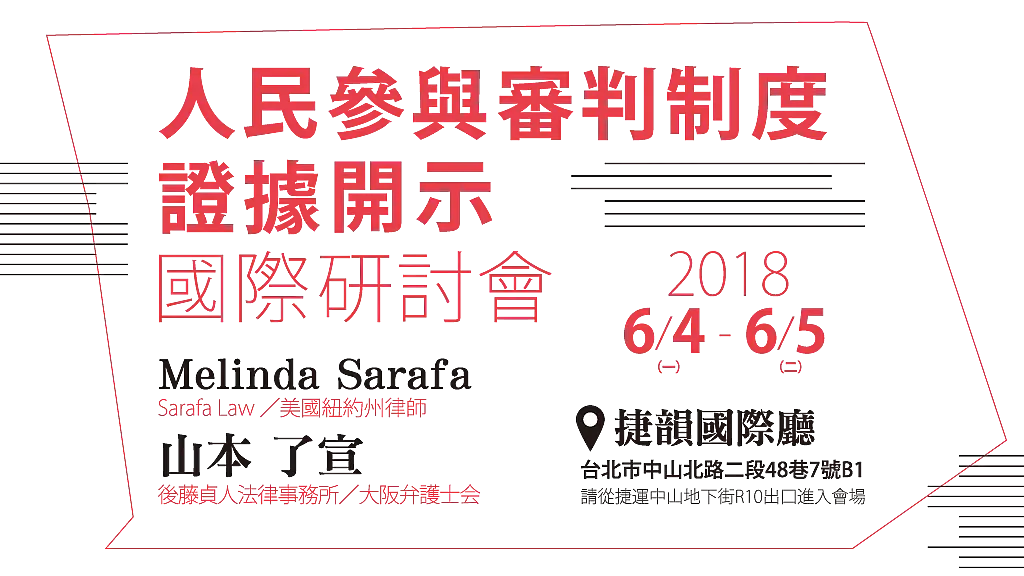
Seminar | International Seminar on Lay Participation in Trials—Discovery
Last edited: 2026-07-27
The Draft Act on Lay Participation in Criminal Trials passed by the Judicial Yuan warrants the most attention and priority review for its unprecedented introduction of the single-charge system (dunsan-ipponshugi) and discovery. To prevent prior review of case files and evidence from imposing an excessive burden on lay judges lacking formal legal training and potentially leading to prejudgment, the draft departs from the current Code of Criminal Procedure—which allows the simultaneous transmission of case files and evidence to facilitate judicial investigation—by explicitly stipulating that upon filing charges, prosecutors shall submit only the indictment to the court and shall not transmit the case files and evidence along with it. This ensures that professional and lay judges form their mental impressions through the presentation of evidence by prosecutors and defense counsel in court only after the trial stage has commenced.
However, alongside the introduction of the single-charge system, the defense counsel's right to inspect case files was abolished and replaced by a discovery system. Operations through several mock trials held by the Judicial Yuan demonstrate that this approach is open to question, and the provisions concerning discovery in the draft are overly rudimentary, raising apparent constitutional concerns. To clarify this, it is necessary to introduce to the public the practical effects of operating discovery systems under the single-charge system in the United States and Japan.
With this consideration in mind, we intend to invite Melinda Sarafa, a New York State attorney with practical jury trial experience, and Yamamoto Takanobu, attorney and drafter of the Japan Federation of Bar Associations guidelines for retrial discovery, to Taiwan for a lecture series discussing practical experiences with discovery under the lay participation system. We also plan to invite representatives from the judiciary, prosecution, defense, academia, and both official and civil sectors with practical mock trial experience to engage in dialogues with the two attorneys from the US and Japan, aiming to achieve mutual learning and experience exchange, and looking forward to deeply understanding the pros and cons of various systems to help select the system best suited to Taiwan's current situation.
Time
June 4 (Mon) 9:00-17:00 (Registration begins at 8:45)
June 5 (Tue) 9:30-17:00 (Registration begins at 9:15)
Venue
Jie-Yun International Hall MAP (B1, No. 7, Lane 48, Sec. 2, Zhongshan N. Rd., Taipei City, please enter the venue from Exit R10 of the Zhongshan Metro Mall)
Target Audience
Practitioners, scholars, experts, students, and the general public interested in lay participation in trials
Notes
- Headsets for simultaneous interpretation will be provided on-site in limited quantities. Attendees are kindly requested to register in advance to assist with headcount estimation.
- Lunch is not provided at this seminar, but morning and afternoon tea and snacks will be served for attendees.
- The content of the two-day seminar will not overlap. If you wish to attend the entire event, please fill out the registration forms for both sessions separately.
Foreign Speakers

Melinda Sarafa
Melinda Sarafa is the founder and principal of Sarafa Law. With more than 15 years of experience dedicated to defending individuals and businesses at all stages of criminal proceedings and related civil litigation, she has represented hundreds of clients in federal, state and international investigations, enforcement actions, trials and appeals, and is adept at handling sensitive and high-profile cases.
Prior to establishing Sarafa Law, Melinda was a partner at the white collar and civil litigation firm Zuckerman Spaeder LLP. Her experience also includes several years of practice with prominent criminal defense attorney Benjamin Brafman in New York City, and as an Assistant Federal Public Defender in Houston, Texas. She served as a law clerk to the Honorable Jerry Buchmeyer in the United States District Court for the Northern District of Texas and to the Honorable Carolyn Dineen King on the Fifth Circuit Court of Appeals.
Melinda earned her J.D. with distinction from Stanford Law School (1995) and is admitted to practice in New York and Texas. She serves on the Board of Directors of the National Association of Criminal Defense Lawyers, where she co-chaired the White Collar Crime Committee, is a member of the New York Council of Defense Lawyers and speaks fluent Mandarin Chinese.

Yamamoto Takanobu
Gotō Sadato Law Office / Osaka Bar Association
- Member, Criminal Defense Committee (Trial Defense Division), Osaka Bar Association
- Member, Human Rights Protection Committee (Special Division on Evidence Discovery in Retrials), Japan Federation of Bar Associations
- Recipient of the 2011 Quarterly Criminal Defense Newcomer Award, First Prize
- Authored subsequent papers on methodologies for pleading in contested cases and arguments regarding the right to remain silent during defendant questioning.
- In charge of planning and lecturing on contested case training for the Osaka Bar Association since 2012.
- Developed an interest in evidence discovery and systematized methodologies for defense evidence discovery requests.
Agenda
| Time | June 4 (Mon) | June 5 (Tue) | ||
| Content | Content | |||
| 08:45-09:00 | Registration | -- | ||
| 09:00-09:30 |
Opening RemarksGuests |
Registration |
||
| 09:30-11:00 |
Session 1 Regulations and Practice of Evidence Discovery in Japan (I)Speaker Yamamoto Takanobu, Attorney ※On-site consecutive interpretation (Li Yi-hsiu / Ph.D. student, Hitotsubashi University Graduate School of Law) |
Session 3 Regulations and Practice of Evidence Discovery in Japan (II)Speaker Yamamoto Takanobu, Attorney ※On-site consecutive interpretation (Li Yi-hsiu / Ph.D. student, Hitotsubashi University Graduate School of Law) |
||
| 11:00-11:15 | Tea Break | Tea Break | ||
| 11:15-11:45 |
Panel DiscussionPanelists |
Panel DiscussionPanelists |
||
| 11:45-12:00 | Q&A Session | Q&A Session | ||
| 12:00-13:30 | Lunch Break *Coinciding with the Wan An Drill, please return to the venue before 13:30 |
Lunch Break | ||
| 13:30-15:00 |
Session 2 Regulations and Practice of Evidence Discovery in the United States (I)Speaker Melinda Sarafa, Attorney ※On-site simultaneous interpretation |
Session 4 Regulations and Practice of Evidence Discovery in the United States (II)Speaker Melinda Sarafa, Attorney ※On-site simultaneous interpretation |
||
| 15:00-15:15 | Tea Break | Tea Break | ||
| 15:15-15:45 |
Panel DiscussionPanelists |
Panel DiscussionPanelists |
||
| 15:45-16:00 | Q&A Session | Q&A Session | ||
| 16:00-16:10 | Intermission | Intermission | ||
| 16:10-17:00 |
Plenary DiscussionModerator Yu Po-hsiang, Attorney All Panelists |
Plenary DiscussionModerator Tsai Chih-hung, Judge All Panelists |
||
Co-organizers
Taipei Bar Association
New Power Party
Taiwan Foundation for Democracy
Taiwan Criminal Defense Lawyers Association
Taiwan Bar Association
Judicial Reform Foundation
This article is an AI-generated translation of the original Chinese text. In the event of any discrepancy, the Chinese version shall prevail.