
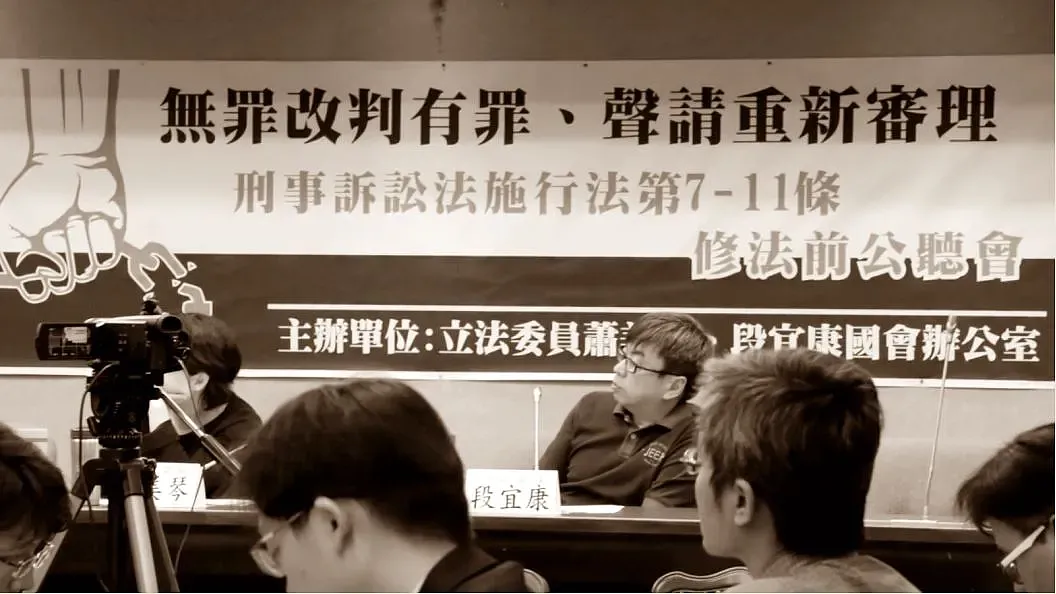
Infringing upon the People's Right to Judicial Remedy for 50 Years—It Is Time to Give It Back
Last edited: 2026-07-27
Legislation reviewing our country's erroneous infringement on the right to judicial remedy over the past 50 years was originally scheduled for review by the Judiciary and Organic Laws and Statutes Committee of the Legislative Yuan this week. However, due to an excessive number of pending bills, it was decided that the review would be postponed to a later date.
Since 1968, citing the excessive caseload of the Supreme Court, the state used Article 376 of the Code of Criminal Procedure to strip individuals convicted of petty offenses of their right to appeal a high court guilty verdict to the third instance. Some defendants were acquitted in the first instance only to be convicted upon appeal in the second instance, yet they were barred from seeking relief in the third instance. Having once received an acquittal made it all the more difficult for these citizens to accept such a verdict.
In view of this, legislators proposed adding Articles 7-11 to the Enforcement Act of the Code of Criminal Procedure to establish a two-year "transition period," granting individuals whose cases were finalized with a guilty verdict in the second instance—after an acquittal in the first instance—an opportunity to seek further legal remedy within two years.
Grand Justices' Interpretation Declares the Old Law Unconstitutional
As early as 2009, when the two International Covenants took effect, it was explicitly stipulated that "everyone convicted of a crime shall have the right to his conviction and sentence being reviewed by a higher tribunal according to law." However, it was not until 2017 that the Code of Criminal Procedure remained unamended, denying cases changed from acquittal to conviction the opportunity for at least one level of review by a higher court.
Last year, Judicial Yuan Interpretation No. 752 declared Article 376 of the Code of Criminal Procedure unconstitutional. At the end of last year, the Legislative Yuan amended the provision in response. Moving forward, "cases resulting in an acquittal in the first instance but a conviction upon appeal in the second instance" may all be appealed to the third instance for relief. However, the new law omitted provisions regarding how final judgments of conviction rendered in the second instance "prior to the enforcement of the new law" should apply. While the new law is well-intentioned, citizens whose right to appeal was previously stripped are still unable to seek relief on this basis. Consequently, many lament that the reform falls short of completion, with the case of Dr. Huang Hui-fu being a prime example.
Depriving the Right to Appeal Minor Offenses Still Greatly Impacts Citizens' Rights
Cases finalized with a conviction following a reversed acquittal may not seem to carry heavy sentences, but a criminal conviction hinders an individual's employment, entry, and exit. If the second-instance judgment is unfortunately a miscarriage of justice, it deals an even heavier blow to the individual's reputation, forcing them to carry the stigma of a criminal for life. Furthermore, some citizens had their prior parole revoked because of a finalized guilty verdict on appeal, forcing them to serve out their original life sentences in prison. This demonstrates that even for minor offenses, the impact on the individuals involved remains profound.
In the past, these cases were finalized without due process protections. Since they have been declared unconstitutional, the state should take proactive measures to return the opportunity for remedy to the people. Through judicial trial, the second-instance judgments should be re-examined, allowing citizens to fight for their innocence. If the original finalized judgments are indeed flawed, compensation should be provided. The state should no longer fob people off with excuses such as the availability of "retrial" and "extraordinary appeal." Moreover, given the stark reality of extremely low approval rates for retrials and extraordinary appeals in practice, many citizens had already been repeatedly turned away at the narrow gates of retrial and extraordinary appeal long before the legal amendments.
The Core of the Enforcement Act Lies in "Restoring" Citizens' Original Right to Appeal
The second-instance judgments finalized in the past may perhaps be "correct," or they may be "incorrect" and "wrongful" as the citizens claim. Even if the legal amendments successfully pass in the future, the cases of these citizens fighting for their right to appeal may not necessarily win the favor of the third-instance court. However, the design of this Enforcement Act aims at more than just individual case relief; it embodies an even more critical spirit: rectifying the long-standing injustice caused by the state's erroneous deprivation of the people's right to appeal. Returning an opportunity for relief to the people is not only to make amends for past mistakes, but also to rebuild public trust in the judicial system. We urge the Legislative Yuan to swiftly pass the Enforcement Act and restore the people's inherent right to appeal.
※ This article was published in the Apple Daily on 2018.05.14
This article is an AI-generated translation of the original Chinese text. In the event of any discrepancy, the Chinese version shall prevail.